My History with Science Fiction

Here’s another autobiographical post, probably repetitious with some of the others, about specific events or circumstances that triggered interests or beliefs, some brief, some that have lasted a life. 3500 words just today—a draft.

Science Fiction

There are several phases to this interest, some of which have waxed and waned. An essential point is that my interest has been to particular forms of science fiction, mostly literary, and not to peripheral forms that most people think of they think about science fiction, including most sf movies, comic strips, and superhero movies. And we don’t use the abbreviation sci-fi; that’s a term of ignorance or disrespect.

How did it start?

  • A couple specific triggers. One was a comic strip in Boy’s Life magazine, the boy scouting magazine that I got for the few years I was in Cub and Boy Scouts, called Space Conquerors! It was the epitome of space opera, with four astronauts in a flying saucer whizzing around the galaxy and encountering bizarre aliens. This article from Black Gate, https://www.blackgate.com/2018/11/07/space-conquerers/, has several samples I remember vividly, especially the panel part way down that shows people dissolving into goo—very impressionable to an 8-year-old.
    • When I tossed my collection of the magazine years later… I snipped out all the Space Conquerors strips and still have them in a folder in my file cabinet.
  • At about the same time or maybe a bit later, when I was 10, the neighbor boy Jeffrey Strausser mentioned the TV show Lost in Space to me and was surprised we weren’t watching it at my house. This must have been Fall 1965 and the show had been on a few weeks. At his house one afternoon we watched an old 1950s movie called Invaders from Mars, a moodily lit sf/horror movie about a boy who realizes aliens have landed and are replacing all the adults in his town, including his parents.
  • I managed to watch Lost in Space at my house (it was a prime time show, in the evenings) once in a while, though we had only one TV and I did not always get my way. Friends at school during recess liked to play robot (“Danger, Will Robinson!). (It wasn’t until years later, actually the early ‘70s after we’d returned to California, that I saw the essential opening episodes that show the Jupiter II departing Earth and crash-landing onto their planet.)

From the Ridiculous to the Sublime

  • Being enthused by Lost in Space – a show aimed at kids, and a show that got increasingly absurd through its run — made me attentive to ads for a new science fiction show—for adults, they stressed—to debut in the Fall of 1966. That was Star Trek, which I managed to see most episodes of over its three years, and is its own subject for a different page here.
  • Then there’s a curious sequence of links from these relatively primitive TV shows, and my parallel interest in astronomy, to discovering literary science fiction.
    • Another astronomy book I ordered through the Scholastic catalog at school was Environments Out There, by Isaac Asimov, published in February 1967. Because I liked that, I ordered another Asimov title through the catalog, this one called Fantastic Voyage, which turned out to be a novelized version of the script for the 1966 science fiction movie (that I didn’t see until years later).
    • In the Fall of 1967, while I was at junior high school, book fairs were held in the cafeteria where stacks of books were laid out on tables for immediate purchase. Among the books I bought was Star Trek, by James Blish, a collection of short stories based on scripts from individual episodes of the show.
    • About a year later the film 2001: A Space Odyssey went into wide release, and though my family generally never went to the movies, I asked to be taken to see this one, and managed to see it twice. I had already bought the book—it came out in July 1968—and so had no trouble following the film.
  • These were the initial triggers. Lost in Space was kids’ stuff (though I saw it at such an impressionable age, I retain a nostalgic fondness for parts of it), Star Trek was adult but old-fashioned, and 2001 was a work of art. Within three years, serendipitously, I’d progressed from the ridiculous to the sublime.

From the Visual to the Literary

  • Then come the links.
    • Because of Isaac Asimov’s film novelization, I moved on to actual Asimov novels and stories.
    • Because of James Blish’s Trek adaptations, I discovered actual Blish novels and stories.
    • Because of Arthur C. Clarke’s novel and film script (both, in a sense, cowritten with Kubrick), I discovered other Clarke novels and stories.
    • In April 1969 Ballantine re-issued five Clarke books, including Childhood’s End, with cover illustrations of various spaceships obviously influenced by those in 2001. Because they were published by Ballantine, I trusted Ballantine for other writers, writers I hadn’t heard of. One of the first of those was… Robert Silverberg, whose collection Dimension Thirteen was published in May 1969. (And which I bought at the supermarket in Cambridge, Illinois.)
    • I joined the Science Fiction Book Club, in part to get a hardcover of 2001, and also chose early selections by Asimov and Silverberg.
    • Even though the first Silverberg books I bought were early works before his full flowering in the late ‘60s/early ‘70s, it was clear to me that he was a level or two above Asimov, Clarke, and Blish, who’d begun their careers two decades before; Silverberg had a literary background and wrote more sophisticated fiction, in terms of prose style and adult themes.

From the Casual to the Current

  • I found plenty of books to buy and read for the next few years, though high school, using chains of associations by author or by publisher in many but not all cases. For the most part I was reading paperback editions of novels and story collections that had first been published years, sometimes decades, earlier, by writers who first published in the 1940s and 1950s. Silverberg’s books, along with some anthologies of annual best stories of the year, were the closest I got to what was being published contemporaneously. (The late ‘60s was the era of the “New Wave” in science fiction, but I was only dimly aware of that, as a still casual, not-quite random reader of the genre.)
  • Then in the Fall of 1973 I began college at UCLA, and as described elsewhere, discovered A Change of Hobbit bookstore. It was significant because the store got, systematically and reliably, all the new books published each month. And because they sold the magazines, including the newsletter Locus, then a twice-monthly newsletter stapled and mimeographed.
  • Through Locus I suddenly became aware of what was going on in science fiction right now. Not just reviews of new books, but news about books authors had just sold to publishers that wouldn’t be out for a year or two. And more significantly, news about what books and stories were being nominated for, and winning, the then two major science fiction awards, the Hugos (presented by fans) and Nebulas (presented by professional writers).
  • This provided a focus for paying attention to current books and stories (mostly in the magazines, like Analog and The Magazine of Fantasy and Science Fiction, which I’d started buying in late 1969), and even playing along. That is, I could read the magazines, and many of the current novels, and decide for myself which ones were best and compare mine to results of the awards, and also to selections in those “best of the year” anthologies, of which at the time there were two, one edited by Terry Carr, the other by Donald A. Wollheim.
  • The first year I did this seriously was 1973. That is, by the time the awards ballots were announced in 1974, and Carr’s and Wollheim’s volumes were published in 1974, I had already read virtually all of those selections. I eventually read most of the nominated novels and stories from 1972 and before, back into the 1950s, but they were history; I hadn’t become keyed to current events until 1973.
  • And then, reading Locus every month (or couple weeks, its schedule was irregular then), I saw Locus had its own annual poll, and annual recommended reading list, compiled explicitly to influence the Hugos, according to the editor, Charles N. Brown. He even invited his own readers to submit their lists of favorite novels and stories! And so, by 1975 or 76, I started doing so. I became a reliable correspondent, often sending lists of stories I’d liked along with paragraphs of commentary. In 1980, I noted in my journal, the short fiction categories of the recommended reading list were credited to Terry Carr, Gardner Dozois, and me.
  • And this went on for over a decade before one day Charles Brown called me up on the phone one day and invited me to write a monthly review column for Locus magazine.
  • This era that began in the early 1970s was when my tastes matured and I discovered so many writers whose techniques and subject matters were superior and deeper compared to the traditional classic SF writers like Asimov, Clarke, and Heinlein. Silverberg was the first; then there were Le Guin, and Bishop, and Dozois, and Effinger, and Malzberg, and Wilhelm, and Wolfe. Earlier writers I’d missed, like Ballard. This continued for a quarter century, as I followed the field closely, discovering important new writers just as everyone else did (Bear, Benford, Willis, Gibson, Sterling, Robinson, Egan). My tastes were “progressive” in the sense that I welcomed novel styles, ideas, and approaches – the new is what science fiction is about! — as opposed to “conservative” writers and readers who required simplistic beginnings, middles, and ends, clearly defined good and bad guys, simple-minded battles of good vs. evil translated into space opera.

Leaving Visual SF Behind, Mostly

  • Which is a nice lead-in to my disdain for virtually all TV and movie science fiction. I retain nostalgic fondness for the original Star Trek, and even for Lost in Space, but that’s because I was in my pre-teens when I first saw them, and everything you’re exposed to in early life leaves a life-long impression. I watched the later Trek series Next Generation religiously when first broadcast, and it was fine, but I’ve never bothered to watch it again. I’ve not watched any of the other Trek series at all, and I’ve not cared much for the Trek movies. My general issue with all of them is that their themes devolve into soap opera or politics: does Spock die, or live?; Federation vs Romulans and/or Klingons. The best original Trek episodes were those that involved meeting something unknown, and dealing with it, trying to understand it, be willing to change from the experience. That central theme has vanished from all the later variations of Trek—possibly because TV changed, given to seasons with story arcs, rather than individual episodes that can be seen in any order, each with a premise and a conclusion. (I think this reflects why I’ve always preferred SF short fiction rather than novels, let alone series of novels that just keep plot churning without ever reaching any kind of conclusion.)
  • History has validated 2001: A Space Odyssey as a great film, a work of art, and the most profound science fiction film of all time. That is in part because how newbies react to it: it’s slow, it’s confusing. No, it’s not; it takes understanding; it’s brilliant because it does things differently than anything before it, which is partly what defines a classic. I was lucky to have seen it at an early age (13) and had read the book.
  • The only other science fiction film I’ve liked well enough to have bought several DVD/Blu-Ray versions of over the years is Blade Runner, from 1982, and even then I have a slightly mixed feelings about it. I love the music, the visualization of its future, the oddly mannered, poetic dialogue, and the thematic ambiguity of the difference between humans and replicants; I cringe at the too numerous gratuitous moments of physical violence.
  • In recent decades I don’t bother to see most science fiction films. Even though for years I procured and posted Gary Westfahl’s film reviews for Locus Online, I never saw the majority of the films he reviewed myself. (Partly for the reasons he expresses in his reviews, generally the formulaic result of virtually all Hollywood films—films and TV are all so much more alike each other than are the literary works of the best writers.)
  • There are some good tries and obscure near-misses, from Solaris to Contact to Interstellar, and I’ll grant that recent films like Annihilation and Arrival are very good. (All one-word titles!) But I’m seldom inclined to see them a second time.
  • And TV? The first claimant to an ambitious TV series, following Star Trek, was Space: 1999, with two major TV stars: Martin Landau and Barbara Bain (from Mission: Impossible). The opening card on the debut episode (I vividly remember watching this, with my family, at our home in Sepulveda) identified the location as “The Dark Side of the Moon.” Nonsense; there is no such place (there is however a far side of the moon, which isn’t the same thing at all). And a nuclear explosion that blew the Moon out of its orbit. Again, nonsense; elementary physics.
  • What followed? Cheesy shows like Logan’s Run? The Six Million Dollar Man? I didn’t pay them attention. In all these decades, I’ve been impressed only by the recent Battlestar Galactica, well-produced and acted in every way, though still relying on stock SF clichés like space warps and humanoid robots, and with a lame ending. (Lost had science fictional potential for a while, but also suffered from its producers making the story up as they went along, and having no decent conclusion.)
  • And movies? The science fiction field was set back 25 years into comic-book terms by Star Wars, in 1977, that fantasized spaceships moving like jet fighters, involved a simplistic good vs. evil battle, and relied on a fantasy pseudo-science “force.” I was astonished when this film took the world by storm, and dismayed that its success led to a dumbing down of science fiction publishing to appeal to readers who liked that film. (Especially at Del Rey, successor to Ballantine.) Its effect wiped out most of the advances of science fiction’s “New Wave” that brought into prominence those early ‘70s writers I was so impressed with. Science fiction became a field of sequels and endless series, alongside the new popularity of Tolkien-inspired fantasy.

And Yet Nostalgia

  • Just as I have some nostalgic interest in revisiting the original Trek, and even Lost in Space, I’m fascinated by watching older science fiction movies, from the 1960s and before. (Thus my page on this site of “Skiffy Flix” reviews: http://www.markrkelly.com/Blog/bibliographies-and-reviews/skiffy-flix/.) I find them interesting mostly because they reflect naïve ideas about how the universe works, either because the writers and producers were scientifically illiterate, or because they depicted things dishonestly for the sake of not upsetting audience expectations (as Trek did with its swooshing sound of the Enterprise flying by).
  • Later films, from the ‘70s forward, I’ve found less interesting partly because of the cheesy costuming and hair styling of the ‘70s and ‘80s, but also because my sense is that by that time the writers and producers should have known better. Audiences really were getting more sophisticated. I’m sure there have been some fine SF films over the past several decades, but very few that measure up to the best SF novels and short fiction. None that I’ve found interesting enough to rewatch, as I still rewatch those creaky 1950s films. (But I need to think about this, and revisit films of the past five decades. If I have time.)

 Keeping Current for a While

  • I wrote the monthly column for Locus reviewing short fiction, which entailed reading all the magazines every month (at that time there were three major ones and a couple minor) and the occasional original anthology, beginning early 1988, for three years, then stopped.
  • Writing for Locus, the major news magazine of the science fiction field (analogous to the book industry’s Publishers Weekly), gave me some legitimacy as a person; it validated my worth. I could go to science fiction conventions – I’d only done so two or three times before, over 15 years – and walk up to a major writer like Connie Willis, introduce myself, and be greeted with interest. (Of course I tended to approach writers whose work I liked. Obviously I avoided those whose work I hadn’t. So it goes with all associations among writers and editors, in a field with many different flavors of science fiction, political attitudes, and opinions about how stories should be written.) The first convention I attended after starting the column was a Westercon in a blistering hot Phoenix (the convention is held over July 4th weekend), where I actually met Charles Brown for the first time in person, and met Robert Silverberg for the first time. Later that year at the Worldcon, that year in New Orleans, I chanced upon some famous writer—it may indeed have been Connie—and she not only welcomed me, but invited me along to lunch with her, Greg Bear, Kim Stanley Robinson, and someone else, maybe James Patrick Kelly. That was a heady start to the weekend. On the other hand, not all writers are nice or approachable. At the same convention I introduced myself to George Alec Effinger, who’d published an excellent story earlier in the year, and all he did was complain that I hadn’t reviewed his other story, the one published in Playboy. Oh well.
  • It was also congenial in those years to be a part of the Locus crew. Charles Brown and two or three of his staff would attend, and there would be a Locus Dinner one night during the con, when we’d all go out to a restaurant and Charles would pay. These conventions usually had dealers’ rooms, and there would always be a Locus table (to sell subscriptions), and so I could drop by there to chat. Furthermore, the big publishers like Tor and HarperCollins would host room parties in the evenings, sometimes open-door but usually by invitation, and anyone associated with Locus got an invitation. Snacks, wine, scotch, more people to meet. I’m not particular extraverted, but again, having Locus creds gave me reason to mix a little and be recognized.
  • I stopped after three years due to a combination of fatigue from monthly deadlines and personal matters. The latter passed, Charles hadn’t found a replacement short fiction reviewer by the end of the next year, and so I decided to start up again, in 1992. That ran until the end of 2001.
  • (Several 1997 era columns are linked to this mirror of my first webpage, on Compuserve: http://www.markrkelly.com/CompuServeHomepage.html.)
  • For the first decade, from ’87 to ’96, I attended the annual World Science Fiction Convention, and twice the annual World Fantasy Convention, the latter a more professional affair with a quite different manner. Beginning 1997 I got more involved with Locus – I launched its website – and started going to more convention, three or four a year. Now I was a web-publisher.
  • For purposes of this discussion, though, I ended my monthly column permanently at the end of 2001, partly due again to that fatigue of monthly deadlines, and also because my partner Yeong had moved in and had little patience for my reading and writing. (Reading was for adolescents and single people, he told me.)
  • And so the upshot is, once I didn’t have to read for my monthly column, I stopped keeping up. I had read the magazines and original anthologies and kept current with the best stories published, all the new writers, and so on, for nearly 30 years. And then, for the most part, I just stopped, I stepped away. I still bought all the magazines and many anthologies (and I still do), but I didn’t read them except occasionally after some stories had already been nominated for one award or another. Yet some years go by when I don’t get around to reading any of the year’s short fiction.
  • I’ve kept up on some current novels over the past 20 years, though again there are some award winners I haven’t read.
  • I do plan to visit some of these works of the past 20 years, discovering them belatedly rather as I discovered Asimov and Clarke and the others only years after their works were first published.

Haphazard Decades, with Ambitions

  • In the past two decades, I’ve lived with a partner who has no interest in books or reading. And yet, intermittently, I’ve read about as much overall as I did in the ‘90s, discounting all the magazine reading I was doing then.
  • In the past five years, since moving to Oakland, I’ve been “retired,” staying at home every day, while my partner goes to work 5 days a week. (Until recently, April 2020, when he’s worked from home given the pandemic.) And so I’ve gotten lots of varied reading done. But not a lot of current SF. My interests have run more to nonfiction in recent years, and to revisiting classic SF. (I’ll explored nonfiction triggers on the Books page.)
  • For a couple years now I’ve been revisiting “classic” (1950s and before) SF novels with an eye to re-evaluating them from the light of contemporary understanding of science, contemporary perspectives of social and moral issues. As usual I’ve read a lot more than I’ve posted about on my blog. But my review/summaries of classic SF novels are now appearing every two weeks at Black Gate (https://www.blackgate.com/), which gives me incentive to keep going.
  • At the same time, it’s impossible to read/reread all the significant novels of the past 7 or 8 decades of science fiction publishing, and I’m now contemplating how to shift my focus from only classic SF novels, to the most significant works by selected authors over all of SF history. In support of my imagined book about “the intersection of science fiction with ancient and contemporary knowledge,” as I’ve noted elsewhere. Which authors should I focus on? The classics by Asimov, Clarke, Heinlein, sure; but then who. Silverberg. Le Guin. Robinson. Egan. Wolfe. And a few more.
Posted in Personal history, science fiction | Comments Off on My History with Science Fiction

My History with Astronomy

How did it start?

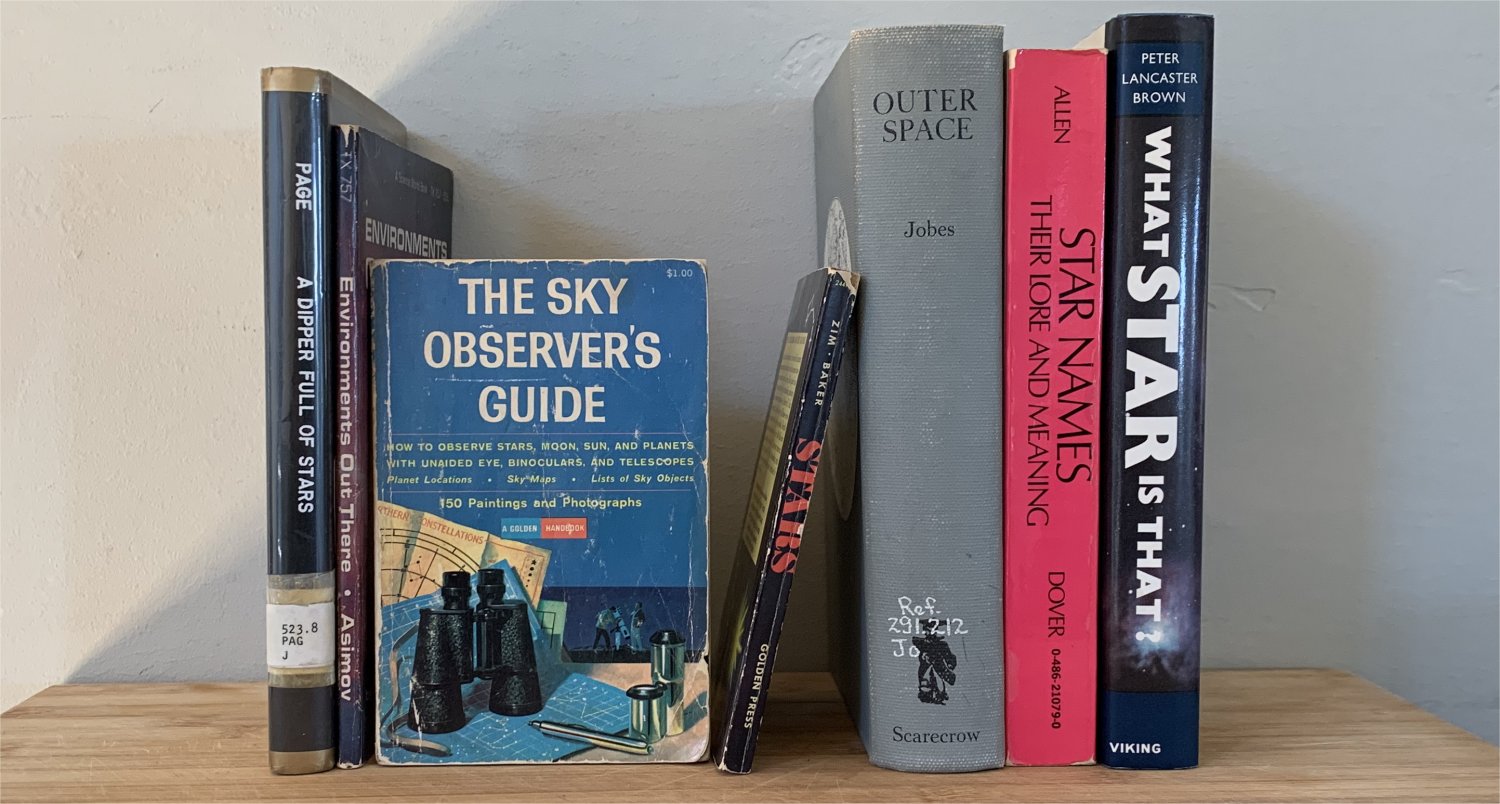
  • There was a specific event: in the 6th grade, I noticed a row of textbooks in a closet, a basic astronomy text called A Dipper Full of Stars. (I already wrote about that here: http://www.markrkelly.com/Blog/2014/05/01/cosmos-and-my-amateur-astronomy/.) I asked to borrow one and read it. Later I bought a couple mini-paperbacks through the school’s book ordering system, one called Stars and the other The Sky Observer’s Guide.
  • That let to requesting a telescope of my own, which I was given for my 6th grade Culmination. Summers looking at the stars in Apple Valley in the dark desert night. Norton’s Star Atlas. An initial ambition to major in astronomy in college. Which I abandoned when the physics got too hard.
  • In parallel I became fascinated by star names, which are matters of history and mythology of course, not astronomy. There are several dozen well-known ones (Sirius, Betelgeuse, Vega, etc.) but several hundred more obscure ones, to be found in larger sky observing guides that detail interesting object to see constellation by constellation. One of these was published in 1971, a hardcover for the then hefty price of $12.95, which nevertheless I bought, in May 1972: What Star Is That? by Peter Lancaster Brown. Others were Outer Space: Myths, Name Meanings, Calendars (1964), by Gertrude and James Jobes, which I first saw at the Victorville Public Library, and much later found a used copy of via the internet; it’s exhaustive on how different cultures have described and named stars, planets, constellations. Finally there was Star Names: Their Lore and Meaning, by Richard Hinckley Allen, first published in 1899 and reissued in a heavy-duty Dover trade paperback in 1963; this one was exhaustive in its accounting for variations in every star’s name through different cultures and spellings.
    • This was perhaps the first topic where I became more obsessed by the peripheral matter of compiling star names than by studying the stars themselves. For several years in my teens I looked for any other astronomy guides that included star names that I could find in libraries, checked out each such volume and compiled which names it included. All these data got sorted into tallies, of sorts, of which names, and spelling variations, were most common for each star. Why did this matter? I’m not sure; but compiling such data (trivia?) seemed important, and came from the same motivation, I suppose, that decades later led me to compile and maintain a website of science fiction awards, which has set a standard for such sites and is widely used.
    • More recently I discovered that the International Astronomy Union (IAU) for a working group in 2016 to formalize the official names of several hundred stars, with the results published here: https://www.iau.org/public/themes/naming_stars/

How did it go?

  • Apple Valley was the ideal place to skywatch through a telescope; the skies are dark away from city lights, and there was no smog in the desert. (Smog was a considerable problem in LA in the ’70s; my journals from those years frequently mentions not being able to see the hills 3 miles to the north, or breathing problems from long bicycle rides on smoggy days.) I suspect I just left my telescope at the Apple Valley house. For several summers in the ’70s I spent multiple weeks in Apple Valley, in between summer classes, and would often spend evenings out in the yard with my telescope.
  • You don’t use a scope to look at the moon much; it’s too bright. But looking at planets is easy and rewarding. What you can see depends on which planets are in the sky at any given time, of course. Saturn’s rings are easy to see, as are Jupiter’s four large moons. Venus is fun to see as a crescent, like a mini-moon. Mercury is hard to spot because it never gets very far from the sun, and so has to be seen just after sunset, or just before sunrise.
  • After the planets the fun things to try to see are double stars, binary stars that appear as a single point of light to the naked eye, but in a telescope can be seen to two or more individual stars. Sometimes one is obviously brighter than the other; sometimes their colors are strikingly different (one yellow, one blue for example). In the constellation Lyra, the star designated Epsilon is a double-double–in the eyepiece you see one pair at the left edge of your view, a similar pair at the right edge, separated by 10 times the angular width of each individual pair. (In one of my early journals, I have a long list of a couple dozen double stars I’d managed to “split” in my telescope in just one evening. You just need your Norton’s Star Atlas and plan in advance where to look.)
  • Beyond that are the various nebulae and galaxies, the 100 or so brightest of which were compiled and numbered by French astronomer Messier, the list known as Messier objects (https://en.wikipedia.org/wiki/Messier_object). Some of the most famous are the big globular cluster in Hercules, M13, and the Andromeda galaxy, M31. They and a few others are easy to spot in the telescope — i.e. they’re bright enough — but can be disappointing nevertheless, mere fuzzy blobs in the telescope, especially compared to the familiar high-resolution photographs of the objects we’ve seen for decades.

How did it end?

  • The looking at stars through a telescope wound down by age 30 or so, when my grandmother died and I lost access to Apple Valley. It was never practical to see stars from the middle of a big city. At some point that I don’t remember, I must have given away the telescope.

Addendum

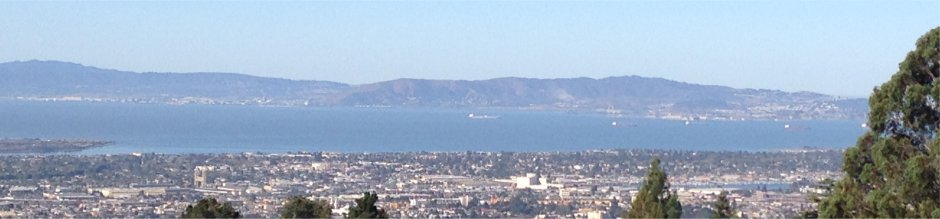
  • But much later, perhaps 2010, my partner Yeong bought me a telescope, a similar small refractor, for Christmas. It sat outside on an inaccessible balcony of our Woodland Hills house until we moved to Oakland in 2015, where it sat outside on a balcony that turned out not to be inaccessible and someone stole it. He replaced it last year with a Cassegrain reflector (https://en.wikipedia.org/wiki/Cassegrain_reflector), a scope of similar light-gathering power in a more compact size. It sits inside. It’s useful for seeing the planets, and details of ships in the bay.
  • The interest in cosmology has never ended, but rather merged into a general interest in science (in particular all matters about the age and extent of the universe) and how our knowledge keeps expanding, e.g. the current mysteries of dark matter and dark energy.
Posted in Astronomy, Personal history | Comments Off on My History with Astronomy

My History with Books

(As I said in previous post, this is an essay that will be cross-post as a page, accessible through the drop-down menus above. For now it’s just a post.)

Anyone entering my home over the past 30 years, maybe even over the past 40 years ago in the tiny apartment I lived in during my mid-20s, would first notice that my life has been dominated by books. Not just science fiction books, but also books on science and philosophy and religion, general literature, reference books, textbooks.

Dysart asked “Why, ultimately, me?” I can’t answer why, ultimately, books. Why are some people attracted to reading, or any other interest, and others not? Clearly there is a range of personality types that influence such tastes, but why any particular personality and not some other? I think part of it is random genetic shuffle, and part is early childhood experience. So, while I can’t answer why I developed a passion for books, I can trace back the events in my earlier life that triggered it.

And I can make some general comments about how a bookish person thinks about and treats books, that non-bookish people don’t appreciate.

History

  • In retrospect it’s curious that my family, that is my parents, did not read books or provide them to their children. There were no picture books in the house when I was growing up, no Cat in the Hat or other Dr. Seuss books, nothing like that. My parents didn’t read books. They watched TV. (But never went to movies.)
  • And yet my parents must have felt some certain responsibility to provide classical education to their children. I see from my notes that our household acquired a set of Harvard Classics (https://en.wikipedia.org/wiki/Harvard_Classics) , a 50-volume set of classic literature, philosophy, and science, as early as 1962, when I was in 2nd grade! And later, a set of Encyclopedia Britannica, a set of the Book of Popular Science, a set of a children’s books called A Bookshelf for Boys and Girls (my favorite volume of which was called “Things to Make and Things to Do”). These sets of books lay in the background as I grew up; I consulted them routinely. By middle school age, I was seen as a boy who read the encyclopedia. More about this here: http://www.markrkelly.com/Blog/2016/06/07/growing-up-with-books/
  • The only household books remotely fictional (well, some of the Harvard Classics were classic plays) were 8 volumes in a set called Book Trails, collecting fairy tales and adventure stories in volumes beginning “For Baby Feet” and ranging to “Of Trail Blazers.” Somehow I’ve inherited only six of the eight volumes; I seem to recall some reason the set was split up between me and my cousin Paula, but then why would I have gotten 6 of the 8? Oh I know—I just realized. It was because when the split was made there were three kids in my family (so it must have been around 1963) and one in Paula’s. Thus the split. Such a split sends shudders down the spine of any book collector, of course.
  • I discovered books on my own at the school library, in 5th or 6th (I had gone to that library in Santa Monica in 2nd grade, but don’t remember anything I read there.) I liked certain mystery novels, I adored the series about the Melendy Family (by Elizabeth Enright) especially Spiderweb for Two, a puzzle/mystery novel involving a family of children following a series of clues that one year at Christmas I emulated (putting a paper clue inside an ice cube in the freezer, e.g., for my mother to find). And my favorites were a series of novels by an English writer, Enid Blyton, the Adventure books, about a family of four children who went off on “holiday” several times a year and discovered various amazing criminal plots, in mountains, valleys, rivers, castles. (More about those here: http://www.markrkelly.com/Views/?p=269 )
  • And I discovered my own books, books that I purchased and owned, also in about the 6th grade, where Scholastic Books catalogs were distributed in class, money was brought from home and orders placed, and books would arrive, one per classroom, weeks later. Much more about this and later processes here: http://www.markrkelly.com/Blog/2016/06/30/15-ways-of-buying-a-book-part-1/.
  • From late elementary school, then, through my mid-20s, I acquired books of my own, given my limited resources, but also drew on libraries, both public and school. I read a lot of early Heinlein from libraries, before I later bought copies of my own. For a period in college (still living at home), I went to the public libraries (in Northridge and Granada Hills) and checked out stacks of 10 nonfiction books every two weeks. I didn’t read them thoroughly, of course, but I paged through them and gleaned a lot about the range of their topics. (Histories of classical music; chemistry and physics textbooks.) I was doing light inspectional reading, as described below.
  • Once I had a full-time job and could afford to buy whatever books I wanted, I had enough to read and stopped going to libraries. And I’ve rarely been in a library since. As I write in April 2020, about two years ago I checked out a couple branches of the Oakland Public Library. They were pleasant, half-filled with computer stations and shelves of DVDs rather than shelves of books. The science fiction shelves were scattershot; seemingly random volumes by many major SF writers, but not the best volumes but all the best writers. In the nonfiction shelves, e.g. cosmology or evolution, it was a decent mix, but my thought was that my own library at home was better.

Themes:

Here are some topics about what people who don’t read books think about people who do, and who have large libraries.

  • Have you read all those books? Accumulating a library is not about reading a lot of books and keeping them. It’s not like having a record/CD collection, where presumably you listen to every new item at least once, and keep everything for future repeat listening. It’s not a pantry, which you keep restocking steadily because you use every item eventually. A library is a collection of resources. It’s a collection of things that interest you, that you might want to visit. There is never enough time to read all the books that interest you. But you keep them, because you don’t know what your future self might deem interesting, even urgent.
  • (As a side point – there are readers of books who treat books like, oh, movies or TV shows, to be seen or read once and then disposed of. This is why on Amazon, or at bookshops like Half Price Books (https://hpb.com/), there are dozens of copies of just-published books that have been quickly read and then put up for re-sale. These readers do not keep books, they don’t have libraries; these readers are transactional, not intellectual.)
  • Downsizing and regrets. Over the years I’ve been in situations where it’s seemed reasonable to sell off books I’ve collected, because of space issues, or because I think my tastes have changed and I can identify books I will never have any reason to read or look at ever again. Again and again, at least in a few specific cases, I have been wrong. I keep discovering reasons why I want to see this or that book that I no longer have anymore. This meshes with the point that a library is a resource that is larger than what interests you at the moment. Still, practical issues intervene, and so in late 2014 I sold off, to the Iliad Bookshop in Burbank (https://www.iliadbooks.com/), some 30 or 50 boxes of books (a couple thousand books, I think) that I thought unlikely I would ever actually need to read, prior to moving to the Bay Area in early 2015. And of course, some of them I miss, especially some of the anthologies I could have used for my current anthology project.
  • How to Treat Books. Transactional readers treat books like tissues to be used once and disposed of; thus, in used book shops, you see paperbacks with bent spines and hardcovers with cocked spines. Those of us who respect books treat them kindly. You don’t crack the spine. You don’t bend the cover. You don’t open the cover of a paperback and put a crease in the middle with your finger, the way you might a magazine. A new hardcover – this was true decades ago, not so much now, when books seem to be better built – needed to be broken in: you set the book spine side down, you opened a few pages on the left, and few pages on the right, back and forth, a few pages more, on each side so the spine would open it evenly, without creating any kind of spine cock (e.g. as seen here: http://www.mywingsbooks.com/coll-terms/spn_.shtml )
  • The result is I have a library of 8000 books where – except for those few books I bought used, in bad condition – you can’t tell whether or not I’ve read them. They are all in perfect condition. I’ve read about half of them, and hope to have time to read many more.
  • How do you decide which books to buy? Several strategies.
    • You go to bookstores and browse. When you’ve read a book by some author and liked it, you look for other books by the same author. If you have an interest in a particular subject, you look for new books on that subject.
    • As I mentioned elsewhere, I developed a brand loyalty early on. The Bradbury paperbacks I’d bought were published by Bantam; several Clarke reissues in the late ‘60s were published by Ballantine. And so I was more inclined to buy a Bantam or Ballantine book by an author I hadn’t heard of, than a book from some other publisher, like Berkley or Lancer. This is a dicey strategy however. There really are differences between publishers, at any given time and for any particular subject. But these differences change every few years, as the industry changes and editors come and go.
    • Better strategies are to read reviews and pay attention to awards. No strategy is guaranteed because tastes are different, but over time you learn which reviewers to trust, i.e. who seem well-informed and whose recommendations are worth following, and which awards to trust, given the people who vote for them and the kind of books that keep winning those awards.
    • One trigger in this regard was my inspiration to start reading The New York Times, around 1991, because a friend I met at the time and admired would read it every Sunday. So I started driving to a newsstand every Sunday morning to buy it, and some years later, subscribed to it daily, as I still do. NYT has the most substantial book review section of any publication in the country – and from there, especially, I first heard of substantial nonfiction books that I might not otherwise have known about.
  • How do you read a book? Not a silly question. You start at the beginning and continue until the end, right? For novels and short stories, sure.
    • For nonfiction, not so much. One of the best books I’ve ever read was called How to Read a Book; I reread it recently, in 2016 (http://www.markrkelly.com/Blog/2016/03/01/rereading-how-to-read-a-book/). The idea for nonfiction begins much as you would do for books at a bookstore. You pick it up, read the flap copy, the back jacket; look at the table of contents; glance through the index if there is one; see if its intent is scholarly enough to have bibliography and notes at the end. Read opening pages of a chapter here and there to get a taste of the prose style. This is inspectional reading. This enables you to consider many books quickly—in order to decide which ones are worth more time. (Not mentioned in that book, but another perfectly reasonable way to get a take on a book is to see who blurbs it – who provides the laudatory quotes on the front or back jackets. Some authors (E.O. Wilson, Steven Pinker) I respect enough to follow them everywhere, to take any of their recommendations strongly. Other people I might take as a reason to avoid a book, Dinesh D’Souza for example, or Deepak Chopra.)
    • Then there’s analytical reading, which I do by taking detailed notes as I read; and syntopical reading, where you pose a thesis and examine books that address the issue. I do the latter often, as I state in my summary/reviews on my blog, by posing questions at the very beginning, even if it’s a vague, what can this book (on a subject I know well) tell me that I don’t already know?).
    • I confess I’m too OCD to apply inspectional reading to books already owned, even though I have some 2000 substantial nonfiction books and am unlikely to live along enough to analytically read half of them. I keep thinking I should try; take a dozen books on similar themes, spend an hour on each, and have some idea of what they claim. Maybe soon.
    • Also, even reading fiction isn’t as simple as reading from start to end. In just the way I take notes on nonfiction, I take notes on fiction. (Usually handwritten notes as I read in an armchair, later written up into a computer file. More often lately, sitting at the computer and reading the book to one side, writing notes as I go. Much more efficient. This is why some of my blog posts summarizing nonfiction books are really long. To counteract such long summaries, my current strategy is to reread the long notes and then summarize in a few bullet points the themes and conclusions of the book at the top of the post that can be seen in one screen.)
    • This whole business of taking detailed notes is necessitated, for me, by having a poor memory for things that I’ve read. After a year or two, I barely remember the contents of a book in any but the most vague way. I’ll forget how the novel ended. Didn’t the villain die at the end? Did the hero get home? That’s one reason I’m rereading a lot of classic sf novels recently, because there’s no way I would be able to discuss them based on 30 year old memories (and secondary sources that provide summaries and commentary often aren’t very good and are, well, second-hand; the point of my discussing them is to provide some unique insight).
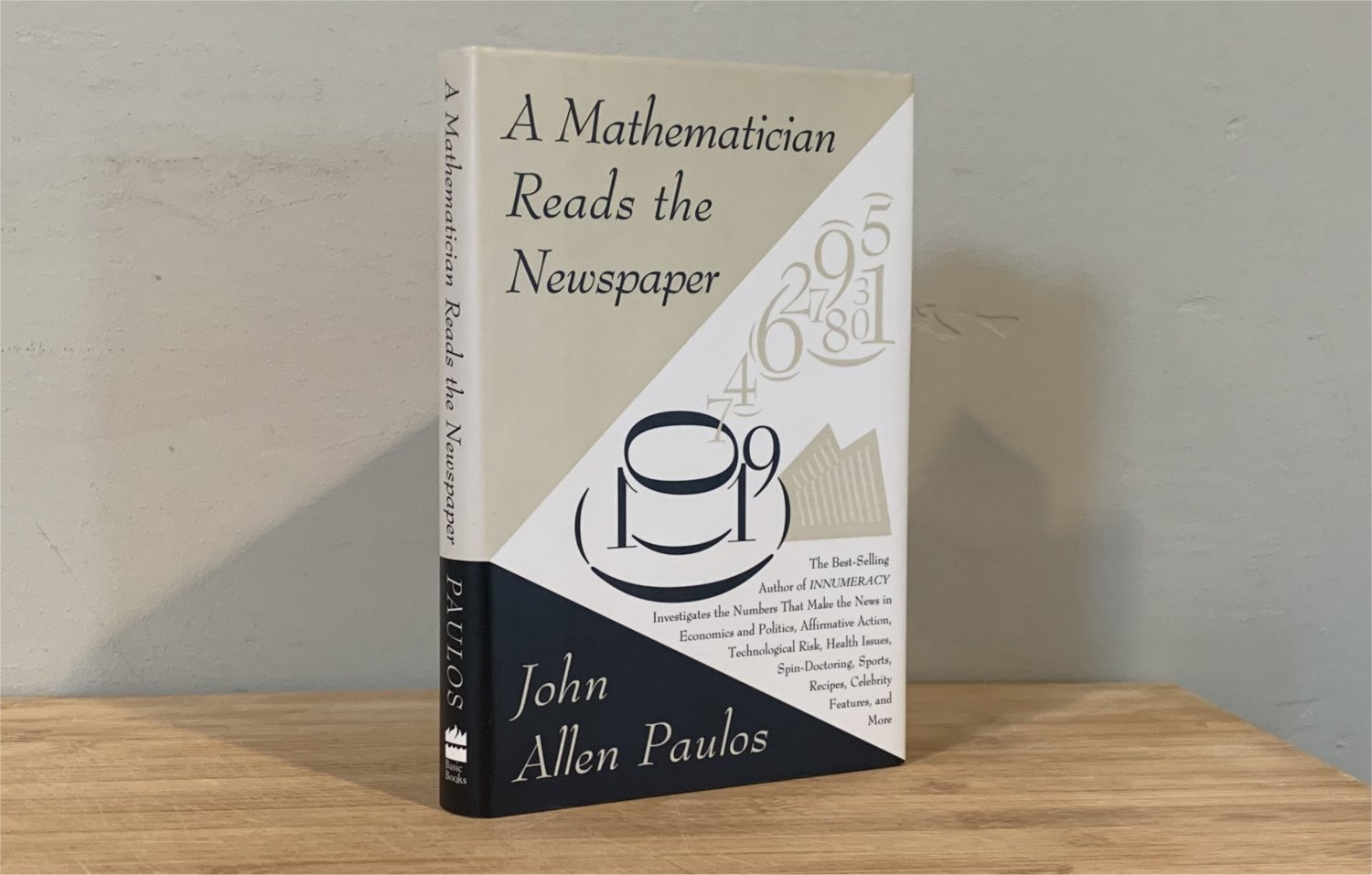
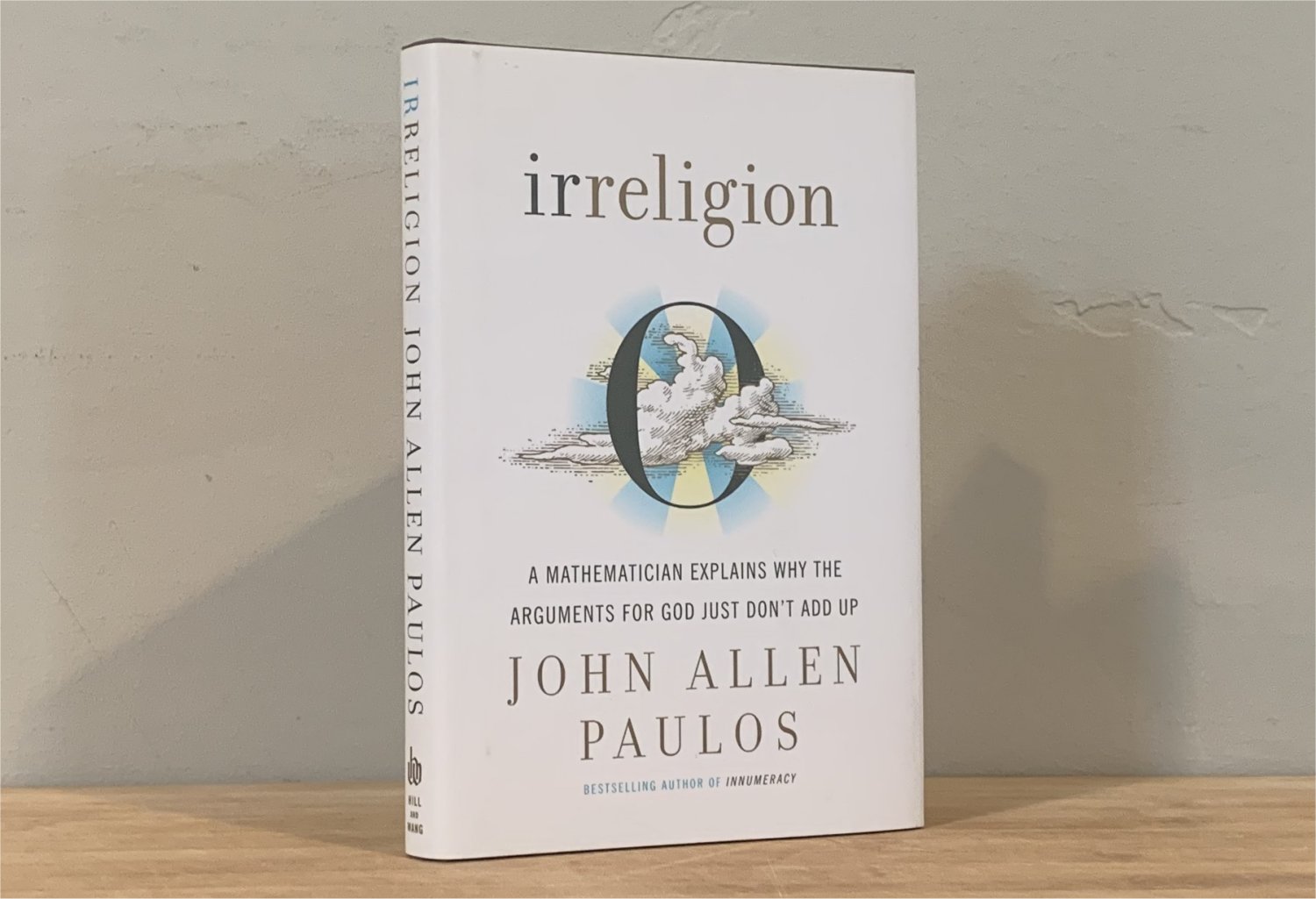
    • Having notes enables me to retrieve in detail the contents of books I read years or decades ago. Thus I read Silverberg’s Collision Course a full year ago, but was able to pull up my notes and fill them out into a substantial summary review for Black Gate (just posted as I write: https://www.blackgate.com/2020/04/09/a-fascinating-ordinary-1950s-sf-novel-robert-silverbergs-collision-course/). Thus the John Allen Paulos book A Mathematician Reads the Newspaper, which I read way back in 1997, but took notes on, which took only minor ironing into full sentences to post here on the blog. (I have such detailed notes on about 200 nonfiction books, only maybe three dozen of which I’ve posted.)
Posted in Personal history | Comments Off on My History with Books

My History with Bicycling

I’ve been writing a series of autobiographical essays recently, to supplement the photo sets of scanned slides and prints I’ve promised to gather on this site. Most will be installed as WordPress “pages” which then automatically appear in the menu bar at the top of each page, though I can create parent/child relations and orders to control how the links appear as drop-down menus. As the pages multiply, I keep tweaking that drop-down menu structure. So I think for the time being I will be cross-posting such essays as ordinary posts, that will appear automatically at the top of the homepage; otherwise no one will notice new “page” essays without my pointing them out. Here’s one about my history with bicycling.

At my peak, in my late 20s, I bicycled obsessively, taking long rides on weekends, riding three “century” rides of 100 miles to Apple Valley or back, and two others as long or longer in Solvang and to Devil’s Punchbowl. In contrast to my school disinterest in P.E., I became very fit by bicycling. I was a slender 135 pounds with a resting heart rate of 48.

  • How did this begin? How did it end?
  • There were a couple false starts. Very early on, in Apple Valley, my father taught me how to ride a bicycle with some red bike he had, perhaps leftover from his own childhood and moved from Illinois. Don’t know whatever happened to that; It didn’t go with us to Santa Monica or Reseda. In Reseda I had a tricycle that usually I zoomed around the back yard, not sitting on it, but riding skateboard like with one foot on the rear platform and the other pushing off the ground, half-standing up.
  • In Reseda, so sometime during elementary school, I was given a full-size grown-up bike for birthday or some similar event. I never had one of the then popular Sting-Ray bikes with high handlebars and banana seats, that were so popular with the other kids. The full-sized bike intimidated me, and I didn’t want to ride it. My father sold it. Another disappointment for him, I suppose.
  • When I started at UCLA in the Fall of 1973, I saw hundreds of students riding back and forth across campus on bikes. The campus was large enough that it could be difficult to get from one class to the next in the 10-minute interval between session times. I became obsessed by wanting a bicycle, arguing to my parents that Phil (my UCLA car-pooling partner) and I could save money at the parking garages by parking off campus on residential streets, and riding into campus on bikes. That never did happen, but I did get a bicycle for Christmas that year. Typically, I’d done some research and picked a model, and when the time came, my mother and I went to the bike shop (on Sherman Way in Reseda) and bought the one I wanted, for something like $110. It was a white Nishiki, a 10-speed with the standard curled-down handlebars of a road bike. (And then in cruel irony, for a week after we brought my new bike home, it rained.)
  • I did ride that bike off and on over the following years while in college, mostly from home to one bookstore or another. (For magazines and paperbacks my go-to place was Reseda Books, a small shop that sold magazines and paperbacks, at Reseda Blvd and Sherman Way, 5 miles from home.)
  • And then I graduated from UCLA and couldn’t find a professional job; I’ll go into that elsewhere. As family plans for the move to Tennessee solidified in the Fall of 1977 after my graduation, I searched for any kind of job and got one with the County of Los Angeles (I’ll go into that elsewhere) at a facility in Reseda, just down the street from Reseda Books. Within a few weeks, from January to March of 1978, I began this job (on 17 Jan, initially driving the family’s second-hand Buick), the family departed for Tennessee (on 17 Feb), and I found a one-room apartment in Northridge and moved in (on 6 March). I’d stayed in the house on Hayvenhurst until then because it hadn’t sold yet. Once the family left… I bicycled to work. From Vincennes Street in Northridge, a couple blocks off the Cal State Northridge (CSUN) campus, to the job at Sherman Way & Louise Ave, was 4 ½ miles.
  • So I bicycled to work for some 2 ½ years until I quit that job and went back to college, at CSUN. Weather in southern California is good most of the year, of course, but on those occasions that it rained, I took the city bus, an easy run down Reseda Blvd. There was one occasion rain hit unexpectedly during the day, and my Uncle Bob came to drive me and my bike home.
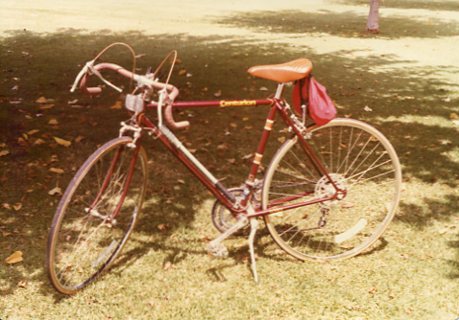
  • After locking up my bike outside at the corner of the office building where I worked, for a year, one day it was stolen, the cable locking it to the rack cut. I had to get a loan to buy a new bike, a Centurion Le Mans.
  • This is the Centurion Le Mans, or one of them; the photo would have to be 1979 or 1980. Centurion Le Mans, with a kickstand and horizontal brake handles. The latter were called ‘safety levers’ or ‘extension levers’ that experienced cyclists would never use, since their grip is indirect and riding with your hands on the crossbar isn’t the best way to keep control.
  • I also used the bike to cycle from Northridge to Westwood, to Change of Hobbit bookstore, which had all the new science fiction books that the local mall shops (Walden and Pickwick) didn’t carry. That entailed cycling up Sepulveda Blvd over the pass from the valley to Westwood. I had a big orange luggage bag that mounted in front of the handlebars that would easily hold 4 hardcover books.
  • Over the following two or three years, I went on increasingly long recreational rides, some half the day. South to Venice Beach (via Topanga Canyon or Sepulveda Blvd alongside the 405 freeway; north to Canyon Country (via the Old Road alongside Antelope Valley Freeway); northwest to Simi Valley over Santa Susanna Pass; east through Glendale, Eagle Rock, and Pasadena as far as Arcadia. Only the last route was mostly flat; the others all involved climbs over passes. So I necessarily got quite fit, at least aerobically.
  • My ultimate rides were three, in 1980 and 1981, from my apartment in Northridge, all the way to Apple Valley where my grandmother lived – or back. In each case I coordinated with Uncle Bob for a ride in the other direction. Two of these were over long weekends, but one, the last one, came at the end of a week-long stay in the desert, returning home at the end of it on that long ride. Each ride took 7 or 8 hours, if I recall, and avoided heavily trafficked highways like 138 and 18 across the desert. Instead I took remote, empty streets like Avenue T, Palmdale Blvd, and El Mirage Road, all two lane highways across the desert flats. Fortunately I never had any serious accidents. A lot of flat tires of course. At worst, on long rides, I was very dehydrated at the end.
  • (I don’t have any photos of these rides. Though I’d acquired a camera in 1979, it was too bulky to take along on such long trips when I had other stuff to carry.)
  • My single longest ride was a run-up to the first Apple Valley century: a ride from my place in Northridge to Devil’s Punchbowl, an LA County park at the edge of the Mojave Desert and San Gabriel Mountains, near Pearblossom. 60 miles each way.
  • In 1982 I got my first (and only) professional job, and first car. I didn’t need to ride as much, and cut back significantly.
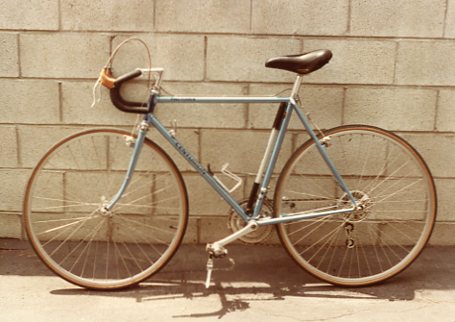
  • Here’s a later bike, another Centurion, with no kickstand, no horizontal brake levers, and toe straps on the pedals. (I never did use the cycling shoes that clip into the pedals, as most serious bikers do.)
  • In the first couple years that I had my car, and a job, I tried various ways of socializing, and one was to join a gay bicycling club. It was called Spokesman at the time, and later replaced this rather sexist name with Different Spokes. Since cyclists are a passionate bunch, the group did lots of events: at least one weeknight evening ride in Griffith Park (convenient for those who lived nearby), and one longer ride on the weekend, in scattered locations (rather analogous to scouting campouts) that required driving to a particular location with bikes in your cars.
    • The first began out in Palmdale and took a path along the aqueduct for an hour or so, then came back. I had naively thought I could fill my water bottle at the parking lot. No. I was dehydrated to the point of cramped legs by the time we finished.
    • Another began in Redondo Beach and went through part of Palos Verdes.
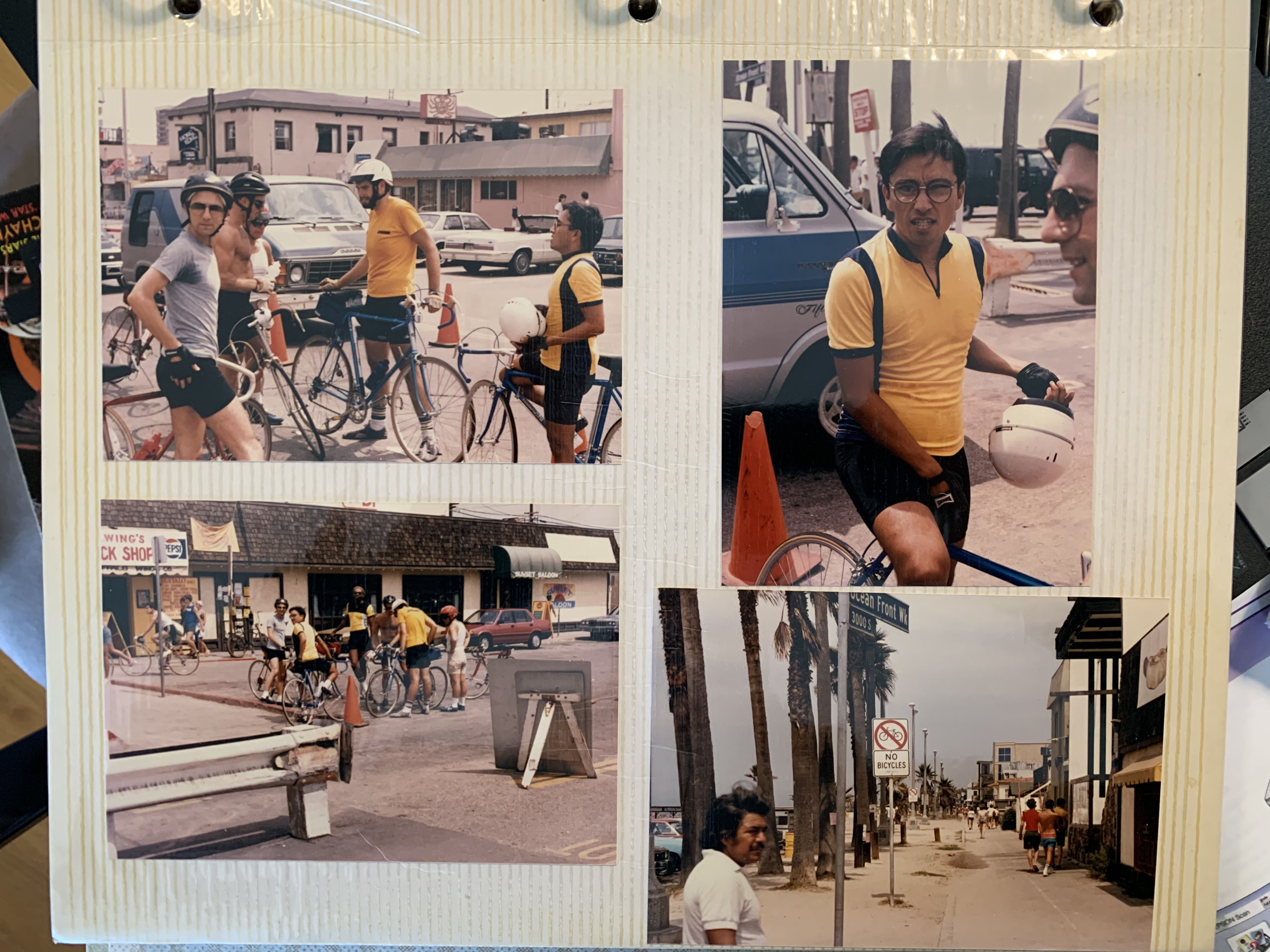
    • Another up and down along Venice Beach. I have some pictures from this!
    • Here’s an iPhone photo of a page from my photo album, four shots from the Venice trip, with Larry Kramer in sweaty gray shirt, Alex Hernandez(?) in yellow and black.
    • And another, my friend Larry just reminded me, of a “citizen’s race” out in Calimesa, southeast of San Bernardino along Interstate 10, in which a team of five of us, Larry, me, Alex, Howard, and Kim, won.
  • And the ultimate ride for southern California cyclists was the annual Solvang Century, a 100-mile ride that began in the quaint Danish town in the wine country northwest of Santa Barbara, went west to Lompoc, north past Vandenberg Air Force Base to Santa Maria, then southeast through Sisquoc amid many wineries along Foxen Canyon Road to Los Olivos and then back to Solvang. I did the ride just once. My friend in the club Larry Kramer did it a second year, while I provided driving support. Larry did an even more ambitious ride a year or two later: A Death Valley to Mt. Whitney ride, where again I accompanied him for the weekend and drove the car as backup support for the riders, since it was a one-way trip. (I have a bunch of photos from that trip that I’ll add here.)
  • At some point in ’84 or ’85 I withdrew from the group’s busy schedule. Most of the members were passionate riders, riding every week, tinkering with their bikes, upgrading their bikes to more and more expensive models. I wasn’t that obsessed, or inclined to invest. Even before leaving my single-room apartment in Northridge, in mid-1984, I’d decided to take up jogging instead, to stay healthy, and to do something I could do in the evenings even after dark. By the time I moved to Tarzana in 1985 I had stopped biking altogether, and sold my bike.
  • Decades have since past, and the only time I’ve been on a bicycle in those decades was May 2011 when Yeong and I did a weekend trip to Santa Barbara and stayed at Hotel Oceana (which doesn’t seem to exist under that name anymore), right along the boulevard across from the beach. They had bikes for hotel guests to use, and we took them out one morning. They were fixed single-gear bicycles, horrible things, that had to be kept pedaling; you couldn’t coast, and to brake you had to pedal backwards. We rode a mile or so west, and back.
  • In recent years Yeong and I have hiked a lot, both in Southern California and here in Oakland, and for a decade I’ve thought about buying a trail bike to ride on the dirt fire roads, those part of Mulholland Drive that are dirt. Here in Oakland, our section of Crestmont Drive is very popular with packs of cyclists who pass by our house in the mornings, on weekends and weekdays. Again I’ve been tempted to invest – especially since our current living situation isn’t as amenable to gym visits, or jogging – but have been dissuaded by those same circumstances. Our street is flat for a few hundred feet to the southeast. Beyond that, any possible bike route involves going up and down hills, usually down and then having to come back up. If I had an easy place to ride on the flats for an hour, I would do so.
Posted in Personal history | Comments Off on My History with Bicycling

Boy Scout Paraphernalia

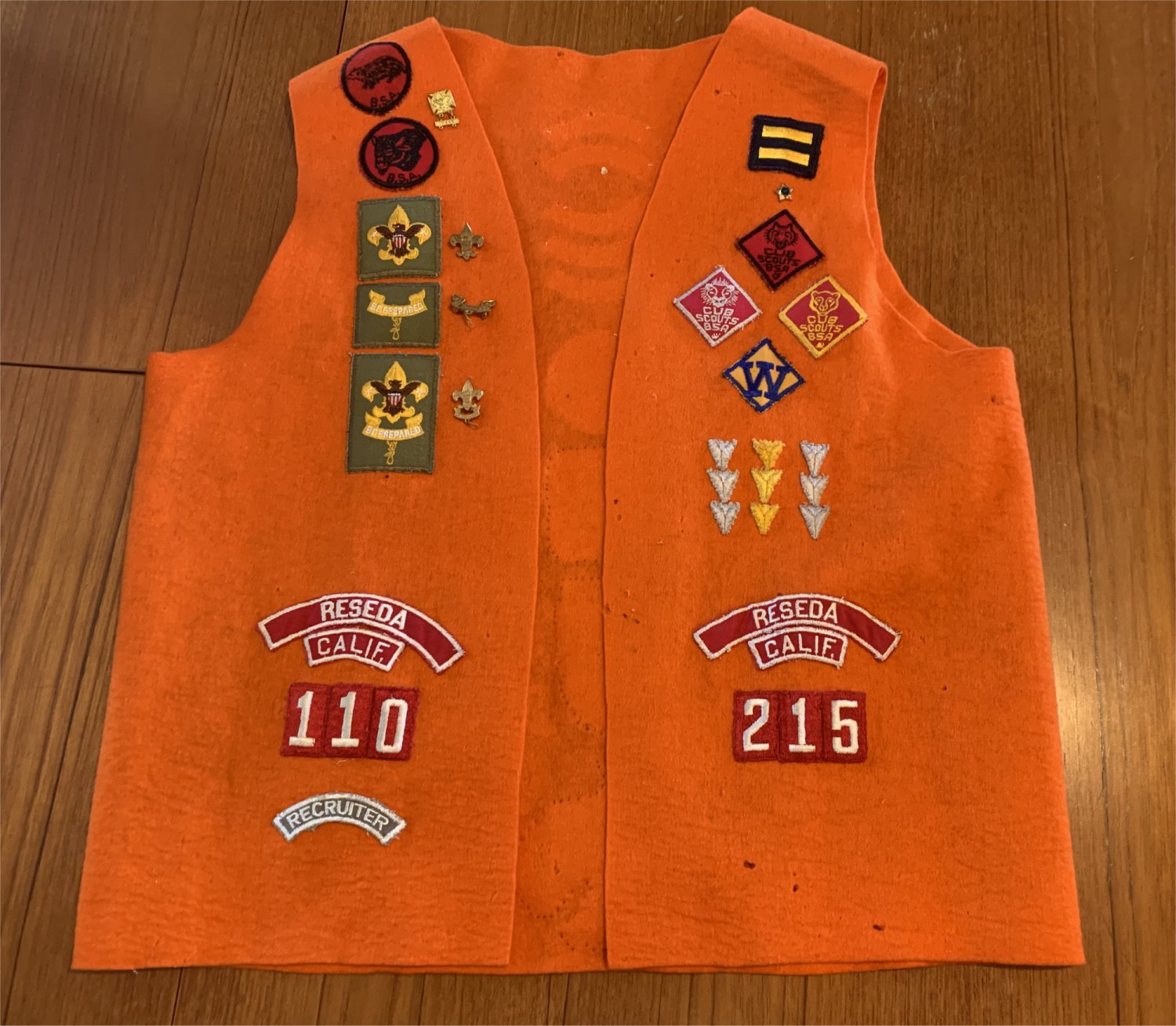
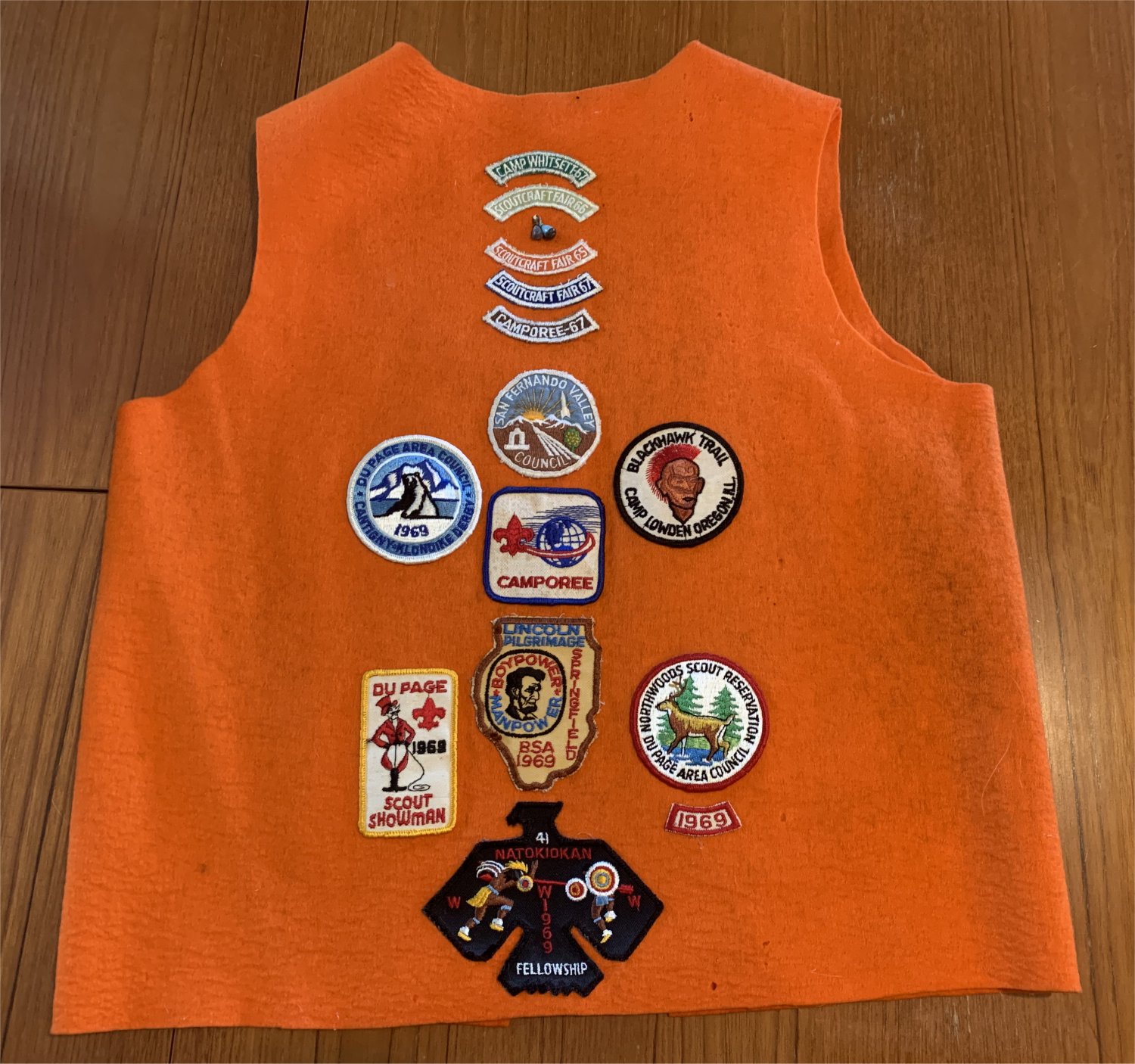
In scouts you earn lots of awards, merit badges and rank badges and patches for every significant scouting event. So many that your scout uniform shirt, and even the merit badge sash, had no room for all of them. So we had, what were they called? Patch jackets, I think. They were a thing with the Boy Scout troop in Illinois. Mine was orange felt (now a bit moth-eaten, as the photo shows), and every time I got a new patch, my mother would dutifully sew it onto my jacket. Here’s the front.

The right side in the photo (left side of the vest) shows cub scout badges. I was in Pack 215 in Reseda, California. Looking at this, I now recall that, even though I entered cub scouting later than I could have, my father had me retroactively earn the earlier badges for Wolf and Bear; Lion and Webelos I earned on schedule. I don’t remember what the silver and gold arrowheads were for.

In boy scouts I was in Troop 110 also in Reseda. I earned Second Class, First Class, and Life.

Back of jacket:

Most of the oddly shaped patches at the bottom are from scouting in Illinois — Du Page Area Council. The Blackhawk Trail, I think, was the site of that 20-mile hike. The center round patch shows San Fernando Valley Council. The semi-circular patches at the top are for Camp Whitsett, a camporee (that was the all-day event) and three scoutcraft fairs (I don’t remember what they were).

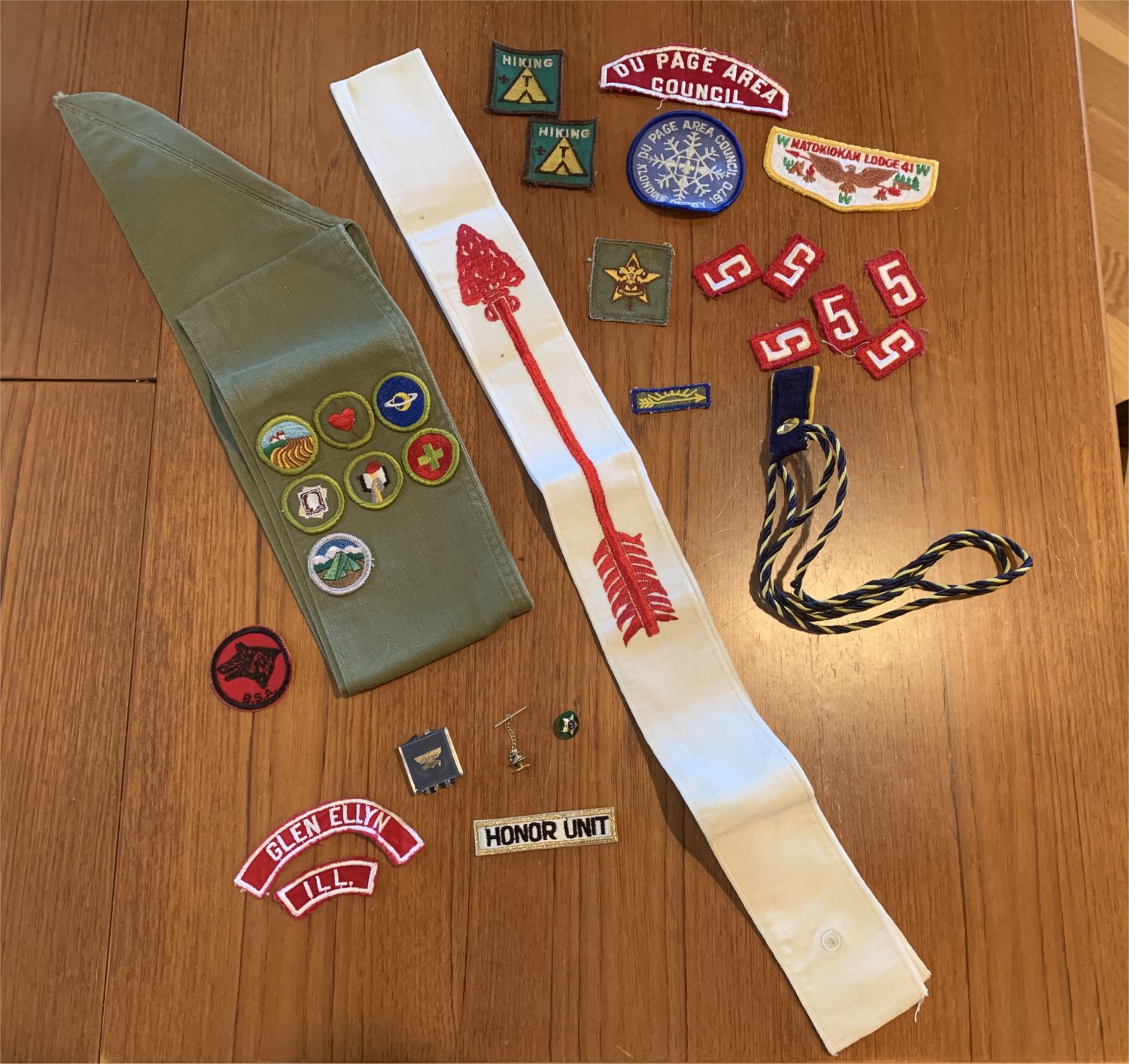
And there’s a bunch of loose patches that never made it on to the jacket.

The green sash is the standard one for merit badges. I only earned a few–astronomy and stamp collecting of course; first aid; camping? Not sure what they all are.

The white sash with the arrow is for being selected for the Order of the Arrow. The blue and yellow shoulder tassel was, I think, for being a “den chief,” a boy scout who would attend cub scout meetings and serve as a role model. I was a role model, for younger boys.

Posted in Personal history | Comments Off on Boy Scout Paraphernalia

Family Dynamics and Social Withdrawal

Family Dynamics

I wish I could say more about what my younger sisters and brother were doing, the whole time I was growing up.

I didn’t pay close attention mostly due to the age difference. I was the oldest, my next two siblings were girls, the youngest, Kevin, was 9 years younger than me. When you’re a kid, boys and girls don’t usually play together. And Kevin and I were too far apart to share interests.

It was while we lived in Illinois that I let go of one activity I shared to some extent with my father – scouting – and more fully developed my own interests. Stamp collecting for a short while (at the encouragement of my Great Aunt, Maude); discovering authors I liked like Ray Bradbury and Arthur C. Clarke and reading all their books I could find; then becoming somewhat obsessed with Star Trek when the original series went into syndicated reruns five times week. By the time we returned to California, and I was doing well in school, I think my parents figured they could leave me alone and I’d be all right; they could pay more attention to the other three kids. Susan was problematic in a few ways. She was the opposite of me in temperament and intellect. She hung out with the wrong kids. At home she sat in her bedroom playing teeny-bop pop music of the era, always too loudly, on her records player. The Monkees, David Cassidy, the Jackson Five.

By the time I graduated from high school, not quite 18 years old, Kevin was 9 and ready for scouting. My father turned his attention to Kevin and became more involved in active adult supervision in his Pack and later Troop than he’d been when I was a scout.

The most unfortunate circumstance in my life, I think, is that I didn’t go away to college. I commuted from home, and so four years at UCLA was like an extension of high school. Coming home every day to noisy little kids and Sue’s loud music and my parents’ cigarette smoke and the TV that was on continuously from mid-morning to 10pm or so when my parents retired. I went into my bedroom and closed the door and did my homework and read my books and wrote my journal.

So no, alas, I did not pay much attention to what my siblings were doing in the years I was at home.

Social Withdrawal

So then, a key theme of my life, one I wasn’t aware of as I grew up and only realized years later in retrospect. Here are the two factors that led to this result.

Factor One

My parents both grew up in small towns, in Illinois.

In Apple Valley, the route to the elementary school was by school bus. On the street where we lived, the area was sparsely populated, the nearest houses in any direction being typically 1000 feet away. There were no neighbor kids to play with. I grew up alone. I didn’t mind; it didn’t occur to me such a childhood was in any way unusual. Perhaps I was inherently solitary in nature, or perhaps the circumstances forced me to become self-sufficient. (Which is cause, which effect?) In those very early days in Apple Valley, I don’t remember what I did. There were no books in the house. We probably had a small TV but I don’t remember any shows from that era. I do recall I was fond of toy plastic cars. I think I had a basic model train set. I had coloring books. (–Now there’s a curious memory. Yes, I had a coloring book. Remember that I was four or five years old, and my entire experience consisting of living in this barren desert landscape. But this coloring book was full of outlined drawings of things like… lakes with sailboats. Big puffy clouds in the sky. Things that were utterly alien to me. It would be nearly a decade later, with the move to Illinois, before I saw sailboats and cumulus clouds in person.)

When we moved to Santa Monica, we were suddenly in a big city, but my school and the local library were only a few blocks away, that I could walk to. The area was populated mostly by seniors, like the nice lady next door to us who once gave me stuffed monkey. There was one kid a few doors down that I played with. In some incident, trying to build a pit that would trick his little sister, his hammer hit my forehead, causing a fount of blood, and his mother carried me up the street to my own mother.

In Reseda, the walk to school was a bit longer. I had two or three friends at school – Milton Lewis, Nader Omana, Gary Wein – but they all lived in other directions from my own home. The point is: I never hung out with friends outside of school. I had no friends outside of school. My mother’s priorities were that I should walk directly home from school. In retrospect, I think it was my parents’, or at least my mother’s, anxiety about living in a large city, compared to her small-town background. Of course I never questioned it at the time.

When we moved to Illinois for three years, the schools were farther away and I took buses. Again, I have couple good friends there in high school – Richard Pointer and Peter Serafin – but they lived in other directions, off other bus lines, and it never occurred to me that we could be friends outside school. I would come home and read my books or work my stamp collection or compile trivia from Star Trek episodes.

And even back in LA, when we moved to Sepulveda. The high school was two long or four short blocks away. I walked to school, walked back home. I developed one good friend there, Philip Klutch, whom I later car-commuted with to UCLA for most of four years, but whom my mother dismissed as a Jew. He, too, lived in another direction. Again, through all these years, I was self-sufficient at home, with my books, my diary, my TV.

And even more extremely: I attended UCLA for four years, commuting from home. I’d applied to MIT and CalTech, at my high school counselor’s suggestion, but only got onto MIT’s waiting list. UCLA was my backup, and it was close enough to home that I didn’t have to move away, to a dorm. I lived at home and drove the family’s second car, a 1964 Buick Skylark with peeling paint on the hood, on the days my car-pooling partner Philip Klutch didn’t drive himself.

UCLA was thus like an extension of high school. I came home every afternoon to the same family situation, with younger sisters and a brother squabbling and noisy, and my parents smoking constantly and watching TV throughout the day. (Apple Valley was my refuge, as I’ll describe on another post.)

Factor Two

This is hard to recover or think about clearly; memories are uncertain, being recalled and reinterpreted over and over, throughout one’s life. But I’m certain there was a transitional period in my mid-childhood where circumstances and influences, mostly due to my father, shut me down. As an early child, despite my isolation, I think that I was relatively voluble and sociable, when in social situations. But then there were a few key episodes. One was, in 5th or 6th grade, learning fractions, I had discovered some clever scheme to simplify the computing of fractions, and asked my teacher to show it to the class. (I’m pretty sure she was a substitute teacher, which might almost excuse her reaction.) I got to the front of the class, chalked my idea onto the chalkboard. And the teacher replied, that’s a cute gimmick. Gimmick?? I was mortified. She didn’t appreciate that I had some true insight into mathematics, at least for my age.

One other classroom demonstration went a bit better. I had a small, educational-toy computer called a Digi-Comp (Wikipedia: https://en.wikipedia.org/wiki/Digi-Comp_I; my blog in 2006: http://www.markrkelly.com/Views/?p=291), and I took it to school one day, likely in the 6th grade, for a show-and-tell. I described the basic mechanics of it, the plastic parts, the rubber bands, and showed how “programming” it with those plastic pegs let you do simple calculations. I thought I was done, but the teacher said, can you explain more about how it works? Um, OK, well–and I went into a tedious explanation of how the upright metal wires either did or did not move depending on those pegs, and so on. The teacher was satisfied, but I thought this extraneous detail was beside the point. It was about the concept of being able to program, not how the program mechanically played out. Again I was taken aback, from then on that much less eager to pass along things I found interesting.

More important were my father’s reactions to several incidents. He was extremely sensitive to shows of vanity; he disregarded expertise, and thought everyone on the nightly news a crook or a fraud. (My sister Sue has inherited some of this attitude, and even Kevin a bit.) A key incident must have been in the sixth or maybe seventh grade. I’d become interested in astronomy and had gotten a small refractor telescope for my sixth grade graduation (called a “culmination”). To encourage me, perhaps, somehow or another my father contacted a friend of a friend who was part of a high-end amateur astronomy group that owned and ran Stony Ridge Observatory (http://stony-ridge.org/), in the mountains off Angeles Crest Highway (and just a few miles northeast of the famous Mount Wilson Observatory). So one evening my parents and I drove up to meet this friend to get a tour of the observatory and actually look through the telescope. As we arrived it was near full dark and the constellations were clearly visible. We met this friend and I pointed out some of the constellations I knew – Orion, Canis Major, whatever. (More likely it was summer, so they would have been Hercules, Scorpio, whatever.) The friend went off to unlock the observatory, and my father took me aside and told me not to show off. Show off? I didn’t think I was; I was just establishing my bona fides, so to speak, as someone who knew something about astronomy. The astronomy friend had nodded along; he hadn’t rolled his eyes as if I were a twerp. But my father thought I was being too big for my britches; he was embarrassed. As the evening passed, we did actually look through the scope (which entailed sitting atop a high ladder to reach the eyepiece), and at one point this astronomy friend trusted me to change the eyepiece, even at the risk of an 11-year-old boy dropping the eyepiece onto the concrete floor below. (See the scope at this page: http://stony-ridge.org/76cm-f6.htm)

There were other incidents like this. On another occasion my father in effect blamed me for Susan’s relatively dismal academic performance. I was showing her up, and she knew she couldn’t measure up, so she didn’t try, he figured. I was thus obliged to stay quiet, not talk about anything that interested me, keep all my pursuits private.

Result

So there were those things, parental disapproval, and then we moved, and then we moved again a few months later, each time to a new school. And a year after that was yet another new school (from junior high to high school). And two years after that, moving back to California to yet another new school. Any friends I had at school lived in other directions. It became not worth the trouble to develop new friendships, except incidentally. I actively suppressed myself at school; I became acutely self-conscious and afraid of embarrassing myself. I attended classes, got good grades, but I never spoke up in class. I did the homework and took the tests and got good grades, but never participated in classroom discussion. I remained this way all the way through college, and was occasionally called out for it. I couldn’t explain.

Over the succeeding decades I relaxed somewhat in workplace situations. The interaction with the public necessary at my county clerk job helped. But in public settings among crowds – e.g. at science fiction conventions, or professional software conferences, where speakers would invite audience questions – I would never ever speak up in such situations.

Somewhere in here, either a consequence or another contributor, is my lifelong preference for working alone. I like big projects (e.g. my awards database) that I can manage and implement and maintain all by myself, for years, for decades; and in contrast bristle at having to attend meetings and have to compromise with fellow workers who have other ideas. (It was because I declined to attend weekly meetings at the Locus offices, not realizing it was a deal-breaker, that Liza took over the website in 2017.)

Posted in Personal history | Comments Off on Family Dynamics and Social Withdrawal

Models, of Cars and Spaceships

At some point at around age 10 or 11 I developed an interest in building model kits, especially of cars. (I’d always had a fascination with cars. In the early ‘60s, when I was 7 or 8 years old, I paid such close attention to various makes of car that, as we drove down the highway, I would call out the identification of each car passing by: Buick. Ford. Mercury. Dodge. Rambler. And so on. For a couple years my father took me around to all the car dealerships (in Victorville), in the Fall when the new models came out, to see the showroom models but especially to collect the new model pamphlets, at the time freely given away. I need to specify that I liked cars not because I wanted to race them or anything like that; I liked them for their designs, how they changed from year to year; I liked them aesthetically.)

I’m not sure what triggered my interest in building plastic models. It may have simply been an outgrowth of my interest in toy cars (see 1962 family pics). It might have been Star Trek, and the availability of AMT models of the Enterprise, by early 1967. In any case I developed an interest in building model car kits, but only those released by AMT, as opposed to those from Revell or Monogram, which were more typically “replicas” and not exact to-scale models; the replicas had obviously visible weird distortions of proportion and detail. Early on I became brand conscious, as I would years later about books from particular publishers. AMT kits typically offered three version of each car: stock, race, or custom. The custom options reflected actual activity in Hollywood, where Hollywood stars would have their cars “customized” to look distinct – this was decades before the availability of exotic European cars like BMWs or Mercedes. The most famous customizer was George Barris, https://en.wikipedia.org/wiki/George_Barris_(auto_customizer), who would modify, one by one for his wealthy clients, stock cars by remolding the body or welding grilles and bumpers taken other cars. (The photos show the three ways you could build a ’57 Chevy Bel Air: stock, drag, or custom.)

I was fascinated by these—by the custom modifications. They appealed to my taste for the strange and the weird. And so I built all these model cars, usually the custom version, using the plain white plastic parts. I never painted them, as hobbyists usually did. My father didn’t understand. I wasn’t trying to create miniature versions of real cars; I was fascinated by the alternative shapes.

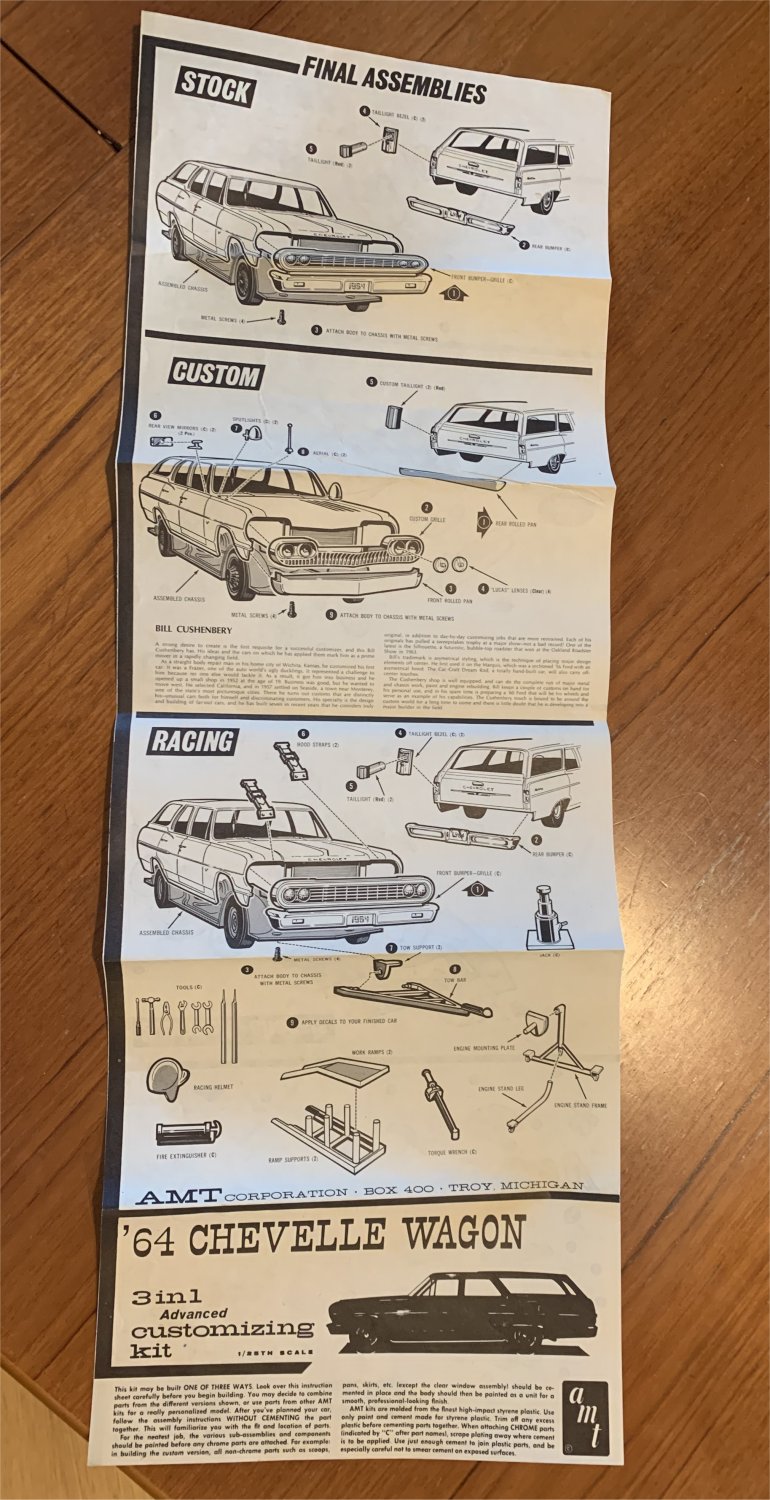
(The model companies like AMT, Revell, and Monogram did not, of course, create kits for every make and model of car. So it was quite a coincidence that one of AMT’s kits was of the exact car my father owned — a 1964 Chevelle station wagon. The final side of the instructions shows the bizarre grill and headlights used for the custom version, with some notes in tiny print about the actual designer, Bill Cushenberry.)

I must have built a dozen such kits, and at least one Enterprise model, by the time we moved from Reseda to Illinois. My father, typically, unilaterally, declared that we could not afford to pack up and move all my models. (Even though his company was paying for the move, presumably.) So I gave them away, and since I had no friends, they went to Linda Bigbee, oldest daughter of long-time family friends in Burbank. She probably tossed them. Once in Cambridge, and then Glen Ellyn, I did one or two more car models, then moved on to more Enterprise and Klingon spaceship models, and then to detailed models of the Gemini spacecraft, a large Apollo/LEM model, and the huge Saturn V stack. My father disapproved (as he did about so many things) of car models, so I built a battleship model (Prinz Eugen), an aircraft carrier model (Enterprise), and a large detailed model of some kind of WWII plane, which I never finished.

Posted in Personal history | Comments Off on Models, of Cars and Spaceships

John Allen Paulos, A MATHEMATICIAN READS THE NEWSPAPER (1995)

John Allen Paulos, A Mathematician Reads the Newspaper. Basic Books, 1995.

Author’s Conclusion:

Always be smart. Seldom be certain. Journalists should ask, in addition to Who, Where, What, etc., How Many? And How Likely? And no matter how detailed the explanation, sometimes things remain baffling because the *world* is baffling.

Brief Summary:

This is a book not so much requiring sophisticated math to understand, but to review many examples of items (of all kinds) in the newspaper with insights for understanding them from math but also from psychology, including the predisposition of humans to turn everything into stories. There are so many short chapters that it’s hard to identify broad themes (aside from those in the conclusion), but here I’ll cite some key points from each section.

Politics: about voting schemes, none perfect; about psychological biases (even back in 1995 people knew about the availability error, the halo effect, the anchoring effect); how newspaper stories are told; how equivocation can enable virtually any claim; beware finding significance in coincidences.

Local and Social issues: How newspapers are nodes of connectedness; why to beware use of SAT scores; how arguments about gun control and abortion can be challenged; why stock markets patterns are illusory; how selection of units or words like “many” and “uncommon” can be misleading; how lawsuits presume every problem has a definite answer; how advertising works; how humans are preoccupied with the short term at the expense of the long term.

Lifestyle and soft news: How to write celebrity profiles; how to perceive trends that don’t actually exist; how statistical factoids depend on definitions.

Science and Medicine: How in science news clarity and precision are not equally balanced; beware implausible precision, and the overemphasis of trivial risks; how reporting seldom debunks even claims about guardian angels, statues that bleed, etc.; how to easily generate a pseudoscience out of meaningless coincidences (this example also in Irreligion); how confidence intervals are often ignored; how some strategies don’t work when scaled up; how you can’t predict discoveries you haven’t made yet; beware category errors; about different reasons to study math and five misconceptions about math.

Food, Fashion, Sports: Beware precision of nutrition information; how team sports are different than individual ones; sports records are simple issues of probability; how advice columns are glib; how to spot obvious exaggerations; the superficiality of top 10 lists; how so few books are reviewed compared to the coverage of every sports game, every murder; how religious coverage avoids discussion of faith to avoid recognizing the absence of evidence for beliefs; how we read obituaries.

Detailed Description

Intro
Author recalls growing up, reading the Chicago Tribune, the Milwaukee Journal. As he grew up, he grew more sophisticated about newspapers, but reads a lot of them, and contributes occasionally. This book is arranged like a newspaper, and is intended to offer a mathematical perspective to enrich our understanding….

Section 1, Politics, Economics, and the Nation
Social choices are necessary because our two most basic political ideals, liberty and equality, are incompatible. Consider the algorithm for dividing a cake: one cuts, the other chooses.

Lani “Quota Queen” Guinier.. voting

The Banzhaf power index: the number of ways a group or party can change a losing coalition into a winning one, or vice versa. Examples apply to, e.g. stockholders’ percentages, in which a small percentage might be just as powerful as a large one, because coalitions can form between groups; or a relatively large one may have no power at all. (examples). Ms Guinier suggested an alternative, a cumulative voting procedure would grant each voter a number of votes equal to the number of contested seats, which votes could be distributed any way the voter wished, separately or cumulatively. This could be an alternative to the gerrymandering that results in geographically bizarre districts.

Many different voting schemes have been proposed. Another is the approval system–one candidate, one vote. Each voter either approves or disapproves of each candidate.

In fact, no voting system is perfect; every one has undesirable consequences. The issue isn’t whether to be democratic, it’s how.

Bosnia: Vietnam or World War II?.. psychological availability
The ‘availability error’ is the psychological tendency to make a judgment based on the first thing that comes to mind. Similarly, emotional news stories, or provocative wording of poll questions, have greater impacts than neutral ones. News stories invite particular interpretations depending on their resonances with other recent stories, or the similarity to other news stories that day. Things or people are judged (the ‘halo effect’) by one salient characteristic–a Harvard pedigree, etc. Or people make different estimates depending on the ‘anchoring effect’ of an initial suggestion. Uncritical newsgathering simply bolsters conventional wisdom.

Recession forecast if steps not taken.. unpredictability; chaos
There are surprising mathematical reasons why most political and economic commentary and forecasting is fatuous nonsense. One example is the Laffer curve, which purports to represent the relationship between tax rate and government revenue, but simplistically neglects the myriad historical and contingent factors which might affect the actual relationship. Like a billiard table set up, weather is a system sensitive to small changes in initial conditions (Lorenz, 1960); thus chaos theory, and the study of nonlinear systems. The trajectory through such a system is a fractal. The lesson is to beware glib interpretations of changes of such complex systems.

Headlines and the inverted pyramid
Newspaper stories are told in inverted pyramid format, from essentials to more details. Ironically this creates a shorter attention span more than does tv, which is usually blamed for it. The coincidence of rival tv news shows running the same stories simultaneously should not be surprising…

Pakistan’s Bhutto… dice and bluffing
Sometimes a conscious randomizing of choices is not irrational, but maximizes one’s effectiveness. Example: a pitcher and batter decide between fast balls and curve balls; it’s best to decide which to do randomly. This is game theory–or negotiation theory. On the other hand, sometimes knowing a probability makes it best to adopt an unvarying policy. A dial that lands on red 70% and green 30% of the time; it is better to always guess red, not to try to guess red 70% and green 30%, because then only the ‘overlaps’ will bring a correct guess.

Who’s News…
Most news is about a very few people who are deemed ‘newsworthy’; it is an inverted pyramid structure. Similarly with coverage of foreigners. 1 American = 5 Englishmen = 500 Ecuadorans = 5000 Rwandans. Similar structure for word frequency in English.

Iraqi death toll… benchmark figures
Figures of war dead are rattled off without any perspective or comparison. Or comparing American dead to Vietnamese dead; or MIA in that war vs previous wars. Such benchmark, or ballpark, figures would be useful to insure common ground in multicultural discussions. The claims of Farrakhan; numbers of aids cases; the national debt.

Hillary most honest.. ambiguity and nonstandard models
By carefully defining terms and equivocating, you can say almost anything. “Most honest person I know.” Mathematically, there is the difficulty of definitions intended to describe one entity that turn out to be satisfied by other unexpected things, thus ‘non-standard’ geometries. Such results also play a role in humor…

Voting fraud.. political and mathematical regression
In a contested race, both sides presented mathematical arguments about machine votes vs. absentee votes. Mathematical interpretations do not bound our actions; deciding between interpretations is a nonmathematical issue.

Cult plot… newspapers, coincidences, conspiracies
There are so many unrelated news stories available that it’s no surprise that odd coincidences should jump out. True believers have no trouble finding support for their theories. The famous coincidences between Kennedy and Lincoln are well known; similar links can be found between other presidents.

Section 2, Local, Business, and Social Issues
What is local? We tend to evaluate relevance of particular news stories by their relation to us, in some aspect or another–location, social type, profession. The multiplication effect reveals the ‘connectedness’ of society–the number of links between any two people, which both theoretically and empirically has been shown to be under 10. A group breakdown by sex contacts would consist of some number of celibate single-person groups, a larger number of two-person groups; a few groups having a few members; and a huge group, perhaps 100 million, connected by their connectedness more than by being promiscuous.

Newspapers, then, are about the nodes of connectedness.

Company charged.. test disparities
Stories about women and minorities often focus on small fluctuations that are magnified at the ends of bell curves. It’s easy to show that the differences between any two groups will always be greatly accentuated at the extremes. And differences between groups (which there must be, by definition) will likely show up on standardized tests. The issue should be whether any particular test is appropriate to its use.

Thus schemes of strict proportional representation are impossible to implement. E.g. hidden relationships between race and being homosexual will yield mixes that will look good or bad from different perspectives.

SAT
The Scholastic Assessment Test, it’s now called. Among many other issues is whether SAT scores are predictive of college achievement. The reason why not is that any one college takes only a particular slice of SAT scores, then this group is spread out by academic achievement (GPA) at that college. If everyone were accepted to the top colleges, then there would be a stronger correlation between SAT score and later achievement.

Guns will soon kill more than cars…
The problem with such a comparison is that deaths due to guns are almost always intentional. The reason stricter gun controls don’t pass, despite a sizeable number of people who would support them, is that those who disagree with them feel strongly about the issue and even though a minority, are more likely than the majority to let the issue be a determining factor in deciding their vote.

Abortion… prohibition and arithmetical arguments
Sometimes radical new arguments enable people to reexamine entrenched positions. Suppose something caused women to become pregnant with 30-50 fetuses at a time, and that some could be saved, or all could be lost. Abortion opponents would presumably opt to save them all, risking a population explosion. Or: if evidence was confirmed that smokeless tobacco drastically reduced tobacco-related deaths, why not encourage smokers to switch?

DNA finger murderer; life, death and conditional probability
The ‘prosecutor’s paradox’ is about conditional probability, e.g. a fingerprint match with an innocent person has a probability of one in a million, but an innocent person matching the fingerprint has a probability of 2 out of 3, which is the relevant issue. In logic, If A then B is not the same as If B then A.

Darts Trounce the Pros: luck and the market
Random selections of stocks do about as well as the pro’s, sometimes even better. This is partly due to statistical fluctuations. Also because of the way random processes work. In a sequence of 1000 random coin flips, most of the time the number of either heads or tails will be greater; it won’t flip back and forth. Even though statistically they come out about the same. Similar things happen with stocks, which become known as ‘winners’ and ‘losers’ without there being much difference between them.

There are also seeming patterns in random sequences, which compel ‘explanation’.

Despite such demonstrations, market analysts are always pronouncing explanations for every market swing.

Cellular Phones tied to Brain Cancer: multiplication, health, and business
Numerical quantities can be made to seem big or small depending on the units chosen, e.g. length vs. volume. This happens in discussing disease rates–minimize by discussing rates; maximize by discussing gross numbers, especially particular cases. Thus, an anecdote about a woman with brain cancer led to stock prices falling for companies manufacturing cellular phones. Similar hysteria applied to stories about silicone breast implants.

The media use words like ‘many’ and ‘uncommon’ which are essentially meaningless. Newspapers typically present only a single ‘credible’ figure, without indicating the range of figures depending on different classification criteria.

GM Trucks Explode on Side Collision: from pity to policy
There is an increase of 143% in the number of lawyers since 1971. We get the impression every daily activity is fraught with danger–lawsuits are everywhere, as if every problem has a definite answer, as if there is no room for uncertainty in the world. Court cases play up the victims. It is probable that the GM engineers made a rational decision in designing their trucks; but how many thousands whose lives were saved by that decision are aware of it? People tend to assign negligence when the consequences are significant, no matter what the element of chance.

The $32 billion Pepsi Challenge: advertising and numerical craftiness
Most everyone knows how advertising works; full of false inferences, omitting crucial information. Ads can even make dumb mistakes without hurting sales (it’s the impression that counts). An exception might be the Pepsi gaffe in which thousands of people had winning numbers in a lottery, and Pepsi couldn’t fulfill its jackpot promise.

Brief Fads Dominate Toy Industry: S-curves and novelty
The S-curve describes trends that rapidly increase and then level off, like bacteria growth in a petri dish. This happens because of a depletion of nutrients, say. But the curve also describes cultural patterns, like the popularity of new toys. Perhaps here what is being depleted is the sense of novelty.

Area Residents Respond to Story: repetition, repetition, repetition
Typical tv news strategy–interviewing men on the street about some breaking story; of course they all say the same thing, having been briefed the same way. (A man was unsure of a newspaper story, so bought dozens of copies of the paper to corroborate the story.)

Researchers Look to Local News for Trends: the present, the future, and ponzi schemes
Humans are preoccupied with the short term, at the expense of the long term; thus our attitudes involving aids, global warming, long-term debts, etc. They play out like ponzi schemes, in which early investors are paid off with later ones, but the even later ones lose everything. Trying to forecast such trends, by ‘adding up’ local short-term events, usually do not yield good results.


Section 3: Lifestyle, Spin, and Soft News
People are most interested in soft news with some pertinence to oneself. Note how often some essayists use the various ‘I’ words…

A Cyberpunk Woody Allen: how to write a profile of the fledgling celebrity
How to write it: pick someone not too well known, compare them to someone who is and gather testimonials, both of which are easy because of the interconnectedness of things…

Tsongkerclintkinbro Wins
(Written in Spring ‘92 when there were still 5 viable Democratic candidates for president.) A set of imaginary voting preferences that show that each candidate can declare himself the winner depending on which voting criteria is used.

Florida Dentist Accused to Intentionally Spreading AIDS: rumors, self-fulfilling prophecies…
Irrational fears can be understood as variations of the Dennett party game in which a dream is deduced through a series of yes no questions answered according to some arbitrary rule. The questioner deduces a dream that never occurred, one which has no author. Similarly dreams themselves may occur when the mind’s question-generating ability is intact, but is getting in effect a series of random answers by being unconscious. Whole societies can be victim of mounting fears when objective information is absent. (Guatemala peasants thought western women were stealing babies…)

Interlude: Selves, Heroes, and Dissociation

(missed a couple chapters here)

Newspaper Circulation Down: factoids on tabloids
Claims are 60,000 newspapers in the world, and 500 million readers… though of course these statistics depend on what one calls a newspaper, or how one counts readers…

Computers, Faxes, Copiers Still Rare in Russia: information and the commissars
It’s not preposterous to imagine that the failure of economies in the former Soviet Union is due to the control of information that suppressed information duplicating mechanisms…


Section 4: Science, Medicine, and the Environment
Usually clarity and precision are not equally balanced. Some scientists are happy with precision without a proper context; journalists often highlight the most alarming scenarios consistent with the story.

Ranking Health Risks: Experts and Laymen Differ
the Dyscalculia Syndrome
(article from Discover mg). The difficulties of ‘false positives’ and other misleading statistics. What’s critical about a random sample is its absolute size, not its percentage of the population. Similarly there’s a widespread confusion about correlation vs. causation. Often incorrect inferences are made due to lack of information (inadequate), e.g. data on condom failure rates, or disease incidence rates, which don’t take into consideration increased susceptibility due to longer lifespans. Implausibly precise statistics are often bogus — e.g. the normal body temperature is actually 98.2 (not 98.6) due to a rounding error from Celsius.

Asbestos Removal Closes NYC Schools: contaminated mountains out of mole spills
News stories of contaminations often overemphasize trivial risks; if everything is risky, nothing is. One pint of liquid dumped into the oceans becomes 6000 molecules per pint of ocean water. ! Virtually any such statistic can be manipulated into sounding alarming.

Super Collider a Waste of Money: science journalism and advocacy
Laypeople are often beset by dueling experts in the press; science journalists cannot assume the same level of audience background knowledge as can, say, a food critic. Example of Rudy Rucker story about mathematical proposals translated into musical performances for congress, “A New Golden Age”. Still, public face-offs and debates on scientific issues should be encouraged.

Harvard Psychiatrist Believes Patients Abducted by Aliens: mathematically creating one’s own pseudoscience
And science reporting should engage in gentle debunking, too. But seldom does, even when reporting on guardian angels, statues that bleed, or UFO abducting aliens. The ease of finding odd coincidences in life has already been discussed. Here’s how to create such coincidences– take four numbers about yourself and generate various combinations of them to different powers; some of them are bound to correspond to this or that physical constant. Virtually all such coincidences are not only not miraculous; they’re meaningless.

FDA Caught Between Opposing Protesters: statistical tests and confidence intervals
Other basic statistical principles to be aware of include Type I and Type II errors–making judgments based on small samples, either rejecting a true hypothesis, or accepting a false one. The FDA must balance these two risks when evaluating drugs.

Also, confidence intervals, as in “95% certain that such and such”; sort of like a margin of error. But these qualifications are often left out of reports.

Senators Eye Hawaii Health Care Plan: scaling up is so very hard to do
Strategies that work on a small scale often don’t work when scaled up…health plans, traffic patterns, size and weight. Compromises are needed, such as the prisoner’s dilemma, the tragedy of the commons. Arrow’s theorem describes ranking problems (nontransitive results).

Breakthrough Forecast by End of Decade: you can’t know more than you know
The Hay Theory of history was that the invention of hay made settlement of northern Europe possible, and thus the spread of civilization. Similar stories about other technologies can be told, and each one involves some contingency that precluded alternate technologies. Thus the qwerty keyboard; VHS over Beta; DOS. But really new paths are unpredictable. Despite the headline, you can’t predict discoveries you haven’t made yet.

Rodent Population Patterns Difficult to Fathom: ecology, chaos and the news
Stories on ecological issues frequently verge on category mistakes–ascribing human motives or agents to natural events. For instance, population trends of rodents may follow a certain formula that generates chaotic results. How much more complex are actual ecological systems! But news stories like facile analyses.

More Dismal Math Scores for US Students: x, y, and u
News stories about dismal scores–so what? There are three broad classes of reasons to study math. First is practical, for job skills, science, technology. Second is informed understanding; third is considerations of beauty, curiosity, wisdom. But politicians like innumerate people who can be easily swayed without recognizing quantitative arguments. Yet some types of mathematical subjects, puzzles and so on, are popular. Why isn’t studying math more popular?

Five misconceptions: Math is a matter of computation, not. Nor is it strictly hierarchical: algebra, then calculus, then etc etc. Storytelling is too infrequently used. The false distinction between ‘people person’ and ‘numbers person’, say. And that math is numbing of other sensibilities.


Section 5: Food, Book Reviews, Sports, Obituaries
761 Calories… : meaningless precision
Given how recipes are written, the precision of nutrition information is meaningless. It only takes one imprecise number to make any combination using it also imprecise.

Top Designs for the Busy Working Woman: fashion, unpredictability, and toast
To author the fashion pages make the astrology column look insightful. A toast and jam sandwich folded and stretch is analogous to reading a newspaper, which folds and stretches the mind to brings things once far apart closer together, in a complex way.

Agassi Wins Again: scoring and amplifying differences
Sports statistics suggest that often the best teams manage to lose, and the worst ones win, occasionally. In contrast, in individual sports the better player usually does win. But the rules of the game typically amplify the differences in skill between players; and who goes first often makes a big difference.

New Survey Reveals Changing Attitudes: societal gas laws
Has polling and measuring become a national pastime? The fascination with profiles counterbalances the fascination with celebrities and other individual stories. And statistical profiles are valid even when the data is erratic–example of sadistic nutritionist. The Central Limit theorem. Statistical averages apply routinely in physics–gases, for example. Or Lem’s one minute profile of sexual intercourse across the planet.

Near Perfect Game for Roger Clemens: how many runs in the long run
Sports records can be explained by the laws of probability, even amazing ‘streaks’, which occur with the same frequency as streaks of heads in coin tossing.

Bucks County and Environs: a note on maps and graphic games
Language includes knowing rules for various idiosyncratic uses and exchanges, which must be understood differently. So to graphs and pie charts and maps, which have peculiar emphases that must be understood in context.

Ask About Your Mother-in-Law’s Lladro: explanations, advice, and physics
Advice columns provide easy, glib explanations. These arise from making ‘intentional’ accounts of situations where only a physical explanation would do. It’s easy to invent numerous intentional explanations for every gesture and situation.

Garden Club Gala: incidence matricies on the society pages
Expressions such as “everybody was there” or “they’re all doing it” are annoying; they’re so clearly exaggerations. Showing incidence matrices with society stories would be revealing.

Ten Reasons We Hate Our Bosses: lists and linearity
The top 10 reasons that Top 10 lists are popular.

Stallone on Worst-Dressed List: traits and rates
Best and worst dressed lists, and the like, are the products not just of the measures of the traits involved, but also popularity or recognition.

New Biography Fills Much-Needed Gap: books and news
Books should be bigger news…50,000 are published each year, how many are reported on, especially compared to the attention lavished to every baseball game, every murder, every tv program listing. Instead, a relatively small number of books are reviewed, often with lavish amounts of attention.

Which way Mecca? Religion in the paper
Coverage is almost never about faith, but about peripheral issues (like the problems mosque builders in the US have in determining the direction to Mecca). But this is just as well. Discussion of the true issues would require explicit discussion of other beliefs, of the absence of evidence for beliefs, and so on. Better a tacit embargo that supports religious tolerance.

R. L. Vickler, 85, Aide to Truman: the length of obituaries
A nice vertical, historical contrast to the nowness of most news stories. Trends can be seen.


Conclusion
Always be smart. Seldom be certain.

Journalists should ask, in addition to Who, Where, What, etc., How Many? And How Likely?

And no matter how detailed the explanation, sometimes things remain baffling because the *world* is baffling.

Posted in Uncategorized | Comments Off on John Allen Paulos, A MATHEMATICIAN READS THE NEWSPAPER (1995)

Links and Comments: Socialism, Conspiracy Theories, Religion, Rationality, Liberalism, William Barr, Republicans

First, a David Brooks column from back in December: I Was Once a Socialist. Then I Saw How It Worked.

I was a socialist in college. I read magazines like The Nation and old issues of The New Masses. I dreamed of being the next Clifford Odets, a lefty playwright who was always trying to raise proletarian class consciousness. … The best version of socialism is defined by Michael Walzer’s phrase, “what touches all should be decided by all.” The great economic enterprises should be owned by all of us in common. Decisions should be based on what benefits all, not the maximization of profit.

But then,

My socialist sympathies didn’t survive long once I became a journalist. I quickly noticed that the government officials I was covering were not capable of planning the society they hoped to create. It wasn’t because they were bad or stupid. The world is just too complicated.

This is precisely why communism failed, as far as I understand; and why conspiracy theories are bunk. These vast conspiracy theories — by the FBI to assassinate JFK, by the government to stage 9/11, and so on — would require so much precision planning without anyone involved giving the game away, for years and years afterwards — that they are unbelievable. Compare how large construction projects *never* come in on time or to budget; coordination among so many planners and workers never goes to schedule or budget. And I recall a comment somewhere years ago, which unfortunately I didn’t capture, by a political operative in Washington DC, that after two weeks working in government, observed that nothing gets done efficiently in government, let alone vast conspiracies.

At the same time, Brooks observes, unbridled (unregulated) capitalism is not the simple answer.

Today, the real argument is not between capitalism and socialism. We ran that social experiment for 100 years and capitalism won. It’s between a version of democratic capitalism, found in the U.S., Canada and Denmark, and forms of authoritarian capitalism, found in China and Russia. Our job is to make it the widest and fairest version of capitalism it can possibly be.

\\\\

Slate: The Bible That Oozed Oil: A small Georgia town, a prophecy about Donald Trump, and the story of how a miracle fell apart.

Long article describing the familiar generalization of how the most gullible are the most religious. Anyone with any ounce of savvy about how the world really works would have suspected fraud from the very beginning.

\\

Contrary to William Barr and other religious moralists, increased religious faith and social prosperity do not go together.

Jerry Coyne: Religion doesn’t improve society: more evidence

In numerous measures including per capita GDP, unemployment rate, homicide rates, life expectancy, etc., the top 10 most religious countries in the world score worse than the top 10 least religious states. Data!

\\

On the other hand, from Aeon: Why Religion Is Not Going Away and Science Will Not Destroy It. Subtitled, Social scientists predicted that belief in the supernatural would drift away as modern science advanced. They were wrong.

Human nature will out, and wins by default in the absence of active education.

\\

This piece makes a distinction between being rational and being reasonable.

Vox: Is rationality overrated?. Subtitled, Sometimes, it’s better to be reasonable.

Citing Kahneman & Tversky and Sunstein & Thaler, the idea that humans are basically rational creatures (a chief assumption of traditional economics) has been undermined. A new study suggests that people are more frequently reasonable, which they define thus:

[T]here’s rationality, where you focus on maximizing the chance of getting what you want, and there’s reasonableness, where you strike a balance between what you want and social norms.

The example that occurs to me is that a rational person might understand that there’s no reason to take the metaphysical claims of religion seriously, but a reasonable person might know not to say that out loud and instead pay lip service to community standards that give them credence.

\\

From 2016, NPR: Why Are Highly Educated Americans Getting More Liberal?

Not only are the better-educated more liberal than others, they’ve been getting *increasingly* liberal over the last couple decades. Suggested causes: polarization; more women getting degree; insularity (living alongside like-minded people). Conservatives have gotten more conservative too, but not because of education.

\\

Daily Kos via AlterNet: Logic versus emotion: Understanding the mass psychology of the Christian right

My take before reading this: religious fundamentalists, believing in an authoritarian god who’s issued strict rules about all manner of behaviors (via the 10 Commandments and the strictures of Leviticus), are naturally attracted to authoritarian leaders, who tell them what to believe and what to do so they don’t have to think, and are uncomfortable with the freedoms and options available in liberal, democratic societies where people are able to reason what’s best for themselves and make decisions different than those made by the primitive desert tribes who wrote the Old Testament.

But let’s see what the article says.

Whatever one likes or dislikes about the Democrats, their appeal to voters is primarily to logic. Whereas the Republicans long ago learned to appeal to the dark side of people’s emotions, since they had no logical or progressive policies to sell. So the Republicans have become the party of hate, misogyny racism, bigotry, homophobia, war, and anti-immigrant sentiment affixed to a false and extremist Christian face. They now, and have been for some time, openly organizing people around these negative emotions and behaviors.

And

People who have fallen under the influence of an authoritarian or religious leader will hold on furiously to their dependence. They have invested their self esteem into the identity and success of these leaders, and by supporting them, they have built up their own self worth. One of the reasons right wing religious leaders can get their members to send them so much money for such ridiculous and scandalous reasons.

This is actually a rather haphazardly written article, but it makes important points.

\\

As an example of the above, a NYT Opinion piece by Katherine Stewart and Caroline Fredrickson, from Dec. 29th 2019. Bill Barr Thinks America Is Going to Hell. Subtitled, And he’s on a mission to use the “authority” of the executive branch to stop it.

In these and other cases, Mr. Barr has embraced wholesale the “religious liberty” rhetoric of today’s Christian nationalist movement. When religious nationalists invoke “religious freedom,” it is typically code for religious privilege. The freedom they have in mind is the freedom of people of certain conservative and authoritarian varieties of religion to discriminate against those of whom they disapprove or over whom they wish to exert power.

This form of “religious liberty” seeks to foment the sense of persecution and paranoia of a collection of conservative religious groups that see themselves as on the cusp of losing their rightful position of dominance over American culture. It always singles out groups that can be blamed for society’s ills, and that may be subject to state-sanctioned discrimination and belittlement — L.G.B.T. Americans, secularists and Muslims are the favored targets, but others are available. The purpose of this “religious liberty” rhetoric is not just to secure a place of privilege, but also to justify public funding for the right kind of religion.

And

Within this ideological framework, the ends justify the means. In this light, Mr. Barr’s hyperpartisanship is the symptom, not the malady. At Christian nationalist gatherings and strategy meetings, the Democratic Party and its supporters are routinely described as “demonic” and associated with “rulers of the darkness.” If you know that society is under dire existential threat from secularists, and you know that they have all found a home in the other party, every conceivable compromise with principles, every ethical breach, every back-room deal is not only justifiable but imperative. And as the vicious reaction to Christianity Today’s anti-Trump editorial demonstrates, any break with this partisan alignment will be instantly denounced as heresy.

This is why conservative Republicans are basically lawless: they presume they can cheat any way they need to in order to achieve their higher purposes. Democrats who play by the rules are wimps.

The answer is that America’s conservative movement, having morphed into a religious nationalist movement, is on a collision course with the American constitutional system. Though conservatives have long claimed to be the true champions of the Constitution — remember all that chatter during previous Republican administrations about “originalism” and “judicial restraint” — the movement that now controls the Republican Party is committed to a suite of ideas that are fundamentally incompatible with the Constitution and the Republic that the founders created under its auspices.

There are many examples every week of fundamentalist preachers who see every perceived malady in the world as due to the gays, or abortion, or same-sex marriage. They are fixated on interpreting the world based on things they don’t like.

\\

AlterNet: Outlandish conspiracy theories didn’t start with Trump’s presidency. Republicans have been promoting ‘fringe crackpots’ for decades: political historian.

Citing a Washington Post article by Matthew Dallek.

“The intellectual life of the American right since Sen. Joe McCarthy’s rise to prominence in 1950 can be seen partially as a series of flirtations with conspiracists and a dedicated reluctance to read fringe crackpots out of its ranks,” Dallek explains.

The John Birch Society in the 1950s, promoting conspiracy theories much like those that Alex Jones promotes today. The many crazy Clinton conspiracy theories.

“Ultimately, Trump was the logical consequence of a posture followed for decades at the top echelons of the conservative movement: the batty screeds are silly, but since they help us, we won’t work zealously to purge them,” Dallek observes. “Trump’s conspiracy-based capture of the GOP has less to do with him and his perspective than with a party that sought and often won the support of people who believe those notions.”

Posted in Conservative Resistance, Culture, Humanism, Psychology, Religion | Comments Off on Links and Comments: Socialism, Conspiracy Theories, Religion, Rationality, Liberalism, William Barr, Republicans

John Allen Paulos, IRRELIGION (2008)


John Allen Paulos, Irreligion: A Mathematician Explains Why the Arguments for God Just Don’t Add Up.  Farrar, Straus and Giroux/Hill and Wang, 2008.

John Allen Paulos is a professor of mathematics who’s become, over the past three decades, well-known as an author who applies basic mathematical reasoning to everyday topics. His first hit was Innumeracy: Mathematical Illiteracy and Its Consequences (1988), exploring how misconceptions about math, especially statistics and probability, leads to errors in public policy and personal decisions. A later book, A Mathematician Reads the Newspaper (1995), extended the theme. (Understanding basic mathematical ideas like these and applying them to everyday things is part of my general concept of being “savvy.”)

The book here, slender and breezy, applies mathematical reasoning and simple logic to the various arguments for the existence of God, and finds those arguments wanting (of course). Appearing in 2008, this book can be seen in the context of the various “new atheism” books by Harris, Dawkins, et al, that appeared in the mid-2000s. There was obviously an audience for books that dismantled the presumptions of religious faith.

Brief Summary:

  • Four classical arguments for the existence of God are examined and dismissed for logical incoherence and/or statistical implausibility: arguments from first cause, from design, from the anthropic principle, from ontology.
  • Four subjective arguments, from coincidence, prophecy, subjectivity, and interventions, are dismantled on statistical grounds.
  • And four Psycho-Mathematical arguments — on redefinition, cognitive tendency, universality, and gambling — are also dismantled.
  • With asides about a personal pseudoscience, recursion, emotional need, Jesus and CS Lewis, a dream conversation with God, and the idea of “brights.”

Detailed Summary: [[ with comments in brackets ]]

Preface

This book addresses if there are logical reasons to believe in God. (Author is droll: “There are many who seem to be impressed with the argument that God exists simply because He says He does in a much extolled tome that He allegedly inspired.”) Author claims an inborn materialism—that matter and motion are the basis of all that there is. Recalls adolescent skepticism about Santa Claus, and God—what caused or preceded him?. The inherent illogic to all arguments for the existence of God are addressed here. The book will be informal and brisk, with no equations. Author always wondered about a proto-religion for atheists and agnostics that would still acknowledge the wonder of the universe: the “Yeah-ist” religion, “whose response to the intricacy, beauty, and mystery of the world is a simple affirmation and acceptance: Yeah.”

Four classical arguments—

The Argument from First Cause (and Unnecessary Intermediaries)

Argument: Everything has a cause; nothing is its own cause; there had to be a first cause; call it God.

The problem here is the first assumption—either everything has a cause, or it doesn’t. If the former, God has a cause too; if the latter, why invoke God?; maybe the universe itself has no cause. Related is the natural-law argument, that something must have caused the particular natural laws we see in the universe.

The very notion of cause has its problems. And perhaps the assumption that nothing is its own cause is the problem.

[[ the other problem with arguments like this is that, even if valid, what does the ‘god’ of this argument have to do with any particular conception of what god is? ]]

The Argument from Design (and Some Creationist Calculations)

Argument: The universe is too complex (or beautiful) to have come about by accident; it must have been created; thus God exists. (Alternatively, the universe seems to have a purpose; thus God.)

Example of William Paley and the watch on the beach.

The problem with this argument is knowing what’s ‘too’ complex to come about randomly. In any event, wouldn’t the creator be even more complex in order to have created the universe? Who created the creator’s complexity? It’s a metaphysical Ponzi scheme. Like a mnemonic more complicated than what it’s designed to remember. In contrast, we have a well-confirmed explanation for the origin of life’s complexity: evolution.

Those opposed to evolution who cite calculations of improbability of a given occurrence (like the eye) miss the point. The argument is deeply flawed; any particular development is unlikely, just as any particular arrangement of a shuffled deck of cards is unlike. Then there is Michael Behe’s irreducible complexity, applied to, say, the clotting of blood. Again, such complexity is explained by evolution; yet those who reject evolution are immune to such explanations.

Further, we can compare evolutionary matters to free-market economies—were those economies set into place, someone determining every rule in advance? Of course not; the system emerged and grew by itself. Odd that opponents of evolution usually support free-markets—they reject the idea of central planning (yet presume such central planning by the omniscient creator). So too does software like the game of Life and Wolfram’s cellular automatons show how simple rules result in great complexity; these ideas are not new. Someone who claimed the economy was the result of a detail-obsessed, all-powerful lawgiver might be thought a conspiracy theorist.

A Personally Crafted Pseudoscience

Digression. To anticipate the following arguments: Take any four numbers associated with yourself—height, weight, birth date etc—and consider various powers and products of them. (It’s straightforward to set up a computer program to generate thousands of combinations of product and factors, etc.) It’s likely that some of these combinations will be close to the speed of light and other such universal constants—especially if you juggle units. Does this imply you have a personal relationship with creation?

The Argument from the Anthropic Principle (and a Probabilistic Doomsday)

Argument: the physical constants are such that if they were slightly different, humans wouldn’t exist; humans exist; so those contants must have been fine-tuned by God.

Well, maybe other creatures would exist if the constants were different; one can’t know. There may be many universes, each with different laws and constants.

Related is the phenomenon of self-selection, applied to the Doomsday argument—example to judge why doomsday, that might happen anytime, should happen in any particular person’s lifetime.

The Ontological Argument (and Logical Abracadabra)

Examples of this go back to Plato’s Euthydemus. This concerns paradoxical, self-referential statements. e.g., If this statement is true, then God exists. Such statements can be used to prove, or disprove, anything.

Argument: The classic argument is that by definition God is the greatest and most perfect being; it’s more perfect to exist than not; therefore he exists.

The same argument could prove that a perfect island exists. Hume observed the only way words can prove anything is where a contradiction can be shown, e.g. that God is both omnipotent and omniscient. But no such disproof of God’s existence is possible.

Self-recursion, Recursion, and Creation

Digression: Recursion is a powerful concept key to computer programming. Examples are virus-like; example of Pete and repeat. Or von Neumann’s recursive definition of positive whole numbers. A lot of religious arguments are similar. If you assume a false thesis, you can prove anything.

Four Subjective Arguments—

The Argument from Coincidence (and 9/11 Oddities)

As in The Celestine Prophecy [a bestselling book]: coincidences impress some as evidence of God. The assumption is things don’t happen by accident; everything happens for a reason, etc.

Examples relate to 9/11—all sorts of numerical derivations. But of course you can do similar things with any date or set of words. Verses attributed to Nostradamus relating to 9/11 were simply made up. Photos were circulated on the internet.

People look for patterns and see them whether they’re there or not. People remember positive examples and forget counterexamples. What are the odds of some uncanny coincidence occurring? Quite high—there are so many potential events. A passage from Clarke’s Rendezvous with Rama told of a fireball on Sep 11th, 2077…

[[ there’s also the point of *why* coincidences would mean anything to anyone; there’s a psychological undercurrent that no one ever seems to discuss ]]

The Argument from Prophecy (and the Bible Codes)

Of course, some prophecies from holy books come true, but not enough of them to mean anything. Oddly, the more details a holy book contains, the less likely they might *all* be true, no matter than people ‘accept’ the book as true. Just because it’s in the Bible doesn’t close the matter; just because a holy book claims it’s true doesn’t make it true. People who think it does sometimes resort to the argument from red face and loud mouth.

Biblical codes concern equidistant letter sequences (ELSs), the way ‘nazi’ is within ‘generalization’. The discovery of rabbi names, etc, in the Torah was taken as proof of divine inspiration. True, the calculated probability of a particular ELS is tiny; but the discoveries weren’t predicted; they could have been anything. The likelihood of *some* interesting ELS *somewhere* is pretty high.

An Anecdote on Emotional Need

Digression: Author recalls helping three Thai girls, on Xmas day in 2006, dupe online boyfriends for cash, and considers how desperate those remote boyfriends wanted to believe in their girlfriends is like the intense need people have to believe in God. Author doesn’t believe in God, but doesn’t want to scoff at emotional need.

The Argument from Subjectivity (and Faith, Emptiness, and Self)

It’s hard to address the argument that people simply feel that God exists in their bones, or wherever. Similar is the argument that the idea there isn’t a God is too depressing, therefore there is. But there’s no way of verifying such subjective insight—unlike the way a blind person might verify the directions given him by a sighted person.

Similar is the argument that since all worldviews are valid, god exists. It would be arrogant for an agnostic to belittle someone’s religious beliefs, but usually it’s the believers who attacks the nonbelievers. How would an argument for theism work, to justify particular creeds? Belief in god doesn’t imply divinity of Jesus.

After all, most people are atheists about others’ gods. Atheists and agnostics just go them one better.

Even more absurd is to claim the existence of a personal god who answers prayers, intervenes with miracles, etc., which presumes an overweening sense of self-importance. [[ And yet my impression is that this is by far the most common sort of belief in God! ]]

Even the idea of self is unstable; we are constantly changing throughout our lives.

[[ The reply to this whole line of thought is to realize that millions of people around the world have passionate, subjective feelings about *other* gods ]]

The Argument from Interventions (and Miracles, Prayers, and Witnesses)

Miracles demonstrate the existence of God? Stories of ‘miracles’ seem to be getting more press lately. But claims are inconsistent; a few saved is a miracle, millions dying is a natural disaster; aren’t both divine or not? A local case (in author’s home Philadelphia) involved a Mother Drexel and two children who prayed to her and recovered. The famous Fatima case, children who experienced prophecies that were so vague they could apply to anything. The idea of miracles is counter to the weight of science—a miracle would simply mean the scientific laws were wrong. And testimony, of course, is not dependable—delusion or lying is more likely than a miracle.

Remarks on Jesus and Other Figures

The popularity of Mel Gibson’s Jesus movie (The Passion of the Christ) suggests that many believe the existence of such figures prove God’s existence. But: we often know little about news stories that happen in full view; we realize that and suspend judgment. But not with distant historical events, such as the events of that movie, recorded in the New Testament decades after the fact. Consider the political situation at the time of J’s death. Compare to the death of Socrates. Would one blame contemporary Athenians on his death? Would a film about it one dwell on the agony of him being poisoned?

CS Lewis’ arguments were uncompelling—we don’t know what Jesus said, or if his story is accurate. The flaw in The Da Vinci Code (the popular book and then film, which presume to identify a modern-day descendant of Jesus) is that any given biological line (e.g. Jesus’) would likely either die out quickly, or grow so that millions could claim to be descendants after centuries. Given parents, grandparents, etc., going back 40 generations we would each have a trillion ancestors; so obviously they were not all different people. If anyone from 3000 years ago has any descendants—it would be all of us.

Four Psycho-Mathematical Arguments

The Argument from Redefinition (and Incomprehensible Complexity)

Some attempt to redefine God as something else—nature, the laws of the universe, mathematics. This may be one reason many people say they are believers. God is Love. Or God is simply incomprehensibly complex. This is equivocation. The theory of everything may be beyond the complexity horizon. Yet nothing can be so complex that patterns aren’t apparent at various levels, enabling descriptions of order—inevitably. And in sufficiently large populations or sets, certain lower-level properties are guaranteed; examples of people at dinner parties who do know or do not know each other. Recall Stuart Kauffman’s work on self-organization. Claims these phenomena prove God are very strained.

The Argument from Cognitive Tendency (and Some Simple Programs)

Some say the fact that cognitive biases and illusions exist as proof of what they perceive, e.g. God. People have an inborn tendency to search for explanations and intentions. E.g., a thought experiment about a man’s car; or why extraordinary causes seem necessary to explain the deaths of JFK or Diana, to say nothing of the universe.

And we seek confirmation more anxiously than disconfirmation; we can be blind to contrary facts. The source of perpetuating stereotypes.

The ‘availability error’ is the inclination to view anything new in the context of what is already known—war, scandal, religion. Thus, other religions confirm the existence of God! The reason most people adopt their parents’ religion—cultural traditions. “…religious beliefs generally arise not out of a rational endeavor but rather out of cultural traditions and psychological tropes.” Children are no more Catholic because their parents are, than they are, say, Marxist because their parents are.

The last is the notion that ‘like causes like’. Complex results must have complex causes. But some computer examples (fractals) show that simple rules create complex results. Stephen Wolfram’s book A New Kind of Science, e.g. his rule 110 (page 112). Very simple rules result in patterns similar to those in biology and other sciences. Wolfman suggests simple programs might capture scientific phenomena better than equations. [[ this is a profound points, I think. ]] [[ there’s also the entirely subjective notion of what is ‘complex’ vs ‘simple’ ]]

My Dreamy Instant Message Exchange with God

Author had a dream conversation with God, who claims he evolved from the universe’s biological-social-cultural nature.

The Universality Argument (and the Relevance of Morality and Mathematics)

That the moral sense of different cultures is similar is taken as being instilled by God. Though this doesn’t explain blasphemers, criminals, homosexuals, etc. [[ if instilled by God, why aren’t they as invariant as the biological processes of staying alive? ]] Anyway, evolutionary forces explain why moral codes are similar in cultures that survive for long. (cf. Marc D. Hauser’s book—another group theory argument.) Also, if moral laws aren’t arbitrary, then their goodness is true without their being a god.

That leads to the old problem of why God would allow evil to exist; the usual answer, that we don’t understand his ways, explains nothing. And the many other obvious childlike notions in religious doctrine. The Boolean satisfiability problem is about determining if a set of statements, true or not, are consistent. Most sets of religious beliefs are inconsistent.

Scientists have long wondered about the universality of science and math. Is the fact that math works to explain the world really mysterious? Our ideas about math derive from interaction with the physical world. Counting, arranging, then abstracting. Evolution has selected those of our ancestors whose behavior and thought were consistent with the workings of the universe.

The Gambling Argument (and Emotions from Prudence to Fear)

Pascal’s wager applies to any religion, of course. And trying to assign probabilities to God’s existence is a futile task. Statements using ‘is’ are subject to linguistic confusion.

The wager isn’t much different than believing in god just because the idea of dying is dreadful. It’s similar to rallying around a leader in dangerous times. Dick Cheney’s one percent doctrine: even a 1% chance of there being weapons of mass destruction justifies war.

Anyway, there’s no evidence that nonbelievers are less moral or law-abiding. In a sense, moral acts by nonbelievers are more moral than those by believers who act to gain some divine reward.

Still, these arguments fail to persuade those whose critical faculties are undermined; and the untruths underlying faith make life more bearable to some.

Atheists, Agnostics, and “Brights”

Despite all this, atheists are the least tolerated minority in the US. Maybe what’s needed is a popular story or film, ala Brokeback Mountain. Another idea is to use a new term—maybe ‘bright’ (as proposed in the 2000s). Or at least greater acceptance of the admission of being irreligious. Author isn’t fond of the word bright. Yet hopes that as more people admit to being irreligious, to give up on divine allies and tormentors in favor of being humane and reasonable, the world would be a bit closer to a heaven on earth.

Posted in Book Notes, Mathematics, Religion | Comments Off on John Allen Paulos, IRRELIGION (2008)