Pinker: Better Angels: Chapter 1: A Foreign Country

“If the past is a foreign country, it is a shockingly violent one.” This 30-page chapter is a “tour” of the past, from 8000 BCE to the 1970s, an impressionist portrait of how violence was so common in the past, compared to today, a trend Pinker will justify with statistics in the latter part of the book.

  • Human Prehistory. Accounts of archaeological finds of skeletons – Otzi the Iceman; the Kennewick Man – who obviously died by violence.
  • Homeric Greece. Accounts of gory violence in Homer’s Iliad and Odyssey.
  • The Hebrew Bible. I quoted a couple passages from this section in this post: http://www.markrkelly.com/Blog/2016/03/09/reading-around-the-bible-1/ (scroll to bottom). He ends several pages with this crucial point:
    • If you think that by reviewing the literal content of the Hebrew Bible I am trying to impugn the billions of people who revere it today, then you are missing the point. The overwhelming majority of observant Jews and Christians are, needless to say, thoroughly decent people who do not sanction genocide, rape, slavery, or stoning people for frivolous infractions. Their reverence for the Bible is purely talismanic. In recent millennia and centuries the Bible has been spin-doctored, allegorized, superseded by less violent texts (the Talmud among Jews and the New Testament among Christians), or discreetly ignored. And that is the point. Sensibilities toward violence have changed so much that religious people today compartmentalize their attitude to the Bible. They pay it lip service as a symbol of morality, while getting their actual morality from more modern principles.

  • The Roman Empire and Early Christendom. Pinker notes Jesus’ attitude toward violence, in Matthew 10:34-37. With comments about the commonality of pagan myths that told of a savior who was “born of a virgin at the winter solstice, surrounded by twelve zodiacal disciples, sacrificed as a scapegoat at the spring equinox, sent into the underworld, resurrected amid much rejoicing, and symbolically eaten by his followers to gain salvation and immortality.”
  • And about the Colosseum and its “spectacles of mass cruelty”; its practice of crucifixion, with a detailed description; and how Christians thought the crucifixion of Jesus was a *good* thing. (See my earlier quote from this passage in this post: http://www.markrkelly.com/Blog/2016/03/21/reading-around-the-bible-2-matthew/; “In allowing the crucifixion to take place, God did the world an incalculable favor.”)
  • And how later Christians reveled in excruciating details of the deaths of martyrs.
    • Institutionalized torture in Christendom was not just an unthinking habit; it had a moral rationale. If you really believe that failing to accept Jesus as one’s savior is a ticket to fiery damnation, then torturing a person until he acknowledges this truth is doing him the biggest favor of his life…

  • And again the crucial point, p17.3:
    • Once again, the point of this discussion is not to accuse Christians of endorsing torture and persecution. Of course most devout Christians today are thoroughly tolerant and humane people. Even those who thunder from televised pulpits do not call for burning heretics alive or hoisting Jews on the strappado. The question is why they don’t, given that their beliefs imply that it would serve the greater good. The answer is that people in the West today compartmentalize their religious ideology. When they affirm their faith in houses of worship, they profess beliefs that have barely changed in two thousand years. But when it comes to their actions, they respect modern norms of nonviolence and toleration, a benevolent hypocrisy for which we should all be grateful.

This is up to page 17.

This issue of religious ‘hypocrisy’ is technically, unavoidably, true, but doesn’t address (this is not Pinker’s purview) the reality of how religion works in modern society, which is about community, tribalism if you like, the coming together of people like yourselves whom you can trust. The ancient texts are vestiges which modern people, fortunately, do not read too closely. If every common person who attends church and who expresses faith and who participates in activities with their brethren were confronted with the sadistic details of their religious texts, and forced to endorse them or not—what would happen? That will never happen.

Posted in Religion, Steven Pinker | Comments Off on Pinker: Better Angels: Chapter 1: A Foreign Country

Link and Comments: The 3% Climate Change Deniers

You know how 97% of climate scientists agree that climate change is real, and due to human causes? So what about the 3% that don’t? A new study examined those.

Quartz: Those 3% of scientific papers that deny climate change? A review found them all flawed

But what about those 3% of papers that reach contrary conclusions? Some skeptics have suggested that the authors of studies indicating that climate change is not real, not harmful, or not man-made are bravely standing up for the truth, like maverick thinkers of the past. (Galileo is often invoked, though his fellow scientists mostly agreed with his conclusions — it was church leaders who tried to suppress them.)

Not so, according to a review published in the journal of Theoretical and Applied Climatology. The researchers tried to replicate the results of those 3% of papers—a common way to test scientific studies—and found biased, faulty results.

Curious that the study is from November 2016.

Posted in Science | Comments Off on Link and Comments: The 3% Climate Change Deniers

Link and Comment: Elizabeth Kolbert spells it out

The New Yorker, September 11th issue.

Elizabeth Kolbert: Hurricane Harvey and the Storms to Come. Subtitle: “In the leadup to the historic flood, Texas Republicans abetted Trump’s climate-change delusions.”

Print title: “Coming Storms”

Elizabeth Kolbert, author of one of the best science books of the 21st century, The Sixth Extinction (my review), spells out the current situation.

She discusses Katrina, in 2005;

As misguided as the Bush Administration was about climate change, Donald Trump has taken willful ignorance to a whole new level. The President has called climate change an “expensive hoax” dreamed up by the Chinese. After much posturing, he announced in June that he was withdrawing the U.S. from the Paris climate accord. With less fanfare, he has rolled back Obama Administration regulations limiting greenhouse-gas emissions from both old and new power plants and from oil and gas wells. (Regarding the wells, a federal appeals court recently ruled against the White House, saying that it could not simply suspend the regulations.) Trump also revoked a 2013 executive order directing federal agencies to prepare for the impacts of warming and tossed out a plan, issued the same year, that outlined steps that the U.S. would take to combat climate change.

She concludes,

In the place of spending cuts, they should demand that Texas lawmakers and the President face up to the facts. The earth is warming, fossil-fuel emissions are the major cause, and the results are going to be far from “beneficial.” The U.S. needs to radically reduce its carbon emissions and, at the same time, prepare for a future in which storms like Harvey, Sandy, and Katrina increasingly become the norm.

Posted in Conservative Resistance, Science | Comments Off on Link and Comment: Elizabeth Kolbert spells it out

Link and Comments: NYTBR reviews Kurt Andersen’s FANTASYLAND

Just published, a big book by novelist and journalist Kurt Andersen, Fantasyland: How America Went Haywire: A 500-Year History (Random House), which is in my to-read stack. For the time being, here are some passages from Sunday’s front page review in the New York Times Book Review, by Hanna Rosin, titled National Delusions.

The review suggests that the book is an enlightening revisionist history of America, analogous to those by Howard Zinn or Richard Hofstadter.

If, for example, you remain confused about what happened in the last election, Andersen’s retelling of history will clarify things for you. As a host of public radio’s Studio 360, a best-selling novelist and a cultural omnivore, Andersen has been tracking and storing the data on the nation’s unraveling for decades. And he knew that what happened that November night, and in the subsequent months, was not just inevitable but in many ways our nation’s natural destiny. As he explains in what must have been an alarmingly self-confirming last chapter: Donald Trump is “stupendous Exhibit A” in the landscape of “Fantasyland,” a fitting leader for a nation that has, over the centuries, nurtured a “promiscuous devotion to the untrue.”

Fake news. Post-truth. Alternative facts. For Andersen, these are not momentary perversions but habits baked into our DNA, the ultimate expressions of attitudes “that have made America exceptional for its entire history.” The country’s initial devotion to religious and intellectual freedom, Andersen argues, has over the centuries morphed into a fierce entitlement to custom-made reality.

Yes, the vaunted “American exceptionalism,” that we Americans are somehow more special than others around the world, more blessed by God, and so on — a legacy of the nation’s founding by religious zealots.

Andersen’s history begins at the beginning, with the first comforting lie we tell ourselves. Each year we teach our children about Pilgrims, those gentle robed creatures who landed at Plymouth Rock. But our real progenitors were the Puritans, who passed the weeks on the trans-Atlantic voyage preaching about the end times and who, when they arrived, vowed to hang any Quaker or Catholic who landed on their shores. They were zealots and also well-educated British gentlemen, which set the tone for what Andersen identifies as a distinctly American endeavor: propping up magical thinking with elaborate scientific proof.

While Newton and Locke were ushering in an Age of Reason in Europe, over in America unreason was taking new seductive forms. A series of mystic visionaries were planting the seeds of extreme entitlement, teaching Americans that they didn’t have to study any book or old English theologian to know what to think, that whatever they felt to be true was true.

Fake news: George Washington and the cherry tree. Water cures, homeopathy, mesmerism. William Cody aka Buffalo Bill. The 1960s: psychedelics, the New Age, conspiracy theories following JFK’s assassination. UFO sightings. And the rise of hair color and plastic surgery, another kind of fake news. And of course:

While the most persistent thread in “Fantasyland” is Christianity — the astounding number of Americans who believe in heaven and angels, which most of Europe gave up decades ago — Andersen reserves a starring role for the secular spiritualists. They were supposed to be a counterpoint to narrow-minded evangelicals, but Andersen says the New Agers committed an even greater sin than the faithful.

The reviewer finds Andersen short on prescriptions for how to address this mess — if America has any way to address its delusions.

At the end of his book he tries to redraw a boundary that moves us a little closer to sanity. “You’re entitled to your own opinions and your own fantasies, but not your own facts — especially if your fantastical facts hurt people,” he says, echoing a comment by Daniel Patrick Moynihan. But the attempt is brief and feels halfhearted. By that point the pile up of detail — gun nuts, survivalists, web holes, scenes of cosplay, sci-fi shows and manufactured bubbles of hope — leaves a reader worried that a short manifesto on facts won’t save us.

“Sci-fi shows”? I checked the index. Andersen spends a couple pages (pp222-223) talking about 1960s TV shows, like “I Dream of Jeanie”; the Tolkien books in the 1960s; and how Star Wars and Close Encounters of the Third Kind impugned spiritual fantasies into past and future science-fictional visions.

I suspect I agree with him here, in his context — he’s talking about fantasy invading the rigor of science fiction. And that, going back to the core of the debate between Trek and Wars, is the division between attempting to understand the real world, and ceding that real world with mystical values that appeal to human biases.

Posted in Book Notes, Religion, science fiction, TV Sci Fi | Comments Off on Link and Comments: NYTBR reviews Kurt Andersen’s FANTASYLAND

Link and Comments: SF and Science

Slate has an interesting essay by Lawrence Krauss that covers basic points about how science fiction doesn’t/can’t truly predict the future, with an interesting point how the internet arose as a tool to coordinate very complex scientific experiments:

Indeed, perhaps the most remarkable thing about the internet is that necessity was the mother of its invention. As particle physics experiments became bigger, with larger collaborations spread around the world, the need for disparate groups to collaborate and share data arose. Thus began the World Wide Web, initiated at CERN, the home of what is now the world’s largest particle accelerator: the Large Hadron Collider.

Posted in Science, science fiction | Comments Off on Link and Comments: SF and Science

Links and Comments: Marcotte on Trump, and Evangelicals

It’s becoming more and more clear that Trump has no values, no ideals, no standards. He’s only about making deals, and he’s willing to align himself with anyone to make deals, no matter for what, no matter with whom.

Salon, Amanda Marcotte: Yes, it’s really this simple: Donald Trump is a cranky, obsessive racist. Subtitle: “Trump is a simple man driven by a single-minded racist obsession: delegitimizing Barack Obama’s presidency.”

Trump’s obsession with delegitimizing Obama’s legacy predates not just Trump’s own presidency, but Trump’s campaign and even his affiliation with the Republican Party. In the endless chaos of our news cycle, it’s easy to forget, apparently, that Trump, a longtime political independent who often donated to Democrats, became fixated during Obama’s first term on a conspiracy theory holding that Obama wasn’t born in the United States and therefore couldn’t be president. …

Trump has a long history of racism and a long history of floating eugenic theories, repeatedly insisting that he must be a genius because of his supposedly good genesTrump is a stupid man who believes whiteness makes him smarter, and Obama’s actual intelligence upends everything Trump thinks he knows about the world. This induced an obsession that happened to dovetail with the racist anger of a large proportion of white Americans.

My bold emphasis.

\\

Amanda Marcotte again: White Christians are now a minority — but they’re getting more isolated and less tolerant: Subtitle: “Religious homophobia is driving away young people, but evangelical leaders double down on anti-LGBT bigotry.”

This refers to the Nashville Statement of a couple weeks ago, issued by something called the Council on Biblical Manhood and Womanhood, which doubles down on basic evangelical insistence of one man, one woman, only in marriage, sexual activity and gender existence. Because Bible — never mind (this is my take, not Marcotte’s) the autonomy of people in a free country not bound by religious dictates, or what humanity has learned about sexuality and gender and family roles in the thousands of years since Bible.

The irony, Marcotte goes on, is that these folks heavily supported Trump. A recurring theme in these days: the hypocrisy of evangelicals.

The white evangelical support for Trump, coupled with the continued denunciation of LGBT people, makes it clear this is not and never was about morality, sexual or otherwise. Instead, “morality” is a fig leaf for the true agenda of the Christian right, which is asserting a strict social hierarchy based on gender.

Posted in Conservative Resistance, Religion | Comments Off on Links and Comments: Marcotte on Trump, and Evangelicals

Wright: Nonzero: Intro and Chapter 1

I’ve decided to tackle three or four substantial nonfiction books, over the next few weeks, in the manner of reading books for college courses — that is, alternating among them over a quarter or semester-like period of 8 to 10 weeks. Pinker’s book, posted yesterday, is one; Robert Wright’s book begun here is the second. At least two more are planned, to all be done by, say, end of November at the latest.

This book is Nonzero: The Logic of Human Destiny, by Robert Wright, published in 2000. Wright wrote one of the best early books about evolutionary psychology –- The Moral Animal, in 1994 — that brilliantly illustrated the principles of how evolution has shaped human nature, through the events of Charles Darwin’s own life. Since then he’s gone in curious directions for a journalist who understands and appreciates science; after this 2000 book he went to to write The Evolution of God in 2009, and just published a new book last month, Why Buddhism Is True. The latter book isn’t about Buddhism supernatural claims, but rather its view of the human condition, which apparently Wright thinks has been validated by evolutionary psychology.

The present book, Nonzero, discusses how progress in human history exists; it’s not a zero-sum game. My initial reaction: beware! It is the easiest thing, given human nature, for humans to perceive order and purpose where there is none, especially if such order and purpose privileges the perceiver. (I’m special!) The past two decades has seen much psychological research and conclusions about the biases of the human mind that would enable such conclusions. So I go in to this book skeptical. But it’s good and necessary to occasionally sample books (and claims of any kind) that challenge one’s provisional conclusions. Let’s see what he has to say.

Frontispiece: a Darwin quote about “sympathies extending to the men of all nations and races.”

Intro: The Storm Before the Calm, p3

Quote by Pierre Teilhard de Chardin, about “something tremendous is at present taking place in the world. But what is it?”

Author’s thesis is that “The more closely we examine the drift of biological evolution and, especially, the drift of human history, the more there seems to be a point to it.”

Wright then evokes both Henri Bergson, who posited a vital force called ‘elan vital,’ and de Chardin’s “Point Omega” outside time and space. Wright thinks that the trends noted by them can be explained in scientific terms, yet asks, “If directionality is built into life—if life naturally moves toward a particular end—then this movement legitimately invites speculation about what did the building.”

DNA was one kind of secret of life, but perhaps so was the idea of “zero-sum” games vs. “non-zero-sum” games, as described by John von Neumann and Oskar Morgenstern, the founders of game theory. Games like tennis or chess are the former – for one to win, the other must lose — while activities like saving Apollo 13, and many kinds of trade, can be the latter, where both, or all, sides can win.

The book consists of a survey of human history, then a brief organic history, and then a conclusion with speculations. Human history shows a pattern of non-zero-sum situations that produce positive sums, beginning as early as 15,000 years ago. The details of kings and battles are part of a larger story, a story that leads to “social organization [of] planetary breadth. Globalization, it seems to me, has been in the cards not just since the invention of the telegraph of the steamship, or even the written word of the wheel, but since the invention of life.”

Author cautions that the ‘destiny’ of the title doesn’t mean inevitable, just chances that are very, very high. It’s like saying the destiny of a poppy seed is to grow a poppy, even if in reality any given seed might get eaten by a bird or baked into a bagel. It’s still reasonable to talk about the destiny of a poppy seed. Author intends to make an analogous argument about human destiny. So does our species have a purpose? That somehow we were “designed” to realize? Author says “I do think the reasons for answering yes are stronger than many people — especially many scientists and social scientists — realize.”

(I remain skeptical.)

[As the author writes in 1999 or so] The world seems to be in crisis. Fundamentalists perceive Judgment Day. Author disagrees but says yes, we are approaching a kind of culmination. “It is a test of political imagination — of our ability to accept basic, necessary changes in structures of governance — but also a test of moral imagination.”

And he anticipates a new era of relative stability, even with a lot of “wiggle room” about the degrees of freedom or privacy that stability might entail, another purpose of this book.

Part I: A Brief History of Humankind

Ch1, The Ladder of Cultural Evolution

This 5p chapter summarizes how early 20th century anthropologists categorized groups of people as “savages,” then “barbarians,” divided into lower middle and upper subdivisions. After that a culture might pass into “civilized”: “At that point its people could start writing books in which other cultures were called savage.”

This scale was unveiled in 1877 by Lewis Henry Morgan. Marx and Engels embraced his book. Such forces of history were also held by sociologist Hebert Spencer, who loathed Marxism; John Stuart Mill also endorsed these ideas.

In the mid 20th century this conventional wisdom changed; the idea of ‘ranking’ cultures came to be seen as unsavory. Franz Boas; Margaret Mead. After WWII, Isaiah Berlin and Karl Popper attacked such theories. The idea of ‘metahistory’ lasted until Francis Fukuyama’s The End of History (1992) [which, post Wright’s book, was undermined by 9/11 and the rise of Islamic terrorism].

Author plans to argue that Popper, Berlin, and Boas were wrong. Oddly, anthropology is more sympathetic to ideas of cultural evolutionism. Because its observations of older societies being more primitive, simpler.

This is up to page 17.


https://en.wikipedia.org/wiki/Robert_Wright_(journalist)

https://en.wikipedia.org/wiki/Nonzero:_The_Logic_of_Human_Destiny (as always, I’ll examine Wikipedia’s summary only after I’ve read the book myself.)

https://en.wikipedia.org/wiki/Francis_Fukuyama

Posted in Evolution, Human Progress, Robert Wright | Comments Off on Wright: Nonzero: Intro and Chapter 1

Pinker: Better Angels: Passages and Outline from the Preface

This is Steven Pinker’s big 2011 book, The Better Angels of Our Nature: Why Violence Has Declined, that takes a long-range view of human history to show that the human condition, over millennia and especially in recent centuries and decades, has vastly improved in terms of the reduced likelihood of any person dying of violence.

I’ve dipped into this book before, including some quotes of its brief discussion of violence in the Bible — in this blog post (scroll down). And it’s gotten huge plugs from the likes of Mark Zuckerberg and Bill Gates (e.g., http://time.com/money/4780337/bill-gates-book-recommendation-better-angels-steven-pinker/, among many other links). There’s a long Wikipedia page, which I’m not looking too closely at before reading the book for myself. Here’s my take on the first 8 pages– the preface.

The book’s thesis:

page xxi.3: “Believe it or not—and I know that most people do not—violence has declined over long stretches of time, and today we may be living in the most peaceable era in our species’ existence.”

And how it relates to the idea of modernity (nice definition):

xxi.6: “How, in particular, are we to make sense of modernity — of the erosion of family, tribe, tradition, and religion by the forces of individualism, cosmopolitanism, reason, and science?”

And the book’s scope:

xxii.2: “This is a big book, but it has to be. First I have to convince you that violence really has gone down over the course of history, knowing that the very idea invites skepticism, incredulity, and sometimes anger. Our cognitive faculties predispose us to believe that we live in violent times, especially when they are stoked by media that follow the watchword ‘If it bleeds, it leads.’ The human mind tends to estimate the probability of an event from the ease with which it can recall examples, and scenes of carnage are more likely to be beamed into our homes and burned into our memories than footage of people dying of old age. No matter how small the percentage of violent deaths may be, in absolute numbers there will always be enough of them to fill the evening news, so people’s impressions of violence will be disconnected from the actual proportions.”

(this last sentence an observation I’ve made several times; many people are especially prone to be panicked and alarmed by nightly news anecdotes)

xxiii.3: “A large part of the book will explore the psychology of violence and nonviolence. The theory of mind that I will invoke is the synthesis of cognitive science, affective and cognitive neuroscience, social and evolutionary psychology, and other science of human nature that I explored in How the Mind Works, The Blank Slate, and The Stuff of Thought. According to this understanding, the mind is a complex system of cognitive and emotional faculties implemented in the brain which owe their basic design to the processes of evolution.”

And, “Some of these faculties incline us toward various kinds of violence. Others—‘the better angels of our nature,’ in Abraham Lincoln’s words—incline us toward cooperation and peace.”

(cf. EO Wilson on the two competitive selection forces.)

The book is, xxiv, “a tale of six trends, five inner demons, four better angels, and five historical forces.”

(I appreciate his use of the Oxford comma.)

Six Trends (chapters 2 through 7)
1. Transition to agriculture, over a scale of millennia beginning ~5000 years ago, with a reduction in chronic raiding and feuding: the Pacification Process
2. Consolidation, especially in Europe, of patchwork feudal territories into large kingdoms; the Civilizing Process
3. Beginning with the Age of Reason and the European Enlightenment, organized movements to abolish socially sanctioned forms of violence (…); the Humanitarian Revolution
4. How since World War II, the great powers have stopped waging war on one another; the Long Peace
5. Since the end of the Cold War in 1989, organized conflicts of all kinds have declined throughout the world; the New Peace
6. In the postwar era, a ‘growing revulsion against aggression on smaller scales, including violence against ethnic minorities, women, children, homosexuals, and animals.’ The Rights Revolution.

Five Inner Demons (chapter 8)
1. Predatory or instrumental violence – violence as a means to an end
2. Dominance
3. Revenge
4. Sadism
5. Ideology – “a shared belief system, usually involving a vision of utopia, that justifies unlimited violence in pursuit of unlimited good.”

Four Better Angels (chapter 9)
1. Empathy
2. Self-control
3. Moral sense
4. Reason – “allows us to extricate ourselves from our parochial vantage points, to reflect on the ways in which we live our lives, to deduce ways in which we could be better off, and to guide the application of the other better angels of our nature.”

Five Historical Forces (chapter 10)
1. Leviathan – “a state and judiciary with a monopoly on the legitimate use of force…”
2. Commerce – “a positive-sum game in which everybody can win…”
3. Feminization – “the process in which cultures have increasingly respected the interests and values of women. Since violence is largely a male pastime…”
4. Cosmopolitanism – “that can prompt people to take the perspective of people unlike themselves and to expand their circle of sympathy to embrace them.”
5. Escalator of Reason – “an intensifying application of knowledge and rationality to human affairs.”

\\

This is a big book that will take me a while to work my way through. It’s been on my to-read shelf for years. I’m finally motivated to take it on, with the news that Pinker has a new book on the way, one that is sort of a sequel to this one: Enlightenment Now: The Case for Reason, Science, Humanism, and Progress, due next February (https://www.amazon.com/Enlightenment-Now-Science-Humanism-Progress/dp/0525427570/).

Posted in Book Notes, Culture, Evolution, Human Progress, Humanism, Steven Pinker | Comments Off on Pinker: Better Angels: Passages and Outline from the Preface

Worlds Beyond Time! Worlds Beyond Ken!: Star Trek 2, by James Blish

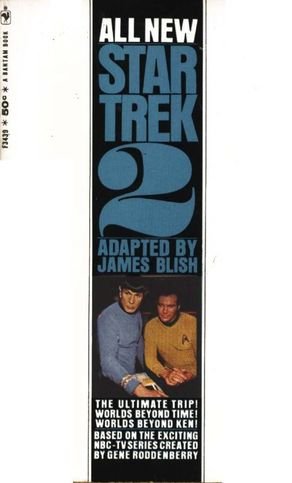
James Blish’s second book of episode adaptations was published in February 1968, just past the half-way point in the production of the show’s second season, even as all the scripts in this book are, as in the first book, from the show’s first season. As with the first book, the adaptations are moderately short, with 8 of them filling out a book of just 122 pages.

And as in the first book, Blish’s narratives follow Kirk’s point of view, so any scenes from the original scripts that dealt with other characters, when Kirk wasn’t in the room, are automatically omitted, or at best summarized in some fashion.

As with the Blish’s own writing, the publisher’s descriptions, especially on the first page inside the front cover, indicate that whoever wrote them had either never seen the show, or had not paid close attention. The inside front cover describes the three main characters: Kirk, Spock, and … Uhura! The last is described as: “Easily the most popular member of the crew, the truly ‘out-of-this-world’ female has drawn the important assignment of scan engineer on her first mission in deep space.” Scan engineer?

Once more, I’ve mentioned in previous posts concerning Blish’s Trek books that for years I’ve felt he did several of the shows some notable improvement, smoothing out infelicities of the plots and providing justification for some stories’ more outrageous gimmicks. But Cushman’s books, especially now his second book (https://www.amazon.com/Star-Trek-These-Voyages-Season/dp/0989238148/), confirm that most of the differences between the broadcast episodes and Blish’s short story version were due to Blish being send draft scripts that were not final. The best such case is one of the stories in this book. Even so, some changes were surely Blish’s own contributions, as I try to note here.

“Arena”

  • Blish jumps to the chase, so to speak, omitting nearly the entire first half of the broadcast episode that concerned the discovery of the destroyed outpost on Cestus III and the pursuit of the alien vessel. All of this is summarized in the first page of Blish’s prose. (Blish makes no attempt to rationalize how alien beings could have faked voice recordings of the outpost’s commander inviting the Enterprise crew down.)
  • After that, the dialogue and action follow the broadcast script pretty closely. Per the focus on Kirk, though, we never see that the Enterprise bridge crew gets to watch the action down on the planet.
  • One big plot difference: Blish retains a line (from an earlier version of the script, presumably), in which, as the Metron reveals himself at the end, he explains that he lied earlier – that the Metrons’ plan all along was the destroy the winner of this battle, since the winner would obviously be the greater threat to the Metrons.
  • But since Kirk refused to kill the Gorn, the Metrons were left with no clear winner. The Metron does offer, after all, to destroy the Gorn ship—and Kirk hastily explains that that’s not necessary.


“A Taste of Armageddon”

  • Blish’s version follows the script closely, though again he collapses initial scenes into a prose introduction, cutting to the introduction to Anan 7 before introducing any dialogue.
  • Minor bit: the female Yeoman in the landing party is Manning, not Tamura.
  • Presumably the script has some specific directions for how particular scenes or actors would play; in any case Blish’s own adjectives seem preternaturally precise, compared to how they came across on screen: Mea Three’s (Blish spells out all the numbers in the Eminiar names) manner is “cool, but correct”; Anan speaks about causalities “evenly.”
  • When Kirk confronts Anan Seven in the latter’s quarters, Blish omits the transparent ploy by Anan and the subsequent fist-fight between Kirk and an Eminian guard in the corridor. Blish tended to omit or gloss over action scenes, which aren’t nearly exciting in prose as perhaps they were on screen (even as they look a bit anachronistic, by TNG standards).
  • Mention is made, near the end, of the name of the head of the Vendikar High Council: Ripoma.


“Tomorrow Is Yesterday”

  • As you would expect by now, Blish omits the initial off-ship scenes of the US air base detecting the ‘UFO’ and sending up a fighter to bring it down. But he does spend a couple long paragraphs at the beginning providing some astrophysical background about the notion of “black star.”
  • In passing, Blish establishes that warp 4 is 64 times the speed of light.
  • On the one hand Blish describes the Enterprise as being in a “fixed orbit” around Earth, but on the other hand that the ship is “too low in the atmosphere to retain this altitude,” which doesn’t sound like an orbit at all. So even Blish doesn’t seem to have a reasonable understanding of orbits or how things move through space.
  • As Blish does several times in his books, he describes Uhura as a “beautiful Bantu girl,” which surely was never in any script.
  • In the scene in which Spock relates his research in the future contributions of this Air Force pilot, Cpt. John Christopher, Blish (unlike the scriptwriters) has Spock note that “There was a popular author by that name, but it was a pen name; you are not he.” He’s referring to http://www.sf-encyclopedia.com/entry/christopher_john.
  • Similarly, Blish adds a bit of background or perspective that didn’t occur to the scripters. When Scott says the engines are working, but “we’ve no place to go in this era,” Blish has him go on: “Mister Spock tells me that in the 1970s the human race was wholly confined to the Earth. Space outside the local group of stars was wholly dominated by the Vegan Tyranny, and you’ll recall what happened when we first hit them.” Fascinating.
  • And Kirk clarifies, for Christopher: “There is no such solar planet as Vulcan… Mr. Spock’s father was a native of The Vulcan, which is a planet of 40 Eridani.” 40 Eridani being a real star, only about 16 light years from the sun (https://en.wikipedia.org/wiki/40_Eridani). But no Trek episode ever established Spock’s Vulcan as being a planet of 40 Eridani. Anyway Spock warns: “If we took the Enterprise there, we would unwrite their future history too.”
  • Blish omits the entire subplot of Kirk and Sulu beaming down to retrieve Air Force evidence of the Enterprise, their capture by a policeman, and the inadvertent beaming up of yet another local.
  • As they discuss the idea of slingshotting back into the future, Blish has Kirk made an extraordinary concession: “I would rather destroy the Enterprise than the future.”
  • And as Christopher expresses distress for possibly losing his memories of this glimpse of humanity’s future, McCoy offers some advice, which at first repulses Christopher, then deeply impresses him. McCoy: “In perhaps sixty more years, or a few more, you will forget things many times more important to you than this—your wife, your children… You will forget every single thing you ever loved, and what is worse, you will not even care.” Christopher is shocked; but McCoy goes on: “I’m only trying to remind you that regardless of our achievements, we all at last go down into the dark. …I’m trying to call to your attention the things that are much more valuable to you than the fact that you’ve seen men from the future and a bucketful of gadgetry. You will have those still…” He goes on; it’s quite a passage.
  • Blish, more than once, refers to a “navigation tank” located presumably at the helm and nav station – a suggestion that a depiction of 3-dimensional space would need a 3-dimensional image, not a flat, round panel.
  • And Blish implicitly acknowledges the absurdity of the crew manually timing the beam down of Christopher as the Enterprise flings past Earth: “This was going to have to be the most split-second of all Transporter shots. No human operator could hope to bring it off; the actual shift would be under control of the computer.”
  • And Blish avoids the question of whether the Enterprise returns precisely to its own time, by not mentioning it at all, nor having the Enterprise contact star fleet command. Instead Blish ends with Spock alluding to the poet Omar, and the passage about the moving finger that, having writ, moves on.


“Errand of Mercy”

  • Follows the broadcast script very closely, though yet again Blish summarizes the set-up and initial encounter with the Klingons, with no dialogue until Kirk and Spock meet the Organian council, and Spock makes his remarks about an arrested culture.
  • Blish implies the Klingons are actually an offshoot of humanity: “The Klingons were hard-faced, hard-muscled men, originally of Oriental stock.” I suppose that might explain how they speak English.
  • Blish has Spock not only explain what trillium is (a medicinal plant of the lily family), but later mentions that the word has some other meaning to the Klingons.
  • Blish collapses the plot a bit: Kirk and Spock explode the munitions dump; Kor immediately responds by phasering 200 Organians; Kirk and Spock surrender themselves in Kor’s office. No scene in a jail cell from which Ayelborne magically releases them.
  • As Kirk and Kor talk, Kirk recalls the Spartans, warriors who nevertheless lost to Athens, known as the mother of all the arts. Kor finds the analogy “a little out of date” which again seems to imply a common background.
  • The rest follows the script very closely, all the way through Spock’s comparison to an amoeba and Kor’s final line “It would have been glorious” – but then omits the redundant final bridge scene.


“Court Martial”

  • Blish’s version of this story seems to be derived from a draft or two before the final script. Kirk’s romantic background with Areel is omitted; the key issue is whether the ship was a “double red alert” rather than just “red alert”; and Finney, at the end, doesn’t sabotage the ship, requiring Kirk’s quick work to repair it.
  • Rather, we get a better resolution of the subplot concerning Jame, Finney’s daughter. In the broadcast script we see her twice: at the very beginning, angry at Kirk for apparently killing her father; and then later, when she’s much calmer and concerned for Kirk’s well-being. She explains her change of attitude as the result of having “read through some of the papers he [her father] wrote, letters to mother and me.”
  • Blish saves those lines for later, and has Jame show up on the ship just as Kirk finds Finney in engineering, resolving that scene in an emotional, rather than violent manner.
  • This may be a case where a character-development plot was sacrificed for the sake of a fist-fight – between Kirk and Finney – an action sequence that NBC always appreciated.
  • Blish retains most of Cogley’s speech about the rights of men in the face of the machine, but omits the specific examples given in the final script: “Rights, sir. Human rights! The Bible, the Code of Hammurabi, and of Justinian, Magna Carta, the Constitution of the United States, Fundamental Declarations of the Martian Colonies, the Statues of Alpha Three.”
  • Blish does not try to rationalize what I’ve always felt were two huge flaws of this episode: how the altered video of the ship’s bridge, when it was or was not at red alert, has anything to do with changed computer logic for playing chess; and the clumsy, implausible manner of locating a missing crewman, by masking out the heartbeats of the last few others left on board.


“Operation Annihilate”

  • This is likely the best example of how very different Blish’s stories could be from the broadcast episodes – and now that we have Cushman’s books, the best verified example of how those differences were due to Blish being sent early drafts of the scripts.
  • (One wonders why the people at, where?, presumably Desilu, would not have taken care to send only final shooting scripts. My guess is that TV in the ‘60s was ephemeral, no one at the time had any idea Trek would become an eventual hit, or that it would quickly attract fans who would notice the discrepancies between Blish’s versions and the broadcast versions, and complain, as they did. In contrast, about the same time there were paperback versions of Time Tunnel and Lost in Space that had nothing to do with their show’s scripts, but with stories, only vaguely consistent with the shows they were based on, invented by their authors. For that matter, there was a Trek book like that too, by Mack Reynolds — https://www.amazon.com/Star-Trek-Horatius-Mack-Reynolds/dp/B000EX7CAO/ — but it was marketed as a kids’ book and no one cared.)
  • In Blish’s version, there’s a character named Aurelan on Deneva, but she’s not the wife of Kirk’s brother or the mother of a son; the family connection to Kirk was added late in rewriting by Gene Roddenberry.
  • More substantially the story here doesn’t end with the experimental blinding of Spock, and the deployment of UV satellites around the planet, and the silly cop-out ending of Spock not really being blind. Rather, the theorizing of the nature of the creatures leads them to conclude that they are all connected to some central core, light years away at the far end of the pattern of mass insanity described at the beginning. So the Enterprise heads off for this planet, launches two (in Blish’s words) “fully-armed planet-wreckers,” and destroys the planet, whereupon the infestation in Spock dies – and the same thing happens back on Deneva, they verify, its inhabitants fully recovering.
  • Cushman’s Season One book (https://www.amazon.com/These-Are-Voyages-TOS-Season/dp/0989238105/) describes this and other earlier drafts of the script, including the final additions by Roddenberry of the family connection and Spock’s blindness.
  • There are some nice concluding lines in Blish, presumably from the earlier script, about the nature of parasites and evolution.
  • This version was better than the broadcast version, I think.
  • Cushman’s Second Season book, pp310-312, describes the production staff’s reactions to James Blish’s first two Trek books. They were not pleased. D.C. Fontana – story editor and writer of several of Trek’s best scripts, including “This Side of Paradise” – wrote a long memo to Roddenberry, in which she complained especially about this episode, but also about the lack of action scenes at the ends of “Tomorrow Is Yesterday” and “Court Martial.” TV writers have different priorities than prose writers.
  • Roddenberry had a Desilu exec send Blish a copy of the Trek Writers’ Guide, along with an admonition not to downplay Dr. McCoy’s character, as Blish had done. (McCoy, not Uhura, should have been the third major character described inside the front cover of Blish’s second book.)


“The City on the Edge of Forever”

  • Blish has a footnote on the first page of this story, about how Ellison’s original script was drastically different than the final version, and how he, Blish, tried to “preserve what I thought were the best elements of both scripts.”
  • But in fact, Blish’s version is 90% the final broadcast version.
  • Again, Blish summarizes the opening scenes, with no dialogue until the landing party is on the planet and sees the ‘Guardian.’ But at least Blish has McCoy’s frenzy due to a defective hypo-spray – not McCoy’s uncharacteristic clumsiness at tripping as the Enterprise bumped over a ripple in time.
  • Blish describes the Guardian as “a large, octagonal mirror… Whatever it was, it gleamed, untarnished, agelessly new. A cube, also untarnished but half-buried in dust and rubble, sat beside it.”
  • In this version the Guardian explains itself as a “time portal,” and “Through me the great race which once lived here went to another age. … The past, always and only the past. And to their past, which you cannot share. I can only offer you yours. Behold—”
  • And it shows primeval images of the forming of the solar system, and life on Earth, and of primitive jungles…
  • As Kirk and Spock arrive in 1930s New York, Spock remarks, “Is this the heritage my mother’s people brag about?” And Kirk replies: “This is what it took us five hundred years to crawl up from.”
  • Blish tempers Spock’s time travel theory about eddies and currents; Spock goes on to say, “Like the solar-system analogies of atomic structure, it is more misleading than enlightening, but there may be a certain truth to it all the same.”
  • Edith Keeler’s speech at the mission is not the unlikely, mystical vision of a future about traveling into space, but an inspirational one, nonetheless, one suited to her time:
    • “Shadow and reality, my friends. That’s the secret of getting through these bad times. Know what is, and what only seems to be. Hunger is real, and so is cold. But sadness is not.
    • “And it is the sadness that will ruin you—that will kill you. Sadness and hate. We all go to bed a little hungry every night, but it is possible to find peace in sleep, knowing you have lived another day, and hurt no one doing it.”
  • To which Spock whispers to Kirk: “Bonner the Stochastic.” And Kirk replies, “He won’t be born for more than two hundreds years.”
  • The narrative proceeds, with most of the best lines retained, though per policy, the scenes of McCoy arriving are omitted.
  • Spock underscores the gravity of Kirk’s decision with a couple more lines than broadcast: “Millions will die who did not die before” and then Kirk: “Abstract millions. A different history. But Edith Keeler is here. She’s real. She deserves to live.” Spock: “And so do Scott, Uhura, and the others we left behind—or ahead. Sir, you are their Captain. They are waiting for you, in the ruined city on the edge of Forever. They, and the future that nurtured you. The choice is yours.”
  • Blish provides a final, substantial scene, that was not broadcast — he adapted it lightly from the final scene of Ellison’s original screenplay. (https://www.amazon.com/City-Edge-Forever-Harlan-Ellison/dp/1880325020/) After they’ve returned to their future, Spock comes to Kirk’s quarters, where Kirk is disconsolate. Spock: “Jim, on my world, the nights are very long. In the morning, there is the sound of silver birds against the sky. My people know there is always time enough for everything. You’ll come with me for a rest. You’ll feel comfortable there.”
  • Kirk can’t over his sacrifice of Edith. “She was negligible.”
  • Spock: “Her death saved uncounted billions of people… Far from negligible. … No woman was ever loved so much, Jim. Because no other woman was almost offered the universe for love.”


“Space Seed”

  • Again, Blish condenses the opening scenes to summary, a chief difference from the broadcast script being that Lt. Marla McGivers is a control systems specialist who happens to be a historian on the side. I always wondered why the Enterprise needed a full-time historian, as implied in the broadcast episode.
  • Better than Trek generally did, Blish makes a smart deduction from the position of an interplanetary vessel being out in interstellar space. “They must have been trying for the Tau Ceti system,” the navigator says. A star only 12 light years from Earth. So that a ‘sleeper ship’ would reach there eventually, without taking forever.
  • Blish has more background about the Eugenics Wars and those behind them, e.g. how the selective breeding was among the scientists responsible themselves; how the “sports and monsters” appeared later, the result of “spontaneous mutations erupting from all the ambient radioactivity” once the war had already started. And that Khan – Blish gives his full name as Sibahl Khan Noonien [though elsewhere throughout, Blish’s version spells it “Kahn”] – was one of those scientists’ children.
  • Per policy, Blish doesn’t include any of the scenes between Khan and McGivers.
  • During the dinner party scene, Blish has Spock challenge Khan about never being afraid. Spock asks, “And does that not frighten you?” Khan thinks this is a contradiction. Spock replies, “Not at all. It is a null class in the class of all classes not member of the given class.” Now that’s logic.
  • Blish makes the focus of the story more on the question of why Khan and his people fled Earth, with Spock trying to apply psychology to draw Khan out—if he wasn’t afraid of anything, why did he flee? The broadcast version focused more on Khan seducing McGivers.
  • Blish condenses the action scenes – omitting Kirk and Khan’s fight in engineering altogether – into one short paragraph, before commencing with the trial scene. Beginning with an answer to the question of why they fled: “To free themselves of the rabble, and start fresh.” But Spock thinks, “In my opinion they would never have succeeded, even had they made it to a habitable world. The man who cannot know fear is gravely handicapped.”
  • The trial ends with Khan and McGivers exiled to a planet – which here Kirk does not name – and Khan invoking Milton. But Blish adds a line apparently scripted but left out of the broadcast version. After Spock says it would be interesting to return in 100 years, “to learn what crop has sprung from the seed you planted today,” Kirk replies: “I only hope than in a hundred years, that crop won’t have sprung right out of the ground come out looking for us.”
  • A last line that inspired the second Trek film.

(All these posts turn out much longer than I’d thought they’d be.)

Posted in Star Trek | Comments Off on Worlds Beyond Time! Worlds Beyond Ken!: Star Trek 2, by James Blish

Notes on Trek music, Season One

The essence of Star Trek’s music was that it was composed of many themes that recurred across many episodes throughout the series, sometimes in variation, sometimes not, in ways that made the series’ music a sort of extended symphony-cycle of recurring leitmotifs, rather than a set of themes tied to particular episodes, the way film scores are. The themes ranged from grandiose action-adventure music, to questing nautically-flavored tunes, to eerie and colorful music suited for the adventures of the Enterprise on strange planets and meeting new civilizations.

Ironically, this effect of a broad set of themes that unified two and half dozen episodes – considering in this post only Trek TOS’s first season – was created not by some grand master plan to unify the show in this way, but inadvertently as a consequence of musician union rules at the time. Those rules required a TV series like Trek to spend a certain number of hours in a studio recording music for each season’s shows, but otherwise allowed the show’s producers to reuse that music as often as they liked, at least within the same season.

Thus, original music was written only for a minority of episodes, generally episodes produced early in the season. Later episodes reused or ‘tracked’ the earlier music as appropriate, no matter which composer had originally written each track, or for which episode. It was up to the show’s music editor to compile a ‘library’ of tracks from the original scores, and then to select from this library appropriate music for later episodes, scene by scene. Individual tracks in this library were often quite short, some only a few seconds long; dozens of such tracks would be strung together to fill out the score for a ‘tracked’ episode.
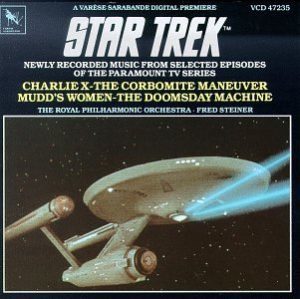
There have been selected releases of Trek scores for decades, beginning in the late 1980s, when Varese Sarabande released, initially on LP, two discs of newly recorded music from a total of eight episodes. You can tell that the music is from the original scores — rather than arranged suites, say — and the music was performed by the Royal Philharmonic Orchestra, under the direction of Fred Steiner, one of Trek’s key composers, the single most prolific composer by episode count, in fact. The first album (https://www.amazon.com/Star-Trek-Recorded-Paramount-Corbomite/dp/B00000153T/) included Steiner’s own music for “Charlie X,” “The Corbomite Maneuver,” and “Mudd’s Women,” plus Sol Kaplan’s music for “The Doomsday Machine”; the second, Steiner’s music for “By Any Other Name” and “Mirror, Mirror,” Jerry Fielding’s for “The Trouble with Tribbles,” and George Duning’s for “The Empath.” Steiner, in these re-recordings, takes his time with music originally written to fit carefully edited and timed scenes; e.g. in “The Corbomite Maneuver,” the “Baby Balok” theme is noticeably slower than in the original soundtrack, as is the big statement of the main “Fesarius” theme. In these recordings Steiner lingers over themes in ways that are often effective, but sometimes distracting considering what we remember and have listened to over and over again for decades.

Then in the early ‘90s Crescendo released three albums of remastered original soundtrack music. Each album contained scores from two episodes: the two pilots on the first, “The Doomsday Machine” (the full score, not the under 6-minute selections on the Fred Steiner album) and Gerald Fried’s “Amok Time” on the second; Fried’s “Shore Leave” and Alexander Courage’s “The Naked Time” on the third.
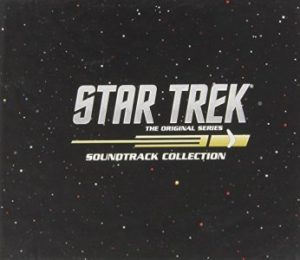
With my recent ambition to rewatch the series, I recalled the ambitious soundtrack set of Trek music issued of La-La Land Records a year or so ago– http://www.lalalandrecords.com/Site/STTOS.html. This is the ultimate soundtrack collection, a gathering of every track recorded for the show, even some that weren’t used, with annotations that include the exact dates upon which each set of tracks was recorded. It’s a boxed set of three fold-open plastic cases holding a total of 15 CDs. It’s not cheap — $225 – but I sprung for it, and it’s finally enabled me to appreciate not only which music was written originally for which episodes, but how that music developed and built on earlier scores by the entire set of Trek composers. And so for this consideration of Trek’s music, I’m focusing on this primary set of original recordings, not on the later re-recordings by Fred Steiner, or the earlier Crescendo soundtrack releases.

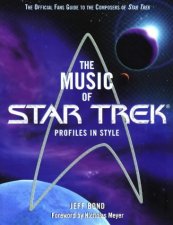
The liner notes for the La-La Lands CD set are by Jeff Bond, who published a book back in 1999, The Music of Star Trek (https://www.amazon.com/Music-Star-Trek-Jeff-Bond/dp/1580650120/), that covered TOS (The Original Series), several of the movies, and three of the later series to a lesser extent. So I tracked down that book also and bought a copy.
To go into further detail, as explained in Bond’s book: the reason producers could get away with generating only a certain amount of music, and then reusing that music in later episodes, is because that was allowed by musician’s union rules at the time. Bond gives some detail via an article by Fred Steiner (pp34-35 in his book). Rules at the time required a one-hour dramatic show of, say, 26 episodes over a year, to spend at least 39 hours in the studio recording music. Further, a typical episode score might run anywhere from 10 to 30 minutes, but a single scoring session could record only some 4 or 5 minutes of music per hour in the studio. Arithmetic leads to the conclusion that such a series would need to fully score only eight episodes. Trek’s first season had 29 episodes, and scored 13 of them, though several only with shorter “partial” scores.

All that changed in the early 1980s, when union rules changed to prohibit such reuse, requiring new music for every single episode. Thus Trek Next Generation has a unique score for every episode.

One twist of the original 1960s-era rules was that music could not be reused from one season to the next, unless the music was re-recorded (so musicians would be re-paid). That’s why, for example, the main Trek theme over the show’s opening credits sounds a little different from season to season. (I noticed this effect at the time, or at least in the ‘70s, when long-running TV shows would have essentially the same theme music from year to year, but you could tell that the themes weren’t exactly the same – there were often slight changes in instrumentation, or intonation, or phrasing. I noticed that especially about Hawaii Five-O back in the ‘70s when I watched that show regularly, and its iconic main theme was slightly different from year to year.) And Trek did that too, thus preserving some of Alexander Courage’s and Fred Steiner’s earliest themes all the way through the show’s second and third seasons.

In each of Trek’s three seasons, therefore, the majority of scored episodes came at the beginning, until enough music had accumulated to constitute a library of tracks for reuse that season. There was an irony about writing music to be suitable for a particular episode, while being generic enough to be re-usable; a theme too specific to a situation might perhaps never be used again. An example might be Riley’s jig in “The Naked Time.”

Another technical bit: almost every episode has a “music by” credit in the end credits, to a single composer, often Alexander Courage, since so many of the show’s earliest themes were by him. Even the episodes without original scores had “music by” credits. So what did that credit mean? It meant that, for a ‘tracked’ episode, the music editors would have compiled an elaborate tracking sheet, listing the length in seconds of each track and who composed it (Courage, Steiner, Kaplan, etc.), and then whichever composer was responsible for the majority of the music tracked when the episode was done, even if only by the slimmest margin, e.g. 51%, was awarded the “music by” credit at the end. You can understand how most of those credits were misleading, because all of the tracked episodes actually contained music by several composers.

Here’s a list of the originally-scored first season episodes, with composers, where the numbers indicate production order. Episodes not listed were ‘tracked’ from the scores for these 13. (There were also a few miscellaneous separate ‘library music’ tracks done by a couple composers, rescoring other composers’ themes or scoring original mood bits for generic use, recorded as time permitted during sessions when original scores were recorded. They are included as a separate group on the La-La Land Records CD set.)

#0, The Cage (Alexander Courage) [pilot #1]
#1, Where No Man Has Gone Before (Courage) [pilot #2]
#2, The Corbomite Maneuver (Fred Steiner)
#3, Mudd’s Women (Fred Steiner)
#4, The Enemy Within (Sol Kaplan)
#5, The Man Trap (Alexander Courage)
#6, The Naked Time (Alexander Courage)
#7, Charlie X (Fred Steiner)
#8, Balance of Terror (Fred Steiner)
#9, What Are Little Girls Made Of? (Fred Steiner)
#12, The Conscience of the King (Joseph Mullendore)
#17, Shore Leave (Gerald Fried)
#28, The City on the Edge of Forever (Fred Steiner)

Note first of all that the shows were not aired in production order; e.g. “The Man Trap,” the fourth episode in regular production (after the two pilots), was the first ever Trek episode broadcast, in September 1966. To further complicate matters, however, the scores for these episodes were not composed in the order of the filmed production. That’s because the scoring was often one of the last things done during the post-production (i.e. after filming) of any episode; ideally, the composer would work from a nearly-finished show, completely edited and with special effects added in. But some episodes took much longer to get through post-production than others. “The Corbomite Maneuver,” for example, had heavy FX (special effects) of the alien spaceships, and took so long to complete that it was the 10th episode broadcast, not the 2nd.

The La-La Land CD set arranges the episodes more or less, but not exactly, in broadcast order – the order is altered a bit to fit on the CDs without splitting any one episode across discs.

But to appreciate which music was written originally for which episode, and to see how themes were reused or redeveloped by later composers, you need to listen to the scores in order of their recording (which even then doesn’t necessarily reflect the order of composition!) of that music. Fortunately, this La-La Land CD set has extensive booklet notes, listing track names and timings, names of performers at each recording session – and the exact date of each recording session. (Notable because in one case, relatively short scores for three separate episodes were recorded on the same day!) (Cushman’s books, too, as they nail down exact dates of every script draft and of filming and post-production, notes dates when original scores were recorded for episodes that got them.)

My notes here list the episodes in that recording order, with those dates noted in bold. As I go through these scores, I’ll give notable themes, especially those I know will recur, name tags for future reference, in bold. I should note that the scoring sheets and CD track listings use rather informal names or descriptions, some rather irreverent (e.g. “Zap Janice” for when Charlie makes Janice disappear, in “Charlie X”). I’ll try to use slightly more formal names.

“The Cage”, by Alexander Courage

  • This first pilot for the series was filmed from 27 Nov 1964 to 18 Dec 1964. Production dates in these notes are taken from Marc Cushman’s book; scoring dates and times are taken from the booklet liner notes for the La-La Land Records CD set. The series did not sell on the basis of this pilot, and the pilot was never broadcast in its original form (it was cannibalized mid-first season as background events for the two-part episode “The Menagerie”).
  • Music for this episode was recorded 21 Jan 1965; total time of the music score: 32:01.
  • This episode’s score debuts what would become Trek’s signature theme, known world-round: the initial sonar-like ‘pings’, the Enterprise ‘fanfare’ flyby on trombone, and then the soaring melody of the main theme with wordless soprano vocals. That melody was based, the notes tell us, somewhat on the old song “Beyond the Blue Horizon”. (This opening in this episode did not yet include Captain Kirk’s narration “Space: the final frontier”, etc.)
  • There are two signature themes of this episode. The first is the so-called “Vina’s theme“, a slow sultry vocal– one two, threefourfive one two, … heard in several variations — including as the basis for the famous green Vina’s dance. It was used again and again, throughout the first season, in situations with the exotic or the alien.
  • The second: the twangy electronic cues when we see the alien Talosians. Let’s call this the Talosian Twang. Very distinctive, it was used sparingly in later episodes.
  • There are other memorable tracks – the calm picnic scene music; bombastic music for Pike’s fight with the barbarian giant; the searing music in the scene when Pike is subject to illusory flames – that were also occasionally used in later episodes.

“Where No Man Has Gone Before”, by Alexander Courage

  • The episode was filmed 19 – 29 July, 1965. Music was recorded 29 Nov 1965; the show aired 22 Sep 1966. This was the second pilot, produced as a one-off and eventually broadcast as the third episode in the show’s first season. Total time: 27:58.
  • In the recording on this CD set, we have the score as originally composed and recorded – and this original version had a different main theme, different than the iconic “main theme” heard in “The Cage” and throughout the regular series. This was an aggressive four note motif stated once then repeated double-time, the pair then repeated a step up, and was scored for both the opening and closing credits. Courage used variations of this theme in other modes throughout the episode, and in fact you can hear a slow, probing version of this theme in the opening moments of the episode as broadcast.
  • The remainder of the score originally composed was retained for the broadcast version, which used the series’ “main theme” for opening and closing to match all the other broadcast episodes.
  • Courage reused this four-note motif in his later original scores, and it was often tracked; I’m dubbing it the NoMan theme for later reference. The aggressive version of this theme survives in several places in the show as broadcast, and in DVD sets: at the very end of the teaser, and again at the very end of Act IV.
  • Speaking of reuse, “Vina’s Theme” from “The Cage” turns up in this score, in track 23 of the CD (not sure which scene this was).
  • The second new theme in this episode is a rising, questing five-note theme, also heard near the beginning of the teaser and again throughout the episode. The liner notes of the CD set, and Cushman’s book, suggest that this was Courage’s attempt to establish a theme particular for Captain Kirk, and again he reused it in his later scores. So we’ll call this the “Captain’s theme.” It was occasionally used in later episodes as a low-key final send-off.
  • And the third prominent theme is heard as the Enterprise approaches and enters the ‘barrier’ at the ‘edge’ of the galaxy, a gradually building, searing collage of brass and electronic tones. Dub this the “barrier theme.”

“The Man Trap”, by Alexander Courage

  • Episode filmed 22-30 June 1966, score recorded 19 Aug 1966; the show aired 8 Sep 1966. This more typical interval – three weeks between recording of score and broadcast of episode – illustrates how scoring an episode is almost the last thing done before broadcast. Including main titles theme, total music is 35:20, for a broadcast show about 50 minutes long.
  • The version of the main title is the ‘electric violin version’ used in the initial batch of broadcast episodes. The electric violin plays heavy in the episode’s eerie score.
  • The episode’s slow, eerie score serves well to establish the strange other-worldliness of this alien planet — especially, I think, considering this was the first broadcast episode, Trek’s debut to the world. Note Courage’s “Captain’s theme” is woven into the score, early on. Especially distinctive are passages of eerie organ music, as the alien invader, in the guise of one crewman or another, wanders around the corridors of the Enterprise; other passages using an electric violin; and the mournful two-note French horn theme that opens the episode – one that appears often enough in later episodes that I’ll dub it the Man Trap moan.
  • Roddenberry reportedly hated the score — he wanted more aggressive, swashbuckling music, like Horatio Hornblower naval battle music, for his show – but the music turned out to be very effective here and in a number of later episodes, as low-key underscore for scenes of mystery.
  • Note there’s lots of winds and brass, and an organ, and an electric violin but otherwise no string section – an orchestration ploy to keep down the number of musicians needing to be hired for this particular recording session. The booklet that comes with the La-La Lands Records soundtrack collection lists, for each recording session, all the players and all the instruments! Not counting the manager or the copyists, there were 24 musicians performing this score.

“Charlie X”, by Fred Steiner

  • Episode filmed 11-19 July 1966; score recorded 29 August 1966; episode broadcast 15 Sept 1966.
  • Opening music is “Captain’s theme” segueing into the two-note horn theme from “Man Trap” – that is, here is Fred Steiner reusing established motifs from Alexander Courage. (Though this was Steiner’s first recorded score, Jeff Bond’s book implies Steiner composed the score for “Mudd’s Women” first.) This episode has an arranged version of the main theme, by Steiner, with cello playing the theme instead of the soprano voice. This leads to a new theme, an inversion of the two-note “Man Trap” theme – a two notes rising in menacing mystery.
  • Act I opens with a new Enterprise fanfare – call this Enterprise fanfare #2 – by Steiner, an eight note nautical-sounding theme that initially descends, almost as an inverse of the more familiar fanfare by Courage. The eight note theme repeats an interval up.
  • The third track includes an up-and-down-scale harp music, under a plaintive oboe, that was often used for no-dialogue scenes of a character looking around in wonder. Here it debuts as Charlie wanders around the deck of the Enterprise, watching crewmen go about their work. Call this Charlie’s wonder music. A similar but slower harp theme appears in track 4, heard as Charlie performs card tricks; instead of an oboe we get tense triplets on a muted trumpet. Call this the tense wonder music, where the wonder is undercut by a suspicion of some threat or danger. This track also has the harsh, trilling french horn ‘zap’ chord that we hear every time Charlie performs a trick – a short motif used many times in later episodes.
  • Track 9 covers the scene in which Kirk has Charlie wrestle a crewman named Sam; Charlie is awkward, Sam chuckles, Charlie is offended and makes Sam disappear. Kirk witnesses this and for the first time realizes what a danger Charlie is – and we hear a strong, determined yet subdued (as if Kirk is struggling to maintain control and not overreact) theme in brass that came to be played many times at moments of grim confrontation. Call this Kirk’s menace theme. Its first three notes, actually, are very similar if not identical to the first three notes of Steiner’s fanfare #2. We hear this again the standoff scene at the opening of Act 3, as it segues into fanfare #2.
  • The appearance of the alien Thasian at the end is underplayed to mysterious effect, punctuated a couple times by an ominous chime, before the music rises up as the alien – and Charlie – disappear. This transitions to a closing as the show began: “Captain’s theme”, the two-note horn theme from “Man Trap”, then Captain’s theme in a more victorious mode.

“The Naked Time”, by Alexander Courage

  • Filmed 30 Jun – 11 July 1966; score recorded 31 August 1966; episode broadcast 29 Sept 1966. Score 33:42 long, not including a track on the CD for the trailer of the next episode.
  • Music begins with the traditional Enterprise fanfare #1.
  • The distinctive elements here are the character-keyed themes for Riley and Sulu; the former, a subdued Irish theme as Riley wanders the halls; the latter, a series of fanfares as Sulu brandishes his sword. (Riley’s vocal rendition of “I’ll Take You Home Again, Kathleen” is not part of the soundtrack music on the CD.)
  • At the same time Courage reuses key themes from his earlier episodes. The episode draws to a climax with tracks of variations of “Captain’s Theme” in a manner that sounds both noble and foretelling possible doom – a terrific underscore that dramatizes the uncertainty and danger the Enterprise is in. These transition to the alternate Courage title music, the “NoMan theme”, in increasingly strident tones for the scene when the Enterprise breaks away from the planet – and finds itself plunging back in time – and for this scene there’s a unique theme for this episode, a Glassian arpeggio underlying a bold three-note brass theme, call it the time travel theme… both gradually slowing down as the time effect ends…. Smoothing out to a somber return of the Enterprise fanfare, then repeated twice in relieved triumph. (This music was used later as the Organians transitioned to their energy being true forms, in “Errand of Mercy.”)

“Mudd’s Women”, by Fred Steiner

  • Recorded 7 Sep 1966; episode broadcast 13 Oct 1966. Length, 22:01.
  • Appropriately this opens with Steiner’s Enterprise fanfare #2, followed by a variation of “Kirk’s Menace,” both from “Charlie X” (or reused in “Charlie X” perhaps, depending on which was scored first).
  • Steiner gives Harry Mudd a jolly, swashbuckling theme that’s cute, but not, so far as I have noticed, ever used again in any later episode.
  • As the women appear we hear the first hints of the episode’s main themes – first, call it the Mudd’s women theme, three rising pairs and one falling pair being the principle. Heard only partially at first, it becomes quite lush in full blossom, and the instrumentation changes many times throughout the score, becoming low and ominous on a bassoon (or bass clarinet?) in a scene where the effect of the Venus drug is wearing off. (This version was used later, e.g. as Kirk and Sulu wander the corridors of the air force base in “Tomorrow Is Yesterday.”)
  • A secondary, complementary theme is highlighted in track 23, and is heard most famously late in the episode as Eve takes the Venus drug (or thinks she does) and seems to recover her glamour.
  • Later a swanky version of the first theme is called, on the CD, “space radio” and appears in the scene on the planet where the three miners try to get to know the women. The secondary theme is worked in here too.
  • And as the Enterprise orbits the planet, there’s a descending fanfare theme on brass that suggests the trauma of the ship running out of power; and a complementary theme with xylophone pulses for emphasis. (The xylophone pulses, a distinctive motif of this episode, appear at the opening of Act I also.)
  • An especially striking moment is the plaintive theme played in the scene in which Eve gets tired cooking for Ben, wearily, as if all hope is lost. This segues to the low/ominous version of the MW theme, the transitional rising flute theme as the pill is taken, then a brief rapturous passage as Eve’s beauty is, apparently, restored.
  • After a humorous bit for the banter between Kirk and Mudd, we end with Captain’s theme and Man Trap moan.

“The Enemy Within”, by Sol Kaplan

  • Recorded 14 Sep 1966. Episode broadcast Oct. 6th. A fairly long score, at 22:58.
  • Opens with a glittery version of standard fanfare, with piccolo figures swirling around the familiar theme. This became, I’m guessing, the most often used version of the theme.
  • The key theme here is the Evil Kirk theme, a strong descending three-plus-one-note piano motif when Kirk’s evil double appears. Bond notes that the three descending notes are an inversion of the first three notes of the standard fanfare – as if to suggest Kirk has been turned inside out.
  • A second key theme comes in the scene in which Kirk tries to seduce, and rape, Yeoman Rand – about two minutes into track 5, on the CD, a driving theme over a pulsing underbeat that becomes increasingly menacing. This theme would be reused in later episodes for similar moments of mounting danger. It appears here a bit later in a scene in which the two Kirks confront one another.
  • Later, in scenes in which the ‘good’ but indecisive Kirk can’t decide what to do, we get a plaintive, cello solo version of the pulsing rape theme.
  • The music for the “Two Into One” scene in which the two Kirks reunite has a few moments that foreshadow the only other Trek score that Sol Kaplan would write – that for 2nd season’s “The Doomsday Machine.”

“The Corbomite Maneuver”, by Fred Steiner

  • Recorded, along with the next two scores, all on one day: 20 Sep 1966. This episode was broadcast Nov. 10th.
  • These three are ‘partial’ scores, this one only 7:11.
  • First principle theme: a whirling aggitato for the alien space cube, overlaid by blaring brass. This is the Corbomite cube music. (This would be reused several times, e.g. as Captain Christopher aims his jet fighter toward the UFO in “Tomorrow Is Yesterday,” and even over a scene of riotous “festival” in “The Return of the Archons.”)
  • Second principle theme: a four+four rising theme of menace, repeated and gradually leading to a ladder-climbing ascendant as the mother ship appears. This is the main Corbomite theme or Fesarius theme, usually heard with xylophone ostinato.
  • Then there’s a variant of the second theme, as it extends to a five+four pattern.
  • Later there’s a mysterioso variant of the Fesarius theme, slower and on organ(?), as we see the puppet Balok. This short segment was often heard in later episodes for moments of exotic mystery. (Used when we see the Guardian of Forever, in “The City on the Edge of Forever,” for instance.)
  • And finally we get a delicate variant of the Fesarius theme (perhaps on oboe and xylophone), as we see the real, childlike Balok. Another short segment used later for moments of childlike wonder.

“Balance of Terror”, by Fred Steiner

  • Recorded 20 Sep 1966. Episode broadcast Dec. 15th. Time: 5:35.
  • Just one principle theme here, we’ll call it the Romulan theme, played in so many variations it fills the entire episode out of just four minutes or so of recorded music (not counting the chapel music at the beginning). It’s a seven-note sawblade theme played in a rising variation with a menacing tone for shots of the Romulan ship; or played in a descending, more contemplative mood for scenes of the Romulan commander doubting the wisdom of his orders. But there are several other variants of these: the rising theme quieter; the descending theme brassy and arrogant.
  • Versions of this theme were used in later episodes, perhaps unfortunately, since the theme’s identification with the Romulans is so strong here.

“What Are Little Girls Made Of?”, by Fred Steiner

  • Recorded 20 Sep 1966. Episode broadcast Oct. 20th.
  • About 7:15, not counting a version of the end title.
  • The principle new theme here, Ruk’s theme, features big kettle-drums underneath menacing chords as we first see the giant android Ruk, and later as he pursues Kirk through the caverns. One version of this, in particular, that begins with a stinger chord, was used many times in later episodes for scenes of imminent danger or fighting (e.g. in “Arena”).
  • The second theme is a romantic one underscoring the female android Andrea, in lush cellos with piano counterpoint.
  • There’s a bit of the “Kirk’s menace” here too.

“The Conscience of the King”, by Joseph Mullendore

  • Recorded 2 Nov 1966. The episode aired Dec. 8th. Time: 28:51.
  • The striking theme here is the mock-period music that underscores the performance of Macbeth, in the first scenes of the teaser. It’s set in winds, then a harp, then strings. On the CD it’s called “Go for Baroque”. I had thought this music – my favorite thing about this episode — was so distinctive that it might not have ever been reused, but it was, at least once: in “Shore Leave,” during the moments when Yeoman Barrows realizes, after an attack by Don Juan, she had just been thinking about such an old-style romantic hero.
  • This was Mullendore’s only score for the series, and the music sounds like some alternate dimension version of Trek, where people stand around cocktail parties (as they do here), and the music matches. We even get swanky, lounge-music versions of the Enterprise fanfare! (Despite the discordancy of some of these tracks, they were reused in at least one later episode, “Court Martial.”)
  • This episode has its own love theme, “Lenore,” which I confess has always sounded to me like the ‘60s Tony Bennett hit, “Who Can I Turn To?” I didn’t notice this theme, unlike Gerald Fried’s “Ruth’s Theme” in the next episode here, reused in any later episode.
  • In contrast to the lounge music, there are several spare, low-key cues for dramatic scenes – e.g. Kirk’s confrontation with Kodos in the latter’s quarters, and Lenore’s revelations and breakdowns at the end, with a counter-intuitive but quite effective solo harp theme.
  • This composer also did a couple notable library cues (see below).

“Shore Leave”, by Gerald Fried

  • Recorded 2 Dec 1966. The episode aired Dec. 29th. Time: 20:34.
  • This is Gerald Fried’s first Trek score; later he would do spectacular and memorable scores for “Amok Time” and “The Paradise Syndrome.” His style is very different from the technical (almost Beethoven-esque) Steiner, who can wring an entire score out of a single seven note theme; Fried, more Tchaikovsky-like, is profligate with memorable themes, even if they don’t fit together in any way, as in this score, which suits a story with a bunch of random incidents that are cute and memorable, but that don’t relate to one another in any necessary way.
  • Opening theme: a playful five-note, broad musical turn, on woodwinds: “new planet”, initially calm. This segues into bouncy ‘rabbit music’.
  • Second theme: the bouncy, then energetic Irish-tinged Finnegan’s theme. This returns several times throughout the show, every time we see Finnegan, including the extended five-minute fistfight sequence between Finnegan and Kirk, bridging a commercial break.
  • Third theme: the tender, very simple, Ruth’s theme, on flute. This music becomes more interesting, more plaintive, as violins take over for a long bridging passage (largely played underneath dialogue), that seems to plead for understanding of how this person, Ruth, could possibly be here. Then the flutes return to restate the opening theme. (This theme was reused as the principal romantic theme in “This Side of Paradise.”)
  • Fourth theme: a joyous ‘old English’ theme as Yeoman Barrows discovers a beautiful gown; this is on the same notes as the “new planet” theme, but here on strings, and differently phrased. (So there is some relation between the themes…)
  • Then we get, in quick succession, a jungle theme with bongos for sightings of a tiger; an oriental theme with gongs for sightings of a samurai; and a fanfare theme for a jousting knight, on brass, a theme with some relation to ‘old English’ (similar intervals). This last theme transforms ominously to a scene finale as McCoy has apparently be killed. Later there’s a very brief, swanky lounge music passage, for the appearance of the two ‘ladies’ who accompany Dr. McCoy.
  • Note about the broadcast episode: it tracks the “Baroque” theme from “The Conscience of the King,” in the scene where Yeoman Barrows is realizing she had been fantasizing about Don Juan. I’d thought perhaps that theme was so distinctive to be unlike any other Trek situation, it would never be heard again! But the point is – even episodes with largely original scores, would occasional track music from earlier episodes. (As in next episode.)

“The City on the Edge of Forever”, by Fred Steiner

  • Recorded 24 Mar 1967. The episode aired April 6th, just two weeks later!
  • Aside from the main theme, the score is only 9:46 – and two tracks, totaling about 3 minutes, intended to establish New York in 1930, and Edith’s character, were not used! Bond’s CD liner notes identifies associate producer Bob Justman as making the decision to used tracked music in these early scenes instead.
  • And another minute and a half, on the CD, is the period song “Goodnight, Sweetheart.” So only about 5 minutes of Steiner’s original 8-minute score made it to the screen. (The producers atypically commissioned an original score for this very-late in the season episode, because they knew this was turning out to be a very special episode, and decided that it needed distinctive music. Which made it ironic that parts of Steiner’s original score went unused.)
  • What survived includes some variations on “Goodnight, Sweetheart”; some slow, vaguely ominous underscore as Edith wonders about Kirk and Spock; and, most recognizably, the climactic musical sting as the traffic accident occurs and Kirk stops himself from saving Edith, a track that quickly calms into sad, tragic echoes of the episode’s signature period song.
  • None of these tracks were reused in any later episode.

Library Music

  • The last CD in the Season 1 set includes 41 tracks, totaling about 25 minutes, of “library music,” consisting of some original themes by Joseph Mullendore, and some variants of themes from earlier scores, all these composed by Fred Steiner to give music editors more latitude in fitting tracks to scenes in future episodes. The disk also has source music used in “The Squire of Gothos,” another version of “Vina’s Dance” from “The Cage”, and then a bunch of sounds effects – the transporter effect, etc., some unused, and some outtakes of the main theme, totaling another 15 or 20 minutes.
  • There are two prominent library tracks by Joseph Mullendore. One, “Impension,” scores the first phrase from the main theme in brass, over a snare drum; it was used in “Shore Leave” as Kirk and the others run toward gunshots.
  • The second, “Lonely to Dramatic,” begins with quiet variations on the main theme, and then – beginning about :45 in – changes to a sequence of ominously pulsing brass, switching then to a swelling viola line — again, a variation of Alexander Courage’s main theme — that climbs, descends, climbs higher, then descends, then climbs even higher, and seems to sustain – before crashing back down. Just that latter portion of the track was used many times, notably in “Miri” when Kirk first finds the girl inside the closet, and during two key scenes in “Space Seed” as Khan subdues Marla McGivers.
  • And there’s a light-hearted “Humoresque,” by music director Wilbur Hatch, which would be used in “The City on the Edge of Forever” as Kirk and Spock steal clothes… in place of an original track written by Fred Steiner, that went unused.
Posted in Star Trek | Comments Off on Notes on Trek music, Season One