I Have Taken My Form Centuries Ago: TOS “Charlie X”

The Enterprise picks up a human orphan who’s grown up supposedly alone on an alien planet.
  • The enhanced graphics, which in an episode like this matter only in scenes of ships rendezvousing or sailing through space, show a more detailed Enterprise, but especially in the first scene, with Enterprise and Antares, they look obviously CGI, a bit artificially phony compared with the relative solidity of seeing models.
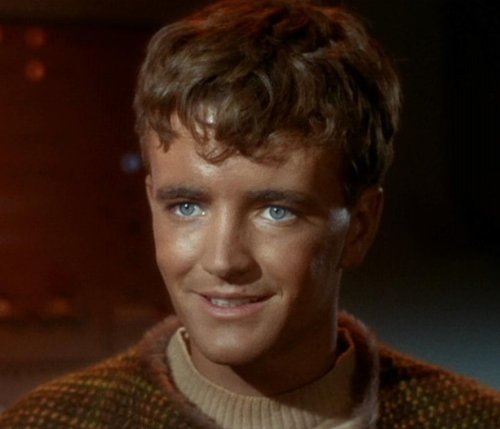
  • Interesting how the main guest character here has a telling tic, as in “The Man Trap,”  where Nancy or her other guises were constantly chewing on their knuckle – here Charlie, when provoked, rolls his eyes up into his head as he makes someone go away, or breaks Spock’s legs. These things might have been in the script, but sometimes they were inspired directorial suggestions.
  • Here we establish that each ship has a distinctive emblem patch sewn onto its crews’ uniforms.
  • Charlie is a classic awkward adolescent, but some of his behavior strikes autistic chords – he interrupts, he has no social skills, he frets about being liked. “I tried to make them like me!”
  • Trek physics: the ‘roar’ of the ship as it passes the POV, even in deep space.
  • As in other early episodes, there nice scenes of everyday crewmen busy about the ship, including a scene (with up and down scale harp music; music in this episode by Fred Steiner) as Charlie watches a technician guiding a plastic pipe downward through a hatch in the floor. And later, a key scene in which Spock, Uhura, and numerous random crewmen hang out in a rec room, with Spock playing his oddly-shaped harp, and Uhura singing, until Charlie interrupts and demands attention.
  • And later: a scene set in a gym, with random crewmen doing calisthenics in the background. We never see this gym again, in the entire series.
  • Set design: The astronomical photos mounted on the upper walls around the bridge are curious. They’re cool but pointless, like the huge galactic photo on the wall of Alpha Control at the very beginning of Lost in Space.
  • Set design: it’s been noted how much the set design benefited from lighting – especially in the corridors and rooms of the Enterprise, how colored lights gave the same sets different looks for different scenes.
  • Kirk isn’t actually particularly good at explaining awkward adolescent things to Charlie.
  • Tech anachronism, perhaps: in this episode we have Kirk instructing a chef to use meatloaf to simulate turkey for “Earth day’s Thanksgiving”, while later in the show (especially by Next Gen), virtually any food or drink can be manufactured with a push of a button, or voice command.
    • Of course he means the United States’ Thanksgiving, and it’s a parochial, nationalistic assumption in TOS that specifically American values will prevail, some 300 years from now. (Another example was how the list of potential starship names, as given in The Making of Star Trek (p164), includes Lexington and Yorktown, significant names in American history no doubt but hardly likely to be so in the world history of 300 years from now.)
  • I have a “Nitpicker’s Guide” book about TOS that points out continuity errors, and I’m trying not to look at it — but I noticed a huge continuity error while watching this evening. After Kirk tries to explain something to Charlie, Kirk is summoned to the bridge, and Charlie follows. Before leaving, Kirk is wearing his gold shirt. When they reach the bridge, he’s wearing his green lounge shirt.
  • Mention in captain’s log of “UESPA”, pronounced “you-spa”, which is never mentioned again.
  • Charlie’s awkward devotion to Yeoman Janice Rand: “If I had the whole universe, I’d give it to you.”
  • Trek physics: how the stars *stream by* as the Enterprise is underway to a new destination. Think about this: suppose the average distance between stars, in our area of the galaxy (not the galactic core) is roughly 4 light years, as our sun is from Alpha Centauri. When the Enterprise travels at warp 1, the speed of light [though I think the relationship between warp speeds and multiples of the speed of light is never specified in the show itself, but was extrapolated in various concordances and commentaries], it would take *four years* to travel from one star to the average next. At warp 10, 1000 times the speed of light [by those extrapolations], it would still take…. 1.5 days to travel from one star to the average next. So how fast would the Enterprise need to move for the stars to be visibly streaming past the camera?? It doesn’t bear close examination. But it makes for subjectively comfortable visuals.
  • Striking scenes from when I first saw this episode at age 11: Charlie turning a woman (a young woman, as is invariably referred to as a “girl” in this series) into an iguana. Another young woman he turns into a very old woman, who is horrified when she realizes her condition. And finally – as Charlie shuts down a raucous rec room, a victim, another woman, stumbles into the corridor *with no face at all*, just a featureless mask.
  • This story is tragic and has a sad ending. Charlie survived for 14 years on a desolate planet by being given special powers by the native Thasians – and now he can’t not use them, to qualm his adolescent fears and rejections, to strike back at those who offend or make fun of him. The Thasians come to take him back, and restore most of his damage. He pleads with his fellow humans. “I can’t even touch them! I want to stay….!”
  • Kirk, to give him credit, tries to negotiate.
  • Mysterious line: the Thasian appears on the bridge and says, “I have taken my form centuries ago so that I may communicate with you.” What does this mean? Centuries ago? No explanation – but its intriguing implications were the kind of thing that thrilled me about this show, more than its surface adventure. A sense of wonder moment, a momentary glimpse at something barely understandable.
  • Ending here also muted. Janice, having reappeared on the bridge (in the nightgown she was wearing when Charlie made her disappear from her quarters), weeps subtlety, stepping up to the comfort of the captain’s chair. Kirk comforts her: “It’s all over now.”
  • This was the first story adaptation by James Blish in his very first Star Trek book. He titled the story “Charlie’s Law”, and he ended it by emphasizing Janice’s anguish:

The boy and the Thasian vanished, in utter silence. The only remaining sound was the dim, multifarious humming surround of the Enterprise.

And the sound of Janice Rand weeping, as a woman weeps for a lost son.

  • After browsing Memory Alpha today – it seems to be the ultimate compendium for story details and production background of every Trek series and film that has ever existed – I should stand corrected on my comment two posts ago that Blish apparently improved on many of the scripts he turned into short story narratives. He was working from early versions of scripts – literally, early typewritten drafts the studio didn’t need any more and mailed to him – and so plot differences from broadcast episodes were at least in part for that reason. Thus, in his version of “The Man Trap”, which he called “The Unreal McCoy”, the characters were named Bierce, not Crater, and the planet was Regulus VIII, not M-113. Still, I should reread Blish’s versions, and follow Memory Alpha’s notes, and try to figure out why I thought Blish’s versions were sometimes superior to the broadcast episodes.

Blish’s adaptation, in ST1:

  • First, Blish renames the story “Charlie’s Law”, as in, be nice to Charlie or else.
  • As was common in these early books, Blish summarizes scenes as often as he transcribes all the dialogue from some scenes.
  • The story explicitly states that Kirk is fond of Rand – a point of possibility that, the producers of the show realized, led to Rand’s character being written out (so the possibility of a romance between them would not interfere with Kirk fraternizing with guest characters)
  • Twice in the book Blish calls Uhura “Bantu”.
  • He references the other ship’s “Nerst generator” – a term from his own Cities in Flight stories, I recall, since when I first read and reread Blish’s early Trek books, I also read his quartet of “Cities in Flight” novels.
  • Blish expands a last-word line from Charlie, p18t: “Being a man isn’t so much. I’m not a man and I can do anything. You can’t. Maybe I’m the man and you’re not”. The script did not include, or omitted, the final line.
  • Blish omits the silly scene of the bridge crew turning every device on to challenge Charlie’s control.
  • The line about “I have taken my form centuries ago….” Is missing, but Blish has a different mysterious reference, as the Thasian explains why they can’t restore the crew of the other ship: “We could not help them because they were exploded in this frame; but we have returned your people and your weapons to you, since they were only intact in the next frame.” The oddness of the reference has a similar effect.

Posted in Star Trek | Comments Off on I Have Taken My Form Centuries Ago: TOS “Charlie X”

She Lives in My Dreams: TOS “The Man Trap”

(This was, chronologically, my first post of notes and annotations I re-watched Star Trek TOS, The Original Series, beginning with this episode because it was the first broadcast is thus the first episode on the Blu-Ray set TOS that I bought a few months ago.)

In this episode: The Enterprise makes a routine visit to a planet occupied by an archaeologist and his wife, only to become prey to an alien monster that can change its form to look like anyone in the crew.

  • The episode’s premise is odd, though not in a way any original viewer of this debut episode would likely have recognized: why is this huge starship, with a crew of 400+, making a stop at a remote planet to perform an annual medical check for two archaeologists? This begs the question of what the starship is for, its authority, its scope, and so on. Would a modern aircraft carrier stop by a remote Pacific island to perform an annual physical on a couple botanists?
  • Kirk and his party beam down to meet Dr. Crater and his wife. The mysterious premise is established immediately: Kirk and McCoy are seeing different versions of Nancy Crater. And Crewman Darnell, an even different version! But it’s always struck me as implausible how, in the opening scenes, the monster can appear differently to three people *simultaneously*. (And what’s up with Crewman Darnell’s service discipline, that he should go wandering off into the wilderness to…shag a young woman who glances at him alluringly?)
  • Trek physics: Trek displayed recurring patterns of intuitive (and wrong) physics – most visibly, the Enterprise in orbit of a planet, always seemingly *banking* inward as it circles the planet like a plane that is turning in the air. And, visibly arcing, as if the planet below is only a few miles in diameter. (Not to mention that there’s no reason the side of the ship need stay aligned with the planet’s surface below; an object in orbit wouldn’t constantly turn to stay in orientation with the planet below unless it were being powered that way.)
  • Also, the planet is *visibly* rotating – both in original effects and in enhanced effects.
  • And the most recurrent bit of pandering to intuitive senses of physics: the silly *swish!* as the Enterprise flies past the viewer, in the credits.
    • All of these issues are not about the producers making careless mistakes. They are about the producers, and their special effects crews, making deliberate decisions, to make audiences feel comfortable with what they are seeing. If a plane makes a swoosh sound flying through the air, then a starship should make a similar sound flying through space. This entails the whole realm of intuitive physics — whose base example is why people assume a heavy object falls faster than a lighter one. (Though it doesn’t.) Science fiction — especially SF films and TV shows — is rife with examples of appealing to audiences’ intuitive physics. The original film Star Wars is one of the worst examples (spaceships flying like jet fighters!); the earlier film 2001: A Space Odyssey is one of the best examples of trying to depict spaceflight as it would actually occur, though even it has minor implausibilities.
  • The story develops as another crewman dies, and McCoy, in his lab on the Enterprise, discovers that the first crewman died of a complete lack of salt in his bloodstream…
  • There is a nice scene as the monster changes itself into a black crewman, apparently not replacing anyone, but responding to Uhura’s imagination. The two meet each other, speak Swahili to each other… the monster apparently mesmerizing Uhura until they are interrupted.
  • And then there’s a silly scene in a botany lab where Sulu is pursuing his latest hobby. (These early episodes, to give them credit, made more attempts to characterize the relatively minor recurring characters — Sulu with his botany here, his fencing in “The Naked Time” — than the last couple entire seasons did.) The scene is cute, but the plant that Yeoman Rand attends, Beauregard, is so obviously played by some guy under the table sticking his arm up into a puppet, it’s embarrassing.)
  • The story has two huge implausibilities. First, how is it a creature needs (only) *salt* to survive? Second, how is it it’s the last one left? What killed them off? Dr Crater explains later that the salt “ran out”. How could that have happened to a race that had presumably evolved and lived for millions of years?
  • On the other hand, there’s a striking echo here of our current awareness of the sixth extinction, and *why* the buffalo and passenger pigeon went extinct – because humanity expanded over the planet and killed them off. Too bad the scenario here did not suggest some more plausible reason for the extinction of these creatures.
  • Kirk’s log entries are narrated in an oddly hushed tone, compared to those in later episodes.
  • A nice touch: the low hum of background noise when on the planet. There’s no implied cause; it’s audio decoration to enhance the feeling of alienness.
  • Uhura is a little dippy here, in her scene mocking Spock.
  • One nice feature of early episodes like this one: there are lots of extras wandering around the Enterprise corridors, as if it really is a ship full of hundreds of crewmen. As the series went on, fairly quickly producers stopped paying for so many extras, and corridor scenes came to show only the main characters in each story.
  • On the other hand, in several scenes we get the impression that all the crewmen know each other. Plausible? Maybe, if the entire crew numbers only 400.
  • One of those quote I’ve always remembered: “She lives in my dreams, she walks and sings in my dreams.” Crater talking about his late wife.
  • Another plot issue: why is the creature suddenly so ravenous? As Nancy she seemed fine when they first arrived, not as if about to starve. They even had a few salt tablets left! And yet, as the story goes on here, no sooner does the creature strike one person down, then it turns on the next.
  • The ending here is muted and thoughtful (unlike many 2nd season shows where they felt the need to end on a joke of some sort) – Kirk thinking about the buffalo.
  • When the Enterprise departs at the end – at warp 1 – the planet recedes fairly quickly, more quickly than similar shots in most of the rest of the series. As if the producers thought it not quite correct. Actually, if the ship is departing at the speed of light (warp 1), the planet would recede fairly quickly.

Blish adaptation, in ST1:

  • Blish retitles it “The Unreal McCoy
  • Presumably following an early draft of the script, the adaptation names the planet Regulus VIII and the characters Bierce, not Crater – while Blish describes the encampment is being inside a crater.
  • Blish uses the term “petachiae” to describe the mottling on the dead man’s face.
  • Blish acknowledges that what Spock finds out about the “Borgia root” is only what the Bierces themselves said in an earlier report. (Otherwise, why would the Enterprise have details – and names – for every plant on every remote barely occupied planet?)
  • This version avoids the shoot-out with Crater in the broadcast episode; instead Kirk orders both Bierces aboard the ship.
  • Per Blish’s practice in his early Trek books, the narrative follows only a single character’s POV. Thus, Blish has none of the side scenes that we saw in the episode, with the creature changing into Uhura’s Swahili-speaking crewman, or the biolab scene with Rand, Sulu, and the silly plant “Beauregard”.
  • Blish adds a bit of speculation about why the race died out: “It wasn’t really very intelligent—didn’t use its advantages nearly as well as it might have” referring presumably to the shape-changing. Spock comments: “They could well have been residual. We still have teeth and nails, but we don’t bite and claw much these days.”
Posted in Star Trek | Comments Off on She Lives in My Dreams: TOS “The Man Trap”

About to Re-watch Star Trek

So a few words about my history with Star Trek, ending with my reflection that while I was obsessed by the show in my teens, I haven’t seen but a handful of episodes, at all, in 40 years. (I’m talking only about the original series.) But now I’m about to re-watch the entire series.

It’s fair to say that Trek is my favorite TV series of all time, and the series that had the most influence on me in my entire life. I saw most of it when first broadcast on NBC from 1966 to 1969, and became obsessed by it for the several years it then ran in syndication (i.e. reruns on local stations, typically five days a week).

Its impact on me was partly about me — I was 11 years old when the show debuted. There’s a saying in science fiction, “the golden age of science fiction is 12”. Meaning, the golden age isn’t a fixed era of classic stories from 1939 to 1950, or 1962 to 1969, or any such thing; the golden age is whatever kind of science fiction you discover when you’re 12 years old. That’s when it has its impact — the idea of greater realms, of other possible modes of being, of strange exciting worlds that you never suspected might exist.

At the same time, Trek *was* an important and influential show. Its impact on so many people is evidenced by its growth into a major cultural theme. What was a show followed in its time by a relatively small group of increasingly obsessive fans has grown, over the decades, into a world-wide cultural institution, where everybody knows who Mr. Spock is, and everybody recognizes the Enterprise musical fanfare.

For me Trek was preceded by Lost In Space, a much lesser show than nevertheless also affected me greatly (I was 10) and has garnered a loyal following over the decades, to the point where occasional remakes are floated or actually made. LIS had its attractive elements — and I’ll discuss them at length eventually — but also its absurdities, relying often on monster-of-the-week plotting, and crippled by scientific illiteracy. Trek, I recall, was advertised before its premiere as an “adult” science fiction show, and I remember assuring my parents — at age 11! — that, nevertheless, I was eager to see it.

Trek TOS ran for three years, at a time when I was the eldest child in a family of four, in a household with *one* TV — that was *black and white*! The former point meant that I didn’t always have dibs to see my favorite show; sometimes my sister would want to see “Tarzan” instead, and I would have to defer. Nevertheless, I’m sure I saw the majority of the series’ 79 episodes when they were first broadcast, which means that the episodes I saw, I saw in their entirety. The second point, that our TV was black and white, meant however that I never saw the show in its initial run in color.

My devotion to the show was fueled by the publication of a book called The Making of Star Trek, by Stephen E. Whitfield, in 1968, a history of the show’s development, with sketches of early Enterprise designs, interviews with Roddenberry, production staff, and actors, and so on, and ending with a list of episodes broadcast up to then — the first two seasons. I bought that book sometime in 1968 and read and reread it obsessively. I must have compiled my own list of 3rd season episodes as they were broadcast. Even if I missed a week for some reason, the TV Guide listings in those days included the episode titles, so I had a list of all the 3rd season shows even if I didn’t see them all at the time.

(I certainly remember seeing “The Cloud Minders” when it was first shown, because I was in a hospital bed recovering from a ruptured appendix at the time.)

TV was very different in those days, in that once a show’s broadcast run ended, the show could easily vanish into the ether, with no expectation by producers or studio execs or fans that it would ever been seen again. There were summer reruns, of course — a show like Trek produced 26 or 29 new episodes per season, running from September through April, with some of them rerun over the four summer months before the next season began. Thus if one did miss an episode on first-run, you could hope it would be rerun over the summer. But you couldn’t count on it.

But summer reruns aside — There were no video tapes, no DVDs, no Blu-rays, and no cable channels or streaming services. There was, however, syndication, a process whereby older shows were leased, or syndicated, to TV stations local to particular cities for broadcast as reruns, typically every weeknight. Generally this worked only for shows that had enough episodes to make it profitable for a local station to run them 5 times a week and keep the audience interested without cycling around to familiar material too quickly. Fortunately, Trek had lasted three seasons, the practical minimum, on NBC. And it had a devoted, if then small, audience, one that had gotten the show renewed for its third season when NBC was inclined to cancel it.

(This type of syndication is still around today, which is how we can watch The Big Bang Theory every single night, forever.)

The loyal fan base was enough to put Trek into syndication immediately after its summer reruns ended in 1969. Suddenly, all the episodes were available, shown at a rate of five times a week, and at that rate it took only 16 weeks to run through the entire series. I could catch up on all the episodes I missed! And I did, in fairly short order. (Since James Blish’s first couple Trek books had been released before the show ended, there were a handful of episodes I read his version of before I ever saw the originals.)

There was a catch, though. The local TV stations were under no obligation to show each episode in its entirety, and to maximize their advertising revenue, the universal practice (whether in suburban Chicago, were my family was in fall 1969, or in LA, to which we returned in the summer of 1971) was to snip 5 or 7 minutes out of each show, in order to show that many more minutes of commercials.

So while you could catch up on all the episodes, you weren’t seeing the *complete* episodes, and to an obsessed devotee, that was extremely frustrating.

On the other hand, as I watched the episodes again and again, in late 1969 and then in 1970 and 1971 — at some point I started taking notes, about the stardates in each episode, the names of planets mentioned, and so on; my own little concordance — I realized that the local stations apparently didn’t create a set of edits for indefinite use. They edited each episode each time they showed it. And more often than not, it was edited differently. That meant scenes that had been cut one time might be included the next time the episode turned up, 16 weeks or so later. And so by diligent watching, over many months and years, one might hope to have seen the entirety of each and every episode.

Also, at some point fairly early in Trek’s syndication run, my parents bought our first color TV (around 1970 I think). From that point on, my interest wasn’t only in seeing episodes of my favorite show again, it was seeing them in color! And color, in those early days of color TV, was deliberately vibrant, as the stark red/blue/tan colors of Enterprise uniforms in that show illustrated. (Compare the much more muted colors of Next Gen.)

As I’ve mentioned there was another resource about the show — James Blish’s “novelizations” of episodes that began with the book Star Trek in 1967 and continued for a decade, until Star Trek 12 (1977). Each book had short story versions of 6 or 7 episodes. Unfortunately, and ironically, Blish’s adaptations were much more liberal in the early books — condensations of detailed scripts, with changes that were usually improvements — while becoming much more literal in the later ones (at fans’ requests, apparently). So his early books were invaluable for being able to read versions of episodes I’d missed, but those versions weren’t exact enough to fill in individual scenes that I might have missed in the edited syndicated episodes I had seen. (I’ll post an appreciation of Blish’s early Trek books at some point.)

At some point part-way through college, say 1975 or so, when I was 20, my obsession with Trek rather suddenly evaporated. I think the reason was that by that time I had discovered, not just literary science fiction in books and magazine, which I’d already been reading since 1969 or 1970, but also SF journalism — I had discovered A Change of Hobbit bookstore near UCLA, and there discovered the newsletter called Locus. So now I wasn’t just reading random paperbacks by authors I’d already heard of (Asimov, Bradbury, Clarke), but was able to know about what new books were popular, what stories were being nominated for awards, and so on, and my attention turned there.

(Ironically, my reputation in my family as a Trek fan lasted forever; they never understood how my interest in science fiction became so much more than that. At my father’s funeral, in 2001, and old family friend giving a eulogy identified my father’s eldest son [me] as a “Trekkie”. I was mortified, but said nothing.)

Eventually, of course, VHS players came along (in the late ’70s) and then DVDs and their players (in the ’80s), and shows with followings like Trek became available in those formats. And I did buy a few VHS tapes, and later DVDs, of a few episodes. Early Trek DVDs had 2 episodes per disc, unlike current DVD and Blu-Ray sets. And at the time, perhaps in the ’90s, I watched only a handful. I never bought a complete series set.

I saw the early Trek films, and I watched every episode but one that I missed in the last season of Star Trek: The Next Generation. But I’ve never watched any of Next Gen again. (Perhaps I will, eventually.) And I checked in only once or twice with all of the subsequent Trek series and films. I’d moved on.

But I still retain an affection for the original series, and after all these years, I bought a complete Blu-Ray set last year. Not only does this set include all the shows, but it also has versions with “enhanced visual effects” that were produced a decade or so ago (by CBS, I think, who ironically owns the show now), and which I’ve never seen. And now I’m about to sit down and watch the entire series again, over the next few weeks or months. As I do so, I have these conclusions from this reflection on my history with Trek:

1, While I saw all these episodes over and over in my late teens, I don’t think I’ve seen most of them at all in the 40 years since then.

2, Because of the vagaries of syndication, and the fact that I missed original broadcast of some shows, it’s very likely that there are a few scenes in a few episodes that I’ve never seen in color. And possibly never seen at all! That’s a very intriguing possibility. If there are such scenes, will I recognize them when I see them?

3, I watched the show so obsessively for those few years from 1969 to 1975 or so, that certain lines of dialogue, and their intonations, and quite a few musical cues, have become cemented into my mental vocabulary. I wonder how I’ll respond hearing them again.

4, I’m also fascinated to reflect on the ways the show might now seem very dated. The gender relationships; the cheesy special effects; the slapdash science (in some cases); how so many stories were resolved with fistfights.

5, And finally, given my current retrospective reflections on the themes of science fiction and how they do, or do not, represent progressive social, technological, and moral issues, I’ll be looking to see how the Trek TOS episodes exhibited any such trends, or did not.

I’ll report back periodically as I proceed.

(Updated slightly 3Feb18)

Posted in Personal history, Star Trek | Comments Off on About to Re-watch Star Trek

Links and Comments: Religious Intellectuals; Lawrence Krauss; Daniel Dennett

Jerry Coyne asks, Are religious people a bit thick?.

He disagrees with someone who claims that many very smart people are also religious.

Look at it this way: if someone spent much of their lives worshiping Santa, elves, fairies, or even Zeus, and maintained in all seriousness that Santa delivers presents to Western children at nearly the speed of light each Christmas, you’d think they weren’t playing with a full deck. But somehow it’s okay if they do the same with Allah, Jesus, Muhammad, God, Vishnu, and the like. They can profess such stuff and still be considered “smart.” I can’t agree.

Of course it’s rude to say such things out loud, or write them down, and sure, one could waffle about how many people are *functionally* effective in their careers and in raising their families while at the same time apparently being quite sincere in their belief in various supernatural entities. The traditional way to think about this is that, these functional matters are one type of behavior, and the way that human minds partition things, often holding contradictory beliefs simultaneously, their religious or supernatural beliefs can be set aside as irrelevant to their otherwise intelligence. Yet Coyne concludes,

I’ll admit here, then, that if you tell me you’re a theist, or adhere to a religion that makes untenable reality claims, I’ll think less of you. I won’t deem you “stupid,” which is an overall assessment of one’s mental acuity, but I’ll think you somewhat irrational and, as the Brits say, perhaps a tad thick.

This reminds me of a Harper’s article from several months ago, The Watchmen
What became of the Christian intellectuals?
.

To which Gregory Feeley, on Facebook, posted: “A serious answer: If you are still a Christian in 2016, you are not an intellectual.”

\\

From Vox, and talk between Sean Illing and physicist Lawrence Krauss: Physicist Lawrence Krauss on the greatest scientific story ever told

Well, the greatest story ever told is the intellectual journey we’ve taken to understand the amazing universe we live in, and see that it’s an illusion in a sense. The reality beneath is much grander and more mysterious than we ever imagined. The greatest story is being told by nature, not by us. We’ve been dragged kicking and screaming, clinging to our illusions and grasping for truth, but nature is there to be seen and admired and studied, and the story it tells is far greater than any mythologies invented by human beings.

His “greatest story” (I’m part way through his new book that they’re talking about) is the history of physics, and how profoundly unintuitive the nature of reality is to human minds.

\\

And in The New Yorker, a long profile of Daniel Dennett, also on occasion of a new book: Daniel Dennett’s Science of the Soul.

If philosophy were a sport, its ball would be human intuition. Philosophers compete to shift our intuitions from one end of the field to the other. Some intuitions, however, resist being shifted. Among these is our conviction that there are only two states of being: awake or asleep, conscious or unconscious, alive or dead, soulful or material. Dennett believes that there is a spectrum, and that we can train ourselves to find the idea of that spectrum intuitive.

Posted in MInd, Physics, Religion | Comments Off on Links and Comments: Religious Intellectuals; Lawrence Krauss; Daniel Dennett

Links and Comments: Conservative Cruelty; Blue Lies

Chauncey DeVega at Alternet: Why Are Republicans So Relentlessly Cruel to the Poor?. Subtitle: “Paul Ryan has dreamed of slashing Medicaid since his keg-party days—and that blithe hostility is widespread”.

Because conservatives are more inclined to think that poor people *deserve* their fate. It’s called the Just-world fallacy (aka blaming the victim), and it’s a spin-off of the “everything happens for a reason” fallacy, and both, by examining real-world cases, can be shown to be false. Perhaps it’s also aligned with the “I’m more special than everyone else, in so many important ways” fallacy, AKA the “self-enhancement bias”, as McRaney called it. (Discussed in my review here.)

The essay at hand (retaining some of its links):

Conservatism is a type of motivated social cognition that by its very nature is hostile to those groups located on the lower rungs of the social hierarchy.

Conservatives are more likely than liberals or progressives to believe in what is known as the “just world fallacy,” where people who suffer misfortune are viewed as somehow deserving their fates. Conservatives are also more likely than liberals or progressives not to use systems-level thinking as a means of understanding that individuals do not exist separate and apart from society.  Conservatives are also more likely to defend social inequality as “fair and legitimate.”

Social psychologists have shown that, in effect, poor people are invisible to the rich and upper classes.

\\

Another topic, via Scientific American: Jeremy Adam Smith, The science of “blue lies”: There’s a reason Trump supporters embrace his alternative facts.

Subtitle: “Blue lies are a very particular form of deception that can build solidarity within groups”

Another example, is my first thought, about how human intelligence isn’t about accurate perception of the world, let alone any kind of rationalism, as about surviving and reproducing, and how group coherence is often key toward that goal. The article asks, how is it Trump can get away with telling so many lies?

Journalists and researchers have suggested many answers, from hyper-biased, segmented media to simple ignorance on the part of GOP voters. But there is another explanation that no one seems to have entertained. It is that Trump is telling “blue” lies — a psychologist’s term for falsehoods, told on behalf of a group, that can actually strengthen the bonds among the members of that group.

Children start to tell selfish lies at about age three, as they discover adults cannot read their minds: I didn’t steal that toy, Daddy said I could, He hit me first. At around age seven, they begin to tell white lies motivated by feelings of empathy and compassion: That’s a good drawing, I love socks for Christmas, You’re funny.

Blue lies are a different category altogether, simultaneously selfish and beneficial to others — but only to those who belong to your group. As University of Toronto psychologist Kang Lee explained, blue lies fall in between generous white lies and selfish “black” ones. “You can tell a blue lie against another group,” he said, which makes it simultaneously selfless and self-serving. “For example, you can lie about your team’s cheating in a game, which is antisocial, but helps your team.”

Posted in Conservative Resistance, MInd | Comments Off on Links and Comments: Conservative Cruelty; Blue Lies

Kurt Eichenwald on the Bible

This 2014 long article from Newsweek was being linked by some of my Fb friends; I don’t recall having seen it before.

The Bible: So Misunderstood It’s a Sin

It covers first the familiar points that believers, even evangelicals, are hardly more familiar with the Bible that skeptics or atheists. Because if they were, they’d have no grounds for their various claims and accusations of sin and supposed Biblical pronouncements intended to justify passages of laws against people they don’t like.

Beyond that, many examples of the inconsistencies of parts of the Bible, based on the increased scholarship over the past century that shows how it was cobbled together from multiple earlier documents — passed down orally, or copied only by amateurs who didn’t always know the language they were copying, over that time. The two creations; the repeated passages in the Noah story, and so on; in the NT, how phrases attributed to Jesus weren’t in the original gospels but were added by clerics later. How critical points of Christian dogma were established by Constantine’s Nicaea council.

With references to Richard Elliott Friedman and Bart Ehrman.

It ends:

The Bible is a very human book. It was written, assembled, copied and translated by people. That explains the flaws, the contradictions, and the theological disagreements in its pages. Once that is understood, it is possible to find out which parts of the Bible were not in the earliest Greek manuscripts, which are the bad translations, and what one book says in comparison to another, and then try to discern the message for yourself.

And embrace what modern Bible experts know to be the true sections of the New Testament. Jesus said, Don’t judge. He condemned those who pointed out the faults of others while ignoring their own. And he proclaimed, “Thou shalt love thy neighbor as thyself. There is none other commandment greater than these.”

That’s a good place to start.

Posted in Bible | Comments Off on Kurt Eichenwald on the Bible

E.O. Wilson on the Ephemerality of Life

In discussing the human advantage of long-term memory [in the book I’ll post notes about shortly], enabling us to plan and imagine possible futures, he reflects that, with every death, an entire library of experience is lost.

He recalls his childhood and his family in Mobile, Alabama.

They existed in what must have seemed to them to be the center of the world and the center of time. They lived as though Mobile as it was then would never change by much. Everything mattered, every detail, at least for a while. Somehow, in one form or another everything collectively remembered was important to someone. Now these people are all gone.

We will all be gone, eventually. Does it matter? What can we do to leave a legacy — or, what should we do, or not do, to promote a greater cause? Just starting the second Harari book, which raises these big issues.

Posted in Uncategorized | Comments Off on E.O. Wilson on the Ephemerality of Life

Media Bubbles and Fake News

There was a fascinating piece on NPR’s Morning Edition Tuesday morning, about an analysis of news media sites shared on Facebook and Twitter during the election campaign, aligned by allegiance to Trump or Clinton. The researchers stressed how neutral they strove to be; nevertheless, they had to conclude that visitors to right-wing sites (dominated by Breitbart) were more apt to visit only other right-wing sites, while visitors to left-wing sites (like Huffington Post) more often also visited more-or-less centrist sites like The Hill. (With CNN, NYT, and WaPo being designated slightly left.) Here’s a link to the radio piece, followed by a link to the actual analysis, with the bubble maps showing inter-relatedness and size of various shared sites.

NPR: Researchers Examine Breitbart’s Influence On Election Information

Columbia Journalism Review: Study: Breitbart-led right-wing media ecosystem altered broader media agenda

Here’s part of the interview, between researcher YOCHAI BENKLER and interviewer Steven Inskeep.

Benkler: There is substantial difference between the left and the right. I think–professional journalists, academics–we’re all trying to make sure we’re neutral, by trying to find similar patterns on left and right. But what we saw was quite substantial difference, and the difference has to do with who you attend to.

Inskeep: He says visitors to partisan sites on the left also commonly shared lots of traditional media stories with a more balanced view of events. Visitors to sites on the right tended to stay on the right; they were less likely to share traditional media, which many distrust. People who did check traditional media nevertheless found many stories favored by the right. Mainstream media coverage of Hillary Clinton as shared on social media tended to focus on her emails, or the Clinton Foundation. …

Key point of interest: this is evidence that the right is focused on its own narrative, and is thus susceptible to ‘fake news’, more so than the left. Why would this be?

Perhaps because, virtually by definition, conservatives (the right) are committed to maintaining established, traditional, social and political orders. Yet the world is changing, more and more every decade, as the population expands, previously isolated groups come into contact, if only by virtue of the expanding global population, and the ease of travel outside one’s own community increases.

For those committed to stability and tradition, this reality is increasingly hard to take, and so the narratives they cling to increasingly become ‘fake’ relative to objective reality.

Posted in Conservative Resistance, Culture | Comments Off on Media Bubbles and Fake News

Winter Comes to Water As Well As Land: Gene Wolfe’s “The Island of Doctor Death and Other Stories”

Gene Wolfe, “The Island of Doctor Death and Other Stories” (1970) (~15 pp)

Winter comes to water as well as land, though there are no leaves to fall. The waves that were a bright, hard blue yesterday under a fading sky today are green, opaque, and cold. If you are a boy not wanted in the house you walk the beach for hours, feeling the winter that has come in the night; sand blowing across your shoes, spray wetting the legs of your corduroys. You turn your back to the sea, and with the sharp end of a stick found half buried writer in the wet sand Tackman Babcock.

In second person, the story addresses the boy Tackman, who lives in a remote seashore house with his ailing mother and her younger, Jaguar-driving boyfriend, Jason. In town Tackman wants a pulp novel from the drugstore, and Jason steals it for him. The narrative then alternates passages from the book Tackman reads, with the events going on around him in the house, events which he does not entirely understand (such as a lewd remark by Jason about how soft Tackman’s mother is).

In the storybook, a dashing Captain Philip Ransom, lost at sea, washes up on a remote island run by Doctor Death, who, in the manner of Dr. Moreau, is experimenting on turning animals into humans, the humans into…something else.

In the morning after starting the book, Tackman goes out to walk along the beach, and sees Captain Ransom on the beach (or thinks he does).

In Tackman’s world, a Dr. Black visits his mother, along with two aunts, one on his mother’s side of the family, one of the father’s. His mother has divorced recently and the father’s aunt is anxious for her to remarry. At a restaurant, Tackman stands on the balcony, leaning over the rail. Dr. Death is there.

“While you were looking down, I slipped from between the pages of the excellent novel you have in your coat pocket.”

Tackman is worried that Captain Ransom is here and will kill him. Dr. Death replies,

“Hardly. You see, Tackman, Ransom and I are a bit like wrestlers; under various guises we put on our show again and again—but only under the spotlight.”

Further passages from the storybook alternate with activities at the house, as preparations are made for a costume party, one which we see involves drugs and open sex. [There’s a sniff of disapproval of ‘60s culture here, by the straight-laced, Catholic Wolfe.]

But during the party Dr. Death — or whoever is there whom Tackman identifies with him — takes Tackman to his mother’s room, where Dr. Black is injecting her… with something. Alarmed, Tackman races outside to the next house and has the police called.

Later, authorities try to explain what was going on (something about amphetamines). Tackman only partially understands. Dr. Death asks what’s wrong. Tackman doesn’t want the book to end. Dr. Death replies,

“But if you start the book again we’ll all be back. Even Golo and the bull-man.”

“Honestly?”

“Certainly.” He stands up and tousels your hair. “It’s the same with you, Tackie. You’re too young to realize it yet, but it’s the same with you”.

The end.

I thought of this story again recently – a story I’ve reread a handful of times over the years since it was first published – as being a story about stories. The commentary in James Gunn’s 4th Road to Science Fiction anthology characterizes it as about “the joys of escape reading”, but I think it’s a bit more complex than that. Tackman doesn’t just read his storybook to ‘escape’ things he doesn’t understand — he incorporates characters from the storybook into situations in finds himself in in the real world.

All fiction, whether we think of it as ‘escape reading’ or not, is to some extent a simplification into human terms situations among humans, or between humans and the universe, which typically are more complex than any story. That’s why, for instance, filmmakers are so eager to dramatize real events, such as in Flight 93, and last year’s Sully, and a forthcoming TV production about the recent Oakland warehouse fire. We understand the events from news reports, but we don’t fully absorb them until they are retold with the proper dramatic flourishes that emphasize the ‘meaning’ of what might otherwise seem merely random and inexplicable.

Wolfe’s story isn’t exactly science fiction or fantasy at all – it’s a psychological story about how a young boy interprets the world, in which the interpretation happens to come from a pulp science fiction story.

And as the final lines suggest, this kind of thing will inevitably happen again and again. Not only is all fiction escapist in a way, so are the narratives we tell ourselves about the meaning of our society or tribe or individual role in life. It’s in human nature to constantly cast every aspect of the universe into terms that make sense as interactions among humans.

Not only is science fiction not necessarily ‘escapist’ in the crude sense of that charge, on the contrary the best of it suggests that the familiar ordinary ways we humans understand the world around us are not the only ways, and may not apply at all. Just as science does.

*

I should mention that this story is infamous for being the victim of a famous awards mix-up comparable to the mis-announcement of the Best Picture Oscar a couple weeks ago. (Maybe that’s why the story occurred to me again.) For some reason the members of the SFWA, voting in the annual Nebula Awards, selected (through the ranked voting process the awards use) “No Award” over any of the seven nominated stories. (Perhaps because of the unusual number of nominated stories.) But the presenter — none other than Isaac Asimov — handed a list of all the nominees in order of finish, mistakenly announced that Wolfe’s story had won. And then embarrassedly retracted the announcement after an SFWA officer hurriedly pointed out his mistake.

sfadb.com: 1971 Nebula Awards

The story is available in:

Gene Wolfe’s collection The Island of Doctor Death and Other Stories and Other Stories

James Gunn’s anthology The Road to Science Fiction #4

Posted in Narrative, science fiction, Short Fiction | Comments Off on Winter Comes to Water As Well As Land: Gene Wolfe’s “The Island of Doctor Death and Other Stories”

Stuart Brand Quote: The Only News

A thought against the daily onslaught of political news (never mind the weather, local crime, and traffic accidents that comprise the everyday local TV news) — in the big picture of human history (and progress), almost none of that matters; and in the little picture of your life, very little of it matters. You can step away from it for days or weeks at a time, and live your life, and it will go on, without being affected in any way by that ‘news’. It’s not that the ‘media’ is biased or has some agenda; it’s that the media’s job is to attract viewers, and thus to alert you about what’s unusual, what’s different, whether or not it has any true relevance to the big, or little, picture.

In that John Brockman book I mentioned several posts ago, I came across this quote, from Stuart Brand (famously editor of the Whole Earth Catalog):

Science is the only news. When you scan a news portal or magazine, all the human interest stuff is the same old he-said-she-said, the politics and economics the same cyclical dramas, the fashions a pathetic illusion of newness; even the technology is predictable if you know the science behind it. Human nature doesn’t change much; science does, and the change accrues, altering the world irreversibly.

Science is news because it changes humanity’s perception of itself and of the universe it resides within. This is why the daily news includes what amounts to political and religious figures trying to deny this changing perception, in order to maintain their political and social advantage. Obvious examples are left as an exercise for the reader.

Posted in Politics, Science | Comments Off on Stuart Brand Quote: The Only News