Links from NYT recently, with Comments

Op-ed by Amy Sullivan in the New York Times, April 1 (posted March 31): Trump’s Christian Soldiers

The recurring, amazing fact that the self-righteous evangelicals support someone like Trump.

You could open a publishing press devoted to the theological and sociological explanations for this phenomenon — from the unlikely belief that Mr. Trump found Jesus on the campaign trail to the idea that his presidency is all part of God’s plan to the role persecution narratives and Christian nationalism play in the evangelical worldview. But the ultimate answer may be the simplest. Mr. Trump owes his continued high standing among white evangelicals to the fact that nearly 40 years after the Moral Majority’s founding, the partisan meld is complete. Decades of fearmongering about Democrats and religious liberals have worked. Eighty percent of white evangelicals would vote against Jesus Christ himself if he ran as a Democrat.

She mentions this curious fact in passing:

But no one is pro-abortion. The crucial difference is not between those who view abortion as good and those who don’t, but between vastly different approaches to reducing abortion rates. One party maintains the fiction that overturning Roe v. Wade will end abortion; the other promotes policies that have actually reduced the abortion rate to its lowest level since 1972. (That more Americans don’t know about this accomplishment has much to do with the fact that national Democrats don’t recognize “pro-abortion” as a slur and have steadfastly refused to take credit for plummeting abortion rates.)

\\

And from an editorial the same day, At Pruitt’s E.P.A.: No Studies, No Data, No Rules:

There’s another word: Fear. From the top down, the people who run this government seem absolutely terrified of scientific inquiry and the ways in which it could threaten Mr. Trump’s promise to ease regulations on fossil fuel companies and increase their profits, no matter the cost to public health and the planet. Think of it from Mr. Trump’s point of view. Why would he want a science adviser telling him that the link between climate change and the burning of fossil fuels is incontrovertible, that he should stick with the Paris agreement on climate change, that it’s a grave mistake to repudiate every one of President Obama’s efforts to slow the dangerous warming of the earth’s atmosphere?

Yet another example of how conservatives deny or ignore science (among many other fact-based professions) that would threaten their myths or, in this case, their business interests. (And more generally, an illustrated of the cognitive bias against taking long-term threats seriously.)

\\

Noted: The Evolution of One of Fiction’s Gay Liberators, about Alan Hollinghurst. I’ve read two of his previous novels; he is, as commentators say, one of the most beautiful stylists writing in English today.

\\

Susan Jacoby, author of The Age of American Unreason, with an op-ed in NYT on March 18: Stop Apologizing for Being Elite:

Our current political discourse is corrupted by two equally flawed narratives about the relationship between social class and politics. The first is a fable accepted by many intellectuals, who have found themselves guilty because just enough white working-class voters in Michigan, Pennsylvania and Wisconsin handed Mr. Trump his Electoral College win in 2016. Many fear that this year’s midterm elections will once again result in a rejection of “elitism” by the same voters.

In a second, equally flawed narrative — adopted by a segment of both blue-collar workers and intellectuals — the American working class is so victimized that almost none of its members are capable of accepting the responsibility of civic self-education.

And

While some studies have indicated that people cling even more strongly to their deepest beliefs when challenged by contradictory evidence, it is also true that human beings frequently do change their minds — about everything from sexual behavior to marijuana to gun laws — if they are treated respectfully by those presenting the evidence.

And among her recommendations,

Second, educators must help turn students into educated voters. Too many schools fail to provide students with tools of logic that would enable them to assess the quality of information they absorb from every screen. All schools, for example, should have a curriculum that teaches children how to evaluate online information. …

\\

Science corner: Carl Zimmer on how ancient DNA helps us refine the history of humanity spread across the globe: David Reich Unearths Human History Etched in Bone, subtitled “The geneticist at Harvard Medical School has retrieved DNA from more than 900 ancient people. His findings trace the prehistoric migrations of our species.” With a cool map.

\\

New York Times Magazine, Jan 30th, Michelle Dean: It’s Getting Harder to Sort the ‘Credible’ from the Incredible

This piece struck me as capturing something essential about our age–something happening slowly enough we don’t realize how utterly different things are becoming. It’s the transition from a shared, consensual reality…

When I was at university, some 20 years ago, learning about the world was a tactile, toilsome sort of experience. I got up in the morning, put on my boots and, yes, trudged through snow to the library. I went through the stacks and pulled down texts older than I was. I don’t remember ever wondering how authoritative those texts might have been. After all, here they were, in a library — and a library, we were taught, was the High Church of “credible” authority. People who published books were assumed to be correct. They had proved themselves worthy of it, had cleared hurdles to put their words and ideas into wide circulation.

… to an era in which the internet makes the ‘credibility’ of anything problematic. There is no there there; no way of assessing any given propostion in a way that most people will agree upon. All Trump has to do is cry “fake news” and his followers (the millions of American who can be fooled all the time) will disbelieve it. Back to the essay:

The business of the country is now conducted like an argument on an unmoderated internet message board — an unceasing thread of squabbles, reversals and revisions.

It is easier than ever to address the world and say something true. But it is equally easy to tell the world something false. I remember what it was like before — being in a brightly lit library, feet on the floor, books in front of me, the High Church of authority very much intact. There seemed to be such clear limits on what was worth believing and what wasn’t. This is precisely the opposite of how it feels now, scrolling through the news each morning, the incredibleness of things screaming at you before you’ve even had coffee.

I need to write about re-reading Orwell’s Nineteen Eighty-Four recently. In Orwell’s world, the government manipulated the official version of history, and current affairs, by constantly reprinting old newspapers and current books to reflect the new official reality. (Often at random, to distract people’s attentions from day-to-day problems.) People would change their understandings automatically; to do not so would be a “thought-crime.” Indeed, some autocrats do work this way in the real world: blatantly denying that this or that genocide or extramarital affair ever took place, for example, and expecting their followers to believe them. This is what Trump does. But something even more insidious is going on, in the modern world. There is no single reality, even if a fictitious one: there are innumerable versions of reality, depending on which political or religious tribe one belongs to. The old ways of being savvy, of understanding how the world works, how things happen in the world and which claims were more or less likely to be true, seem to no longer apply.
Posted in Conservative Resistance, Culture, Evolution, Politics, Psychology | Comments Off on Links from NYT recently, with Comments

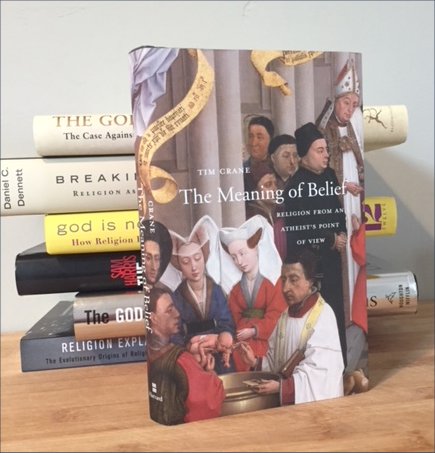
Tim Crane, THE MEANING OF BELIEF

Subtitled: Religion from an Atheist’s Point of View

This is a small volume that appeared in 2017 and was well-reviewed in the New York Times. The author is a philosopher, and as the subtitle indicates an atheist (he denies the existence of a transcendental realm, and therefore God and an afterlife), and not a humanist (on Peter Singer’s grounds that other beings than humans might deserve moral consideration).

His thesis is that the conceptions of the “new atheist” authors – Sam Harris, Richard Dawkins, Daniel Dennett, Christopher Hitchens, and later A.C. Grayling, who published books beginning in 2003 challenging religious beliefs and practices, on various grounds – of religion as being defined by cosmological, supernatural beliefs – God, an afterlife – as too limiting. What makes religion endure is more than that, which is why arguments to counter the supposed proofs of God make no difference to the vast majority of humanity who are believers.

Religion, Crane says, has four elements: it’s systematic, it’s practical, it’s an attempt to find meaning, and it appeals to the transcendent. The very idea of religion, or the supernatural, is a relatively recent concept – earlier cultures made no distinction between these ideas and their absence. [An effect of science, and the Enlightenment.]

The most interesting section of the book for me is chapter 3, discussing how religion is as much about identification as about supernatural claims. It’s about belonging to a group of shared believers, it’s accumulated culture wisdom about how to live, it’s part of one’s identity, like being part of a family or a nation, something one can’t necessarily renounce. He discusses the idea of sacrament, of the sacred vs. the profane, and how people attribute to objects access to things that don’t have to exist.

Now all this strikes me as perfectly obvious, but Crane many times claims that the various atheistic authors mentioned above ignore these points. Which might be true; I’d need to check. He goes on to challenge their identification of religion with much of the violence in the world – conflicts between Sunnis and Shiites, Pakistanis and Indians – claiming instead that such violence has many other causes, with religion being only an obvious distinction between opposing groups. Perhaps so.

And so I acknowledge many of Crane’s points. I’ve said many times that I’m sure people are not religious because they find the claims of a (micromanaging) God or an (eternally boring) afterlife the least bit plausible; they identify with a religion because their family or friends do, and their shared religion forms a social bond, a way of defining a community, or more cynically defining their in-group against all the out-groups. No one ever sits down to study all the religions and comes to a conclusion about which one is true on the basis of any kind of rational analysis, or evidence from the real world – because there is none. Religions represent social and tribal history; they are arbitrary cultural traits, like languages or cuisines, which don’t have any basis in empirical reality. (Unlike the accumulated discoveries of science…) They represent human psychological needs.

Yet Crane equivocates. He addresses the idea that religion derives from human psychology’s willingness to accept “counter-intuitive beliefs” but dismisses the idea on abstruse grounds (p47-48); he hasn’t read Jesse Bering. For me that is still the key. Crane’s style is too often that of the lawyerly philosopher more concerned with parsing the meanings of words than in reaching a conclusion.

And at the end he discusses how the decline of religious belief is wishful thinking, that atheists need to accept the reality of religion, even if such tolerance does not entail approval, or respect. Fine, but he has no recommendations for this tolerance should be implemented, beyond following the rule of law, and not making fusses at social faux pas (he reads at times like an advice columnist).

And what he doesn’t do is address the evidence that many prosperous, well-educated countries – especially in Northern Europe – do in fact have far lower rates of religious faith than less prosperous and educated countries. (On this point the US is an outlier.) Or that scientists are far less likely to be religious than the general population – a point he mentions and denies, despite the much evidence I’ve seen.

It may be true that human nature is inescapable, as long as we remain the humans we are (pending taking control of our genetic identity and making modifications), and that human nature entails a propensity for some kind of belief in the supernatural, and with its attendant tribalism, the idea of religion.

But the evidence is not all in one direction. And here’s where this topic dovetails with the speculations of science fiction. Arthur C. Clarke, in particular, liked to imagine futures in which religion was obsolete and humanity had attained a peaceful maturity that understood that religion was an artifact of its primitive past. And indeed, the vast majority of science fiction – that imagines future civilizations, galactic empires – takes no account of religion. The few works that do, by Miller and Blish and a few others, are so few they are easily counted. Even fantasy, in a way the opposite of science fiction, more often assumes the supernatural perceptions about ghosts and elves, about simplistic worlds of good vs. evil, than they assume the reality of any particular religion. (Some early works by Zelazny are curious exceptions, but they explored various religions in Sfnal ways.)

Posted in Atheism, Book Notes, Religion | Comments Off on Tim Crane, THE MEANING OF BELIEF

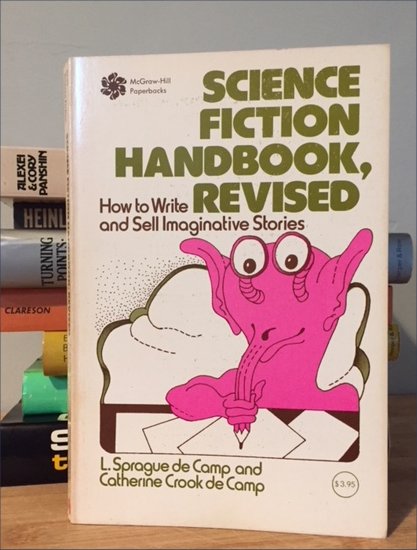
de Camp & de Camp, SCIENCE FICTION HANDBOOK, REVISED

Subtitled: “How to Write and Sell Imaginative Stories”

This is more of a curiosity now, than an essential book of criticism or history, though it does reveal some attitudes of its time. I have a 1975 revision, show here, of the original 1953 edition, so while it wasn’t a book of SF history or criticism, it was certainly one of the earliest nonfiction books published about science fiction.

The first two chapters spend 1/4 of the book summarizing the history of SF, all the way from Homer and the Greek playwrights, to Gernsback and Campbell, to Tolkien and the New Wave, and making a casual attempt to define what he calls “imaginative fiction” – “stories that could not have happened.” He concludes this section by noting that “imaginative fiction is escape fiction. It is primarily designed for the entertainment of the reader.” And he repeatedly throughout the book invokes “the reader” as the ultimate customer and judge for a writer’s work.

Then follows some basic information about editors and publishers, readers and writers, a writer’s talent vs. technique, where writers get their ideas, how to plot a story, how to write it in terms of action vs. description, dialogue, how to depict old or alien languages, and so on. Some of this expands on Sprague de Camp’s essay in Modern Science Fiction (notes here), such as remarks that it takes de Camp a week or two to conceive and plot a story, a month or two to outline a novel. (Which seems extraordinary, compared to writers like Asimov – and Hubbard! – who apparently could write clean copy as fast as they could type, with no lengthy mulling beforehand; I suspect they were the exceptions.) And how to sell it, and how to keep records of sales and of resales of subsidiary rights. (This last chapter is by Catherine Crook de Camp, we’re advised, who became Sprague’s business partner, and kept track of these matters. A situation Sprague recommends.)

Some of this is dated, though much is still valid, especially basic considerations of how to write fiction, and certainly business habits of keeping records. Here’s a passage that is a tad dated, his description of a magazine editor’s office:

Most editors work in small, glass-partitioned offices amid mountains of manuscripts, letters, galley proofs, proofs of covers and illustrations, back files of magazines, advance copies of next month’s issue, a couple of typewriters, stationery, a pot of paste, scissors, ash trays, and the other clutter of the trade.

Pot of paste? Later he describes how to make corrections to a (typewritten) manuscript, e.g. retyping a paragraph and gluing it over the old one, rather than retyping the whole page! Even in 1975, it was an era of typewriters. (And, ash trays? I suppose, even in 1975, but not in 2018.)

Two more curious passages, which strike me as dated as well — characterizations of when reading and writing science fiction wasn’t an element of popular, and even literary, culture as it is today. His characterization of “who reads this stuff?”, readers, p73:

Because many science-fiction fans are adolescents, and because some adolescents are given to exhibitionism and gaucherie, fans as a group have sometimes been scorned as eccentric. Actually, the average fan displays high intelligence, a voracious appetite for reading, and a personality type that often finds it hard to get along with other people.

And about writers, p75:

If they have any common characteristic besides their intelligence and word-mindedness, they probably tend toward the introverted type called the schizoid personality. Many started out as precociously intellectual but under-muscled children, bullied by their peers. Contrary to a common impression, writers are not necessarily fascinating companions, or staunch and helpful friends, or promising matrimonial material. They have a rather high suicide rate.

He mentions, near the end, that there are only 150 – 250 writers of imaginative fiction, and only a minority of those make a living at it. (These numbers strike me as high for 1953, low for 1975, so I’m not sure how to understand these statistics.)

The book ends with a substantial bibliography of recommended SF works (updated for the 1975 edition) and of general reference works, for the author who aspires to write anything about science, engineering, history, and mythology. He mentions in the text that his personal recommendation is to read 1/3 imaginative fiction, 1/3 realistic fiction, and 1/3 nonfiction, mainly science, history, and biography. And to take notes, and keep clippings. (Which I do! Though these days clippings are links.)

Posted in Book Notes, Science Fiction Nonfiction | Comments Off on de Camp & de Camp, SCIENCE FICTION HANDBOOK, REVISED

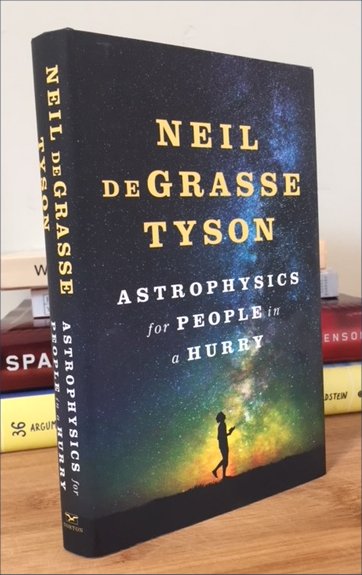
Neil deGrasse Tyson, ASTROPHYSICS FOR PEOPLE IN A HURRY

This slender volume of magazine essays came out nearly a year ago, and I read it then, and thought it pleasant but nowhere near foundational. But since it still shows up on bestseller lists, nearly a year later, and has a 4 1/2 star rating on Amazon, I skimmed it again today to document here on my blog. The main problem, I thought when I first read it, was that its scope begins the grandest way possible, with a description of the earliest moments of the universe, and the creation of the elements over subsequent billions of years; but that subsequent essays gradually diminish in scope. We read about Newton’s discovery of physical laws, the discovery of the expansion of the universe, the recent discovery of the ‘dwarf’ galaxies that outnumber the 100 billion larger galaxies, and then about dark matter and dark energy — fascinating, unresolved, topics. And then the book trails off with essays about the periodic table, how spheres are more common in the universe than jagged edges, about the discovery of the full electromagnetic spectrum, and of asteroids, the Kuiper Belt, the Oort Cloud, planetary moons, and via the Kepler telescope, some 3000 exoplanets. All fascinating topics, yet.

The final essay, “Reflections on the Cosmic Perspective,” is a nice finish, though, ahem, Tyson is no Carl Sagan, or Ann Druyan (who wrote the recent “Cosmos” TV series that Tyson narrated, and who rivals Sagan as a writer herself). Tyson says it’s a luxury to think cosmically, acknowledging real-world problems, poverty, people being killed in the name of political or religious dogmas. The universe is bigger than the traumas of life, he says. “Dare we admit that our thoughts and behaviors spring from a belief that the world revolves around us?” p196. If we all had an expanded view of our place in the universe, our problems would shrink.

And then he lays out eleven points of ‘cosmic perspective’, p205-207. They begin with “The cosmic perspective comes from the frontiers of science, yet it is not solely the provenance of the scientist. It belongs to everyone.” And ending with, “The cosmic perspective not only embraces our genetic kinship with all life on Earth but also values our chemical kinship with any yet-to-be discovered life in the universe, as well as our atomic kinship with the universe itself.”

And he concludes, we owe it to ourselves to explore, p208. “The day our knowledge of the cosmos ceases to expand, we risk regressing to the childish view that the universe figuratively and literally resolves around us. In that bleak world, arms-bearing, resource-hungry people and nations would be prone to act on the ‘low contracted prejudices.’ And that would be the last gasp of human enlightenment—until the rise of a visionary new culture that could once again embrace, rather than fear, the cosmic perspective.”

Posted in Astronomy, Book Notes, Cosmology | Comments Off on Neil deGrasse Tyson, ASTROPHYSICS FOR PEOPLE IN A HURRY

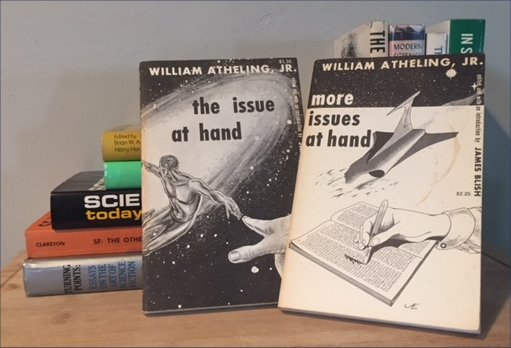
James Blish’s ISSUES AT HAND

James Blish, a science fiction author who emerged in roughly the same era as Damon Knight (they were born a year apart in 1920 and 1921 and both began publishing notable fiction in the early 1950s), wrote critical essays about SF in the 1950s and 1960s that eventually were collected in two slim volumes, THE ISSUE AT HAND and MORE ISSUES AT HAND, both published by Advent:Publishers as Damon Knight’s IN SEARCH OF WONDER was, the books long regarded as counterparts or companions to Knight’s influential volume. Blish was not as prolific a commentator as was Knight, but his approach was similar in many ways: he insisted on scientific veracity and on literary standards. If anything, Blish was more persnickety than was Knight. In these books Blish frequently opines how certain habits of storytelling had by his time become established as most effective, and any variation from those habits were errors that needed to be fixed. Thus, for example, he has trouble with Frank Herbert’s DUNE because of its switching from one character viewpoint to another, a technique he understood to be not as effective a storytelling technique and single point of view. And he hoped Herbert would figure this out and become a better writer.

Blish’s first book, THE ISSUE AT HAND (first edition 1964; I have the second 1973 edition) focuses on magazine short fiction, in contrast to Knight’s focus on books. The essays range from 1952 to 1962. He begins with an essay of ‘propositions’ – that SF needs more criticism, in order to grow; writers need to know there are certain standards of competence. He doesn’t spell these out, so much as criticize stories on various grounds that he assumes everyone understands are those standards of competence.

  • He quotes Sturgeon’s definition of science fiction – “a story built around human beings, with a human problem, and a human solution, which would not have happened at all without its scientific content” – and notes that Sturgeon later explained he meant that as a definition of a *good* science-fiction story.
  • He dispels the apparently then-common rumor that Jack Vance was a pseudonym for Henry Kuttner. (Kuttner did, in fact, use many pseudonyms in the 1940s and ’50s, but Jack Vance wasn’t one of them.)
  • He faults a story in Astounding for its phony realism — e.g. extended descriptions of lighting cigarettes – and ‘deep purple’, by which he apparently means overwriting and writing outside one’s experience, e.g. trying to describe alien music.
  • (A general issue in the book is that Blish states a problem, but doesn’t provide examples, so at this remove we can’t be certain what he’s talking about.)

In the second essay, he begins by recommending the essays of Damon Knight.

  • Blish alludes that Fantastic magazine, at that time, was supposedly the ‘adult’ counterpart of Amazing, whatever that might have meant at the time. (They were a pair of magazines co-edited and co-published for another couple decades, lastly by Ted White in the 1970s.)
  • Blish curiously uses, at least twice in this book, the term “space-opera” to mean a science fiction story that might as well be translated to the present, i.e. faux-science fiction. (Whereas by now “space opera” means a story actually set in space, generally an action or military story set in interstellar space and employing SF conventions like warp drives, rather than adhering to the hard-SF constraints of actual physics.)

In later chapters,

  • Blish mentions ‘deus ex machina’ endings, and ‘funny-hat’ characterizations, as obsolete writerly techniques.
  • He complains about the frequency, at the time, of ‘one-punch’ or surprise ending stories, with a list of authors who committed this abuse, especially Robert Sheckley.
  • Or how writers merely pile one idea on top of another (van Vogt!) rather than developing any one; an exception being Damon Knight’s “Four In One.” (He compares these to Russian music on the former point, German symphonic tradition on the latter.)
  • He disdains what he calls ‘naturalism’ in a story by Erik van Lhin, again without providing examples or sample passages; apparently, he meant how events were told in very plain, everyday terms, with a result he calls dreadful.
  • A long essay concerns “A Case of Conscience,” the original novelette by James Blish. (Here is an essay, presumably originally bylined “William Atheling, Jr.”, that gave Blish a means of critiquing himself in secret.) He begins by discussing the general issue of whether religion would arise on other planets, and references HPL, Heinlein, and Chesterton; then discusses “Case” with mentions of precedent stories about religion, by Lewis and Bradbury (“The Man”), Boucher and Miller. In the second 1973 edition that I have, Blish provides three afterwords, commenting about the extended book version of his story once it won a Hugo Award (http://www.sfadb.com/Hugo_Awards_1959), discussing a novel by Lowndes and then, at some length, discussing Heinlein’s STRANGER IN A STRANGE LAND, which he decides is ultimately about religion (though its metaphysics are shambles).
  • In one essay he misses the letter columns in the magazine (of the time), and doesn’t trust the reviews of popular nonfiction by the reviewers in SF magazines.
  • Has high praise for Theodore L. Thomas’ “The Weather Man” in Analog – despite its breaking Blish’s rule about not moving the POV among several characters!
  • Mentions Dean McLaughlin as one of the current ‘hard SF’ writers – along with Budrys, Dickson, and Garrett. Not authors we we now think of as exemplifying hard SF.
  • Criticizes “said-bookisms”.
  • Wonders why British reviewers, in newspapers, are better than American reviewers. Here’s a revelation to me: according to Blish, some American papers *really did* just reprint the book jacket blurb, and call it a review, sometimes even signed by the ‘reviewer’! This must explain one of Damon Knight’s key points, that a review is not a jacket blurb.

In the final essay of this first book, he wonders about the central appeal of SF. How while SF readers are often more widely read than readers of other genres, writers of SF almost always confine their energy to SF. He cites Poul Anderson’s speech at the 1959 Worldcon, “an appeal for a unitary approach to science fiction, in which philosophy, love, technology, poetry, and the elements of daily life would all play important and roughly equal roles.”

And then Blish wonders why the popular novels of Orwell, Vonnegut, Bernard Wolfe, Aldous Huxley, and Franz Werfel have not attracted more readers to genre SF. His conclusion: because most genre SF is about technical things; those books were about things that mattered–the relationship of the individual to the state; about power for its own sake; about what people do when technology replaces their jobs.

He cites Childhood’s End and More Than Human as SF that has such conviction. And is dismayed by recent Hugo nominations. Good SF is not about comfort and safety. “It is precisely the science-fiction story that rattles people’s teeth and shakes their convictions that finds its way into the mainstream” And so, he urges (in 1960!), that his reader vote in the Hugos, and think about each title, and ask, is it about anything??

The second book, MORE ISSUES AT HAND, consists of material first published mostly in the mid-1960s, with a couple essays going back to 1957 and one from as late as 1970. These focus more on novels than on the short fiction of the first volume. Highlights:

  • The intro discusses various types of critics: the evaluative critic, the impressionist critic (which is all about how a work makes the critic feel), and the technical critic, who attempts to identify what makes a work go wrong. Citing Frank Herbert’s multiple viewpoints.
  • Describes how SF, in 1965, has become a literary movement, not just a category of commercial fiction: the movement defined by the existence of histories and bibliographies, of critics and critical journals, of professional organizations, of awards, of specialized publishing houses. [ It strikes me that there has been more of this institutionalization of the science fiction than there has been in any other literary genre, including the “mainstream” – in fact, in this way SF is more like science itself. ]
  • He reviews, in 1965, the extant critical literature of SF, just five books: Damon Knight’s; his own first book; Sam Moskowitz’s EXPLORERS OF THE INFINITE, despite its numerous errors; THE SCIENCE FICTION NOVEL (discussion here http://www.markrkelly.com/Blog/2017/12/22/sfnf-the-science-fiction-novel/); and Kingsley Amis’ NEW MAPS OF HELL. (He mentions OF WORLDS BEYOND (discussion here http://www.markrkelly.com/Blog/2017/12/20/sfnf-eshbach-of-worlds-beyond/) and L. Sprague de Camp’s SCIENCE FICTION HANDBOOK in passing [its revised edition will be the next book I cover here].)
  • On Moskowitz, he describes how Moskowitz attributes ‘influence’ between authors based solely on the literal publication date of stories, even as close as a month apart, without understanding the lead-time of publications, or without knowing if later authors had ever read the earlier ones, which he might have tried to find out.
  • A long essay on Heinlein from 1957 admires his use of either a single POV or a 1st person POV, with a 1967 afterword considering subsequent novels, and noting how Heinlein’s apparent political conservatism clashed with the liberal trend of most SF.
  • Blish greatly admires Algis Budrys and ROGUE MOON, a masterpiece.
  • An essay about Sturgeon, adapted from the special F&SF issue on Sturgeon; how Sturgeon does not write about wheeler-dealers, as do so many other SF authors, how rather he writes about love, with a love of language. Calls Sturgeon “the finest conscious artist science fiction has yet had.”
  • Wonders why A. Merritt’s awful novels are so popular, with a sample passage supplied by an admirer. Blish: “The prosecution rests.”
  • Discusses John W. Campbell’s current obsession – in 1957 – with psi, and notes that how psi, if it existed, would undercut the entire purpose of fiction. An aside notes that some authors, like Lester del Rey, made a point of concocting a new ‘explanation’ for space drives, or psi, each time they wrote a new story.
  • And in this same essay he admires Carol Emshwiller’s “The Hunting Machine,” despite his distaste for “lady authors.” He even says “Mrs. Emshwiller is not a lady author. She is an author, period.” [ Dangerous distinction! ]
  • A chapter on ‘translations’ by which he means stories that might as well be set in the present. And about ‘science-fantasy’ with its lack of respect for facts, considering Brian Aldiss’ “Hothouse” stories. Discussion of how many SF writers perceive only woe in the consequences of new technology – and so how they don’t mind being wrong about known facts. Bradbury’s Mars. Aldiss.

The final chapter, from 1970, is about the term “speculative fiction,” how SF is often judged by its worst examples, and how the Hugos are not reliable judges of the best SF (because e.g. that Vonnegut’s THE SIRENS OF TITAN didn’t win).

And then he discusses the “New Wave” of science fiction’s late 1960s, which he characterizes thusly: emphasis on problems of the present; emphasis on manner of telling; claims that this is the direction SF must go. And a few worthy stories among it all.

He discusses the various advocates and examples of New Wave writers, with special attention to Judith Merril, who wrote a few stories and novels but was best known by the mid-60s as the editor of a series of “Best of the Year” anthologies, beginning in 1956 and ending in 1968. Blish/Atheling’s take is that Merril began (like Moskowitz) as a reader exclusively of SF, with no knowledge of general literature, or of science. As she went on, she discovered literature – and so her anthologies became more and more idiosyncratic, including pieces by mainstream authors, ordinary satire, comic strips and cartoons. She embraced the term “speculative fiction” (over “science fiction”) and later the “New Wave” because they exonerated her from any implication of an obligation to understand science. Also: how she submitted, in the early years with Simon & Schuster, many more stories than could be used, and how the publisher at S&S made the final selections.

Finally, Blish discusses the prominent New Wave authors. Ballard, whose stories seemed to be forming a mosaic on some topic that even he may not be aware of. Aldiss, Brunner, Moorcock, Ellison. Zelazny and Delany and their “mytholotry” – Blish finding Delany nearly unreadable, more sympathetic to Zelazny. And he concludes by discussing Aldiss’s BAREFOOT IN THE HEAD at length, with its allegiance to James Joyce [an interest of Blish’s]. Among its themes: “the biological hypothesis that modern man is stuck with equipment (particularly mental equipment) which served well enough in the Neolithic Age but is of increasingly less use as man’s world multiplies in complexity.” (Which is a very contemporary observation.)

And Blish ends by noting that the New Wave is pulling itself apart, with all these writers going off in their own directions. (As they did.)

Posted in Book Notes, Science Fiction Nonfiction | Comments Off on James Blish’s ISSUES AT HAND

From the Ridiculous to the Sublime: My Own Journey to 2001

Yesterday, April 2, 2018, was the 50th anniversary of the release of the film 2001: A Space Odyssey, still regarded as the best (or at least one of the best) science fiction films of all time, and as among the best films of all time, according to any number of polls of cinema fans over the decades. I had the good fortune to experience it at that so-called “golden age of science fiction” — i.e., when I was age 12, the age at which, traditionally, many SF fans first experience the “sense of wonder” of science fiction and become devotees of the genre for life. It’s also the age when one’s tastes begin to form, and some people stay fixed with those tastes, defending their interest in what they first experienced at that age, against all following change. I think I’m fortunate enough not to have to defend 2001 on those grounds, as the verdict of history has vindicated its status.

(When the film was released, there were, for example, middle-aged and senior science fiction writers, whose tastes had been formed by pulp magazine stories of the 1930s and the “golden age” of magazine science fiction in the 1940s, who dismissed 2001 as New Wave nonsense. These were some of the folks who rejoiced when Star Wars was released just nine years later; a film I felt regressive and was embarrassed by.)

In retrospect, I went through a fairly quick maturity in my experience and understanding of science fiction, both dramatic and literary, in just a few years of my young life. 2001 was the culmination, at age 12 1/2. My exposure to SF began with the TV series Lost in Space, which debuted in the Fall of 1965, when I had just turned 10. I discovered the show via a neighbor kid — it wasn’t the kind of show my parents would have watched — and so I missed the first few episodes (which I saw only 6 years later, when the show was in syndication), but thereafter watched it whenever I could, a fan of Will Robinson and the Robot and mysterious aliens like the Keeper. By the time LIS went camp — became utterly ridiculous — in its second season, Star Trek debuted, in the Fall of 1966. It was a much more serious show, with a cohesive premise and serious themes, and which I’ve recently rewatched, with posts here on this blog.

In parallel with those TV shows, I’d discovered science fiction books, beginning, ironically, with film and TV adaptations by Isaac Asimov and James Blish (Fantastic Voyage and Star Trek respectively). Via book sales at school and bookshops, I discovered Bradbury, and Clarke.

And then came the sublime: when 2001 debuted in April 1968, my family had moved to suburban Illinois, and I was just old enough to be aware of it and want to go see it. I’d already read the book! I knew what it was about. My parents took me to see the film in a movie theater in downtown Glen Ellyn, Illinois. I had no problem understanding it; I’d read the book. I remember my mother complaining that much of the music was just noise, and she had expected the movie would be something like a grandiose Star Trek; she didn’t understand it. My parents didn’t read anything, much less science fiction.

I got my father to take me to the film again, a few weeks later, but he got home late from work that night, and we got to theater late, walking in after the opening Dawn of Man scenes. The theater was full and I was stuck behind a tall man in front of me, partly blocking my view. (Funny how you remember such things, 50 years later.) To compensate for our late arrival, my father and I stayed until the next showing began. And then… we left after the Dawn of Man scenes. In retrospect, I am mortified, to have left a movie — THE movie — part way through, like some simpleton who leaves a movie they don’t understand or approve of.

(I probably didn’t see the movie again until 1980 or so, at a campus screening at Cal State Northridge, a showing in their steeply slanted auditorium. Videotapes and DVDs came out in subsequent decades, of course.)

And at about the time I saw this film, I was beginning to discover the more sophisticated and mature science fiction writers, past Asimov and Bradbury and Clarke — beginning with Robert Silverberg.

And I bought the 2001 LP soundtrack, which not only introduced me to the music of Richard and Johann Strauss, but also to that deeply introspective, mournful music of Aram Khachaturian, and especially to the strange soundscapes of György Ligeti, giving me a taste for unusual music that has lasted my entire life.

The movie itself is unconventional, even paradoxical, as has been explored in many books (perhaps in the new one by Michael Benson). First of all, it’s a visual splendor, but it has little story and no likeable characters. (One take: the movie is merely an *illustration* of a story you’re expected to deduce, or might know from reading the book.) Especially: almost all the dialogue is superfluous. When characters do talk — beginning some 20 minutes into the film — they are not saying anything that’s necessary to understanding the overall story. (Only one speech, which David Bowman hears by transmission after he has decommissioned HAL, that explains the point of the mission to Jupiter, is key.) But this is part of the film’s strategy: to depict the evolutionary advance of the human race as one about the discovery and use of tools. The bone at the end of the Dawn of Man is the first tool — which is used to kill. The flash-forward to the orbiting device, is to a device that is an orbiting nuclear weapon — not clear in the film, but clear in the book — another weapon intended to kill. HAL, the computer on Discovery, is another tool, programmed to hide the Jupiter mission’s true objective from the two astronauts who remain awake, and so, given conflicted programming, tries to kill those astronauts to assure the success of the mission. And language is another tool, with little value, that we see. The finale, a trip through a ‘star-gate’ (in Clarke’s novel version), is a closing advance in human evolution, triggered by the outsiders who deployed the monolith, that parallels the advance in the Dawn of Man scenes. And so on. (The story recalls the theme of Clarke’s famous 1953 novel Childhood’s End, about a similar advance of humans into another kind of race, due to alien intervention.)

No other science fiction film since has measured up to 2001, in my opinion; not in grandeur, not in special effects, not in seriousness of its theme.

Yet there are a couple small scientific errors. (I rewatched it a year ago, and noticed them.) For one, as we see the Discovery slide through space, we see stars that *do move*, albeit slowly — nothing like the firefly cloud of stars passing the Enterprise, in Star Trek. They do move. They wouldn’t move, from any reasonable vantage point; the Discovery is moving from Earth to Jupiter, and compared to that distance, the stars are so far away that their relative motion would be extremely slight. And then there is the famous one about Heywood Floyd, sipping his meal through straws, where we see the liquid food sliding back down the straws, despite his being in freefall, on his trip to the moon. And: Kubrick did a better job than most, for his time, showing his astronauts walking in parts of the Discovery that are in freefall, but these scenes aren’t perfect. (Why aren’t Bowman and Poole *floating* inside the pod, as they discuss the problem of HAL and are being lip-read, rather than obviously sitting?) For that matter — the idea that HAL can read their lips… is a stretch. Clarke avoided that in his novel version.

For now, here are a few good links from a quick Google search of the many, many articles about the film’s 50th anniversary in the past few days.

NY Times op-ed, in today’s paper, by Michael Benson, author of the just published Space Odyssey: Stanley Kubrick, Arthur C. Clarke, and the Making of a Masterpiece: What ‘2001’ Got Right [comments and quotes below]

NY Times: Happy 50th, HAL: Our Favorite Pop-Culture References to ‘2001: A Space Odyssey’

Guardian: 50 years of 2001: A Space Odyssey – how Kubrick’s sci-fi ‘changed the very form of cinema’

Metro UK: Six reasons why you should rewatch Stanley Kubrick’s 2001: A Space Odyssey on its 50th anniversary

Michael Benson’s op-ed ties the film to current interest in A.I., and to recent controversies in social media and their effect on American politics.

Traditional media — “one transmitter, millions of receivers” — contain an inherently totalitarian structure. Add machine learning, and a feedback loop of toxic audiovisual content can reverberate in the echo chamber of social media as well, linking friends with an ersatz intimacy that leaves them particularly susceptible to manipulation. Further amplified and retransmitted by Fox News and right-wing radio, it’s ready to beam into the mind of the spectator in chief during his “executive time.”

Democracy depends on a shared consensual reality — something that’s being willfully undermined. Seemingly just yesterday, peer-to-peer social networks were heralded as a revolutionary liberation from centralized information controls, and thus tools of individual human free will. We still have it in our power to purge malicious abuse of these systems, but Facebook, Twitter, YouTube and others would need to plow much more money into policing their networks — perhaps by themselves deploying countermeasures based on A.I. algorithms. Meanwhile, we should demand that a new, tech-savvy generation of leaders recognizes this danger and devises regulatory solutions that don’t hurt our First Amendment rights. A neat trick, of course — but the problem cannot be ignored.

Posted in Arthur C. Clarke, Films, Personal history, science fiction | Comments Off on From the Ridiculous to the Sublime: My Own Journey to 2001

Intro

This is the blog and homepage of Mark R. Kelly, the founder of Locus Online in 1997 (for which I won a Hugo Award in 2002 — see the icon at right) and of an index to science fiction awards in 2000 that became sfadb.com in 2012. I’m retired from my day job of 30 years, from 1982 to 2012, as an aerospace software engineer, supporting the Space Shuttle and the International Space Station.

Posts here are mostly about my reading, of science fiction and of books about science, history, philosophy, and religion; and comments to articles in newspapers that I link to. Movie reviews and pics from travels are posted on Facebook.

More on my About page, including a photo of the Hugo Winners the year I was among them, and links to an index of my columns and other writings, and to my earliest homepage with links to some of my work.

Likes and Dislikes:

Continue reading

Posted in Personal history | Comments Off on Intro

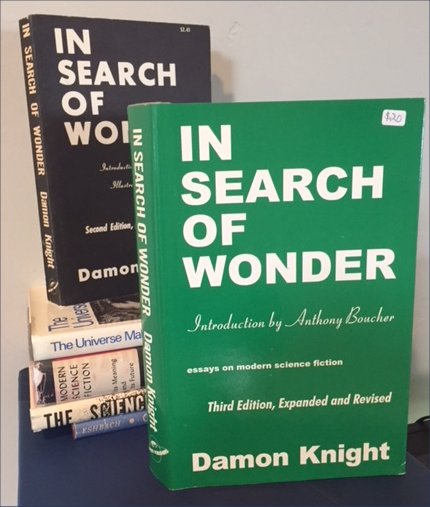
Damon Knight, IN SEARCH OF WONDER 3/e

Damon Knight was perhaps the earliest knowledgeable critic of science fiction. He was a science fiction author himself, beginning in 1948, and is most famous for a couple early short stories, “Not with a Bang” (1950) and “To Serve Man” (1950), the latter made famous by its adaptation into a Twilight Zone episode. (Notable later stories included “Four in One” (1953), “The Country of the Kind” (1956), “Stranger Station” (1956), “Masks” (1968), and my favorite, “I See You” (1976).) He wrote novels too, though none quite as notable as his short fiction. Knight’s greatest impact on the science fiction field, aside from his critical work, was as an anthologist; he edited the earliest series of original anthologies, ORBIT, 21 volumes from 1966 to 1980, and produced several volumes of classic SF and fantasy stories, compiled at sfadb.com here.

Knight made his critical reputation in 1945 with an essay that assaulted the works of A.E. van Vogt, author of popular novels SLAN and THE WORLD OF NULL-A, by pointing out that they were badly written and incoherent, as he explained at length.

(We met van Vogt in the critical anthology OF WORLDS BEYOND, summarized here, where he described his kitchen-sink method of writing.)

Knight went on to establish, in 1952, a “credo” for his work, of which the third point is the most essential, quoted here in full rather than paraphrased:

  1. That ‘science fiction’ is a misnomer, but we might as well learn to live with it;
  2. That a publisher’s jacket blurb, and a review, are two different things;
  3. “That science fiction is a field of literature worth taking seriously, and that ordinary critical standards can be meaningfully applied to it: e.g., originality, sincerity, style, construction, logic, coherence, sanity, garden-variety grammar.”
  4. That a bad book hurts SF more than 10 bad notices.

This third point was controversial, because it declared that Knight was not writing magazine reviews like those common at the time, in which the reviewers generally liked pretty much everything. Knight was stating he had no problem calling out bad work. He wrote critical essays for various publications, throughout the 1950s and ’60s, and these essays formed the first edition of this book, with later editions adding some later items.

It wasn’t until I reread the book just now that I appreciated why that third point was so controversial, and why the magazine reviews of the time were so mild. It was this: there simply weren’t very many SF books published in those days. (Recall the counts presented by Anthony Boucher in Bretnor’s MODERN SF, discussed here; 20 or 30 books a year, total!) And because there weren’t very many, it would have been ill-mannered to criticize any of them, like criticizing a member of one’s own family, especially since there was no shortage of outside critics dismissing science fiction as sub-literary. Indeed, Knight immediately in this essay presents an example, a 1953 essay in Harper’s Bazaar by none other than Arthur Koestler, called “The Boredom of Fantasy.”

The majority of IN SEARCH OF WONDER’s 33 chapters consists of essays about particular books, demonstrating Knight’s impatience for bad writing and bad science, and also revealing why he admires, to one degree or another, the work of many authors—especially Heinlein, Sturgeon, Kornbluth, to some extent Asimov, Clarke, Blish, Pratt. His essay on van Vogt is included, as is one on Ray Bradbury, titled “When I Was in Kneepants,” whose thesis is that Bradbury doesn’t write SF at all, how his ‘imagination’ consists merely of borrowed backgrounds, how his one subject is childhood.

There are also occasional essays on other topics:

  • In this third edition, Chapter 1 is a brief autobiography (adapted from his 1975 essay in HELL’S CARTOGRAPHERS);
  • A piece about Charles Fort (who famously gathered historical accounts of odd events that could not be explained; Knight wrote a whole book about him);
  • A controversial essay on unconscious symbolism in SF, using James Blish’s “Common Time” as a primary example;
  • A history of the Milford and Clarion workshops;
  • And a chapter, cobbled together from three earlier sources, working toward a definition of SF, presenting a set of seven common themes and then rating the contents of the first volume of THE SCIENCE FICTION HALL OF FAME and a couple other anthologies against those themes. His conclusion: stories that include three or more of those themes are commonly considered SF, while stories with only two are considered borderline, and those with one or none are not considered SF.
  • Near the end, an essay about writing SF, expanded from his contribution to Robin Scott Wilson’s THOSE WHO CAN in 1973, in which he annotates his own story “Masks,” to illustrate how a theme is played out over the course of a short story.
  • And finally, the last chapter, oddly, titled “What Next?”, is mostly about the two “most successful” SF books of 1956, Frank Robinson’s THE POWER and Richard Matheson’s THE SHRINKING MAN, both of which Knight criticizes on conceptual grounds, concluding they are “anti-science fiction.” It’s oddly titled because even in the 1996 third edition, the book ends with a chapter mostly about 1956, though it does end with a 1966 coda attempting prediction: how the field would split into divisions: hard SF, science-fantasy, adventure SF, ‘gonzo’ SF (by Ellison, et al), and ‘literary’ SF (by Le Guin, Aldiss, Wolfe, and others). In this, we can appreciate now, Knight was pretty much right.

This last chapter illustrates an irritant of the entire book: how it’s a mish-mash of pieces originally written in the 1940s, the 1950s, into the 1960s, as late as the 1980s, rearranged by topic and then divided up thematically into chapters. But the perspective, as in the last chapter, sometimes shifts, jarringly, and occasionally you can’t be sure from when he is writing. A complex Acknowledgements section at the end of the book, describing how portions of this or that chapter were first published in this or that year, helps a bit. I think a better approach would have been to tag each chapter, or each portion of a chapter, with an unobtrusive but clarifying tag, a year in brackets, something like [1966:].

Here are some other points from the essays on particular books that especially struck me:

  • His chapter about “Classics” makes a generational remark about how, for example, older fans want to talk about Stanton A. Coblentz while everyone else is talking about Heinlein; how some fans say that, for example, no SF published later than 1935 is worth reading, while younger colleagues simply place the date still later. (I think it’s easy to imagine fans over subsequent decades making analogous remarks! Think of that 1960 book by Earl Kemp, WHO KILLED SCIENCE FICTION?)
  • A chapter about John W. Campbell identifies his reaction to the competition from Galaxy in the early ‘50s: he responded by allowing into Astounding mediocre writers, with ideas but not technique, and elsewhere insisted that SF wasn’t literature anyway. The result was that Astounding’s contents pages became full of people who published nowhere else, a trend that lasted into the Analog era. [I think this changed for a few years under Ben Bova’s editorship of Analog in the 1970s, but reverted to form under Stanley Schmidt’s editorship in the ‘80s and beyond. It was certainly an issue I noticed when I first discovered Analog around 1970, a couple years before Campbell died.]
  • On the other hand, Knight considered Campbell’s “Don A. Stuart” stories his greatest contributions to the genre.
  • Knight thought Jack Williamson’s THE HUMANOIDS an important work, but crippled by “excruciatingly bad” prose and plotting, a legacy of Williamson’s pulp origins.
  • Knight was unhappy with Asimov’s early novels, including the FOUNDATION books, since they were so clearly derived from history and so offered nothing new. Knight responds to Asimov’s defense of his “history repeats” thesis, in MODERN SCIENCE FICTION (again, see here, http://www.markrkelly.com/Blog/2018/01/19/sfnf-bretnor-modern-science-fiction/), by pointing out that Asimov’s examples of three parallel histories were actually the same historical process, just not quite simultaneous. Knight therefore welcomes THE CAVES OF STEEL, stories in THE MARTIAN WAY, and the novel THE END OF ETERNITY, though he suspects the last is a dying breed of cerebral SF novels.
  • He admires Kuttner and Moore, but mentions that the end of “Vintage Season” – one of those SF Hall of Fame classics, now – is awkwardly prolonged.
  • He admires the intellect and technique of James Blish, but can’t warm to any of Blish’s novels, especially EARTHMAN, COME HOME, which he thinks a kitchen sink story, with too much crammed in. He does admire two great stories in Blish’s collection GALACTIC CLUSTER: “Common Time” and “A Work of Art”.
  • He admires Charles Harness, whose works were recomplicated like the novels of A.E. van Vogt, but which made sense.
  • He admires the first two novels by Philip K. Dick, especially compared to Dick’s dozens of short stories in the early ‘50s, though not quite so much the third and fourth novels.
  • He considers Robert Sheckley to be like Ray Bradbury: an SF writer who knows nothing about science, and whose SF tropes are all borrowed.
  • In discussing works by Wyndham, Gunn, and others, Knight mentions that “evil” and “meaning” are opposite terms. I would dispute that; the universe has no inherent meaning, is it then evil? No. It just is.
  • Knight reviews PREFERRED RISK by Edson McCann, winner of a contest, without realizing (and not revised in later editions to recognize) that “Edson McCann” was actually Frederik Pohl and C.M. Kornbluth, who hastily wrote this novel since none of the submissions to the contest were good enough to give the award to! And so ironically Knight complains that PREFERRED RISK was too similar to Pohl & Kornbluth’s books THE SPACE MERCHANTS and GLADIATOR-AT-LAW. It was a legitimate reaction at the time, I suppose, and perhaps later editions left this initial reaction in place, as a sort of in-joke.

Finally, I can’t help but include some the Knight’s examples of bad writing and scientific ignorance, both to illustrate the kind of things that Knight took issue with, and to illustrate how bad some science fiction books of the ‘40s and ‘50s were, by contemporary standards.

He quotes samples of Van Vogt’s prose, on p68, from which I’ll reproduce just some short ones:

“His mind held nothing that could be related to physical structure. He hadn’t eaten, definitely and unequivocally.”

“His brain was turning rapidly in an illusion of spinning.”

“There was a drabness about his surroundings that permitted thought.”

From a book by Roger Lee Vernon (Chapter 23), bad science.

“In the early days numerous ships had been torn into ribbons by meteorites. Ships would fly into a bed of the rapidly moving objects and be filled with holes. Now the gravitation locator solved all such problems… This device spotting and accurately charted the course of every particle… when the object was still about three minutes away.”

Knight then describes how the ship is said to move at L7, seven times the speed of light, and then how a character claims that if an alien ship is more than 8000 miles away, it would be undetectable. These numbers don’t add up. (But they anticipate Lost In Space-style astronomy and physics.)

From a book by Austin Hall and Homer Eon Flint (Chapter 4):

“For years he had been battering down the skepticism that had bulwarked itself in the material.”

“There was a resemblance to Rhamda Avec that ran almost to counterpart.”

Knight says this about Hall, who wrote most of the book in question:

His knowledge of science, if he had any, is not discoverable in these pages. He used “ether,” “force” and “vibration” interchangeably. On p.85, a chemist refers to a stone’s thermal properties as “magnetism.” “Magnetic”—like “sequence,” “almost,” “intrinsic,” “incandescense” (sic) and “iridescense” (sic)—is a word Hall kept tossing in at random, hoping to hit something with it eventually. For example:

“She [a dog named Queen] caught him by the trouser-leg and drew him back. She crowded us away from the curtains. It was almost magnetic.” (P. 95)

In the chapter about Campbell, he describes a work by Nat Schachner in which a spaceship is described in terms of ocean liners, complete with the scrubbing of decks and swervings of courses and constant rocket fire to maintain a steady speed.

There are lots more. Part of the pleasure in reading this book, aside from admiring Knight’s critical acumen, is to read these many examples of bad writing and bad science, and to conclude that the genre really has improved greatly over the decades, and maybe some of those outside critics of the field, back then, who dismissed SF as sub-literary, were perhaps somewhat right.

Posted in Book Notes, Science Fiction Nonfiction | Comments Off on Damon Knight, IN SEARCH OF WONDER 3/e

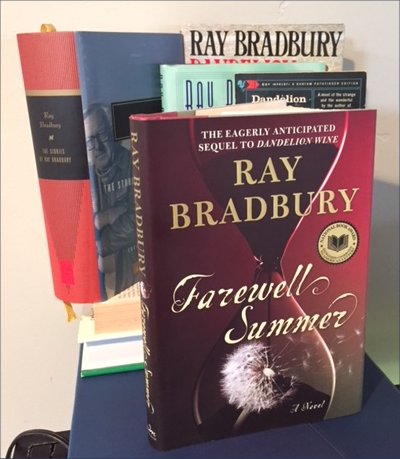
Ray Bradbury: FAREWELL SUMMER

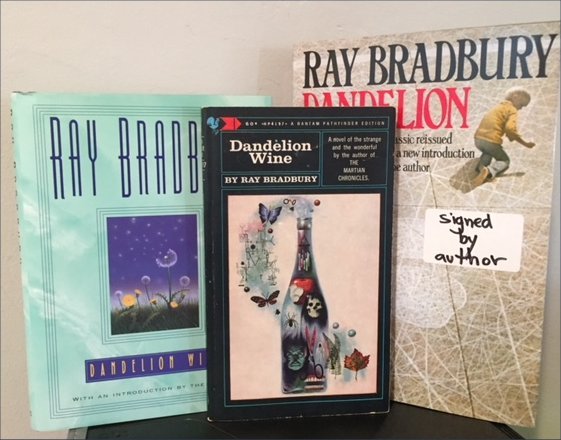
FAREWELL SUMMER (2006) is a belated sequel to Ray Bradbury’s famous novel DANDELION WINE (1957), the book set in a fictionalized version of the town Bradbury grew up in, in Illinois, named in the books Green Town. (My post about DW is here.) The ‘novel’ DW was actually a composite novel that included numerous short stories RB wrote in the early 1950s and then assembled within a frame story about the 12-year-old Douglas Spaulding experiencing the summer of 1928, with his realizations of his being alive, and that he would someday die.

In the ‘core bibliography’ for Ray Bradbury that I posted here, you can see that FAREWELL SUMMER was one of the last books published in Bradbury’s life. It was one of a number of final books that RB issued beginning in the early 1990s, up until his death in 2012, books that mostly contained work he had written decades before and never sold.

(That these late books were published was, I think, perhaps, because at this same time in the early ‘90s, he made a deal with Avon Books to reissue five of his core books – TMC, TIM, TOC, DW, SWTWC – in new hardcover editions, and perhaps this deal involved publishing a couple new collections, namely QE and DB, as well. Later books were then published by William Morrow… I suspect a key editor was involved.)

Thus, the last half dozen of Bradbury’s short story collections, beginning with QUICKER THAN THE EYE in 1996, were mixtures of a few recently written and published stories (in magazines like Playboy and F&SF), with many more previously unpublished stories, which commentators at the time realized were ‘trunk’ stories, i.e. stories written years or decades earlier and tossed into a real or figurative truck after they’d made the rounds of potential buyers, but did not sell. Bradbury perhaps had hundreds of these; somewhere I read that he wrote at least one short story a week, and if he did that from the 1940s to the 1990s – or, since his pace curtailed in the ‘60s, then even from the 1940s to the 1960s — he must have produced 600 or 700 stories over that time; and the result we have in all his published collections, even including these later ones, is at best three hundred stories. So there are a lot still unaccounted for, in some trunk.

Not all writers work that way, but RB was an inspirational rather than a methodical writer, and in some of these later collections he appends afterwords in which he describes the circumstances that inspired this or that story, and how he would go home and bang out said story in a couple hours. It’s no wonder that all of them didn’t sell.

In the case of the present book, the backstory is even more interesting. Published in 2006, it was billed as the “eagerly anticipated sequel” to DANDELION WINE, though frankly I doubt anyone had been eagerly anticipating such a sequel, or knew that such a sequel might exist. Once it was published, though, it became third of a trio of Green Town books, along with DANDELION WINE and SOMETHING WICKED THIS WAY COMES, now all tagged as a series, at least by Amazon.

RB provides an afterword to this book, also, in which he explains where this book came from. In the mid 1950s (several years after the successes of THE MARTIAN CHRONICLES and THE ILLUSTRATED MAN)  he submitted a manuscript to his publisher, Doubleday, for the book that became DW. But that original manuscript was too long and his editor suggested cutting it. RB quotes his reply (p210 in FS): “ ‘Why don’t we published the first 90,000 words as a novel and keep the second part for some future year when you feel it is ready to be published.’ At the time, I called the full, primitive version The Blue Remembered Hills. The original title for what would become Dandelion Wine was Summer, Morning, Summer Night. Even all those years ago, I had a title ready for this unborn book: Farewell Summer.”

With DANDELION WINE such an entrenched classic, it’s difficult to imagine how the content of FAREWELL SUMMER could have been incorporated into it. That would have been a completely different book. As it came to be, DW has a perfect story arc, across one summer in the life of a 12-year-old. Yet even as a leftover, on its own, FS is a quite different, a rather oddly amazing and moving, book.

To begin with, it’s not a fix-up in the same way DW was. I’ve seen no evidence that parts of it were previously published in separate pieces, with just two possible exceptions.

First is a 6-page story called “Farewell Summer” that was included in the 1980 compilation of 100 Bradbury stories published by Knopf, with no previous publication credit. (The 1980 book was reissued by Everyman’s Library in 2010, the edition I have, in the photo above.) It describes the boy Douglas taking a nap and dreaming of a band playing outside, where all the players are his own family, and this band leads him down to the lake shore, and then onto a boat, which is pushed out onto the lake, leaving him alone… He wakes up, tells his Grandpa about it, and realizes the dream was a metaphor for death. This story is included in an early chapter of FS.

Second is a startling passage late in this book, FS, that describes Douglas’ awakening into puberty, very delicately described. Here it serves in the conclusion of the book, in the resolution of its war between the young and old, as part of a sort of passing of the torches, in the cycle of life. The precedent here is “Junior,” a story first published in THE TOYNBEE CONVECTOR (1988), about an 82-year-old man named Albert who discovers one morning his “Albert Jr.” has emerged, and isn’t going away. He calls three lady friends, with whom he’s had friendly non-committal relationships over the years, to come and admire it, realizing it will never happen again in ‘this life’. Yes, Ray Bradbury is talking about sex, he’s talking about male erections, and it’s startling, I admit, to discover this story, and the similar passages in FS, after a lifetime of thinking that Bradbury is all about the preeminence of innocent childhood and the dangers of adulthood. (As it turns out, there are a handful of other stories in RB’s oeuvre with similar concerns, which I’ll get to in later posts.)

Aside from these echoes of late-published fragments, the key issue about FAREWELL SUMMER is this: it’s a through-story, one that doesn’t involve asides about other characters in the way DW does, though it does alternate between two sets of characters. It’s set a year after the events of DW. It concerns a war between youngers and elders, progress vs. stability, and ends with Douglas Spaulding’s discovery of physical change. It’s a completely different theme and story arc than what we’ve lived with in DANDELION WINE for these 60 years; yet on its own terms, despite some awkwardness of plot, it’s quite affecting and moving. A secondary issue is, there’s even less fantasy content than in DW; the suggestion of ghosts fleeing a haunted house is about it.

The book is also fairly short, 205 pages of largish type, in 37 chapters with blank pages between many of them.

Here’s the rough summary of FAREWELL SUMMER. It begins on October 1st, the end of a lingering summer, when Douglas is almost 14 — so this is just one year after the summer described in DW. (It’s mentioned, p30.2, that Douglas is a C-minus student.)

Douglas and his friends run through the ravine, and pee on the creek bank, tracing out their names – another adult bit such as you never saw in DW – and vow war against the houses along the edge of the ravine occupied by old men, Braling and Quartermain. One of these old men actually says to them, “Get off the lawn!” The boys’ pranks with cap-pistols scares Braling to death. Quartermain and another old guy, Bleak, occupy the school board, and plan to change the rules to keep the kids off the streets.

The boys stage various attacks against the old men. They steal the old men’s chess pieces, as they play chess in the town square; they sabotage the town clock, thinking it somehow alive and controlling the march of time—here’s a quote, from p100:

There, in the shellac-smelling, paper-rustling rooms of Town Hall, the Board of Education slyly unmade destinies, pared calendars, devoured Saturdays in torrents of homework, instigated reprimands, tortures, and criminalities. Their dead hands pulled streets straighter, loosed rivers of asphalt over soft dirt to make roads harder, more confining, so that open country and freedom were pushed further and further away, so that one day, years from now, green hills would be a distant echo, so far off that it would take a lifetime of travel to reach the edge of the city and peer out at one lone small forest of dying trees.

Douglas’ grandpa intervenes and makes Douglas repent. Meanwhile, the old men have second thoughts. Quartermain realizes that Douglas is the grandson he should have had, and wonders what he can do for the boy to redeem his own life. He begins by staging a birthday party, in that famous Green Town ravine, which Douglas and his friends attend. And Douglas is struck by the sight of a girl, Lisabell:

He was suddenly conscious of the grass under his shoes. His throat was dry. His tongue filled his mouth.

Again, something we never saw in DW, or any other of RB’s famous books, where the worlds of childhood and adulthood were

Final scenes involve a haunted house, Lisabell showing up to kiss Douglas, and a bizarre “mystery tent” scene in which the old men – who apparently have medical backgrounds – put on display a series of jars full of odd shapes, like oysters, or seaweed, or small animals, but which Douglas and his friends realize are all babies, in various stages of life. Douglas is overwhelmed, by this blunt demonstration of the mysteries of human life, and his recognition that he is a part of it:

He took a deep breath of the hot summer-like air, and squeezed his eyes shut. He could still see the platforms and the tables and the glass jars filled with thick fluid, and in the fluid, suspended, strange bits of tissue, alien forms from far unknown territories. What could be a swamp water creature with half an eye and half a limb, he knew, was not. What could be a fragment of ghost, of a spiritual upchuck come out of a fogbound book in a night library, was not. What could be the stillborn discharge of a favorite dog was not. In his mind’s eye the things in the jars seemed to melt, from fluid to fluid, light to light. If you flicked your eyes from jar to jar, you could almost snap them to life, as if you were running bits of film over your eyeballs so that the tiny things became large and then larger, shaping themselves into figures, hands, palms, wrists, elbows, until finally, asleep, the last shape opened wide its dull, blue, lashless eyes and fixed you with its gaze that cried, Look! See! I am trapped here forever! What am I? What is the questions, what, what? Could it be, you there, below, outside looking in, could it be that I am … you?

(This seems to be another episode that might well have been published separately, though, again, I’ve seen no evidence of such.)

And so the war between olders and youngers simply deflates. Douglas is suddenly attuned to another whole level of existence. He notices girls. He visits the old man, Quartermain, asking what life is about. Quartermain prepares to answer, and the scene shifts to the situation similar to that in “Junior” – the old man Quartermain waking up in the night, aroused for the first time in years, feeling a second heartbeat. Saying farewell, a voice in reply saying goodbye.

And then in a matching passage, Douglas awakes at 3am, feeling something down where his legs join, and he speaks to it. “Where did you come from?” The voice replies: “A billion years past. A billion years yet to come”. Inside those glass jars, in a way. Every boy names us, the voice says; every man says that name ten thousand times in his life. “You have two hearts now. Feel the pulse. One in your chest. And one below. Yes?” p203.  Are we friends? “The best you ever had. For life.”

And then Summer’s finally over. Douglas goes to bed, little brother Tom worries about dying, Douglas comforts him, and Grandma sits downstairs and “named the season just now over and done and past.”

Posted in Book Notes, Ray Bradbury | Comments Off on Ray Bradbury: FAREWELL SUMMER

Ray Bradbury: DANDELION WINE

DANDELION WINE (DW) is certainly Bradbury’s most personal book, because it is so clearly based on Bradbury’s own life as a boy in small-town Illinois. It was published in 1957 as a novel, not a short story collection, though actually it’s a hybrid, what SF critics call a ‘fix-up’ (http://www.sf-encyclopedia.com/entry/fixup), a book made up of previously published material, strung or stitched together often with added material. Since the book editions of DW do not identify the previous material, once again I’ll copy the TOC from Bill Contento’s Locus Index. (The * after some titles indicates no prior publication; a remarkable number of sections were previously published as short magazine pieces.)

Dandelion Wine Ray Bradbury (Doubleday, 1957, 281pp, hc)

Illumination · Ray Bradbury · ss The Reporter May 16 1957
Dandelion Wine · Ray Bradbury · ss Gourmet Jun 1953
Summer in the Air · Ray Bradbury · ss The Saturday Evening Post Feb 18 1956
The Season of Sitting · Ray Bradbury · vi Charm Aug 1951
The Night · Ray Bradbury · ss Weird Tales Jul 1946
The Lawns of Summer · Ray Bradbury · ss Nation’s Business Feb 1952
The Happiness Machine · Ray Bradbury · ss The Saturday Evening Post Sep 14 1957
Exorcism · Ray Bradbury · vi *
Season of Disbelief · Ray Bradbury · ss Collier’s Nov 25 1950
The Last, the Very Last · Ray Bradbury · ss The Reporter Jun 2 1955
The Green Machine · Ray Bradbury · ss Argosy (UK) Mar 1951
The Trolley · Ray Bradbury · ss Good Housekeeping Jul 1955
Statues · Ray Bradbury · ss *
Magic! · Ray Bradbury · ss *
The Window · Ray Bradbury · ss Collier’s Aug 5 1950
The Swan · Ray Bradbury · ss Cosmopolitan Sep 1954
The Whole Town’s Sleeping · Ray Bradbury · ss McCall’s Sep 1950
Good-By, Grandma · Ray Bradbury · ss The Saturday Evening Post May 25 1957
The Tarot Witch · Ray Bradbury · ss *
Green Wine for Dreaming · Ray Bradbury · ss *
Dinner at Dawn · Ray Bradbury · ss Everywoman’s Magazine Feb 1954, as “The Magical Kitchen” (?)

Bradbury had done something similar with THE MARTIAN CHRONICLES (1950; TMC), but that wasn’t presented as a novel, but as what I call a ‘linked-collection’ of related stories, listed in a table of contents at the front of the book. (Somewhat like Asimov’s I, ROBOT — the same year!) DW has no such TOC; there are page breaks between sections, but no titles. The TOC above shows that the material for this 1957 book was first published in the early 1950s — once RB’s reputation had been established by TMC. My guess is he was relaxing, or indulging, writing what he wanted to write rather than imitating what was popular, and managing to get into the ‘slick’ high-paying magazines, like Good Housekeeping and Saturday Evening Post. Only one of the items above was published in a genre magazine — that fifth item, in Weird Tales in 1946.

There’s a more significant issue with both this book and TMC, one I’d not recalled before embarking on this reread program: Bradbury wrote many more Green Town stories than those in DW; he wrote many more Mars stories than appeared in TMC. He wrote Green Town stories and Mars stories throughout his life. They were his go-to settings for the kinds of stories he liked to write, and there were only half a dozen different kinds of stories he liked to write — or perhaps, there were only half a dozen different settings that he used, over and over, for most of the stories he wrote.

Yet the stories written in any one setting were not consistent. Especially when TMC was assembled, RB and his editor Walter Bradbury at Doubleday (no relation) apparently chose from among RB’s published Mars stories those which were more-or-less consistent, and those which could be fitted into a framework of an overarching story. (Much as what we now call the Biblical “New Testament” was assembled in the 4th century by church officials who chose some ancient texts, those which were more or less consistent, and left out those which were not – and limited the ‘gospels’ to four, on numerological grounds!) So not only were some early Mars stories left out of TMC, but RB continued to use Mars as a setting for later stories, stories that were not necessarily consistent with the broad story arc established by TMC. The same is true for stories set in Green Town, and DW.

In the case of the Green Town stories, for example, those not incorporated into DW, he varied the protagonist’s name, his age, and his family situation. Some Green Town stories have an adult returning to his home town. Some don’t involve the boy Douglas at all, in any guise.

The key issue of DW is that it is almost entirely a realistic novel, with no science fiction and almost no fantasy, save one or two episodes. It’s Bradbury’s homage to his own Arcadia, his Eden, the perfect past that adulthood and progress threatened — that key theme of his entire career.

*

So: DANDELION WINE is about Douglas Spaulding, age 12, as he spends Summer of 1928 in this small Illinois town of Green Town, living with his family in a boarding house and next door to his grandparents’ house. The book opens and closes beautifully with Douglas looking out over the town from the fourth-floor cupola in his grandparents’ house, first at dawn, later at dusk, watching lights go on or off, and imagining himself as a conductor, cueing a performance.

The summer is bookended by two key moments in Douglas’ life: early on, while walking in the woods with his father and younger brother, Douglas has a sense of deep perception and realizes that he’s alive!, in a way he’d never realized before. Subsequently he keeps a notebook of “rituals” and “revelations” that he experiences throughout the summer. Then, near the end of the book, the counterpart realization occurs, as he’s witnessed people in town die, and even as he sees cowboys ‘killed’ in the movies and realizes what death actually means. His great-grandma does die, after saying, “I’m not really dying today. No person ever died that had a family. I’ll be around a long time.” (A sentiment echoed by the recent Pixar animated film Coco!) And so Douglas realizes, and tries to write down, “I, Douglas Spaulding, someday must…” but can’t finish it.

In between, much of the book describes incidents that do not involve Douglas. Grandpa harvests dandelions from the lawn and makes wine, for the family to sip throughout the next winter; a boarder offers to plant a type of grass that doesn’t need cutting, and suffers Grandpa’s wrath (a typical RB rant against ‘progress’); a man tries to invent a “happiness machine”; two little old ladies drive an electric car and worry they’ve killed a neighbor.

The ‘happiness machine’ episode involves a man obsessed with building a device to provide true happiness, that turns out to be a box that displays scenes and plays music from the most wonderful examples in existence. (It reminds me of the Edward G. Robinson death scene in the film Soylent Green, with scenes of gorgeous scenery and music by Beethoven.) But his machine malfunctions, and he concludes that true happiness is accepting what is stable, not transitory or easily forgotten, and that stability is looking at one’s household of wife and children, his family. It’s a typical RB statement of true verities.

Another incident is about an elderly woman, who saves every receipt and ticket stub, who is visited by children who can’t believe that she really was ever a girl, or even that she has a first name, and think her childhood photos were of someone else. At first disconcerted, the old woman comes to respond by admitting this is in some way true; and so she burns all the souvenirs of her past, and allows to the children that she was never pretty, or has a first name.

Another: a friend of Douglas’s, John Huff, announces his family is moving away to another town, and they’re leaving tonight. The boys play one last game of “statues,” during which John takes the opportunity to leave. And Douglas, heartbroken, decides he hates John Huff.

And there’s even a serial killer episode, concerning several elderly ladies who walk across the town’s ravine to see a movie, despite rumors of the “Lonely One,” who’s apparently killed a couple other women. Sure enough they find a woman, just murdered, and summon the police, but then attend their movie anyway. Later one of them, Lavinia, returns to her home, locks her door, and then realizes someone is inside the room with her— The end.

(This episode, “The Whole Town’s Sleeping,” was first published in 1950; in 1954 RB wrote a companion piece, told from the man’s POV, though the resolution is different than what’s [later! In 1957!] implied in DW. “At Midnight, in the Month of June” and the earlier story were both published in Ellery Queen’s Mystery Magazine in 1954; this other story was reprinted in The Toynbee Convector in 1988.)

There are one or two sections that do have some fantasy content. The most obvious is the section about Elmira Brown, who thinks she is the target of a neighbor, Clara Goodwater, whom she suspects is a witch, especially since Elmira’s postman husband Sam reports that Clara has ordered books about becoming a witch. Elmira has suffered many misfortunes, including general clumsiness, and has failed, time and time again, to become president of the Ladies Lodge. In the finale of this story, Elmira concocts a potion to counteract the witchcraft, but collapses on stage, upon which Clara repents – and pulls the pins out of her Elmira doll.

The second fantasy item concerns a “Tarot Witch” at a local carnival, which dispenses fortune cards. Doug and his brother Tom get a blank card, which they decode, via flame, to reveal a hidden lemon juice message, which is “secours” – “help”. The boys try to “rescue” her and are outwitted by the manager, who throws the Tarot Witch doll into the ravine.

And maybe there’s a bit of fantasy in a late episode in which Douglas falls into a fever, and the town junkman brings round some bottles of water, grandly described, which heal Douglas by morning.

*

It’s necessary at some point to discuss Bradbury’s prose style. It wasn’t consistent across all his works, but in the stories closest to his heart, his style was his most recognizably florid and breathless. And his characters typically speak as Bradbury writes — In this sense, if in no other, RB is like Rod Serling, who also wrote speeches for his characters in long paragraphs of prose utterly unlike the way actual people speak. RB’s style was more restrained in other tales, e.g. the Mars stories, but especially in the Green Town stories of DW, and in the other stories that responded to his personal experience – the Ireland and Mexico stories, the Hollywood stories – he orated, he expounded, as if bursting from within at the glory of the world and passion of his beliefs.

Here’s a typical passage (not searching for an extreme passage, just a typical one), near the beginning of DW, as Douglas, his dad, and his brother, wander in the woods:

And he was gesturing up through the trees above to show them how it was woven across the sky or how the sky was woven into the trees, he wasn’t sure which. But there it was, he smiled, and the weaving went on, green and blue, if you watched and saw the forest shift its humming loom. Dad stood comfortably saying this and that, the words easy in his mouth. He made it easier by laughing at his own declarations just so often. He liked to listen to the silence, he said, if silence could be listened to, for, he went on, in that silence you could hear wildflower pollen sifting down the bee-fried air, by God, the bee-fried air! Listen! The waterfall of birdsong beyond those trees!

This is pretty good – but a little of this goes a long way. You get used to it, and calibrate your reception of this prose to follow the story, sometimes despite what can seem excessive, even obscuring. At times this rapturous, poetic prose verges on the ungrammatical; you can read entire long paragraphs without quite understanding what is supposed to be going on. I’ll provide some of those examples in future posts.

Here’s another passage, about those water bottles that heal Douglas’ fever:

Derived from the atmosphere of the white Arctic in the spring of 1900, and mixed with the wind from the upper Hudson Valley in the month of April, 1910, and containing particles of dust seen shining in the sunset of one day in the meadows around Grinnell, Iowa, when a cool air rose to be captured from a lake and a little creek and a natural spring. Now the small print… Also containing molecules of vapor from menthol, lime, papaya, and watermelon and all other water-smelling, cool-savored fruits and trees like camphor and herbs like wintergreen and the breath of a rising wind from the Des Plaines River itself. Guaranteed most refreshing and cool. To be taken on summer nights when the heat passes ninety.

*

Finally, though: about this book, DANDELION WINE. As I mentioned earlier, I’m rereading some of my favorite sf/f authors, in part to revisit that golden age when I was 12, and in part to reconsider what I think science fiction means, what it’s about, after 50 years of reading it.

There’s no science fiction in DANDELION WINE – but there are stories that reveal Bradbury’s attitude about change, about technology. The “Happiness Machine” episode is one: the device is unnecessary and destructive, since true happiness lies in the verities of family. The “Green Machine” episode is another: two old ladies try out new technology, but it’s dangerous and uncontrollable. The “Lawns of Summer” episode suggests that the conveniences of technology (grass that doesn’t need cutting) aren’t worth the loss of traditions.

Bradbury famously said “I don’t try to describe the future. I try to prevent it.” (https://www.brainyquote.com/quotes/ray_bradbury_124755)

And so did Bradbury write science fiction? Or some illegitimate counterpart? (In those nonfiction anthologies from the 1950s that I blogged about late last year, Bradbury was noted as an exception to the general rule for how science fiction should be rigorously scientific.) Yes, he did. Bradbury, to this day, is recognized as a major science fiction author, and I don’t want to fall into the “No True Scotsman” fallacy of thinking that a recognized science fiction author didn’t really write science fiction, according to some private definition. Yes, Bradbury wrote science fiction, especially in THE MARTIAN CHRONICLES and FAHRENHEIT 451, as I’ll explore in future posts. And my job is to understand what science fiction really means, and is about (as opposed to fantasy), in a way that accounts for Ray Bradbury.

*

One final tease: I’ve only realized during the past couple months of rereading Bradbury, that my own childhood, the places I grew up in, correspond rather remarkably to the three settings of RB’s key books: Mars, Suburbia, and Green Town. I need to post further family photos from my early life, the places I grew up, to justify this claim. Perhaps this is why, despite my relatively hard-nosed attitude about science fiction vs. fantasy, I still feel a deep affection for the works of Ray Bradbury.

*

Wait, one more tease: I’ll follow up on RB’s oddly remarkable sequel to DANDELION WINE, FAREWELL SUMMER, in a separate post.

Posted in Book Notes, Ray Bradbury | Comments Off on Ray Bradbury: DANDELION WINE