Links and Comments: Arc of Social History; Academic Freedom

Just a couple recent items for today.

NYT: A March Toward Acceptance When Civil Rights Is the Topic. (This was the in-print title; the title at the link is different.)

The arc of history. If these charts went further back, I’d expect similar trends about interracial marriage (in the 1960s), women’s suffrage (a century ago), and slavery (150 years ago). Religious conservatives of those times resisted those advances, of course.

\\

If academic freedom doesn’t lead to correct conclusions, make those pesky academics sign statements of faith that they cannot reach conclusions based on their investigations of the real world that contradict the best thinking of our ancient desert sheep-herding ancestors, who thought the world was flat. (Or at least, don’t tell the *children*!)

Professor Resigns from Christian College After It Mandates Acceptance of Young Earth Creationism.

Which refers to earlier article If Faculty Members Don’t Accept Young Earth Creationism, This Christian College May Fire Them, from which:

Not all Christian schools require you to preach Creationism like Bryan is about to, but college should be a place where students are made to think critically about their beliefs. Bryan administrators are telling these faculty members not to challenge them at all — the Bible says it so there’s no room to question it. It’s the opposite of preparing them for the real world. Instead, Bryan College is billing itself as the place to go if you want to remain in a Christian Bubble for life.

Posted in Uncategorized | Comments Off on Links and Comments: Arc of Social History; Academic Freedom

The Irish Need Not Apply

» New York Times, Timothy Egan: Not Like Us

Donald Trump is attracting quite a following with his comments about Mexican immigrants:

When Mexico sends its people, they’re not sending their best. They’re not sending you. They’re not sending you. They’re sending people that have lots of problems, and they’re bringing those problems with us. They’re bringing drugs. They’re bringing crime. They’re rapists. And some, I assume, are good people.

(And Ted Cruz endorses him!)

This NYT Op-Ed by Timothy Egan reminds us of history. Before the Mexicans, there were the Chinese, and before them… as Egan describes,

They were criminals — thugs and thieves — a single ethnic group that filled the jails of big cities. “Scum unloaded on American wharves,” one speaker in Philadelphia said of them. Dirty, filthy, foreign. As for their children, they were “utterly ignorant of a place such as school,” The New York Herald reported.

The Irish, in the 1850s. (Hello! My name is Mark Kelly, with a family line aligned to Ireland and the Isle of Man.) Anyone remember from their history books, The Irish need not apply?

Every era has its immigrants to demonize, and there is always a (lower) class of American society eager to demonize the outsiders. Trump is tapping into the Republican base enthusiastic to do so. He will win his base, and lose in any larger election.

Posted in Culture, Human Progress, Morality, Social Progress | Comments Off on The Irish Need Not Apply

Links and Comments: Steven Weinberg; Trek vs Wars; How the world is getting better; Undermining the Bible

Here’s a archival essay by Steven Weinberg, whose new book I just reviewed in previous post: A Designer Universe?. This is the essay in which Weinberg wrote this oft-quoted passage (though usually only its final line, here bolded):

Where religion did make a difference, it was more in support of slavery than in opposition to it. Arguments from scripture were used in Parliament to defend the slave trade. Frederick Douglass told in his Narrative how his condition as a slave became worse when his master underwent a religious conversion that allowed him to justify slavery as the punishment of the children of Ham. Mark Twain described his mother as a genuinely good person, whose soft heart pitied even Satan, but who had no doubt about the legitimacy of slavery, because in years of living in antebellum Missouri she had never heard any sermon opposing slavery, but only countless sermons preaching that slavery was God’s will. With or without religion, good people can behave well and bad people can do evil; but for good people to do evil — that takes religion.

\\

Slate has a nice summary of the virtues of Star Trek vs. Star Wars, though the writer especially likes one of the later ST series that I never watched more than an episode or two of: Deep Space Nine. Perhaps it’s not too late to catch up.

\\

Vox: The world is getting better all the time, in 11 maps and charts.

Journalism doesn’t have a liberal bias so much as it has a bias to the extraordinary, as I’ve mentioned here: if there were only one murder in the entire world on a given day, that would be the lead news on all the news sites, perpetuating the idea that there is violence in the world.

\\

And the on general theme of stepping back .. stepping back … from one’s cultural assumptions, taking a look at those cultural assumptions as if one had not grown up with them, seeing them in an objective view: well,

Southern Skeptic.com: God is a Terrible Writer.

About how if the Bible were really the word of God, it should have been so much better, on ten points. Among them: it would be consistent; it would have *specific, verifiable prophecies*; it would contain knowledge that humans of the era in which the Bible was written couldn’t possibly have known; and — this is a point I haven’t seen suggested before — it would “have beautiful, heart-rending poetry and stories” to outmatch any human author. Which it clearly does not. The author provides examples.

If you’re a Christian, I don’t expect this post to change your mind. When a belief gets drilled into your head everyday for years, it can take years to get it out again. But can you at least have a little sympathy for us atheists? Can you see how the Bible seems like nothing more than a collection of writings by religious fanatics? You have no trouble dismissing the Koran or the Vedas or the Book of Shadows, and rightly so. But it is for the same reasons that we dismiss the Bible.

\\

All of these items will be categorized into my philosophical scheme…eventually.

Posted in Narrative, Physics, Religion | Comments Off on Links and Comments: Steven Weinberg; Trek vs Wars; How the world is getting better; Undermining the Bible

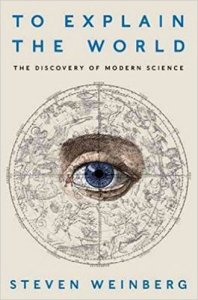
Steven Weinberg, TO EXPLAIN THE WORLD

Steven Weinberg is a Nobel Prize-winning physicist who is best known (I gather) as a leading proponent of the idea that progress in physics will ultimately lead to a small set of fundamental principles that explain everything — i.e. the concept of ‘reductionism’. (An idea that is common but that is not shared by everyone.) His famous early books were The First Three Minutes (1977) and Dreams of a Final Theory (1993), both books I have, but read so long ago I don’t have any summaries at hand.

This new book is not so much about the history of science, as about the history of how the idea of science emerged over the past three millennia. Nevertheless it does provide a history of science, at least of physical science (astronomy and physics) from the Greeks through Newton, and so there are many familiar stories and ideas here. But Weinberg recounts these historical events with attention to what those people were thinking about at the time, and how their ideas relate to the modern concept of science. (He explains in his preface why he talks about the “discovery” of science rather than the “invention”.)

Thus: the early Greeks, familiar from basic courses in science and philosophy. Thales, who thought the world was composed of water. Anaximander, who settled on air. Xenophanes: earth. And Heraclitus: fire. The idea of four elements, water air earth and fire, came from Empodocles, in the mid-400s BC. Then came Democritus, with his idea that all matter was composed of tiny indivisible particles called ‘atoms’…

Weinberg’s point is that these propositions were essentially poetical. No one of that era thought to defend these ideas against any kind of real world experience, let alone experiment. (There was nothing in those days like the modern idea of performing experiments to test hypotheses.) Zeno claimed, famously, that motion is impossible, because of his eponymous paradox — but he didn’t bother to explain why motion does in fact happen.

This is the theme that extends through the book: that the tentative ideas we retroactively identify as early ‘science’ were in fact modes of thought quite unlike our modern, rigorous idea of the scientific method. As the author puts it, “The progress of science has been largely a matter of discovering what questions should be asked.” (p29.7), and “This progress [of science] has been something objective, not just an evolution of fashion. … It was never fruitful to ask what motions are natural, or what is the purpose of this or that physical phenomenon.” (p29.9) The point is how difficult it was for someone even as intelligent as Aristotle to learn about nature; “Nothing about the practice of modern science is obvious to someone who has never seen it done.”

There wasn’t much distinction between ‘science’ and ‘philosophy’ for thousands of years. A running theme in the book is the distinction between the mathematicians and astronomers, on the one hand, who developed elaborate schemes to predict the positions of the planets, the lengths of the seasons, and so on — these adhered to Plato and Ptolemy and latter’s ‘epicycles’ — and the philosophers and physicians, allegiant to Aristotle and his teleology and, incidentally, astrology. The latter group liked to think of themselves as concerned about true reality, treating the methods of the former group as tricks for the sake of accuracy, but not, you know, *real*. This split persisted for nearly 2000 years, until Copernicus.

And so the book follows developments in ‘science’ and ‘philosophy’ over the millennia, during which there was little distinction between astronomy and astrology, chemistry and alchemy (it wasn’t until the 19th century that the goals of alchemy were proven impossible; before that, it was not an illegitimate goal).

The book provides useful historical overview, including a summary of the many Arabic scientists who preserved the Greek thinkers, and who made advances of their own, while Christian Europe wallowed in the Dark Ages, for a thousand years. (The Arabic influence on modern thought shows up in our words for algebra and algorithm, as well as many of our common star names.)

In Europe, Thomas Aquinas tried to fuse Aristotle with Christianity, and had his books, and Aristotle’s, banned by the Catholic Church.

Finally in the 15th and 16th centuries came Copernicus, Tycho, Kepler, and Galileo. Copernicus’ idea that the sun is the center [of the universe, he assumed] dramatically eliminated the complexities of the Ptolemaic system, at the expense of demoting Earth to just another planet [the first of many demotions of mankind from the center of everything], with, of course, attendant religious condemnation. Tycho, famous for his observation of a ‘new star’ [nova] in Cassiopeia, thus disproving Aristotle’s contention that the heavens are perfect and unchangeable (so much of Aristotle was later proven wrong), nevertheless resisted Copernicus, and tried to recast his system with the unmoving Earth back at the center.

Johannes Kepler came along and combined Copernican theory with the notion, derived from Plato, that the five regular polyhedrons (cube, octohedron, etc.) should somehow fit between the orbits of the planets. This strikes me as an extreme example of thinking that something pretty must necessarily be true, and Weinberg notes that this tendency still exists, and how Kepler’s conclusion was somewhat reasonable considering that he assumed the solar system was the entire universe… with the analogy that modern cosmologists resist the idea of a multiverse because of the assumption that our observable universe is the only one that exists…

And then Galileo, who studied falling bodies, who acquired a ‘spyglass’ and refined it, and with it saw the outer universe beyond what the naked eye could perceive for the first time in human history: the mountains on the moon, the many more stars than are evident by that naked eye, that the planets are globes — and some, like Jupiter, have moons orbiting them — and some, at least Venus, has phases like the moon does; and that there are spots on the sun [yet again refuting the ancient idea that the heavens are perfect and unchanging]. These observations were published in 1610. Religious authorities objected because his observations contradicted passages in scripture (and they refused to look through his telescope), and in 1616 the church banned his books. His books remained banned until 1835, and it wasn’t until 1979 that the Pope admitted that the church had been wrong.

True experiments began with Galileo, then Christiaan Huygens, Torricelli, and Blaise Pascal, Robert Boyle.

Weinberg considers Francis Bacon and Rene Descartes, often regarded as key figures of the scientific revolution, overrated. Bacon stressed that science must have practical value — a position echoed by modern politicians who ridicule (and try to de-fund) pure scientific research for its own sake. (The notorious case in the US, likely hopefully forgotten, was Wisconson senator William Proxmire.) And Descartes, famously skeptical even of human senses (thus his famous claim that the only thing he could be sure about was “I think, therefore I am”.) His own scientific work was mostly wrong — his ideas about the soul, the nature of light, of ‘God’ — though he did make contributions in analytic geometry (Cartesian coordinates!) that enabled him to write algebraic equations and solve systems of multiple equations. He partly solved how rainbows work. Yet his books were also banned by the church. Weinberg makes the point that both Bacon’s and Decartes’ claims to rule or prescribe how science should work… were misguided. Were not useful, in the long run.

With Isaac Newton, born 1642, we get the climax of the scientific revolution. (Newton was an odd fellow; he never travelled much, and perhaps never had sexual relations with anyone in his entire life.) He invented calculus [with competition from Leibniz; eventually they were both acknowledged], and he applied the idea to his insight that the same force that drops an apple to the ground is the reason the Moon orbits the Earth — he united the celestial and the terrestrial. His book Principia, in 1687, was the model of a scientific work, beginning with definitions (of what we now call mass, momentum, etc.), a statement of conclusions, i.e. ‘laws’, his famous three laws; and then an exploration of those laws’ corollaires and consequences, all the way to explaining, once and for all, the solar system, and how the planets move around the sun. His notion that ‘gravity’ exists without any ’cause’ upset the religious folk, of course. Yet — even Newton figured that ‘God’ must have a hand in guiding the planets on their tracks, or else why wouldn’t the solar system eventually degenerate? (This is not a bad question — modern astronomers have concluded that the solar system may in fact be chaotic, over millions of years; and this [my added thought, not something Weinberg wrote] might explain the occasional weird orbits of some of the planets in our system.)

What strikes me in this historical account is how the early ‘scientists’ were driven by what can be seen in retrospective as biases of the human mind. The early Greeks, Plato especially, were committed to the idea that the heavens were ‘perfect’, that therefore the planets *must* be moving in perfectly circular orbits, since the circle is the perfect shape, and moving in perfectly steady motions. This assumption hobbled the human comprehension of reality for two millennia — until the realization, by Copernicus and Kepler and Newton, that perhaps the planets were moving not in circles but in ellipses… a betrayal of human assumptions about perfection, but which led a better comprehension about what is real.

This is a lesson to be kept constantly in mind. The contrast between what humans presume must be true, based on subjective experience, compared to what, on the basis of evidence and experimentation, turns out to be true. PvC: the difference between perception and reality.

Another nice quote:

p44b:

It is not that the modern scientist makes a decision from the start that there are no supernatural persons. That happens to be my view, but there are good scientists who are seriously religious. Rather, the idea is to see how far one can go without supposed supernatural intervention. Only in this way can we do science, because once one invokes the supernatural, anything can be explained, and no explanation can be verified. This is why the ‘intelligent design’ ideology being promoted today is not science–it is rather the abdication of science.
Posted in Book Notes, Science | Comments Off on Steven Weinberg, TO EXPLAIN THE WORLD

Links and Comments: Criminal Justice; Evangelicals and Divorce; Vaccine Narratives; Anthony Doerr’s favorite science books; Jeffrey Tayler’s latest; social trends and arcs of history

Monday 6 July:

Today’s episode of NPR’s “Fresh Air” has an interview with Adam Benforado, author of new book Unfair: The New Science of Criminal Justice, which applies the developments of the past decade or two in human psychology to the field of criminal justice. The familiar example is the unreliability of eye-witness evidence, which has been acknowledged, if not incorporated into police or legal procedures, for decades. The book (I gather from the interview) also explores how biases creep in about such things about how good-looking the defendant is, how tired a judge is late in the day when he makes a decision, the impossibility of a jury ignoring an overruled exchange just because the judge tells them so, of course the fallibility of memory, and so on. This is further evidence about how the human mind creates a kind of reality in the context of human society that is not an accurate perception of the real world.

\\\\

Sunday 5 July:

Nice op-ed in today’s LA Times What would Jesus say about same-sex marriage?, about how evangelicals were once upon a time just as adamant about the decriminalization of *divorce* as they now are about the legalization of same-sex marriage. What happened to soften their views: Ronald Reagan, who “divorced and remarried, a clear violation of biblical teaching.”

Evangelicals like to present their position as biblical and therefore immutable. They want us to believe that they have never before adjusted to shifting public sentiments on sexuality and marriage. That is not so.

Divorce — and especially divorce and remarriage — was once such an issue, an issue about which evangelicals would brook no compromise. But evangelicals eventually reconfigured their preaching and adapted just fine to changing historical circumstances.

\\

Same day Sunday 5 July:

Frank Bruni’s column in New York Times, California, Camelot and Vaccines.

In which he avoids a confrontation that anti-vaxxer Robert F. Kennedy pursues. Also Jim Carrey. And Phil Plait in response. What fascinates me about these debates is that they’re not about evidence; they’re about those immune to evidence digging in to the narratives they are committed to… Because why? Because, I suspect, it’s largely a matter of maintaining their personal integrity, never admitting they are wrong or can change their minds. Human nature vs. reality. This is a provisional conclusion….

\\

In the same day’s NYT’s Book Review, a Q&A with Anthony Doerr (who won a Pulitzer Prize for his 2014 novel All the Light We Cannot See).

(What’s fascinating about these Q&As is how authors, or celebrities, who have a public persona based on whatever made them famous, often have quite different interests in their personal lives, including their reading tastes.)

You’ve written a column on science books for The Boston Globe. What are your favorite science books?

“The Lives of a Cell,” by Lewis Thomas; “On Food and Cooking: The Science and Lore of the Kitchen,” by Harold McGee; “Silent Spring,” by Rachel Carson; and “Unweaving the Rainbow,” by Richard Dawkins. My all-time favorite might be “Microbe Hunters,” by Paul de Kruif, a 1926 microbiology classic that brims with humor and fervor and wonder.

Hmm. I admit to never having read Silent Spring, though I have a copy somewhere. I read the de Kruif book in that college ‘breadth’ course about the history of infectious diseases that I alluded to here recently. I have the McGee book on food and cooking, which I’ve glanced through — the concept fascinates me, but it’s not the kind of book you would think to sit down and read through. Lewis Thomas, I just blogged about. And Richard Dawkins, despite his occasionally ill-advised social media posts, is one of the great science writers of our time.

\\

Salon and The Atlantic writer Jeffrey Tayler is posting weekly (Sunday) screeds on the former site, about the invidious influence of religion on American politics and culture in general, in a non-apologetic, uncondescending way rarely seen in mass media outlets (as opposed to personal blogs/sites, like Jerry Coyne’s).

Salon: Let’s kick God off the Court: Marriage isn’t the only place where the law has been infected by religion. It’s mostly about the Supreme Court decision supporting marriage-equality, and the reactions from religious conservatives — Huckabee, Jindal, Santorum, et al. A taste:

A poll conducted a couple of years ago showed that 41 percent of American adults believed the End Times were upon us.  Now, that same segment of our fellow citizens – those who have surrendered their common sense to stubborn faith in a cock-and-bull collection of ancient scribblements (i.e., the Bible) — must feel triumphantly, even gleefully, vindicated.  The Supreme Court’s recent 5-to-4 ruling in Obergefell v. Hodges in favor of same-sex marriage surely affirms we’re living through a rerun of the “days of Noah” (times of widespread fornication and sodomy) that are supposed to precede the Apocalypse.  The seventh trumpet, as they would have it, is a-blowin’, the Rapture nigh.

I can’t resist quoting a couple more passages.

Time saw fit to publish Rod Dreher’s melancholy yet foreboding dirge for Christians now roaming astray in a world where “the ground under [their] feet has shifted tectonically.”  God-coddlers, or those worshiping His never-having-existed offspring, must accept “how weak [their] position is in post-Christian America.”  (Hear, hear!)  The First Amendment will offer only “the barest protection to religious dissenters from gay rights orthodoxy.”

“If marriage,” Dreher warned, “can be redefined according to what we desire — that is, if there is no essential nature to marriage, or to gender — then there are no boundaries on marriage.”

Correct. Marriage, a man-made convention, must ever and always remain what man makes of it. If we, again through reason, debate and consensus, arrive at a definition differing from that which has obtained for the past millennia, so be it.

And in conclusion,

What ultimately transpires through all the Christian objections to the Supreme Court’s decision is their mean-spiritedness. Recourse to rancid old myths and “divine” injunctions that would be laughable were they not so pernicious only makes our days on Earth less pleasant, less livable. Some context: In some 5 billion years, our sun is destined to die in a supernova, which will incinerate whatever life remains on our planet. In the extremely improbable event that we humans still exist then, we will have evolved beyond anything recognizable as human today; evolution never stops, never slows. Our habits, customs, and laws need to evolve too.

\\

Monday 30 June:

New York Times has a set of graphs that show Why Gun Control and Abortion Are Different From Gay Marriage.

Graphs that show polling on social issues shows increasing acceptance, over the past 50 years or so, of same-sex marriage, the idea of a black president, the ideas of various other presidents (female, Jewish, etc). While polling about other ideas, gun laws, abortion, and the death penality, do not show similar trends.

So there’s a distinction here (my comments now) about some kinds of social issues, and others. I suspect — assume, based on historical evidence and trends — that if these charts went further back, there would be *of course* similar rising trends about interracial marriage (in the 1960s), women’s suffrage (a century ago), and the religious justification of slavery (150 years ago). Arcs of history.

Posted in Culture, Human Progress, Morality, Science | Comments Off on Links and Comments: Criminal Justice; Evangelicals and Divorce; Vaccine Narratives; Anthony Doerr’s favorite science books; Jeffrey Tayler’s latest; social trends and arcs of history

A Just Ended (perhaps) Arc of History

History happens, and historians establish dates, sometimes retroactively, about when history happened even though people at the time might not have noticed. Here’s a nice perspective about how one 150-year-old arc of history may have just closed, in The New Yorker:

Last Battles

In some future footnote or parenthetical aside, it may be observed that although General Robert E. Lee surrendered in 1865, the Confederacy’s final retreat did not occur until a century and a half later.

Which is when confederate flags started to be taken down in front of southern state capitals, in response to a brutal mass murder by a white man of black church-goers in an explicit attempt to incite a race war, and incident so blunt and racist that the defenders of the confederate flag (on the basis of memorializing some vaguely “southern way of life”) were, finally, shamed into acknowledging it really has been about racism, and white supremacy, all along.

Yes, the civil war was about slavery, and the continued flying of the confederate flag has celebrated the presumed superiority of the white race. The essay quotes the South Carolina convention in 1860, explaining the rationale for succession:

A geographical line has been drawn across the Union, and all the States north of that line have united in the election of a man to the high office of President of the United States, whose opinions and purposes are hostile to slavery.

The article author comments:

The South is exceptional not primarily because of its literature or its food or its politics but because, as historians have pointed out, it is the only region of the United States that has lived for the majority of its history with the experience of military defeat.

And:

It may seem odd, decades after the civil-rights movement, to note that for a sitting President to say that the Confederacy fought for the institution of slavery—and that doing so was a moral wrong—is a radical statement.

The arcs of history sometimes move slowly…. but they move.

Coincidentally, we watched the film Selma the other night, and in the archive footage of the actual march, there were the white hooligans on the sidelines, protesting the marchers, and waving their confederate flags.

Posted in Conservative Resistance, Culture | Comments Off on A Just Ended (perhaps) Arc of History

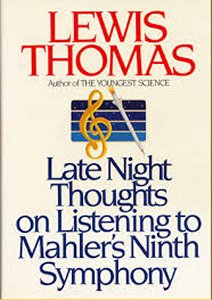
Lewis Thomas, Late Night Thoughts on Listening to Mahler’s Ninth Symphony

This was the third collection, published in 1983, of Lewis Thomas’s elegant, mostly short, essays, following The Lives of a Cell (which I blogged about last week) and The Medusa and the Snail. I read (or reread, I’m not sure) this volume over the past week.

The title essay isn’t about Mahler per se; it’s about how the author hears the final, melancholy, elegiac movement of this symphony, traditionally heard as an accepting, almost consoling acknowledgement of death, completely differently in this age – he’s writing in the early 1980s – of imminent nuclear doom. That’s the theme that pervades the book, in at least four essays. The opening essay, “The Unforgettable Fire”, is a review (in very relaxed sense) of two books documenting the horrors of the bombings at Hiroshima and Nagasaki, and Thomas’s flabbergasted outrage at the military planners currently anticipating the worst, as they busily maintain the latest nuclear arsenals. Another essay addresses how the medical community – the nation’s hospitals – will be of absolutely no use in such a conflict; the hospitals, in the major cities, will be gone first, and in any event the casualties will be so enormous there will be no possibility of helping any immediate survivors.

This was the early 1980s, and this sense of imminent doom, of a worldwide catastrophe to end them all, possibly the near-extinction of the human race, was still very much in the air. (A book-length consideration of the subject was Jonathan Schell’s The Fate of the Earth in 1982, which meditated at great length and in highly mannered prose how we got to that point and how awful awful it would be for the nuclear conflagration to happen.) I say ‘was’ in the air, since it isn’t so much now, compared to relatively localized incidents of terrorism, even though the potential threat is nearly as great, isn’t it? Don’t both the US and Russia (no longer Soviet Union) have nuclear arsenals? And several other countries? And if some terrorist organization manages to hijack even one bomb, couldn’t that trigger the end just as surely as a Soviet/US battle in the 1980s?

Here’s a taste of Thomas in the essay about hospitals (p119.5):

How is it possible for so many people with the outward appearance of steadiness and authority, intelligent and convincing enough to have reached the highest positions in the governments of the world, to have lost so completely their sense of responsibility for the human beings to whom they are accountable? Their obsession with stockpiling nuclear armaments and their urgency in laying out detailed plans for using them have, at the core, aspects of what we would be calling craziness in other people, under other circumstances. Just before they let fly everything at their disposal, and this uniquely intelligent species begins to go down, it would be a small comfort to understand how it happened to happen. Our descendants, if there are any, will surely want to know.

But the whole book is not like that, fortunately. As with two previous volumes of essays, most items here are short, as few as three pages, and address striking insights about the complexities of biology, the relationship of science and the humanities, and the urgencies of current issues concerning science and society. A few random notes and quotes:

  • p20b: “As we learn more about the fundamental processes of living things in general we will learn more about ourselves, including perhaps the ways in which our brains, unmatched by any other neural structures on the planet, achieve the earth’s awareness of itself.”
  • p26.7: “The age of science did not really begin three hundred years ago. That was simply the time when it was realized that human curiosity about the world represented a deep wish, perhaps embedded somewhere in the chromosomes of human beings, to learn more about nature by experiment and the confirmation of experiment. The doing of science on a scale appropriate to the problems at hand was launched only in the twentieth century and has been moving into high gear only within the last fifty years. … It is not as easy a time for us as it used to be: we are raised through childhood in skepticism and disbelief; we feel the need of proofs all around, even for matters as deep as the working of our own consciousness, where there is as yet no clear prospect of proof about anything. Uncertainty, disillusion, and despair are prices to be paid for living in an age of scence.”
  • p27b: “Instead of coping, or trying to cope, with the wants of four billion people, we will very soon be facing the needs, probably desperate, of double that number and, soon thereafter, double again.” (cf my Kolbert summary)
  • He’s asked to imagine seven wonders of the modern world, and suggests 1) the bacteria that exist in hot ocean vents; 2) a certain kind of beetle; 3) the scrapies virus; 4) olfactory cells, brains cells on the lining of your nose; 5) termites, how individuals are useless but mass aggregates form an amazingly complex social structure; 6) a human child, for which childhood is about the learning of language; and 7) and the Earth, “a living system, an immense organism, still developing, regulating itself, making its own oxygen, maintaining its own temperature, keeping all its infinite living parts connected and interdependent, including us.”
  • He discusses the side-effects of amazing drugs for treating schizophrenia: that the mental hospitals closed down, leaving victims on the streets, and advocates restoring them.
  • Addresses altruism, and the then current sociobiological explanation, then goes on to propose that *all species* have a kind of social obligation to each other, and wonders if some new word might do better at describing this. P107: “But at least we should acknowledge the family ties and, with them, the obligations. If we do it wrong, scattering pollutants, clouding the atmosphere with too much carbon dioxide, extinguishing the thin carapace of ozone, burning up the forests, dropping the bombs, rampaging at large through nature as though we owned the place, there will be a lot of paying back to do and, at the end, nothing to pay back with.”
  • An essay, “Falsity and Failure”, p108, about incidents of scientific fraud, and how villains can never get away with it; the system works. Another issue in the news today that really isn’t news; this kind of thing has always happened, and the system works.
  • A relatively long (13 pages!) essay on “Humanities and Science”, recalling Lord Kelvin’s insistence that nothing matters unless it can be quantified, and how, at the end of the 19th century, he declared that physics was about done. Similar attitudes persist… p150: “Science, especially twentieth-century science, has provided us with a glimpse of something we never really knew before, the revelation of human ignorance…”
  • And an essay on the “two cultures”, in which he suggests a shared bewilderment, considers various things we don’t understand, including music: “The professional musicologists, tremendous scholars all, for whom I have the greatest respect, haven’t the ghost of an idea about what music is, or why we make it and cannot be human without it… It is a mystery, and thank goodness for that. The Brandenburgs and the late quartets are not there to give us assurances that we have arrived; they carry the news that there are deep centers in our minds that we know nothing about except that they are there.”

A nice note to close on.

Posted in Book Notes, Culture, Music, Science | Comments Off on Lewis Thomas, Late Night Thoughts on Listening to Mahler’s Ninth Symphony

Links and Comments: Philosophical principles; social programs; narrative; FDS; religious conflict and the gullible

I’ve belatedly added a link to Adam Lee’s Statement of Principles, a set of philosophical positions that I mostly endorse (I reserve the right to quibble), in the intro to my Provisional Conclusions.

\\

And speaking of Adam Lee, this post makes an interesting point about why the religious right is against government social programs:

It’s no coincidence that some of the fiercest opposition to Obamacare has come from the religious right: they want to shred the social safety net, so that people have no option but to turn to churches when they need help. There’s plenty of research to establish that in societies that are prosperous, peaceful and secure, people see less need for religious consolation; and I don’t doubt the religious right knows this as well. Their defeat has weakened their influence and made us a more just and humane society, and that’s very much worth celebrating.

(He’s responding to the latest Supreme Court decision upholding the intent of the Affordable Care Act, aka Obamacare.)

\\

Via Mary Anne Mohanraj on Facebook, another citation about the overarching human mindset to think in terms of narrative:

We are, as a species, addicted to story. Even when the body goes to sleep, the mind stays up all night, telling itself stories.

–from The Storytelling Animal: How Stories Make Us Human by Jonathan Gottschall

\\

I’ve not been keeping up with Jeffrey Tayler’s weekly (on Sundays!) column challenging religious verities at Salon.com, but I wanted to note this one from a couple weeks ago, Antonin Scalia is unfit to serve: A justice who rejects science and the law for religion is of unsound mind, not so much for his commentary about Scalia, but for his description of FDS, Faith Derangement Syndrome:

Sufferers of faith-derangement syndrome (FDS) exhibit the following symptoms: unshakable belief in the veracity of manifest absurdities detailed in ancient texts regarding the origins of the cosmos and life on earth; a determination to disseminate said absurdities in educational institutions and via the media; a propensity to enjoin and even enforce (at times using violence) obedience to regulations stipulated in said ancient texts, regardless of their suitability for contemporary circumstances; the conviction that an invisible, omnipresent, omniscient authority (commonly referred to as “God”) directs the course of human and natural events, is vulnerable to propitiation and blandishments, and monitors individual human behavior, including thought processes, with an especially prurient interest in sexual activity.

Secondary symptoms exhibited by sufferers of FDS comprise feelings of righteousness and sensations of displeasure, even outrage, when collocutors question, reject or refute the espousal of said absurdities. Tertiary symptoms, often present among individuals self-classifying as “evangelicals”: Duggar-esque hairdos and Tammy Bakker-ian makeup, preternaturally sunny dispositions and pedophiliac tendencies, sartorial ineptitude and obesity.

A definition worth capturing, for future reference.

This past Sunday’s post by Tayler is about Sean Hannity, very bad critic: Fox News, Sony, Sarah Palin pal help hit movie prey on the gullible, about how those laughably bad “Christian” movies about how heaven is real prey on the gullible.

\\

Yet, won’t there always be the gullible? The latest issue of The Atlantic is an “ideas” issue, with many diverse ideas about the modern world summarized sometimes very briefly (the trend even in print journalism these days). Here’s a quote from one, by Graeme Wood, about Why Global Religious Conflict Won’t End.

The conviction that every sacred text is a long-winded paraphrase of the Golden Rule requires, among other things, a rather low regard for those texts—and not much understanding of them, either. As the events of the past year suggest, they all contain recipes not just for peace but for conflict, which means that as long as there are literal-minded people, religion will likely remain as much a force for the latter as for the former.

Won’t there always be the gullible and the simple-minded, whose trust in literal readings of ancient writings drive religious wars and denial of the humanity of people unlike themselves? I’m reminded of this quote by H.G. Wells, which I need to highlight somewhere on this site: History is a race between education and catastrophe.

Posted in Narrative, Philosophy, Religion | Comments Off on Links and Comments: Philosophical principles; social programs; narrative; FDS; religious conflict and the gullible

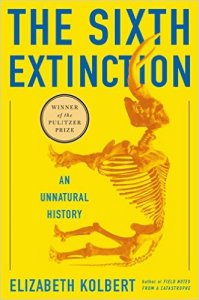
Elizabeth Kolbert, The Sixth Extinction

This book won the Pulitzer Prize for Nonfiction (and was a finalist for the National Book Critics Circle Award). I finally got around to it on my plane flight back east a month ago. The title refers to five prominent mass extinctions that have occurred throughout the history of the Earth, as evidenced by the fossil record (there’s a graph on p16), the fifth of which was the event 65 million years ago that wiped out the dinosaurs. The book focuses what seems to be going on right now (i.e. over the past couple hundred thousand years, but especially *right now* this century) – a sixth mass extinction, caused by the successful dominance of our planet by the human race.

Each of the book’s thirteen chapters focuses (sometimes incidentally) on a particular species that’s already gone extinct or that’s threatened, describing each with a combination of historical perspective and personal narrative – the author’s visits and interviews with scientists working in the field — and knits them together with an overarching narrative thread that sketches out the history of the human race, and the history of our ideas about other species and how we affect them.

The book starts strikingly in its first three pages with a thumbnail account of humanity’s spread across the globe and impact on the planet, starting in a slice of eastern Africa…

The members of the species are not particularly swift or strong or fertile. They are, however, singularly resourceful. Gradually they push into regions with different climates, different predators, and different prey. None of the usual constraints of habitat or geography seem to check them. They cross rivers, plateaus, mountain ranges.

The process continues, in fits and starts, for thousands of years, until the species, no longer so new, has spread to practically every corner of the globe. At this point, several things happen more or less at once that allow Homo sapiens, as it has come to call itself, to reproduce at an unprecedented rate. In a single century the population doubles; then it doubles again, and then again. Vast forests are razed. Human do this deliberately, in order to feed themselves. Less deliberately, they shift organisms from one continent to another, reassembling the biosphere.

Meanwhile, an even stranger and more radical transformation is under way. Having discovered subterranean reserves of energy, humans begin to change the composition of the atmosphere. This, in turn, alters the climate and the chemistry of the oceans. Some plants and animals adjust by moving. They climb mountains and migrate toward the poles. But a great many – at first hundreds, then thousands, and finally perhaps millions – find themselves marooned. Extinction rates soar, and the texture of life change.

I like the conciseness and sweep of this account: e.g. doubles again, and then again. In the perspective of the history of life on Earth, all of this has happened in a flash.

The first chapter highlights an effect that has occurred just in the past century: the advent of airplane flight around the globe has, inadvertently, allowed species to come into contact that had previously been completely isolated. The case study is how species of frogs in Central America have disappeared, victims of a fungus spread by humans.

The second chapter, ostensibly about the American mastodon, is a historical sketch of how the very idea that species could go extinct did not arise until a couple centuries ago. Until then, the discoveries in the 1700s of the skeletons of huge animals (e.g.) that had never been seen alive was passed off as due to the many areas of the planet that had not yet been explored. Cuvier in France, around 1800, was the first to suggest that species had become extinct. Ironically, he opposed the idea of evolution, or transformisme in French [this was before Darwin, but the idea was in the air].

The next few chapters advance the historical context: the ebb and flow between ideas of catastrophes or uniform trends throughout the Earth’s history. Darwin applies Lyell’s ideas to animal species in his ideas of natural selection. Both ideas were correct. The idea of a meteor impact on Earth that triggered the extinction of the dinosaurs, first put forth about 1980, was ridiculed at first, until mounting evidence supported it.

However earlier extinction events had their own causes, some variations of climate change.

Currently the idea we are living in the Anthropocene epoch – successor to the Holocene – that, as subsequent chapters explore, may have begun hundreds of thousands of years ago, as humans moved out of Africa, spread across the globe, and killed off the numerous large animal species that had survived the last ice age (many examples). This trend accelerated in the past century as our airline flights have inadvertently mixed previously isolated species around the globe together again, leading to deaths of many species of frogs and bats, and most recently to the effects of climate change, which already portend the deaths of coral reefs and other ocean ecosystems, while humanity’s spread across the globe is leading to the imminent extinctions of large mammals like rhinos, elephants, and our fellow large primates in Africa.

In a chapter about the Neanderthal, and the possible DNA analysis of how our species differed from theirs, author quotes a scientist with the idea that humanity has a sort of ‘madness’ gene that led us to seek out and explore.

It’s only fully modern humans who start this thing of venturing out on the ocean where you don’t see land. Part of that is technology, of course; you have to have ships to do it. But there is also, I like to think or say, some madness there. You know? How many people must have sailed out and vanished on the Pacific before you found Easter Island? I mean, it’s ridiculous. Any why do you do that? Is it for the glory? For immortality? For curiosity? And now we go to Mars. We never stop.

And at the end the author summarizes and philosophizes:

What I’ve been trying to do is trace an extinction event – call it the Holocene extinction, or the Anthropocene extinction, or, if you prefer the sound of it, the Sixth Extinction – and to place this event in the broader context of life’s history. That history is neither strictly uniformitarian nor catastrophic; rather, it is a hybrid of the two. What this history reveals, in its ups and downs, is that life is extremely resilient but not infinitely so.

She describes an exhibit at the American Museum of Natural History of all six big extinctions. And asks, will we be the victim of our own extinction event? Or might our species have the cleverness to prevail, via atmosphere re-engineering, or even relocation to other planets? P268b:

Right now, in the amazing moment that to us counts as the present, we are deciding, without quite meaning to, which evolutionary pathways will remain open and which will be forever closed. No other creature has ever managed this, and it will, unfortunately, be our most enduring legacy.

Posted in Book Notes, Evolution, Science | Comments Off on Elizabeth Kolbert, The Sixth Extinction

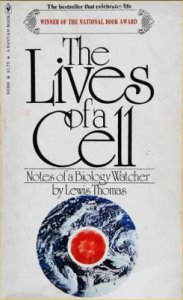
Lewis Thomas, The Lives of a Cell

Lewis Thomas was a pediatrician and doctor, who became president of the Memorial Sloan-Kettering Cancer Center in New York, and who wrote a series of short essays which were first published in New England Journal of Medicine in the early to mid 1970s.

His first book, The Lives of a Cell, was a collection of some 30 of these essays. (I don’t have the original first edition hardcover; I have the first 1975 Bantam paperback reprint, imaged here.) It won a National Book Award. The essays mix detailed understanding of the intricacies of the biological world with profound insights about the position of humans amidst that biological world.

Here are the first two paragraphs of the opening, title, essay:

We are told that the trouble with Modern Man is that he has been trying to detach himself from nature. He sits in the topmost tiers of polymer, glass, and steel, dangling his pulsing legs, surveying at a distance the writhing life of the planet. In this scenario, Man comes on as a stupendous lethal force, and the earth is pictured as something delicate, like rising bubbles at the surface of a country pond, or flights of fragile birds.

But it is illusion to think that there is anything fragile about the life of the earth; surely this is the toughest membrane imaginable in the universe, opaque to probability, impermeable to death. We are the delicate part, transient and vulnerable as cilia. Nor is it a new thing for man to invent an existence that he imagines to be above the rest of life; this has been his most consistent intellectual exertion down the millennia. As illusion, it has never worked out to his satisfaction in the past, any more than it does today. Man is embedded in nature.

Thomas went on to publish at least two more books of similar essays, including Late Night Thoughts on Listening to Mahler’s Ninth Symphony, which I need to revisit, and two or three additional books. He died in 1993.

Posted in Book Notes, Personal history, Philosophy, Science | Comments Off on Lewis Thomas, The Lives of a Cell