Links and Comments: Friedman on historical change, why evangelicals like Trump, Paulos on math and biography, Gawande on science, the case against reality

Today in NYT, Thomas L. Friedman: Another Age of Discovery. Friedman lets Ian Goldin, co-author of a book about the lessons we can draw from the period of 1450 to 1550, i.e. a period of extraordinary change. Then: Gutenberg undermined the Catholic Church’s monopoly on knowledge; science undermined humanity’s place as the center of the universe. Public leaders and institutions failed to keep up; people felt worse off (though they were better off than any time in history, as people are now). Populists won elections, reactionary laws were passed, intellectuals intimidated–the “Bonfire of the Vanities”. And, with the advent of cannons and gunpowder, walls stopped working.

Now, like then, “this is the best moment in history to be alive” — human health, literacy, aggregate wealth and education are flourishing — and “there are more scientists alive today than in all previous generations.”

And, yet many people feel worse off.

Because, as in the Renaissance, key anchors in people’s lives — like the workplace and community — are being fundamentally dislocated. The pace of technological change is outstripping the average person’s ability to adapt. Now, like then, said Goldin, “sizable parts of the population found their skills were no longer needed, or they lived in places left behind, so inequality grew.” At the same time, “new planetary scale systems of commerce and information exchange led to immense improvements in choices and accelerating innovations which made some people fabulously rich.”

\\

Alternet: Valerie Tarico on Why So Many Evangelicals Find Donald Trump Irresistible

A puzzle because Trump isn’t much like Jesus. Tarico suggests it’s because “Trump is a lot like a different Bible character—one who also is the polar opposite of Jesus in many ways, but whom young believers are nevertheless taught to worship and praise. I’m talking about the character of Jehovah; Yahweh as some people call him; the Great I Am; the LORD God of the Old Testament…”

Her points: He’s all powerful, and wants us to know it; He’s an insatiable attention-seeker; He’s mean; He’s racist and prejudiced; He demeans women; He’s bellicose and vindictive; His statements contradict facts and each other; He’s wildly rich, and promises to make you rich too if you follow him.

(I take this as a teensy-bit tongue-in-cheek. People don’t like Trump because he resembles the vindictive God of the OT; people like Trump because, like the God of the OT, they both appeal to authoritarian personalities.)

\\

The CSI site has a feature excerpt from John Allen Paulos’ A Numerate Life, a book published earlier this year that is a semi-autobiographical look at how mathematics informs daily experience, and biographies. The excerpt posted appears to be sections of at least a couple different chapters. A couple samples:

To vary the examples a bit, consider the museum guard who claimed that a dinosaur on exhibit was 70,000,009 years old. Asked how he knew that, he said that he had been told it was 70,000,000 years old when he’d been hired nine years before. The precision would be laughable, but shouldn’t we find it almost as laughable when someone claims to be relating someone else’s verbatim (precise) conversations as well as their dates, locations, and contexts?

One proto-Bayesian, the empiricist Scottish philosopher David Hume, underlined the importance of considering the probability of supporting evidence when he questioned the authority of religious hearsay: one shouldn’t trust the supposed evidence for a miracle, he argued, unless it would be even more miraculous if the report were untrue. In ancient times, biographies of saints and kings were replete with miracles. Contemporary biographies are devoid of miracles but still contain too many exploits and adventures that seem considerably less likely than their nonoccurrence. It’s the same impulse, but attenuated.

\\

Now collecting a number of pages I’ve “saved” on Facebook the past few weeks.

The New Yorker, Atul Gawande, The Mistrust of Science, his commencement speech at CalTech, June 10th.

If this place has done its job—and I suspect it has—you’re all scientists now. Sorry, English and history graduates, even you are, too. Science is not a major or a career. It is a commitment to a systematic way of thinking, an allegiance to a way of building knowledge and explaining the universe through testing and factual observation. The thing is, that isn’t a normal way of thinking. It is unnatural and counterintuitive. It has to be learned. Scientific explanation stands in contrast to the wisdom of divinity and experience and common sense. Common sense once told us that the sun moves across the sky and that being out in the cold produced colds. But a scientific mind recognized that these intuitions were only hypotheses. They had to be tested.

A beautiful, crisp summary of how science works, why some people resist it, and what to do about it.

\\

Vox: Watch 6,000 years of people moving to cities

And, Kottke.org: What would happen if all humans disappeared?. (The theme of Alan Weismann’s book The World Without Us.)

And, a Carl Sagan quote about science.

\\

Two by Valerie Tarico, at Salon: The 12 worst ideas religion has unleashed on the world (chosen people, heretics, holy war, blasphemy, glorified suffering, genital mutilation, blood sacrifice, hell, karma, eternal life, male ownership of female fertility, bibliolatry (book worship)).

And 5 reasons to suspect that Jesus never existed (no secular evidence; early NT writers seemed ignorant of Jesus’ life, later ‘discovered’ by other writers; the NT stories aren’t first-hand accounts; the gospels contradict each other; depictions of the historical Jesus vary widely).

\\

And finally for now, an essay from the April issue of Atlantic, The Case Against Reality, by Amanda Gefter, subtitled “A professor of cognitive science argues that the world is nothing like the one we experience through our senses.” This expands upon my own provisional conclusion that our minds are optimized for survival, even if they skew our perception of reality.

The world presented to us by our perceptions is nothing like reality. What’s more, [Hoffman] says, we have evolution itself to thank for this magnificent illusion, as it maximizes evolutionary fitness by driving truth to extinction.

Science, and in a speculative Bayesian way science fiction, are techniques for detecting actual reality.


Posted in Atheism, Culture, Mathematics, Science | Comments Off on Links and Comments: Friedman on historical change, why evangelicals like Trump, Paulos on math and biography, Gawande on science, the case against reality

Reading In and Around the Bible: Three More NT Epistles; Revelation

Final post of notes about my first reading of the New Testament.

List of previous posts:
Intro and sources used (Oxford’s edition of the New Revised Standard Version, the King James Version via Steve Wells’ Skeptic’s Annotated Bible, Stephen M. Miller’s Complete Guide to the Bible, Isaac Asimov’s Asimov’s Guide to the Bible); Matthew; Mark; Luke; John; Acts; Paul #1: 1 Thessalonians, 2 Thessalonians, Galatians; Paul #2: 1 and 2 Corinthians; Romans; Paul #3: Colossians, Ephesians, 1 and 2 Timothy; Hebrews, James.

(Also, before finishing these notes on the NT, I’ve wrapped around to do close readings of the OT: Genesis #1; Genesis #2)

1 Peter is just 5 full pages in NRSV. Miller, in his Complete Guide, spends 6 pages discussing it. (Virtually every guide and commentary I’ve seen on the Bible dwells far more on the NT than on the OT. Well, those by Christians, obviously.) The theme here is that suffering should be welcomed, and will be repaid in heaven; and more about the imminent return of Jesus.

  • 1 Peter 1:18-19, earlier epistle writers may have been distancing themselves from OT blood rituals, but not Peter: “You know that you were ransomed… but with the precious blood of Christ, like that of a lamb without defect or blemish.” (It was always important to sacrifice only non-blemished animals.)
  • 1:24, and this is true because of selectively quoting Isaiah: “All flesh is like grass…” (cf. a Simak novel)
  • 2:18, “Slaves, accept the authority of your masters with all deference, not only those who are kind and gentle but also those who are harsh.” Just a couple hours ago I was listening to Fresh Air, with Terry Gross, interviewing historian Wendy Warren about the slave trade of the early New England colonists, and how slavery was taken for granted and justified by the Bible. (Social progress proceeds *despite* religious believers who adhere to ancient, antique, texts.)
  • 3:7, “Husbands, in the same way, show consideration for your wives in your life together, paying honor to the woman as the weaker sex…
  • 5:13, Asimov points out that the reference to Babylon is not literal, but a metaphor for Rome.

The next book, 2 Peter, is taken to be written not by the apostle Peter nor by the author of 1 Peter, but given that name by some anonymous writer to give it a kind of authority. Oxford: “Such pseudepigraphical attribution is frequent in the Bible and in other ancient literatures.” (p2132). Its structure, on the contrary, is very close to Jude. This is only 4 pages in NRSV.

  • 2 Peter 1:20-21, “First of all you must understand this, that no prophecy of scripture is a matter of one’s own interpretation, because no prophecy ever came by human will, but men and women moved by the Holy Spirit spoke from God.” The writer clearly would like this to be true, so that no one would question his or scriptural authority – but (as Thomas Paine shows) a great many, perhaps most, of the citations of OT prophecy in the NT are twisted or taken out of context to some degree. Prophecy is, the evidence shows, very much a matter of interpretation.
  • 3:8, So why hasn’t the second coming happened? “But do not ignore this one fact, beloved, that with the Lord one day is like a thousand years, and a thousand years are like one day.” Say what? Is this to say nothing in scripture can be taken at face value? (And how does the writer know this?) This is very much like Alice in Wonderland, where (someone else’s) words mean whatever the present writer wants them to mean.
  • 3:10-13, how the world will end in fire, leading to “new heavens and a new earth, where righteousness is at home”. One can see how the compilers of the NT, a couple hundred years after this letter was written, wanted to retain this message, that don’t worry, the second coming will come eventually. Unfortunately, this is one of those passages some Christians like to cite to justify pillaging the Earth and taking no action against climate change—because this earth is expendable and will be replaced by a new one! (Here is where Biblical belief is actually dangerous not just to believers, but to the rest of us.)
  • 3:16, Referring to Paul’s writings, “There are some things in them hard to understand, which the ignorant and unstable twist to their own destruction, as they do the other scriptures.” If you point out the parts that are incredible, you’re unstable and doomed to destruction. (Don’t think, just believe!)

The three John epistles are taken by have been written by the author of the fourth gospel. They’re all very short, all hitting familiar notes of the antichrist coming at any moment, the warnings against false prophets, and the entreaties to love one another.

  • 1 John 2:18, “Children, it is the last hour! As you have heard that antichrist is coming, so now many antichrists have come. From this we know that it is the last hour.
  • 2:22, what then is an antichrist? “Who is the liar but the one who denies that Jesus is the Christ? This is the antichrist, the one who denies the Father and the Son”.
  • So… all nonbelievers are antichrists; despite which, what John claims therefore follows in 2:18 was not true (the world didn’t end).
  • 5:19, “We know that we are God’s children, and that the whole world lies under the power of the evil one.” God is on our side [says every rival faction in history]; the others are wicked.

I don’t have any specific notes on 2 John, 3 John, or Jude. They’re all quite short.

Finally we come to Revelation, a controversial book that many church leaders rejected. It’s a symbolic, sadistic, fever dream by a zealot who relishes the destruction of all non-believers – Rome in particular. It reads like a bad fantasy novel, and its themes are completely at odds with the relatively gentle, merciful Jesus of the gospels. It’s absurd and incredible all the way through, so I took only very selected notes.

Coincidentally, as I was reading this book five or six weeks ago, David Brin published a post on his blog called The Politics of Religion (wryly noting that by that time “All of the Republican
candidates who claimed to have been chosen by God have now dropped out.”), with a section about how Jesus was “hijacked by John of Patmos”, i.e., the author of Revelation.

The core illness separating the now-dominant fundamentalist movement from Red Letter Christians swirls around the screed where latter-day thumpers go, to stoke their rancor — the Book of Revelation (BoR). 

Barely added to the early Christian canon, over strenuous objection by the era’s top sages, and despised by later scholars, such as Martin Luther, this froth of cackling sadism is diametrically opposite — at every level of morality, compassion and intent — to the homilies of Jesus. 

Those who express hand-rubbing yearnings for the world to tumble into armageddon, as soon as possible — in the BoR’s forecast bloodbath for all-but-a-very-few — thus disqualify themselves from any say over the use of our nuclear stockpile, which was designed by scientific geniuses to end major war, not to end the world

The Book of Revelation is a Rorschach test, exposing those who yearn for an insane deity, not the Creator of Maxwell’s Equations and a gorgeous, galaxy-rich 14 billion year ongoing-bang, and the refractive laws that give us rainbows… as well as the gifts of Beethoven and Schweitzer and liberty and tolerance and the joyful ambitions that fill a child’s heart.

For all that, what Revelation certainly does is provide a dramatic conclusion to the sequence of increasingly dull NT books, and I suspect that was in part why it was included.

Just a few specific notes:

  • Asimov, p535, details how the significance of the number 7 derives not so much from Jewish creation myths, as earlier Babylonian astrology.
  • Revelation 13:18, the number of the beast “is six hundred sixty-six”. Asimov, p555, explains the numerological origin of this number, how Roman numerals were aligned to the letters of the name of some particular villain the writer of Revelation was impugning. A leading candidate was Nero, but depending on how his name was spelled out, the letters added up to either 616 or 666, and early copies of Revelation had the 616. Asimov thinks Nero was an unlikely target, however, being likely already dead 25 years when this book was written. In any event, the number 666 was appealing for its missing the magical 7 not once, but three times.
  • Author relishes the destruction of Rome, 19:3, “…the smoke goes up from her forever and ever.” (Of course, Rome was not destroyed as imagined, and ironically remains today the center of the Christian church.) (Also, there’s a Tiptree title here.)
  • 20:3, Satan is consigned to a pit for a thousand years, “After that he must be let out for a little while.” Huh? Asimov, p555, explains this as a bit of mystical symmetry involving the seven days and how each day is like 1000 years. Whatever.
  • 21:1-2, the “new heaven and new earth”, after the first ones passed away, is a “new Jerusalem, coming down out of heaven from God…” It’s all about Jerusalem, the whole world.
  • 21:12, and this new city “has a great, high wall with twelve gates…” Why are there gates at all? This is a new, perfect world! Failure of imagination.
  • 21:16, Moreover, “The city lies foursquare, its length the same as its width; and he measured the city with his rod, fifteen hundred miles; its length and width and height are equal.” An enormous *cube*, 1500 miles on a side! (KJV translates the number as 12,000 furlongs on a side; NRSV notes the measurements are multiples of 12 and are symbolic.)
  • 22:20 as elsewhere, “Surely I am coming soon”.

Asimov ends his 1969 volume thusly:

And with that assurance—still unfulfilled nearly two thousand years later—the New Testament ends.

Posted in Bible | Comments Off on Reading In and Around the Bible: Three More NT Epistles; Revelation

Reading In and Around the Bible: Hebrews, James

Next set of Biblical commentary. See Part 1 about sources used — NRSV, Asimov, Miller, KJV via Wells.

List of previous posts:
Intro and sources used (Oxford’s edition of the New Revised Standard Version, the King James Version via Wells’ Skeptical Annotated Bible, Stephen M. Miller’s Complete Guide to the Bible, Isaac Asimov’s Asimov’s Guide to the Bible); Matthew; Mark; Luke; John; Acts; Paul #1: 1 Thessalonians, 2 Thessalonians, Galatians; Paul #2: 1 and 2 Corinthians; Romans; Paul #3: Colossians, Ephesians, 1 and 2 Timothy

Hebrews

This letter was not attributed to Paul until the end of the 2nd century, according to Oxford; modern scholars tend to regard it as anonymous. It does not begin with Paul introducing himself, as do his other epistles; and as both Oxford and Asimov discuss, stylistic differences between this and earlier epistles argue against it being written by Paul. Still, those who argued it *was* written by Paul succeeded in getting this book into the NT canon, in the 4th century. Thus it is taken, by believers, to have equivalent authority as every other book in the Bible.

  • Like Paul’s epistles, this is another sermon, and the opening chapters strike me as a lot of specious ‘reasoning’ based on the *absence* of detail in Genesis to deduce something about Jesus, an argument keying off the supposed resurrection as the justification for eternal life. I suppose this might some powerful sense to the illiterate listeners of this sermon who never had any occasion to read copies of the ancient scrolls to study for themselves.
  • 2:6, famous line, “What is man, that thou art mindful of him?” in KJV; “What are human beings that you are mind of them” in NRSV. Asimov used “That Thou Art Mindful of Him” as a title for one of his stories, in fact.
  • 8:7, the writer is obsessed with dismissing the “first covenant” in favor of the new; “For if that first covenant had been faultless, there would have been no need to look for a second one.
  • 8:13, and this verse, “In speaking of ‘a new covenant,’ he has made the first one obsolete.” (Miller sees this as the central point of the book.)
  • Two points: first, 8:13 is the kind of verse one would quote to deny that OT proscriptions still apply. (Though as I recall Jesus said the opposite—but the gospel where he supposedly said that hadn’t been written down yet, and so wasn’t handy to constrain the writer of Hebrews.) If you want to excuse Biblical pronouncements against homosexuality, or about the stoning of disobedient children, just cite Hebrews 8:13, to dismiss everything in the OT. If you want to cite Biblical pronouncements against homosexuality, or…. (well nothing else comes to mind; homosexuality seems to be a preoccupation among fundamentalists)… then ignore Hebrews 8:13 and cite Leviticus.
  • Second, presumably the Muslims and the Mormons think they have good reasons for overturning, or at least amending, the testimony of the NT. If the witness of the apostles and the revelations of Paul and others are convincing to a modern person, why aren’t the justifications for the Qur’an and the Book of Mormon? (Answer: because people don’t actually think about these things. They follow the teachings of their tribe — their community, their family. And there is no reason to disrespect their reason for doing so. Unless you are some kind of scientist, obsessed with tracking down the actual truth of reality.)
  • Ch9, this writer, like many in the OT, is obsessed with blood sacrifice, e.g. 9:22.
  • 9:28, “Christ… will appear a second time”. Still waiting.
  • 10:4, “For it is impossible for the blood of bulls and goats to take away sins.” The writer here is stating that a basic principle of the OT is invalid. What is his authority to say so? Why would these rules have changed? One wonders to what extent, and when, did the various religions move away from blood rituals to more symbolic kinds of sacrifice; i.e., how did the ancient religions need to ameliorate their more barbaric practices to accommodate a gradually more civilized world? Because otherwise those religions would not have survived, in a more civlized world. (Natural selection!)
  • 11:1, famous line, KJV: “Now faith is the substance of things hoped for, the evidence of things not seen.” The explanation for this sentiment is the first phrase, and its evocation of what we now understand as self-serving human nature; its undermining is the second, which implies that *anything* not seen can be the basis for any kind of faith. See Jerry Coyne’s Faith Versus Fact to spell this out.
  • 12:7, “Endure trails for the sake of discipline. God is treating you as children; for what child is there whom a parent does not discipline?” The analogy of God to a stern father laid bare. (See Sagan’s book, lecture 7, summarized here.) This was the best these ancients could imagine about the nature and purpose of the universe, at that time, that it’s all about fathers and disobedient children.
  • 13:2, “Do not neglect to show hospitality to strangers, for by doing that some have entertained angels without knowing it.” Only be nice to people in case they are angels. Is that what Jesus counseled?
  • On this point as on many, many others – the Bible is an anthology of texts from various authors with various agendas directed to various audiences, that obviously do not agree with each other on many, many points. The more I read the Bible, and listen to preachers and politicians cite particular verses, the more I think anyone citing any Bible verse to support some position, is being disingenuous; it’s the well-known issue of cherry-picking verses to support whatever one wants to believe, or support.
  • 13:9, “Do not be carried away by all kinds of strange teachings…” Like Paul, this author warns his audience listening to any lessons or sermon from anyone else. Don’t think, just believe!

James

A short, controversial book, whose theme is that faith without deeds is useless. (2:20)

There are a couple famous James in the Bible, and no one really knows who wrote this book, if either of them did.

  • 1:19, “You must understand this, my beloved: let everyone be quick to listen, slow to speak, slow to anger…” Good advice.
  • 2:17, “So faith by itself, if it has no works, is dead.” Key point.
  • 4:13ff, “Come now, you who say, ‘Today or tomorrow we will go to such and such a town and spend a year there, doing business and making money.’ Yet you do not even know what tomorrow will bring.” That is, if you are so presumptuous to make any kind of plans, 4:16, “you boast in your arrogance; all such boasting is evil.” Really?? (I’m trying again to think why this book is regarded by so many as a fount of wisdom. Because most of its followers have not actually read it, I suspect.)
  • 4:14, “…What is your life? For you are a mist that appears for a little while and then vanishes.” Wells in SAB alludes this to “All we are is dust in the wind”.
  • 5:15, “The prayer of faith will save the sick, and the Lord will raise them up; and anyone who has committed sins will be forgiven.” There are people to this day who let their children die because they pray rather than seek medical attention. This would be a key reason why the Bible is an evil [edit] incoherent and obsolete book — to the extent that it counsels believers about how to live and survive.
Posted in Bible | Comments Off on Reading In and Around the Bible: Hebrews, James

Reading In and Around the Bible: Colossians, Ephesians, 1 Timothy, 2 Timothy

These follow Romans chronologically, written from 60 to 67, along with Philippians, Philemon, and Titus, which I read but about which I don’t seem to have taken any notes. (These epistles by Paul, or his surrogate, are all pretty similar.) See previous post for links to my earlier posts on Biblical commentary and sources referenced.

Colossians: Paul counseling his follows to avoid false prophets (i.e. anyone besides himself).

  • Asimov, 467b, interprets the concern here as about the attraction of Gnostic ideas, which included doctrines concerning a vast hierarchy of angels, all intermediaries between God and man. This would make Jesus just another intermediary. No, says Paul—
  • 1:16, “for in him all things in heaven and on earth were created… all things have been created through him and for him.”
  • As always, I’m impressed by the certainty with which Paul makes such claims.
  • 2:4, and so he warns that “no one may deceive you with plausible arguments” – or, in KJV, “enticing words”. The curious vocabulary suggests that the issue is not about argument or debate in any modern sense, but rather rhetoric and sermonizing. (Remember, even the early Greeks hundreds of years earlier, theorizing about the nature of the universe, presented them as interesting concepts to consider, without any notion of looking at the evidence of the world for verification. Those concepts did not arise for another 1500 years.)
  • 2:8, similarly, “See to it that no one takes you captive through philosophy and empty deceit, according to human tradition, according to the elemental spirits of the universe, and not according to Christ.” Oxford notes that ‘philosophy’ includes ethical and religious teachings. Word meanings change.
  • And 2:18, “Do not let anyone disqualify you… insisting on self-abasement and worship of angels, dwelling on visions, puffed up without cause by a human way of thinking.” How ironic of Paul to dismiss visions – of others.
  • Asimov, p468, comments on this: “Nevertheless, in the centuries after Paul, mystical thought invaded Christianity and hierarchies of angels were adopted in profusion, although Jesus was recognized as transcending them all. The two highest, seraphim and cherubim, come from the Old Testament, as do the two lowest, archangels and angels. The intermediate levels: thrones, dominions, virtues, power, and principalities are, however, taken from the Gnostic theories that Paul denounces.”
  • 3:22, “Slaves, obey your earthly masters in everything…”, one of many citations throughout the Bible of an ethical standard never questioned therein.
  • 4:1, in which the slave/master relationship is explicitly cited in reference to God: “Masters, treat your slaves justly and fairly, for you know that you also have a Master in heaven.”

Next is Ephesians, which Oxford notes, in a table of matching verses, is very similar to Colossians. There is emphasis here about how the followers of Christ are “chosen”; more about masters and slaves – 6:5, “Slaves, obey your earthly masters with fear and trembling…” – a practice which Miller defends as not so bad, p415, “Slavery was usually much different in Roman times than it was in the United States…”; and an extended metaphor, 6:13-17, about suiting up for battle, i.e., against “the rulers, against the authorities, against the cosmic powers of this present darkness, against the spiritual forces of evil in the heavenly places” (6:12).

1 Timothy.

These letters, as arranged in the NT, get increasingly short; this one, in NRSV, is five full pages (including footnotes). This is one that scholars think might not have been written by Paul himself. The theme is proper conduct in the household of God.

  • It begins by immediately warning against other doctrines, “meaningless talk” (1:6), and discusses how “the law” is “not for the innocent” (1:9) but rather for “the lawless and disobedient” including “…murderers, fornicators, sodomites, slave traders, liars” and so on. (Curious that slave traders are condemned but slavery itself is fine.) Why doesn’t the “law” (i.e. OT) apply to everyone? [Isn’t everyone a sinner?]
  • 2:7, “For this I was appointed a herald and an apostle (I am telling the truth, I am not lying), a teacher of the Gentiles in faith and truth.” Curious protestation! In KJV it’s “I speak the truth of Christ, and lie not”. Why does Paul need to say this?
  • 2:9ff, Paul goes on about how women should properly dress and fix their hair.
  • 2:11, in particular, “Let a woman learn in silence with full submission. I permit no woman to teach or to have authority over a man; she is to keep silence.” Because Adam was formed first, and the woman was deceived [Eve, by the serpent]. Needless to say, this advice is today widely ignored.
  • Ch3, and then Paul goes on about proper behavior of bishops, deacons, et al.
  • Ch4, More about false teachings and avoiding useless activities; 4:8, “for, while physical training is of some value, godliness is valuable in every way…” KJV has this as “bodily exercise profiteth little”.
  • 5:3, curious passage that says “Honor widows who are really widows”, with a list of standards a widow should meet (being over 60, with no children or grandchildren, etc.) before they can be honored. ‘Honor’ presumably means support.
  • 5:23, “No longer drink only water, but take a little wine for the sake of your stomach and your frequent ailments.” Really! Perhaps an example of how, in ancient civilizations, alcohol was safer to drink than the water, from available streams or rivers. (There was no modern sanitation in those days.)
  • 6:5, Paul warns against those who imagine that “godliness is a means of gain”, which would seem to impugn the many wealthy mega-star pastors of our current age.
  • 6:10, More to the point: “For the love of money is a root of all kinds of evil…”. There are many today who would agree.
  • 6:20, “Avoid the profane chatter and contradictions of what is falsely called knowledge…” KJV says here, “avoiding profane and vain babblings, and oppositions of science falsely so called.” Don’t think, just believe!

2 Timothy

This is just 3 ½ pages in NRSV. Another book possibly not written by Paul himself.

  • 2:3, the recurring theme that Christians should welcome persecution: “Share in suffering like a good soldier of Christ Jesus.”
  • The letter goes on to warn against “profane chatter” and “controversies” and generally railing against anyone who teaches differently than Paul.
  • 3:16, “All scripture is inspired by God…” A useful premise to discourage any questioning of what Paul is reliant on to justify belief in Jesus; but without any evidence whatsoever.
  • 4:7, “I have fought the good fight, I have finished the race, I have kept the faith.”
Posted in Bible | Comments Off on Reading In and Around the Bible: Colossians, Ephesians, 1 Timothy, 2 Timothy

Reading In and Around the Bible: Romans

Returning to my notes upon reading sections of the Bible for the first time. The last couple posts here were about Genesis, but before that I’d finished the New Testament, and left off with the two books of Corinthians, trying to read Paul’s epistles more-or-less in chronological order as written. Eventually I stopped bothering with that and just read them in Bible order; and some of the later ‘books’ are so short, and similar to the others, I took no specific notes.

List of previous posts:
Intro and sources used (NRSV, KJV via Wells’ SAB, Miller, Asimov); Matthew; Mark; Luke; John; Acts; Paul #1: 1 Thessalonians, 2 Thessalonians, Galatians; Paul #2: 1 and 2 Corinthians.

So next, chronologically after Corinthians, and first of those I hadn’t read in Bible order, is Romans.

The longest of Paul’s letters, and thus placed immediately after Acts in the NT, but not written until 57 CE or so, following the five earlier epistles I’ve already talked about but which come later in the NT.

What’s strikes me about these epistles of Paul is that they are perhaps the only books in the entire Bible that are fairly likely to have been written by the claimed author (though even some of Paul’s are doubtful). The OT books were oral stories written anonymously after hundreds of years; the NT gospels also were oral traditions not assigned their authors for a century or more after they were written (which was decades after the events they describe). Acts is assigned to the author of Luke, but there are several odd first-person passages that interrupt the third-person narrative, that suggest at least two authors crudely edited together.

Paul’s epistles, therefore, bear a common resemblance not seen anywhere else in the Bible. They are consequently rather repetitious—basically, it strikes me, a series of long-winded sermons by a zealous proselytizer who repeats certain hobby-horse themes (the evils of sex beyond the necessities for reproduction, the resurrection as evidence of immortality, correspondence to OT prophecy, the centrality of sin) and ignores other elements of what became central to Christianity, notably the supposed virgin birth and most of the life of Jesus. (The NT gospels were still oral stories at the time Paul wrote his letters, not part of any ‘bible’ Paul had to consult.)

That these epistles are all from one hand in a way somewhat undermines them. Why take them any more seriously than the sermons of any preacher today? Pat Robertson, say? They’re just one guy’s opinions (and the huge variations among the sermons of modern day preachers, who find very different lessons from their common Bible, should caution us in this regard), whereas the legends and histories and gospels that weren’t written down until having survived being retold for decades or centuries – stories that both grew in the telling, as stories always do, but which also were shaped by the needs of the storytellers and those being told the stories – were in some sense more robust and tempered by time, somewhat more, so to speak, authoritative. They were the results of many tellers, not just one. Be that as it may.

Romans: Paul assures his followers in Rome that everyone is a sinner and deserves the death penalty (including notably the homosexuals), but that they’ll be forgiven if they believe in Jesus.

  • 1:20, “Ever since the creation of the world his eternal power and divine nature … have been understood and seen through the things he has made.” Argument from design. This line of thinking still persists, though it’s mostly disappeared among the educated. It was the basis for Thomas Paine’s deism in his The Age of Reason (1796), which I read recently and will discuss soon.
  • 1:24, “There God gave them up in the lusts…”, where “them” refers to those who suffer “wickedness” in 1:18; that is, only nonbelievers suffer “degrading” passion. (Remember Paul is the ascetic who’d just as soon everyone remain unmarried.)
  • 1:27, “…men, giving up natural intercourse with women, were consumed with passion for one another”. These are the famous lines in the NT that Christians like to quote, in addition to Leviticus in OT, to condemn homosexuality, and consign homosexuals to death. (And there are numerous modern Christian preachers who take Paul at his word and advocate government extermination of homosexuals — see references in my previous posts on this blog.) Oxford suggests that Paul is talking more about “immoderate indulgence” that “weakens the body” more than about orientation; Miller also offers alternate explanations for what Paul was talking about; as recently does Matthew Vines; but all of these attempts seem to deny the plain meaning of Paul’s words, attempts to explain away the uncomfortable parts in order to save the whole. (More likely is the instinctive animus toward behavior that doesn’t promote tribal growth, as I discussed in previous post.)
  • 1:32, all these people with debased minds “deserve to die”.
  • Ch2, But don’t judge those wicked others because you do those things too! This line of thinking about how we are all sinners presumably has appeal to some (i.e. bad people), but ignores the obvious evidence that most people are more-or-less good in their conduct toward others, in contrast to a minority who are genuinely harmful toward others. Belief in Jesus, being born again, strikes me as a get-out-of-jail free card for even the worst murderer to get into heaven at the last minute of their lives, if they just *believe*. (Where as nonbelievers like me, no matter how much good we do in our lives, are consigned to Hell.)
  • 2:25, still obsessed with circumcision.
  • Ch3, Jews are special.
  • 3:10, OT scripture citations about awful everyone is; how Paul does dwell on this, in an almost a sadistic way.
  • Ch4, yet more!
  • 5:12, “and so death spread to all because all have sinned.” Seriously? (Do animals die because they too are sinners?)
  • 5:18, Paul finds some kind of parallel between the lives of Adam and Jesus. He’s just making this up; a skilled rhetorician can explain anything.
  • 6:4, Paul claims Jesus’ resurrection implies immortality for believers. (Thomas Paine describes why this doesn’t follow at all.)
  • 6:9, famous line: “death no longer has dominion over him” in NRSV; “death hath no more dominion over him” in KJV.
  • 6:15, in several places Paul asks a rhetorical questions and answers himself “By no means!”, in NRSV. In KJV these passages are translated as “God forbid”.
  • 6:23, famous line: “For the wages of sin is death”.
  • Ch7, Paul is obsessed with sin, and the “law”.
  • Ch8, more rhetorical parallels; sermonizing. (How does he know?)
  • 8:18, “the sufferings of this present time are not worth comparing with the glory about to be revealed to us”. Again, moaning about the sorry state of the world is a historical cliché across all time (usually accompanied by a longing for a lost, glorious past – c.f Donald Trump!); and here is Paul yet again alluding to the second coming, which has never happened.
  • Ch9, It’s all about Israel; more from scripture. What went wrong? Rationalization. (No doubt every oppressed people throughout history has excuses for their misfortunes, and their leaders promise them eventual redemption. Human nature. We hear about the winners, but not the many more losers whose leaders made similar promises.)
  • 9:11ff, “Even before they had been born or had done anything good or bad…” suggests it doesn’t matter what you do in your life, you are predestined to be either saved or damned. (Wells’ SAB.)
  • Ch10, Yet more on this theme. Paul can explain away anything.
  • Ch12, Welcome persecution! 12:14, “Bless those who persecute you; bless and do not curse them”. Oxford notes how this echoes statements of Jesus, though obviously Paul can’t be quoting as he does from OT. Presumably oral ‘gospels’ about Jesus were in the air, and collections of Jesus’ sayings.
  • Ch13, Instruction to obey authorities, always sensible advice. More echoes of Jesus’ sayings.
  • 13:9, a very similar list of commandments as Jesus sometimes cited, leaving out the strictly religious proscriptions.
  • 13:11, “For salvation is nearer to us now than when we became believers” places a fairly tight schedule on the second coming, which, of course, never happened. (How did Paul think he knew?)
  • Ch14-16, more about not passing judgment, his travel plans, and introductions with long lists of names. Asimov, p435ff, traces the significance of some of them that are mentioned elsewhere in the Bible.
  • 16:17, “I urge you… keep an eye on those who cause dissensions and offenses, in opposition to the teaching that you have learned; avoid them”. Not exactly a recipe for multiculturalism or a modern pluralistic society—but advice that some Christians seem intent on passing into law via “religious freedom” bills that allow them to discriminate and disassociate with people who are unlike themselves.
Posted in Bible | Comments Off on Reading In and Around the Bible: Romans

The Orlando Shooter and the Evil of Religious Fundamentalism

To put this as concisely as possibly, my take on the Orlando mass-shooting is that it is rooted ultimately in the animus to sexual minorities — a portion of humanity that for whatever reason has *always existed* [see footnote] — that is instinctive, because the behavior of such minorities conflicts with the basic evolutionary urge to propagate, to reproduce, so that your tribe can compete with other tribes for survival. And this animus and these priorities have been captured into scripture by the ancient desert religions, Islam and Christianity and Judaism, for precisely these reasons — such people did not contribute to the growth (via children) of those ancient tribes. (Especially in times when many children died in infancy, and so being fecund was essential — in contrast to current times when most children survive infancy (because *science*!, not religion), and even gays manage to turn out the occasional child, despite not being heterosexual.)

This animus, in the sense that is about tribal identity and growth, is deeply rooted in human nature; it is in a sense, instinctive, for reasons understandable in primitive tribal cultures. In our modern world — where, if anything, expansion of the global population might best be discouraged — it takes culture, and increased exposure to other peoples (tribes) from around the world who are different, to ameliorate the instinctive animus to others, or to people who do not contribute to the expansion of the tribe. That people today, like (perhaps) the Orlando shooter, and certainly various radical Christians, cite scripture in order to justify their animus, exposes the dangerous irrationality of relying on fundamentalist interpretation of religious scriptures. They are rationalizing their instinctive hatreds, instincts that are destructive in the modern world.

The future of the world, of humanity, must be to overcome these ancient prejudices, acknowledge reality, and expand the tribal sense to encompass all of humanity.

The ancient scriptures, Jewish and Islam and Christian, would be best disregarded, like all the theologies of the many thousands of forgotten religions that did not happen to get written down. People in this modern world should learn how to think for themselves, rather than deferring to the supposed wisdom of people who lived millennia ago, of sheepherders and tribesmen who thought the world was flat, and acknowledge the reality in which we live, and the shared humanity of everyone on the planet.

(Footnote: that the evidence indicates sexual minorities have always existed, as far back as recorded history, is a separate, fascinating, topic for another time.)

PS: posted on Facebook, an hour ago:

I drafted these comments, hesitated to post it, and this morning saw almost the same words in a Richard Rodriguez op-ed in today’s Los Angeles Times. That is, the issue isn’t so much about Islam, as about fundamentalist religion of all flavors, with the certainty that God hates the same people you hate, and confirmed by scripture, whether Qur’an or Old Testament. (Echoed by Christians, recently in the news, including pastor Roger Jimenez, Theodore Shoebat, pastor Steven Anderson, and Texas Lt. Gov. Dan Patrick, as well as Kevin Swanson, proponent of the death penalty for gay people at a conference last year attended and presumably endorsed by Ted Cruz.) Rodriguez:

“The desert religions of Abraham — Judaism, Christianity, Islam — were shaped by an encounter with a God who revealed himself within an ecology of almost lunar desolation. In such a place, the call to belief was tribal, not individualistic. Sexuality was an expression of faith to increase the tribe. Allegiance to God and to one’s ancestors was fulfilled by giving birth. …

http://www.latimes.com/opinion/op-ed/la-oe-rodriguez-orlando-religion-homophobia-20160614-snap-story.html

Posted in Culture, Religion | Comments Off on The Orlando Shooter and the Evil of Religious Fundamentalism

Family & Personal History, 2016/1

After a couple year’s gap — the interval being occupied by the move from SoCal to Oakland, among many other things — I’m resuming my family history project of scanning old photos taken by myself, or more importantly scanning photos taken by my father, of my early family and family history before I was born. To kick this off, here are four photos from my early childhood. I realize these are unlikely to be of any interest to anyone outside my family…except perhaps for their window into how people lived 50 years ago, and what people then thought important.

First, here is a family photo from February 1966 (according to the tag at the top of this print).

My parents and four children: I am in the yellow shirt; others are my younger siblings Susan, Lisa, and Kevin; Kevin was about 2 years old here.

Next, Christmas 1964. I think this was at the house in Apple Valley, where my grandmother was then living. You can tell my the mountain view through the window.

Then, Christmas 1966. This is in our home in Reseda, with my slightly older cousin Paula and us four kids: Sue, Lisa, me at the top, Kevin below.

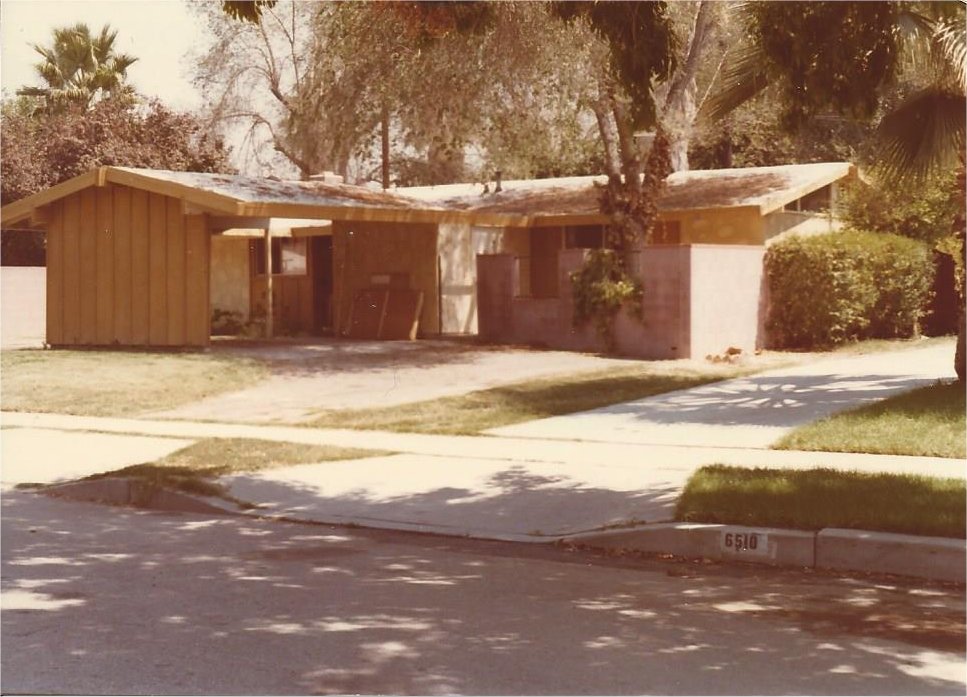
Finally, here is a street view of the house where we lived from roughly 1962 to 1968 — when I was in 2nd through 7th grade — at 6516 Rhea Avenue, in Reseda, Ca.

The house had a semi-circular driveway, with a carport in the middle, no garage. Connecting the carport to the house was a toolshed, with a locked door. It was a 4-bedroom, 1200 square foot house. My bedroom was at the front, in the closest corner to that toolshed.

Earlier family history posts:

Personal History, Part 1, about by parents and my birth in England;

Personal History, Part 2, about how my family settled in Apple Valley, CA;

Personal History, Part 3, with photos from where my parents lived when I was born, taken by me in a visit there in 1990

Posted in Personal history | Comments Off on Family & Personal History, 2016/1

Never Be the Same Again

Best song from the elusive Darren Hayes album WE ARE SMUG…, released online back in 2009, but not available on CD until last year, and which I finally caught up with via Amazon last month.

I am not generally a fan of generic pop music, but a chance encounter in a Time Magazine article, back in 1999 or so, about Hayes and his then group Savage Garden, led me to check them out (partly because Hayes in the accompanying photo was so cute ;), and resulted in a firm devotion. Their tunes were catchy, and many of Hayes’ lyrics were actually pretty smart. About love and romance and genetic drives; a two-CD set, This Delicate Thing We’ve Made, a song-cycle involving time travel and visiting one’s past.

https://en.wikipedia.org/wiki/Darren_Hayes

http://www.dhdepot.net/lyrics/neverbethesame

You can take a broken heart
And smash it through a windowpane
It will break right through
But it’ll never be the same again

Posted in Music | Comments Off on Never Be the Same Again

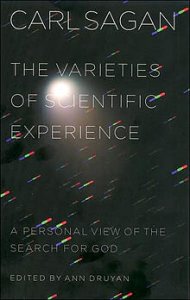
Carl Sagan, THE VARIETIES OF SCIENTIFIC EXPERIENCE (2006): History is a battle of inadequate myths

Here’s a book I had forgotten I had, relatively speaking; I obviously bought it back in 2006 or so, but I didn’t read it right away and so it sat on my shelves among many other books (by Sagan and many others) for years. As I was packing and unpacking books during our move a year and half ago, I noticed it anew, especially since it appeals to my current interest in the grand scheme of things, how science and religion and science fiction intersect and relate. So I pulled the book off the bookshelf, and onto my to-read-shelf, and finally read it last month.

The book compiles a series of lectures Sagan gave in 1985, just five years after his TV series Cosmos was broadcast to great acclaim and made him a media star and frequent Tonight Show guest. The book didn’t appear until 10 years after Sagan’s death in 1996. It’s subtitled “A Personal View of the Search for God”, and is edited by Ann Druyan, his wife, and later writer of Neil deGrasse Tyson’s recent reboot of the Cosmos. All those beautiful words, in that series, that I sometimes quoted at length (e.g. here, were narrated by deGrasse Tyson — but written by Druyan.

And in fact Dryan’s introduction is gorgeous and inspiring, but for the moment I’ll focus on Sagan’s lectures.

The irony is that the lecture series in which Sagan was invited to participate back in 1985 was on the topic of “natural theology”, i.e. the idea that theological knowledge can be established by reason and experience and experiment alone, not by revelation or mystical experience, as Sagan describes in lecture 6. It’s ironic because Sagan, delicately but repeatedly throughout these lectures, dismisses the notion of such theological knowledge. Sagan, throughout his many books, avoided any direct discussion of his opinions about God, or any implication of his atheism. He preferred to dwell on the positive, so to speak — what experience and experiment tell us about the universe itself, and how grand it is. So without ever directly challenging any religious beliefs, in these essays, he repeatedly, politely, mentions such notions and then wonders if we should not perhaps seriously consider that there might be better explanations. In so many words, or less.

The book is a tad dated in its preoccupation with issues that were important to Sagan, and to society, at the time: UFOs, ancient astronauts, the threat of nuclear war.

Brief outline with some quotes:

Lecture 1, “Nature and Wonder: A Reconnaissance of Heaven”

Sagan quotes Plutarch, Carlyle, Einstein, discussing the region between godlessness and superstition, and how the best way to induce awe is by looking up at night. Apparently during this essay there were lots of photos of nebula and diagrams of the solar system, which are captured in the book. p27.6:

And this vast number of worlds, the enormous scale of the universe, in my view has been taken into account, even superficially, in virtually no religion, and especially no Western religions.

Science, Sagan suggests, is informed worship.

Lecture 2, The Retreat from Copernicus: A Modern Loss of Nerve

We tend to “project our own knowledge, especially self-knowledge, our own feelings, on others” and we have a sense of privilege, thinking ourselves the center of the universe. Yes! — here is Sagan, 30 years ago, anticipating what psychologists have been confirming and crystallizing in recent decades, about human mental biases (as posted here about David McRaney, among several related posts). Thus Aristotle presumed a privileged Earth, stationary, around which everything else turned. He was wrong; nor were the heavens perfect. More recently resistance to evolution is an “assault to human vainglory” 39.3; special relativity in the 20th century; dismissing the argument from design; explanations for the anthropic principle; quoting Rupert Brooke’s poem “Heaven” about a fish’s view of reality and eternity.

Lecture 3, The Organic Universe

There are no crystal spheres. 64.2: “The history of science in the last five centuries has done that repeatedly, a lot of walking away from divine microintervention in earthly affairs.” We’re left with a God of the Gaps, a do-nothing king. Evolution is not intuitive because it involves vast amounts of time. Why the objection about the odds against complex molecules randomly forming, like a Boeing 747 forming by a whirlwind, is misguided and ignores the reality of evolution.

Lecture 4, Extraterrestrial Intelligence

We have concepts for more *powerful* beings than us (angels, demigods), but not for beings more intelligent than us. Even scientists can get things wrong, lured by a predisposition to believe: Schiaparelli and his (mistranslated) ‘canali’. What kind of evidence would convince us of demigods, or ETs? Plausibility, to begin with. The Drake equation, failures of imagination, and a Clarke quote about the threat to Christianity of the discovery of ETs.

Lecture 5, ET Folklore: Implications for the Evolution of Religion

Addresses the then (in the ’70s and ’80s) popular notions that “ancient astronauts”, i.e. aliens, visited Earth and were responsible for the pyramids and other artifacts, popularized by the books of Erich von Däniken. Why do people want to believe in such things? Perhaps in hopes of someone to save us from ourselves. There isn’t even one good example of a UFO, and plenty examples of fraud. 134.3: “I maintain, that we are dealing with some combination of psychopathology and conscious fraud and the misapprehension of natural phenomena, but not what is alleged by those who see UFOs.”

People get angry when ‘miracles’ are explained. History of failed prophecies, e.g. charismatic leaders who predict the end of the world, and whose believers still believe even when the world doesn’t end! Discusses the emotional stakes people have in wanting to believe, comparing it the the skepticism inherent in buying a used car.

And you do this for something as unimportant as an automobile. But on issues of the transcendent, of ethics and morals, of the origin of the world, of the nature of human beings, on those issues should we not insist upon at least equally skeptical scrutiny?

Lecture 6, The God Hypothesis

Many ideas of God over the centuries. Suppose there were proof of a god who, say, originated the universe but was indifferent to prayer?

Proofs of God? Sagan cagily starts with a list of 11th century Hindu proofs of their God, among them: Things must have a cause; an argument from atomic combinations; from the suspension of the world (we aren’t falling); the existence of human skills; the authoritative knowledge in the Hindu holy books—surely God must have written them. (Example of Sagan understatement, 154.8, “…these arguments are not always highly successful.”)

Western examples: cosmological, design, morals. He mentions various logical possibilities, then remarks, p157.5, “And it’s curious that human myth has some of these possibilities but not others. I think in the West it’s quite clear that there is a human or animal life-cycle model that has been imposed on the cosmos.” [Yes, exactly!] Followed immediately by his trademark understatement, “It’s a natural thing to think about, but after a while its limitations, I think, become clear.”

Then Anselm’s ontological argument, which Bertrand Russell dismissed as ‘bad grammar’. Personal experiences of God are no more reliable than witnesses of UFOs. Problem of evil. Why long lists of things God tells people to do? 165.3:

Why didn’t God do it right in the first place? You start out the universe, you can do anything. You can see all future consequences of your present action. You want a certain desired end. Why don’t you arrange it in the beginning? The intervention of God in human affairs speaks of incompetence.

Why not clear evidence of his existence? Phrases in the holy books we’d only understand later. Engrave the ten commandments on the moon. Concerning the convergence between revelation and knowledge of the natural world, why is this convergence so feeble when it could easily have been so robust? (Echoes of the Sean Carroll book I just read.)

Lecture 7, The Religious Experience

Our emotional predispositions were set millions of years ago, to some selective advantage. We can examine them by studying modern primitives. Hunter-gatherers. Some are highly hierarchical; others more democratic. One scientists analyzed them against characteristics of whether they hug their children and whether they permit premarital sexual activity among adolescents. Where these things are not permitted, powerful hierarchies emerge; where they do, such hierarchies don’t exist yet everyone’s happy.

Other characteristics: animism; sacrifice (propitiation to the gods) that devolved into prayer, neither of which actually influence the gods, or God, as pointed out beginning in late Victorian times. Not that anyone who believes is convinced. That says something about ourselves. P177b:

I maintain that everyone starts out with that sort of attitude. We all grow up in the land of the giants when we are very small and the adults are very large. And then, through a set of slow stages, we grow up, and we become one of the adults. …

The formative experiences of propitiating adults lingers into adulthood. “Could that have something to do with prayer specifically and with religious beliefs in general?” 178.4. As Freud suggested.

Moving on to discussion of chemicals in the brain. Hormones. LSD. Suppose something called “theophorin”, a material that makes you feel religious. Wouldn’t be useful, for social conformity? Submission to the alpha male, the ruling classes, the biblical God?

Lecture 8, Crimes Against Creation

We cherish tradition, but the world is changing fast. P193t how things have changed from a couple centuries ago. The wisdom of the ancients does not necessarily still apply. Thus, 193.9, “wisdom may lie not in simply the blind adherence to ancient tenets but in the vigorous and skeptical and creative investigation of a wide variety of alternatives.”

Thus science, unprecedented from previous eras. Evidence of extinctions 65mya. The current threat is nuclear war—but how have religions reacted to the threat? The most dangerous are the Christians who see the prospect as consistent with Revelation, and welcome it. The nations of the world stockpile more weapons; what about the Christian dictum to love thy enemy? No nation takes that view.

Lecture 9, The Search

The search for meaning is two-pronged: to understand the universe, and to understand ourselves, p213m.

We are still a world of tribes growing into city-states, nations, empires. We need new alternatives; “We run the danger of fighting to the death on ideological pretexts.” 216.8. History is a battle of inadequate myths, everyone feeling threatened that their own worldview might be exposed as a lie, willing to fight to prevent that, p217t. The prevailing conclusions of science are poorly accommodated by religion, 218. But things have changed: we’ve abandoned the divine right of kings, we’ve abandoned slavery.

We need more than one example of a planet, of an intelligence, before we can understand ourselves better. The search is endless; it

goes with a courageous intent to greet the universe as it really is, not to foist our emotional predispositions on it but to courageously accept what our explorations tell us.

Posted in Book Notes, Cosmology, Culture, Evolution, Human Progress, Provisional Conclusions, Religion, Science | Comments Off on Carl Sagan, THE VARIETIES OF SCIENTIFIC EXPERIENCE (2006): History is a battle of inadequate myths

Growing Up with Books

My parents weren’t readers themselves, but they were conscientious enough in raising their four children to stock our modest home with sets of encyclopedia and other resources. Many of these were adult resources, not the children’s books that fill large sections of bookstores, though there must have been a few of those too.

We had an Encyclopedia Britannica, of the kind common in households in an era long before the internet. We had a set of Harvard Classics, 50 volumes compiled and edited by authorities at Harvard University in 1909, an edition printed in 1961. I still have the set of Harvard Classics. We had a 10-volume set called The Book of Popular Science, probably the 1961 edition seen here; grey-bound volumes with articles about how atoms are like solar systems and how room-sized computers were revolutionizing the world. Alas, I don’t know what happened to those (they probably moved with the family to Tennessee, in 1978, when I stayed on my own in California).

I was told in later years that I was the type of boy who would sit and read the encyclopedia, for fun. I don’t actually recall being so diligent.

And we had a one-volume “red letter edition” of all of Shakespeare’s plays, published by John C. Winston in 1952, “with the most famous quotations printed in red”. I still have this.

We also had a set of children’s books called The Bookshelf for Boys and Girls, like this, nine volumes with stories in some and games and crafts in others. I don’t know what happened to that set either, but I was intrigued enough by my memory of one volume, Things To Make and Things To Do, that I searched the web to identify it and found a used copy via Abebooks a couple years ago and browsed through it. I recalled the instructions for making flowers out of crepe paper, and rebus puzzles.

Finally there was a set of story books called Book Trails, eight slender volumes bound in embossed red leather, ranging from elementary fables in the early volumes (with vivid color illustrations typical of children’s books of the era) to longer tales and myths in later volumes. Somehow I acquired only six of the eight, and I’ve never been able to track down the two separate missing volumes. (I’ve seen complete sets on sale…)

There were also a handful of books in the house that had been my mother’s when she was a girl, notably one Nancy Drew novel, and three novels in a similar series about a detective’s daughter named Penny Nichols. And there was one called Blondie and Dagwood’s Snapshot Clue, based on the comic strip characters. Of these I read and reread the Penny Nichols volumes especially.

I discovered public and school libraries by the time I was in second grade, in Santa Monica, and a few of the books I read from those became lifelong favorites that I tracked down my own copies of years later as an adult. By far my favorites were Enid Blyton’s Adventure series, novels about a family of two boys and two girls living in Britain in the 1940s and 50s, who during ‘holidays’ or convalescence trips were always getting into ‘adventures’ involving criminals, often in semi-exotic locales (e.g. Scotland, Wales, even Europe and northern Africa). The books were alluring in part for their exoticism—the children’s terms of speech and habits of dress and assumptions about school vacations and proper meals were utterly unlike anything in my experience.

One of the volumes, The Mountain of Adventure, included a couple scenes that may have been the first science-fictional notions I ever encountered. [Edit: well…in print. Not counting kiddy cartoon shows like Space Ghost.] The story concerned a holiday trip to Wales, where the children go off on a donkey ride into the mountains and encounter a mad scientist (of German vintage) and his secret laboratory inside a mountain, where he is trying to invent wings that enable men to fly, via some sort of anti-gravity substance. A key scene involves the children’s discovery of a laboratory where some glowing substance exudes a range of colors – including “a color the children did not know!”. The idea that there could be *another* color struck some chord of awe within me.

A second point about Enid Blyton’s Adventure series is one that echoed over the next few years, and indeed to an extent, throughout my life. That is: I was never there at the beginning, or if there at the beginning, missed some of it along the way. Meaning in this sense, the Adventure books I discovered in my school and public library (Vanalden Avenue Elementary, in Reseda, and the West Valley Regional Branch Library, also in Reseda, that I used to walk to from our house, only had five of what I came to realize were eight volumes in the series. The five were Castle, Valley, Mountain, Sea, and Circus, i.e. “The Castle of Adventure” and so on. It wasn’t until the 1980s, in my late 20s, that I learned how to order books directly from the UK, where Blyton was (and still is) much more popular and her books had always been in print, and ordered the three volumes I’d missed: Island (the first one! the origin story!), River, and Ship. I still reread the entire set once every ten years or so, and have blogged about it…

My grandmother’s house, the Apple Valley house, was decorated by a couple rows of Reader’s Digest Condensed Books. These were popular in their day, but seen to have gone extinct in 1997 (they began in 1950), according to Wikipedia (everything is on the internet these days!). They were anthologies, published every two or three months, of abridged versions of current popular novels and nonfiction works, four or five per volume, shortened for casual readers who might be intimidated by full-length books, or who simply liked the convenience of having current popular books pre-selected and condensed for them. One of them, the Autumn 1961 volume, included a condensation of Arthur C. Clarke’s novel A Fall of Moondust (published earlier that year). I’m sure I read that, not in 1961 but likely a few years late – again, one of my earliest exposures to science fiction.

My grandmother had one set of encyclopedia herself: a 10-volume set called The American Educator Encyclopedia, published in Chicago in 1938 (when my mother and her brother were three or four). I managed to ‘inherit’ these after my grandmother’s death in 1984. These are fascinating, partly for the overtly, uh, nationalistic and rather clichéd view of the world outside the US, and partly as a prism into how cultural values have changed since then. There is no article in this set about Gustav Mahler, for example, who died in 1911 and whose reputation was fairly obscure until the 1950s, since when he has become one of the most popular symphonic composers of all time. But not in 1938.

Next post in this autobiographical thread will be about how methods of buying books have changed so many times since I first discovered ways of buying books, in the sixth grade.

Posted in Personal history | Comments Off on Growing Up with Books