The Arc of History: The Expansion of Marriage

So much reaction to today’s Supreme Court decision I hardly need to chime in, except perhaps to note how this, of course, supports my Provisional Conclusion #7,

Another, social, arc of human history has been a gradual expansion of allegiance from immediate social groups to larger social groups, from families and tribes to states and nations, with the social inclusion and equal treatment before the law of more and more people previously marginalized or demonized as ‘the other’. This arc is largely an effect of the growing world population, recent social media, and the consequent coming into contact of previously isolated groups. It involves recognition of the common humanity of children, former slaves, women, of other ‘racial’ and ethnic groups, of sexual minorities, those who adhere to other ideologies and religions, and even other possibly intelligent species.

It’s fun to watch the religious reactionaries squirm, and make threats about civil disobedience or wholesale abandonment of the US for other shores, threats they will never follow-through on. They will get over it. It really is the arc of history, and progress, as has happened again and again, despite conservative resistance (Provisional Conclusion #8).

(If anyone is still obsessed by the so-called ‘traditional’ definition of marriage, see this cheeky Matt Baume video, linked at Huffington Post and many other sites, about the wide variety of historical ideas of marriage, especially from the Bible, which people today no longer endorse.)

Posted in Conservative Resistance, Human Progress, The Gays | Comments Off on The Arc of History: The Expansion of Marriage

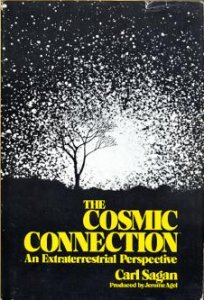
Revisiting Carl Sagan’s The Cosmic Connection

The Cosmic Connection, published in 1973, was the first popular book by Carl Sagan, after some academic tomes and an anthology of essays about UFOs, who later gained much fame as the author and host of the 1980 book and TV series Cosmos (recently remade with Neil deGrasse Tyson as host, and Sagan’s widow Ann Druyan as author), and who wrote numerous other books, including the novel Contact, before his premature death in 1996 at the age of 62.

It was a foundational book in my own experience, likely the first nonfiction book I read aside from those by SF authors like Isaac Asimov and Arthur C. Clarke, certainly the first (aside from those authors) that explicitly evoked the vastness of the universe and humanity’s place in it. And it was one of the first hardcover first editions I acquired, in days when I bought mostly paperbacks and SF book club editions.

(I had requested the book as a birthday gift from my grandmother, in fact. Thinking back, I can reconstruct how I heard of the book in the first place (since the bookshops I frequented did not carry hardcovers at all). In Fall 1973 I began college at UCLA, and soon discovered the original Change of Hobbit bookstore a few blocks away in Westwood, and at that store, copies of a (then) biweekly newsletter (it was mimeographed and stapled together, not yet a magazine) called… Locus. And Locus, in due time, reported the winners of the second annual (1974) John W. Campbell Memorial Award, which included a special award for Nonfiction Book to… The Cosmic Connection by Carl Sagan. The awards were made in April, and likely reported in Locus in May. I had never heard of or seen the book, but made a birthday request to my grandmother on the basis of the Campbell win. My grandmother had to special order it from a local bookstore (in Apple Valley CA), which entailed waiting for 2 or 3 weeks for it to be shipped by the publisher from New York. That’s how those things worked in those days. She got it in June, and went ahead and gave it to me, even though my birthday wasn’t until August. (Knowing nothing about the content or subject of the book, she was a tad mortified to see that back dust jacket depicted the Pioneer plaque, which included line drawings of a nude human male and female.)

The Cosmic Connection, subtitled “An Extraterrestrial Perspective”, has an unusual co-author credit, “produced by Jerome Agel”. I gather “producer” is some combination of editor and packager; Agel’s earlier credits included The Making of Kubrick’s 2001, a fat paperback compilation of background material, reviews, and commentary on that film (which I read obsessively after seeing the film twice on its initial release in 1968), and the Sagan book was apparently commissioned by Agel. The contents of Sagan’s book, some 39 chapters in three sections, are shortish essays on related themes, but semi-independent as if composed in response to (I’m speculating) a list of specific topics Agel developed with the author…. and which can mostly be read in any order.

So how does the book hold up 40 some years later? There’s still lots of inspiring stuff. The entire middle section, on The Solar System, is understandably dated, concerning then current discoveries about Venus and especially Mars, via Mariner 9. There is a certain you-are-there historical thrill in the chapters about Mars, as observers decipher various kinds of data and realize for the first time that there are some *really big* volcanoes on Mars…

The opening section, Cosmic Perspectives, and the final section, Beyond the Solar System, are mixtures of casual thoughts, provocative insights, and profound speculations. Here are some highlights:

  • From the first chapter, “A Transitional Animal”, describing the 5-billion year history of Earth.
     

    In Man, not only is adaptive information acquired in the lifetime of a single individual, but it is passed on extra-genetically through learning, through books, through education. It is this, more than anything else, that has raised Man to his present pre-eminent status on the planet Earth.

    We are the product of 4.5 billion years of fortuitous, slow, biological evolution. There is no reason to think that the evolutionary process has stopped. Man is a transitional animal. He is not the climax of creation.

    (Note the outmoded, déclassé use of the word ‘Man’ to refer to the human species; this was 1973.)

  • Three chapters explore motivations for space exploration on three points: scientific interest, public interest, historical interest. Pages 51-52:
     

    The universe is vast and awesome, and for the first time we are becoming a part of it.

    The planets are no longer wandering lights in the evening sky. For centuries, Man lived in a universe that seemed safe and cozy — even tidy. Earth was the cynosure of creation and Man the pinnacle of mortal life. But these quaint and comforting notions have not stood the test of time. We now know that we live on a tiny clod of rock and metal, a planet smaller than some relatively minor features in the clouds of Jupiter and inconsiderable when compared with a modest sunspot.

    These realizations of the Copernican and Darwinian revolutions are profound — and, to some, disturbing. But they bring with them compensatory insights. We realize our deep connectedness with other life forms, both simple and complex. We know that the atoms that make us up were synthesized in the interiors of previous generations of dying stars. We are aware of our deep connection, both in form and in matter, with the rest of the universe. The cosmos revealed to us by the new advances in astronomy and biology is far grander and more awesome than the tidy world of our ancestors. And we are becoming a part of it, the cosmos as it is, not the cosmos of our desires.

    Page 53.6:
     

    A fundamental area of common interest is the problem of perspective. The exploration of space permits us to see our planet and ourselves in a new light. We are like linguists on an isolated island where only one language is spoken. We can construct general theories of language, but we have only one example to examine. It is unlikely that our understanding of language will have the generaltiy that a mature science of human linguistics requires.

    And as an aside, topics that are controversial today are not new, they’ve been around for decades, e.g. p57:
     

    But we live in a time when the atmosphere of Earth is being strongly modified by the activities of Man. It is of the first importance to understand precisely what happened on Venus so that an accidental recapitulation on Earth of the runaway Venus greenhouse can be avoided.

  • Chapter 9, about the historical interest of space exploration:
     

    But it is remarkable that the nations and epochs marked by the greatest flowering of exploration are also marked by the greatest culture exuberance. In part, this must be because of the contact with new things, new ways of life, and new modes of thought unknown to a closec culture, with its vast energies turned inward.

    Followed by historical examples, especially how the age of European exploration to the ‘new world’ coincided with Montaigne, Shakespeare, the authors of the King James Bible, Cervantes, et al.

    And this striking observation about our current era (p69). As long ago as I read this and have not reread it until now, you can see echoes of these thoughts here in my blog commentaries.
     

    In all the history of mankind, there will be only one generation that will be first to explore the Solar System, one generation for which, in childhood, the planets are distant and indistinct discs moving through the night sky, and for which, in old age, the planets are places, diverse new worlds in course of exploration.

    A human infant begins to achieve maturity by the experimental discovery that he is not the whole of the universe. The same is true of societies engaged in the exploration of their surroundings. The perspective carried by space exploration may hasten the maturation of mankind — a maturation that cannot come too soon.

    He’s being optimistic about the pace of interplanetary exploration, perhaps, but the principle is valid.

  • Chapter 10 is a cute account of giving a talk to first-graders who do, to author’s surprise, understand why we know the Earth is round.
  • Chapter 11 describes the crank mail the author receives, from all manner of crazies, and a case study about a man in an asylum and how he was certain the planets are inhabited. (Because of his personal encouter with “God Almighty”.)
  • Other chapters in Part II involve the incompetence of the CIA and/or Air Force Intelligence; Edgar Rice Burroughs’ Mars novels as the inspiration for so many; more comments about humanity’s influence on the environment (p142b); a restatement of the passage from p69, on p155 (“There is a generation of men and women for whom, in their youth, the planets were unimaginably distant points of light…”); and Sagan’s ‘belief’ that there would be semi permanent bases on the Moon by the 1980s.
  • Section III includes chapters about dolphins, concerning John Lilly, how the author was ‘propositioned’ by a dolphin, and how our disregard for dolphins and whales parallels the dehumanization of human enemies to make them easier to kill, and what this implies about potential contact with extraterrestrials; one about Sagan’s advice to Stanley Kubrick about depicting the aliens in 2001 (don’t depict them, imply their presence indirectly, advice which seems to have been taken)… and Chapter 26, the title chapter, “The Cosmic Connection”, which contrasts the presistent interest in astrology (“In his vanity, Man imagined the universe designed for his benefit and organized for his use” and p186.7, “It satisfied an almost unspoken need to feel a significance for humans beings in a vast and awesome cosmos…”) with the reality of our heritage, as a species on a planet of relatively heavy elements, elements the result of stellar evolution:
     

    The fate of individual human beings may not now be connected in a deep way with the rest of the universe, but the matter out of which each of us is made is intimately tied to processes that occurred immense intervals of time and enormous distances in space away from us. Our Sun is a second- or third-generation star. All of the rocky and metallic material we stand on, the iron in our blood, the calcium in our teeth, the carbon in our genes were produced billions of years ago in the interior of a red giant star. We are made of star-stuff.

    The last sentence a central quote which made it to the dust jacket.

  • Other chapters concern extraterrestrial life as an “idea whose time has come”, focusing on the likelihood of other planetary system [he would so gratified by the recent Kepler discoveries]; a dismissal of the idea that UFOs are evidence of ETs having visited us, mostly on statistical grounds…. artifacts put forward as evidence, especially by Erich von Däniken in Chariots of the Gods, a bestselling book that has since languished into obscurity (I still own the paperback edition depicted on the Wikipedia page), of visitations by alien astronauts in ancient times… p207:
     

    These artifacts are, in fact, psychological projective tests. People can see in them what they wish. There is nothing to prevent anyone from seeing signs of past extraterrestrial visitations all about him. But to a person with an even mildly skeptical mind, the evidence is unconvincing. Because the significance of such a discovery would be so enormous, we must employ the most critical reasoning and the most skeptical attitudes in approaching such data. The data do not pass such tests.

  • Sagan contemplates what it would mean if we succeeded in contact with ETs, via radio signals, even considering the likely decades-long pace of the exchange. p218:
     

    The scientific, logical, cultural, and ethical knowledge to be gained by tuning into galactic transmissions may be, in the long run, the most profound single event in the history of our civilization. There will be information in what we will no longer be able to call the humanities — because our communicants will not be human. There will be a deparochialization of the way we view the cosmos and ourselves.

  • Final chapters expand into considerations of astroengineering (Dyson spheres), classifications of cosmic civilizations, how long it would take for a ‘galactic cultural exchange’ to happen [always assuming the speed of light limitation for communication and travel], and speculation that (the then recent idea of) black holes might serve as a kind of cosmic transportation system.
  • The last three chapters are expansions on the idea of “starfolk” — histories and projections of the universe and mankind’s place in it. Here’s the last paragraph of the second of those chapters (p262).
     

    The births of stars generate the planetary nurseries of life. The lives of stars provide the energy upon which life depends. The deaths of stars produce the implements for the continued development of life in other parts of the Galaxy. If there are on the planets of dying stars intelligent beings unable to escape their fate, they may at least derive some comfort from the thought that the death of their star, the event that will cause their own extinction, will, nevertheless, provide the means for continued biological advance of the starfolk on a million other worlds.

And that is what I was reading at age 18.

Posted in Book Notes, Evolution, Personal history, Quote at Length, Science, Space | Comments Off on Revisiting Carl Sagan’s The Cosmic Connection

Links and Comments: Lucky Numbers; Paleo diet; Narratives about Charleston; Pinker on violence, and the news media

First, keying off my earlier post today about the Alan Lightman book, here’s an essay by George Johnson in the New York Times about Humankind’s Existentially Lucky Numbers.

Four fundamental forces rule reality, but why is the number not three or five or 17? Matter is built from a grab bag of particles whose masses differ so wildly that they appear to have been handed out by a punch-drunk God. The proton weighs 0.9986 as much as the neutron, and each is more than 1,835 times as massive as the electron.

These values, like all the others making up the spec sheet of the universe, seem so arbitrary. Yet if they had been slightly different, theorists tell us, the universe would not have given rise to intelligent life.

Rejecting the possibility that this was nothing more than a lucky accident, physicists have been looking for some underlying principle — a compelling explanation for why everything could only have unfolded in this particular way.

With references to Philip K. Dick and Douglas Adams.

\\

Today on Alternet, from The Conversation: Paleo Diet Only Makes Sense If You Don’t Understand Human Evolution

Because humanity has in fact adapted over the past few hundred generations to adapt to agricultural sources of food. We are no longer paleolithic cave-men.

\\

At Psychology Today, David Niose associates the Charleston tragedy with the history of anti-intellectualism in America: Anti-intellectualism Is Killing America: Social dysfunction can be traced to the abandonment of reason.

He may be overthinking it. (Not that anti-intellectualism isn’t a long-recognized trend in the US; the famous book on this subject is Richard Hofstadter’s Anti-Intellectualism in American Life, from 1963.) But people have a tendency to interpret events in the context of their personal narratives. Especially those whose narratives rule their world-views and are resistant to counter-evidence, i.e. the religious and the ideological. Thus, from this essay at Salon:

Fox provides a support system for hatred, and in this instance its collaborators include people like Rick Santorum, who in a craven act of opportunism turns a racist attack into an attack on, what else, himself and his political base, the religious right; Lindsey Graham, who argues the same and defends flying the Confederate flag as a sign of Southern pride and defiance; Rick Perry, who called the shooting an “accident” (OK, he has now corrected that — he says he meant “incident,” but what an interesting Freudian slip); and those in the NRA who make this about their cause, the right to own arms. Apparently it’s about everything except race, and, more specifically, white supremacy.

Never mind the shooter’s explicit statements about trying to incite a race war; for Santorum and Graham, it’s all about *their religion*.

As Dan Savage summarizes,

Christians are under attack. Nothing has anything to do with race. Guns don’t cause problems that more guns can’t solve.

Of course the best examples of this tendency to contort every current event into predisposed narratives are those religious scolds who see every tornado and mass shooting as due to God’s wrath because of things those scolds personally disapprove of – typically abortion or homosexuality. Daily examples at Right Wing Watch.

\\

To conclude on a more optimistic note, here’s an interview with Steven Pinker, author of The Better Angels of Our Nature: Why Violence Has Declined (2011), at Vox: Steven Pinker explains how capitalism is killing war

[The US is] an outlier among Western democracies along a number of dimensions: the US has a higher rate of violent crime, it gets involved in more wars, it continues to have capital punishment, [and] has high rates of religious belief compared to other Western democracies.

Now, the US is a complex, heterogeneous country. But the more populist southern and southwestern areas are less shaped by the Enlightenment and more by a culture of honor: there are threats, and moral virtue consists in having the resolve to deal with them. A “manliness versus cowardice” mindset.

On top of that American peculiarity, the general style of punditry and analysis both in journalism and the government is event- and anecdote-driven, rather than trend- and data-driven. And we know from cognitive psychology — Daniel Kahneman and others — that people are overly impressed by big, noisy, memorable events as compared to slow, systemic trends. The natural tendency is to go with what you read this morning.

The United States is also in the unique circumstance of having such outsize military power that it has the dual demands of protecting its own interests globally but also being seen in the role of “global policeman.” It’s the only single country that can do that, but it has no official mandate for doing it.

I’ve mentioned the issue of journalism a couple times on this blog. Right-wingers like S**** P***** dismiss the “lamestream media” as politically motivated, but I’m not sure that the media’s most insidious effect. (The public subscribes to whatever media source that confirms their political views, to a large extent.) It’s that ordinary news focuses on outlying events, the occasional mass shooting or horrible traffic accident; no matter how rare such events might be, if there’s one in the world on any given day, the nightly news will focus on that, giving the viewer the repeated impression that things continue to be horrible. Polls have shown that people believe crime is as bad as ever, despite statistics that show major crimes have reduced substantially over the past decade or two… to tie back to Steven Pinker’s book.

This is not to condemn the news media, but to suggest how to understand it. In the long run, however, I’m not sure how this might be resolved. If we reach any imagined utopia, won’t there still be reporters who attract attention (make a living) by identifying the rare events that confound the norm? If not murders and traffic accidents, insults and slights? Imagine a society so perfect, devoid of violence and accidents, where the lead news story is about a subtle insult by one person to another at a dinner party. Utopia indeed.

Posted in Cosmology, Culture, Evolution, Narrative | Comments Off on Links and Comments: Lucky Numbers; Paleo diet; Narratives about Charleston; Pinker on violence, and the news media

James Morrow: We’re not tourists on this planet, we’re citizens

Many thoughts resonate with me in the James Morrow interview in the June issue of Locus, which I excerpted here.

E.g.,

That’s the great gift of the 18th-century Enlightenment, that insistence on a conversation that must never stop, a conversation that must never be shut down by theistic fantasies about the workings of the uni­verse. Absolute certainty is the great malaise of our species, all those clerics and political thinkers who say, ‘Please ignore this pile of bodies over here while I tell you how the world works.’

Here are some other passages that didn’t make it into the posted interview excerpts:

One of my favorite writers and philosophers, Rebecca Newberger Goldstein, invented an athe­ist hero for her recent novel 36 Arguments for the Existence of God: A Work of Fiction, and I’m waiting for someone like that to appear on the scene in modern America. Cass Seltzer becomes a culture hero, because he’s charming and charismat­ic, and he doesn’t irritate people, and yet he’s a rig­orous thinker. He’s called ‘the atheist with a soul.’ Today’s atheist movement needs a real-life Cass Seltzer, and we don’t have one. If I were the kind of person who could become a media celebrity, I like to think I might fill that role. We have no really fa­mous, bestselling public intellectual who champi­ons atheism from a philosophical, theological, and literary perspective, who loves his fellow humans and loves those theists and wants to talk to them, and knows that their way of being in the world is neither privileged nor ipso facto delusional.

And:

In Mem­phis I’ll deliver a talk titled ‘The Seven Deadly Sins of Charles Darwin,’ keyed to my new novel, Galápagos Regained. I can’t remember all seven right now. ‘Darwin killed God,’ that’s one of the sins. He didn’t kill God, of course, but he certainly made hash of the teleological argument, the argu­ment from design, which for centuries was the most satisfying of all the proofs of God. Darwin’s real sin was not so much that he killed God but that he replaced God – replaced him with the Tree of Life, which is something far more magnificent and sublime than anything you’ll read about in Scrip­ture. Here’s another sin: ‘Darwin confiscated our passports,’ by which I mean our passports to Heav­en. After Darwin, it’s difficult to believe the human race is on a trajectory to eternity. Ah, yes, but he gave us something in return. He gave us citizenship papers. Darwin tells us we belong here. We’re not tourists on this planet. We’re citizens. The Earth is our home.

And regarding this passage in the post:

In one of his essays Stephen Jay Gould makes the point that William Jennings Bryan and his fellow fundamentalists weren’t the big losers in the Scopes trial. In the decades that followed, there was a resurgence of Evangelical­ism, and a rise in textbook censorship. When I took biology in ninth grade, not a word was said about the theory of evolution, the Tree of Life, or the in­sights of Darwin. It was all about taxonomy.

Through the vagaries of a family move half-way through high school, I never did take a high school biology course. But it doesn’t surprise me that a high-school biology course could easily avoid the topic of evolution. The high school biology texts I’ve seen focus on things like the cell, and the carbon cycle, and human anatomy, and so on. And the threat of fundamentalist objections shies textbook publishers away from confrontations. I did however take a college ‘breadth’ course on some biological subject (the history of infectious diseases, if memory serves), at UCLA, and do remember the instructor advising the class that while some of them may not ‘believe’ in evolution, it was bound to come up in a biology class and they would just have to live with it.

Posted in Atheism, Culture, Evolution, Personal history, Quote at Length | Comments Off on James Morrow: We’re not tourists on this planet, we’re citizens

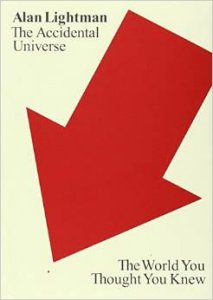
Alan Lightman, The Accidental Universe

Alan Lightman’s THE ACCIDENTAL UNIVERSE (2014) is a short book of seven essays, most previously published, on various ways the universe is not obviously what it appears to be, or is at odds with what humans might prefer. (Lightman is both a scientist and a novelist, and has served both at Harvard and MIT.) As he says in the preface (p. x),

We often invent what isn’t there. Or ignore what is. Why try to impose order, both in our minds and in our conceptions of external reality. We try to connect. We try to find truth. We dream and we hope. And underneath all of these strivings, we are haunted by the suspicion that what we see and understand of the world is only a tiny piece of the whole.

The first, title, essay concerns how the history of science has can “be viewed as the recasting of phenomena that were once accepted as ‘givens’ as phenomena that can now be understood in terms of fundamental causes and principles.” The goal was a ‘Theory of Everything’, in which all the known forces and particles could be ‘explained’ in terms of a small number of basic principles, and perhaps a few arbitrary values (like the weight of the electron).

This ideal may be unreachable; ideas of string theory and inflation imply ideas of a ‘multiverse’, an infinite number of universes, perhaps each with different sets of physical laws. We just happen to live in one that has physical laws suitable for the existence of stars, and life. Other universes would not. That means in a sense ours is ‘accidental’, not necessary in terms of some fundamental principles that drives our set of physical laws.

“The Temporary Universe” has a touching passage about how the author watches the marriage of his daughter and wish she could have remained 10 years old, or 20, forever. (p23b). Humans long for permanence, despite the evidence of the universe that everything passes. “To my mind, it is one of the profound contradictions of human existence that we long for immortality, indeed fervently believe that something must be unchanging and permanent, when all of the evidence in nature argues against us. I certainly have such a longing. Either I am delusional, or nature is incomplete.” (p34.2)

“The Spiritual Universe” is the author’s attempt to understand how both science and religion can coexist in so many minds. He concludes that science, with its central doctrine that all properties and events in the physical universe are governed by laws, is consistent with the religious idea of a God who is unrestricted by such laws (and has a purpose and will, and so on), as long as God stepped to the sidelines once the universe began.

Yet some scientists apparently reject that central doctrine, believing in a God who does continue to intervene in the world–Francis Collins, Ian Hutchinson, Owen Gingerich.

Author stipulates that he himself is an atheist, but understands that we take some things on faith: what is right or wrong, why certain artworks affect us the way they do. [[ I think this is a very loose use of the word ‘faith’ compared to how most people use the word… ]]

He goes on to discuss kinds of scientific knowledge, and kinds of religious knowledge. The former are subject to rational analysis; the latter are matters of personal experience. We need both, he says; both share a sense of wonder. [[ But he’s sidestepping the issue of religious claims to knowledge about the world that are inconsistent with scientific observations… a key theme of Jerry Coyne’s new book and therefore why religion and science are not really compatible. ]]

“The Symmetrical Universe” wonders why we are so attracted to symmetries — perfect roundness, and symmetry of a six-sided snowflake. Symmetry is highly prized as a guidance in physical theories. He supposes that we crave order amidst a chaotic existence… as long as it’s not boring, which is why we also often prefer a slight bit of asymmetry.

“The Gargantuan Universe” concerns how our conception of the size of the universe has gotten so much larger in recent centuries. The size of the Earth was deduced in the 3rd century BC; the size of the solar system and stars, not til nearly two millennia later. We no longer believe that heavenly objects, or living objects, are made of some different kind of matter than everything else. “Science has vastly expanded the scale of our cosmos, but our emotional reality is still limited by what we can touch with our bodies in the time span of our lives.” p99.8 As Kepler identifies more and more Earth-like planets, we can calculate, even being very generous, what fraction of the universe might be alive: an infinitesimal amount (p101t). If the universe was ‘created’, it seems life was an afterthought.

“The Lawful Universe” begins with the Greek notion of atoms, and how Lucretious used the idea as a defense against the idea of the capriciousness of the gods. Yet God remained a viable hypothesis even until Newton’s time; Newton imagined that God was necessary to keep the planets in their courses. Later, Laplace dismissed that hypothesis.

Scientists remain deeply committed to the lawfulness of the universe, with the example of how, when the discovery of beta particles in the early 20th century seemed to violate the conservation of energy, Pauli had the audacity to propose an as-yet-undiscovered particle, a neutrino, to balance the books (rather than abandoned the idea of the conservation of energy). The neutrino was finally observed in 1956.

Finally “The Disembodied Universe” describes Foucault’s demonstration that the Earth really does rotate — something no one can see or feel, except indirectly.

Since Foucault, more and more of what we know about the universe is undetected and undetectable by our bodies. What we see with our eyes, what we hear with our ears, what we feel with our fingertips, is only a tiny sliver of reality. Little by little, using artificial devices, we have uncovered a hidden reality. It is often a reality that violates common sense. It is often a reality strange to our bodies. It is a reality that forces us to re-examine our most basic concepts of how the world works. And it is a reality that discounts the present moment and our immediate experience of the world.

Maxwell’s equations implied ‘invisible’ light, demonstrated by Hertz’ radio wave apparatus. Einstein overturned conventional ideas about time. And quantum physics revealed that matter can be both particles and waves at the same time.

The irony, says the author, is that as science has revealed more of nature than we were aware of, its consequences in technology (cell phones, etc) have separated us from the nature we have access to; we become self-involved, our experience of nature mediated through our devices. People in a nature preserve staring at their phones; a dinner with 25-year-olds, ditto. Just as the author seems to going into get-off-my-lawn! mode, he admits that this is an old story; cultures have long rebelled against changes in the relationship of humans and nature. And there will always be pockets that rebel, becoming disconnected from the human world, and the natural world, in different measures.

Posted in Book Notes, Cosmology, Philosophy, Science | Comments Off on Alan Lightman, The Accidental Universe

The Human Impact on Earth; About Book Culling

A nice Slate photo gallery, a couple days ago, which is not unrelated to the issue of the Sixth Extinction:

Gorgeous, Stunning Satellite Images of the Human Impact on Earth.

I especially recommend watching the video linked at the end, about how astronauts, from Apollo to the Space Station, have had their perspectives expanded by seeing the Earth from space.

Personal angle: I was certain I had a copy of the the book by Frank White alluded to, The Overview Effect, somewhere in my stacks. But I have not been able to find it, even after reorganizing my garage last Friday to sort all the books that haven’t been able to fit into our current house. I’m sure I did have a copy, but I suspect I must have culled it in one of my periodic library reductions. Again and again, I have learned, whenever I cull my collection and dispose of books I think I will never need to see again — something always turns up, something I realize retroactively I am desperate to look at. (I am tempted now to order an expensive copy of The Overview Effect via any number of websites, because I now realize its theme informs my grand provisional narratives…)

Posted in Evolution | Comments Off on The Human Impact on Earth; About Book Culling

The Sixth Extinction and the Pope’s Encyclical

Weekend Facebook post, amended:

The Sixth Extinction: Curious this topic is in the news suddenly, all over the past couple days, since the idea has been recognized for years and the latest Pulitzer Prize winning nonfiction book, by Elizabeth Kolbert, was on precisely this subject. Coincidentally, I read that book a couple weeks ago and will post a summary and comments about it on my blog shortly. The current trigger that all the news is about a new report from an American Association for the Advancement of Science site, http://advances.sciencemag.org/content/1/5/e1400253, which summarizes:

The oft-repeated claim that Earth’s biota is entering a sixth “mass extinction” depends on clearly demonstrating that current extinction rates are far above the “background” rates prevailing in the five previous mass extinctions. Earlier estimates of extinction rates have been criticized for using assumptions that might overestimate the severity of the extinction crisis. We assess, using extremely conservative assumptions, whether human activities are causing a mass extinction.

As the Time article indicates, “this paper hardly breaks ground in its premise…. What differs, here, are the criteria; the scientists estimated very conservatively when it came to how many species have recently gone extinct, and still found that conservative estimate showing the likelihood of an environmental cataclysm.”

Here’s another post about this at Slate: The Earth’s Sixth Mass Extinction is Here—and Humans are to Blame

There’s a tie here with the recent Pope environmental encyclical and criticism of it on the grounds that it dismisses a primary cause: the exploding [in the contest of Earth’s history] population of the human race.

http://time.com/3929419/scientists-sixth-extinction/

http://www.amazon.com/Sixth-Extinction-Unnatural-His…/…/0805092994/

Some realists/rationalists/scientists welcome the Pope’s stance on accepting climate change, while being troubled by his sidestepping of one of the principal causes: the every-expanding population of humanity. (Of course, the Catholic Church’s stance on abortion to birth control has the underlying motivation of *increasing the human tribe*. Be fruitful and multiply! If only the Church would acknowledge that we humans are smart enough to perceive that this advice cannot continue forever, or we will fill up the planet, destroy all other life on the planet, and doom our species.)

Here’s Lawrence M. Krauss at Scientific American:

Ideology Subsumes Empiricism in Pope’s Climate Encyclical

One can argue until one is blue in the face that God has a preordained plan for every zygote, but the simple fact is that if one is seriously worried about the environment on a global scale population is a problem. A population of 10 billion by 2050 will likely be unsustainable at a level in which all humans have adequate food, water, medicine and security.

Posted in Culture, Evolution, Religion | Comments Off on The Sixth Extinction and the Pope’s Encyclical

Bible System Updates

From The New Yorker, last November: Bible System Updates

VERSION 1.0: Original release. Heavens, Earth, formless void.

And so on.

1.6 “Sodom and Gomorrah” N.S.F.W. glitch identified and removed. Bible now free of “Homosexuality” virus.

And then

VERSION 2.0: “New Testament” expansion pack. Adds Jesus features.

And so on and so on.

VERSION 6.0: Homosexuality-compatible. Homosexual colors added back (sea-foam green, fire-engine red).

6.1 Eve now known as Steve.

6.2 “Original Sin” glitch fixed; basic human goodness implied.

And finally,

6.12 “God” feature removed entirely. Replaced with “The Cloud.”

Posted in Religion | Comments Off on Bible System Updates

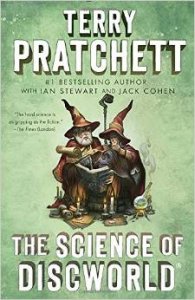
Narrativium and Lies-to-children

I was looking at the third volume in this series, published in the US last week (the publisher, Penguin Random House/Anchor, has kindly been sending me copies), and realized the book wasn’t at all what I’d thought at first glance – i.e. not about justifying the ‘science’ of the Discworld universe, as the title might suggest (the way a book like THE SCIENCE OF STAR TREK might try to do) – but something quite different and much more interesting. I read a few pages of that and then went back to read the first volume, end of last week.

[I confess I have not read any Discworld novel. I need to catch up.]

What these books do (a fourth is due in the US later this year) is *contrast* how the fantasy universe of Discworld works, with the reality of how our own universe works, on two basic points: in Discworld, magic works, and things happen for reasons, i.e. because of narrative imperative. Discworld has ‘narrativium’ p10. Our real world doesn’t have narrativium, though the concept is fundamental to how humans *think* about that world, p11.

The book’s structure alternates fictional chapters (3 or 4 pages each) of a story in which the wizards of Discworld have accidentally created what they call Roundworld, i.e. our own Earth, inside a container that’s infinite on the inside (and thus encompassing our entire universe), with nonfiction passages (8 or 10 pages each) that expound upon the points raised by the story. As the wizards advance the arrow of time to watch Roundworld develop, they are concerned by how things seem to develop without magic and without narrativium – just by virtue of the ‘rules’ or ‘laws’ built into it. As the wizards puzzle things out in the fiction chapters, the nonfiction chapters [presumably by Stewart and Cohen at least mostly] explain what they don’t understand.

So the book is a primer on current scientific thinking about the origins of the universe, physical theories of everything, the formation of our planet, the history of life on earth, the evolution of dinosaurs and ultimately of humans, told in a straightforward, insightful and occasionally cheeky, occasionally profound, manner.

Will not summarize entire book, but will note several insightful points. [Page references are to the Anchor trade paperback edition, where p12t means top of page 12 (m=middle, b=bottom), and p18.3 means 3/10 of the way down page 18.]

P12t: Many important questions of science are not about how the universe actually is, but about what would happen if the universe were different.

P33.3: regarding deep mysteries like consciousness: “A scientist wants plausible answers to such questions, not just an excuse to stop thinking about them.” (Contrasting, of course, the religious and ID proponents who would say God did it, end of story.)

P37m, authors use the idea of a space elevator as a recurring metaphor for e.g. various evolutionary developments: the initial expense of the elevator would be enormous, but once it’s done, and you can balance the cost of moving things up with the energy of things coming down, it’s relatively free.

P41 We have ‘magic’ in our world to the extent we are surrounding by technology that we don’t personally understand; cf. Clarke’s law. But TV, e.g., is magic to everyone who uses it *now*.

P43 Education is a special kind of magic that humans use to pass ideas from one generation to the next. But early explanations to children have to be simple: “lies-to-children”. Most basic science is lies-to-children; only later do some learn the more complex ideas. Examples p44, and footnote comment: students arrive at university confidant they know nearly everything, and leave years later certain they know practically nothing. (I see Lie-to-children has its own Wikipedia entry!)

P52, discussion of human concepts of beginnings and becomings, but the universe may not actually work to those ideas. E.g., our best idea about the beginning of the universe, per Hawking, is that it *didn’t* begin, any more than there’s a place further north than the north pole. But we need creation myths, p58b, that appeal to our sense that things must have beginnings.

P59 In contrast some things about are becomings, with no clear boundary from one stage to the next – e.g. abortions, or gender identity between male and female.

P88.3 Science is common sense *applied to evidence*.

P103-104, description of a computer program called Langston’s Ant, which produces very simple results for a while, then chaotic results, and then emergent order, all resulting from the same simple rule. (The point is, a single simple “theory of everything” wouldn’t ‘explain’ in any obvious way the emergent order that might result from it.)

P185 How humans ‘reify’ ideas by supposing corresponding ‘things’ must exist in the real world. Bravery? Cowardice? Space? Debt?

P188:

Concepts like gods, truth, and soul appear to exist only in so far as humans consider them to do so … But they work some magic for us. They add narrativium to our culture. They bring pain, hope, despair, and comfort. They wind up our elastic. Good or bad, they’ve made us into people.

P219 Amidst some explanation of how DNA works, i.e. it’s not a blueprint, but a series of instructions that have been cobbled together by natural selection because they work, not because they make any kind of obvious sense. (One of many reasons there is rarely a single gene for any particular characteristic.) The comparison is an engineer who ‘evolved’ electronic circuits using a sort of genetic algorithm, repeating attempts each generation by selecting those that were closest to the desired answer. Amazingly, after some 4100 generations a perfect solution was found—which used only 32 of the 100 available logic cells.

P274, in a chapter about probability and statistics, with details about how ‘coincidences’ happen all the time, and so on, and stressing that apparent remarkable incidents are often the result of selective reporting.

Humans add narrativium to their world. They insist in interpreting the universe as if it’s telling a story. This leads them to focus on facts that fit the story, while ignoring those that don’t. But we mustn’t let coincidence, the clump, choose the sample space – when we do that, we’re ignoring the surrounding space of near-coincidences.

P307 Discussion of ‘Deccan Traps’, something I hadn’t heard of before – huge geological deposits of lava that are apparently the consequence of meteor strikes *on the other side of the planet*, strikes which generated shockwaves that converged half way round the world and triggered volcanic events.

P335, nice concept of “Grandfather” as a unit of time for discussion evolutionary periods among recent eras: a Grandfather is 50 years. Thus, Christ lived 40 Grandfathers ago. On this scale, humans diverged from chimps some 140,000 Grandfathers ago. (While simulations have shown that an entire eye can evolve in a mere 8000 Grandfathers, p336.)

P338-9 discussion of how brains are recursive and involve neural networks… How the invention of the nest was crucial to human culture, since humans spend so much time and energy rearing their children. And oh, how high sex drives seem related to intelligence… 😉 About those Bonobos.

P348 Humans compliment their intelligence with ‘extelligence’, all the external influences, culture and otherwise, that affect the brain and the mind.

P351 The context for the evolution of the mind is being among lots of other minds.

Each culture has devised a technique for putting into the minds of the next generation what it is that will make them put it into the minds of the next generations after that – a recursive system that keeps the culture going. Lies-to-children often feature prominently.

And:

We are running into problems doing this today, because old-style tribal cultures, even national cultures, are becoming intermingled with an international culture. This leads to clashes between what used to be separate cultures, triggering their breakdown…

P355 Authors cite a concept from Samuel R. Delany’s 1966 novel Empire Star (which I read years ago), about simplex vs complex vs multiplex:

Simplex minds have a single-world view and know exactly what everyone ought to do. Complex minds recognize the existence of different world views. Multiplex ones wonder how useful a specific world view actually is in a world of conflicting paradigms, but find a way to operate despite that.

And p356 last para:

We are having to cope with multiplexity. We’re grappling with the problem right now: it’s why global politics has suddenly become a lot more complicated than it used to be. Answers are in short supply, but one things seems clear: rigid cultural fundamentalism isn’t going to get us anywhere.

The second to last nonfiction chapter considers the idea that, in the long term (they’ve just reviewed the history of our planet, with its mass extinctions, after all), a planet is not a safe place to be. Where might we go? Back to the idea of the space elevator; Mars; generation ships.

The final chapter acknowledges that this book isn’t called the “Religion of Discworld”… but this is “explained to the hilt” in the second book. They advise, “All religions are true, for a given value of ‘truth’.” P378.

And they ponder what it might mean if there we never do encounter intelligent life, and our world is all there is.

This is our Discworld. In its little cup of spacetime, humanity has invented gods,* philosophies, ethical systems, politics, an unfeasible number of ice-cream flavours and even more esoteric things like ‘natural justice’ and ‘boredom’.

With the footnote: *We apologize to any real gods.”
Posted in Book Notes, Children, Evolution, Narrative | Comments Off on Narrativium and Lies-to-children

Links and Comments: Jerry Coyne; Max Planck; Creationism and Education; Human history and progress; and others

Finished reading Jerry Coyne’s new book Faith Vs. Fact, subtitled “Why Science and Religion Are Incompatible”, which I took extensive notes on that at some point I will summarize here on my blog. Meanwhile, Coyne did a Q&A with National Geographic, In Age of Science, Is Religion ‘Harmful Superstition’?, from which I will quote his key claim in his book:

In a nutshell, why are religion and science incompatible?

They’re incompatible first of all, because they both compete to find truths about the universe. There are some fundamental truths about the universe that believers have to accept in order to be religious. Many Muslims see the Koran as literally true. To question any of that is to bring a death sentence on yourself. The reason why people are so concerned with harmonizing science and religion, as opposed to, say, science and architecture, or science and baseball, is because science and religion are competitors in the field of esoteric truths about the cosmos.

But we use different methods to ascertain what’s true. Science has an exquisitely refined series of methods honed over 500 years to find out what’s real and what’s false. Richard Feynman  gave the best definition of science I ever heard, “It’s a way to keep you from fooling yourself, because you’re the easiest person to fool.” Religion doesn’t have a methodology to weed out what’s false. In fact, it’s a way of fooling yourself. They have authority, revelation, dogma, and indoctrination as their methods and no way of proving their tenets false.

There are thousands and thousands of religions and all of them make incompatible claims about the universe. The reason that that’s the case is because they don’t have any way of testing those claims.

The book is a distillation of the themes of Coyne’s website (he doesn’t like it being called a blog… though it is), and of several important themes of my Provisional Conclusions.

\\

And now a linkdump of items of collected over the past two weeks but which I’ve not had time to post until now. (A scratchy, coughy, sneezy cold has interfered this past week.)

Slate: Louisiana is teaching Creationism: The Bible v. the Constitution

File this under Conservative Resistance

And for that matter this one, not to mention advice from Rick Santorum about not getting an education at a university.

Jehovah’s Witness Leader to Crowd: Only Visit JW-Approved Websites or You’ll Be At “Spiritual Risk”

Cut off the outside world, lest your beliefs would wither in the daylight of reality.

\\

Nice piece about changing one’s mind, and how Max Planck was able to do this throughout his life.

Slate: Genius Move: Max Planck, the unlikely founder of quantum physics, knew how to change his mind.

We live in an age—perhaps the age—of confirmation bias. And given a turbulent sea of information, who can blame us for latching onto the familiar while looking away from anything jarring or mismatched? We yearn for the comforts of our main tribe, be that tribe political, religious, scientific, or economic. If that’s a failing, it is probably a hominid design flaw, far beyond evolutionary recall at this point.

Planck is the one who said “A new scientific truth does not triumph by convincing its opponents and making them see the light, but rather because its opponents eventually die and a new generation grows up that is familiar with it.” This also applies to social standards, too, of course.

\\

A five minute video about how we live in the greatest time in human history (because Industrial Revolution and modern technology).

Vox: 5 minutes that prove we’re living through the greatest time in human history

On the other hand, here’s philosopher John Gray:

Vice: John Gray Says Human Progress Is a Myth

His point is all apparent ‘progress’ could easily be swept away. I agree; see my Provisional Conclusions.

\\

New York Times op-ed by Molly Worthen: Wanted: A Theology of Atheism.

I’m not entirely on board with this; like many religious writers, this writer assumes that the accouterments of routine religious faith are somehow necessary for mental and social health, even if redirected to something non-supernatural. Typical lack of imagination, or myopia.

\\

One more from NYT: Timothy Egan on The Arrogance of Jeb Bush

You simply cannot be a leader of the Republican Party without appearing to know less than a fifth grader about earth science. …

“And for the people to say the science is decided on, this is just really arrogant, to be honest with you,” said Bush. “It’s this intellectual arrogance that now you can’t have a conversation about it even.”

[The opinion writer asks:] Is it arrogant to say that smoking causes lung cancer? That you shouldn’t text and drive? That the American diet and lifestyle cause Type 2 diabetes, which is killing people? There is some wiggle room in each of those assertions. But you test them at your peril. Since when did prudence become a vice in a family whose presidential patriarch was guided by what “wouldn’t be prudent”?

\\

Nice summary of plans to build huge new telescopes: Vox: These giant telescopes are going to change astronomy.

Unfortunately, the ones in Hawaii are being held up by locals who feel such telescopes would desecrate their holy grounds.

\\

Two more interesting items from Vox.

Steven Pinker explains how capitalism is killing war

A gloss on Pinker’s 2011 book The Better Angels of Our Nature, which argues that human violence has greatly reduced in recent centuries, that humanity is becoming more peaceful.

[ My own aside, not a thought in this article or anywhere else: so then, what is fueling the anger in the US about threats to the 2nd amendment to stock up arms, and the attendant paranoia that the Obama administration is about to take away all their guns? (Which conspicuously has not happened.) I suspect this is an issue apart from the trend of actual violence, which Pinker addresses. ]

One more, without comment: Game of Thrones is secretly all about climate change

\\

Finally, a cartoon that is spot-on about how most people assume their religion from their environment, and if they think about it at all, somehow don’t realize how very lucky they were to grow up in an area where the one true religion was revealed.

The Outsider Test for the Right Faith

Posted in Book Notes, Psychology, Religion, Science | Comments Off on Links and Comments: Jerry Coyne; Max Planck; Creationism and Education; Human history and progress; and others