First, because the general subject fascinates me, here’s a response, by Samuel Goldman in The Week, to the Rauch/Wehner essay in NYT I posted about two days ago about what it is about the left that makes conservatives tolerate Trump.

First, because the general subject fascinates me, here’s a response, by Samuel Goldman in The Week, to the Rauch/Wehner essay in NYT I posted about two days ago about what it is about the left that makes conservatives tolerate Trump.

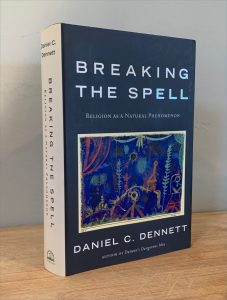
Two contrasting perspectives, today, both passages I just happened to read during my morning web browsing. Rival worldviews. One characterizing religious myths, the other about Kim Stanley Robinson.

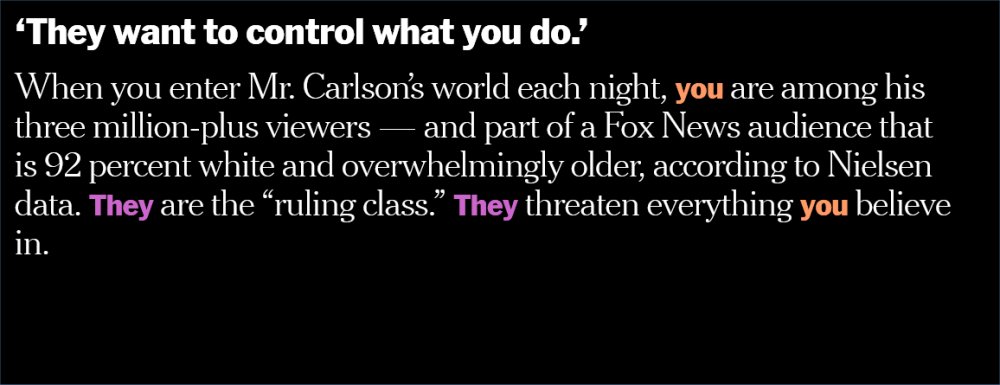
NYT, Jonathan Rauch and Peter Wehner, posted 20 Jan 2022: What’s Happening on the Left Is No Excuse for What’s Happening on the Right

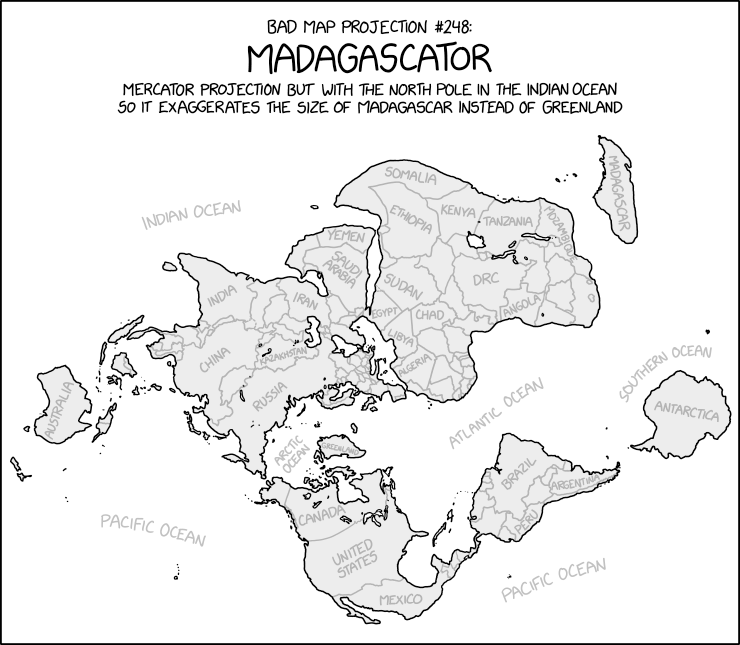
Here’s one of my favorite counter-intuitive facts: how our impressions of the sizes of countries and continents that we get from (flat) maps are wildly inaccurate.
This slender book was first published in 1988 (I have the 1990 paperback edition) and became a bestseller. It was one of the earliest books on the very general theme of how many people don’t understand the world around them, or believe things about it that aren’t so. (This is what I mean, partly, when I refer to people who “don’t know how the world works,” in the sense they have no idea of proportion and size and thus no clue about what things are plausible or not – and thus are prey to so many conspiracy theories.)
Sunday’s New York Times Magazine had an interview with SF writer Neal Stephenson, whose latest novel is Termination Shock.

NYT Times Magazine: Neal Stephenson Thinks Greed Might Be the Thing That Saves Us
E.O. Wilson’s THE SOCIAL CONQUEST OF EARTH, from 2012, is in my estimation one of the four most significant books by this scientist and writer. (The others are ON HUMAN NATURE, 1978; CONSILIENCE, 1998; and THE MEANING OF HUMAN EXISTENCE, 2014.) And it’s the one book to read before all the others, for two reasons: It summarizes his thinking in many different areas (as explored separately in other books), and it refines and expands on his core ideas that began in ON HUMAN NATURE (and before), which is to say, a book like OHN is in a sense an earlier version of this book, and comparing them directly would show how a scientist’s ideas mature and grow.
We are weary of this, as I alluded a few posts ago, but that’s what they count on, I think, that the events of the past year, or past five years, will become the new normal.

(I refuse to link any pic of DJT, so I’ll post this random image of flowers from Google Images instead.)
This was Wilson’s second to the last original book, and it’s quite short, perhaps simply a long essay; 125 pages divided into 7 chapters with illustrations and blank pages in between; many references, and an index.
Key Points
What is creativity?
It is the innate quest for originality. The driving force is humanity’s instinctive love of novelty—the discovery of new entities and processes, the solving of old challenges and disclosure of new ones, the aesthetic surprise of unanticipated facts and theories, the pleasure of new faces, the thrill of new worlds. We judge creativity by the magnitude of the emotional response it evokes. We follow it inward, toward the greatest depths of our shared minds, and outward, to imagine reality across the universe. Goals achieved lead to further goals, and the quest never ends.