Links and Comments: An Abortion Thought-Experiment, and Conservative Thinking

Salon: The Twitter thought experiment that exposes “pro-life” hypocrisy. Subtitle: “Comedian and sci-fi writer Patrick Tomlinson on the dangerous question that abortion foes refuse to answer”

Last Monday, a tweetstorm eviscerating abortion foes went viral. Science fiction writer and comedian Patrick Tomlinson introduced it this way:

Whenever abortion comes up, I have a question I’ve been asking for ten years now of the “Life begins at Conception” crowd. In ten years, no one has EVER answered it honestly.

The question is as follows: Would you save one 5-year-old child from a burning building, or save 1,000 embryos. The point: No one actually thinks that embryos are the same as living children. But an entire movement is based on lying about it, and using that lie to manipulate people, in order to control women like slaves.

The balance of the Salon article consists of an interview Tomlinson (whose work in SF I am not familiar with), from which I noticed a couple passages in particular. First, Tomlinson claims he never got a straight answer to his thought-experiment — but he did get personal attacks against him:

If no anti-choicer could answer the question Tomlinson posed, they could still respond — with everything from death threats to a DDOS attack on his website. Which only proved his point: They can’t handle the truth. And they desperately need to protect the lie, as if their very lives depended on it.

(The more interesting questions is: why do some people “desperately need to protect the lie”? I think I know; it’s been a theme in this blog.)

And, discussing the classic conservative movement,

The intellectual foundations of the movement is described by people like Edmund Burke or Oakeshott. They conceived of conservatism as a counterweight to the utopian impulses of the left. Progressives in England at the time — which is where both those men originated — were very much about legislating away human vice. They were like, we can fix all the problems of humanity through the power of government. The conservative movement had its intellectual roots as a pushback against that impulse, saying, “No, we have to base this on facts. We have to base this on logic and evidence. We have to base this on real-world examples, and we have to adapt policies to human nature, instead of assuming human nature can be adapted by policy.” And that’s what I say when I say I’m a conservative, which is what the word meant for more than 100 years, before it was co-opted by the extreme religious right in our country.

I was just reading about Burke in the Steven Pinker book I’ve been reading; Pinker contrasts the values of the Enlightenment with Burke’s “tragic view of human nature,”

In that vision, human beings are permanently saddled with limitations of knowledge, wisdom, and virtue. People are selfish and shortsighted, and if they are left to their own devices, they will plunge into a Hobbesian war of all against all. …

And so on. (Pinker p184) Pinker goes on to reflect how extreme visions of human nature — “a Tragic visions that is resigned to its flaws, and a Utopian vision that denies it exists — define the great divide between right-wing and left-wing political ideologies.” (p186)

This recalls one of the earliest sea changes in my own life’s thought — how in the 1970s it was widely thought, especially by those promoting various civil rights movements, that there was no psychological or mental difference between men and women. Give boys and girls equivalent experiences and toys, and they will not grow up into familiar masculine and feminine stereotypes. That turned out simply not to be true, as I learned beginning with E.O. Wilson’s ON HUMAN NATURE; there are in fact differences between the sexes, differences which moreover are entirely understandable via evolutionary psychology and the taking into account of the differing reproductive strategies of males and females.

The long-term problem with the conservative movement, it seems to me, is by clinging to its perception of an essentially flawed human nature, it does nothing to overcome base tribalism and hostility toward others, and a supernatural perception of the world which is objectively false. The better understanding of human nature is, again, an inescapable conflict and see-saw balance between individual, ‘selfish’ desires, the result of individual natural selection, and altruistic desires that are the result of group selection, as Wilson describes in recent books; and the innate variability of human mental perception that manifests itself in the range of personality types along the axes of Haidt’s moral foundation theory (cf.). These insights tie in nicely with Pinker’s ongoing (as I read) description of the ‘Civilizing Process’ and the ‘Humanitarian Revolution’, in which the former desires are gradually tempered by the latter, as groups of human gather and co-depend on larger and larger groups. The rule of law (‘Leviathan’ Pinker calls it) is part of it, but so is the increased empathy of individuals necessary to get along in a large community of people different from oneself. (This is one reason why everything Trump is doing is wrong. The future harmony of the world, the avoidance of nuclear war and the stewardship of the planet, does depend on international political alliances, trade agreements, and scientifically-based revision of our industrial and technological policies.)

Back to Tomlinson:

The attacks are meant to silence and intimidate, in order to preserve the status quo of the conversation and the underlying power dynamic. The nominal right wing has long positioned itself as the true arbiter of absolute morality, patriotism, fiscal responsibility, respect for the troops, defenders of life, liberty, yada yada. It lets them set the parameters and tone of public debate.

Never mind that in literally every instance, their claims to ethical and moral authority are laughably false. “Conservatives” are responsible for installing a Russian traitor in the White House, exploding the deficit under Bush II (which Obama cut by a trillion dollars, with a T) and refusing funding for the VA to handle the surge in wounded veterans that resulted from their wars of choice. They have relentlessly attacked the gains we’ve made in health care coverage and the uninsured rate with the ACA, and on and on.

With many examples around every corner:

https://www.vox.com/2017/10/22/16516184/trump-tax-reform
https://www.salon.com/2017/10/22/dumb-and-dumber-trumps-foreign-policy-repeats-decades-of-american-mistakes/
http://www.patheos.com/blogs/friendlyatheist/2017/10/21/trump-administration-pushes-abstinence-and-rhythm-method-over-contraception/

Conservatives, it seems to me, are people who refuse to learn, or benefit from others’ experience. They just *know* what should be so.
Posted in Conservative Resistance, Culture | Comments Off on Links and Comments: An Abortion Thought-Experiment, and Conservative Thinking

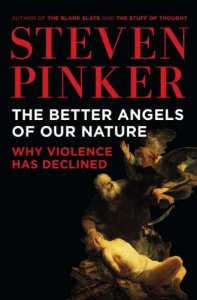
Steven Pinker’s THE BETTER ANGELS OF OUR NATURE, Chapters 2 and 3.

More on Steven Pinker’s magisterial 2011 book, The Better Angels of Our Nature: Why Violence Has Declined — one of the best books of the 21st century, surely — that takes a long-range view of human history to show that the human condition, over millennia and especially in recent centuries and decades, has vastly improved in terms of the reduced likelihood of any person dying of violence, and thus the betterment of the human condition.

(Earlier posts on this book here and here)

A bit more on Chapter 1: A Foreign Country

  • The medieval knights – like those in Camelot – were set in the 6th century, via stories written in the 11th to 13th. The stories recount extreme violence every few pages – skulls split, decapitations, etc. etc. Lancelot was regarded as a ‘gentleman’ for never killing a knight who begged for mercy.
  • The realm of early modern Europe, its kings and queens, includes beheaded queens and other murders among family members, as recounted in Shakespeare. Grimm’s fairy tales include at least three stepmothers who attempt to murder their children. Punch and Judy were a famous puppet act, featuring infanticide and murder. Even Mother Goose, in the 17th and 18th centuries, features traumatic violence of a sort that wouldn’t be tolerated today.
  • Honor’ later involved duels, as that of Alexander Hamilton, who died in one. Dueling is an example of a behavior that persisted for centuries, before abruptly vanishing, and becoming subject to ridicule, p23t.
  • In the 20th century we’ve seen a decline in martial culture – e.g. the flaunting of public works of military men, the naming of subway stops for military battles, etc. In contrast, modern memorials to wars more often list names of the victims.
  • Even nuclear weapons were glamorized in the 1950s, via names like ‘bikini’ and the design of toys and cafes. Everyday force was common – men engaging in fistfights; Truman threatening a critic with a black eye; Charles Atlas ads. [[ and Star Trek!! In the 1960s, patterned after TV Westerns of the time, with stories that routinely included fistfights, a feature IIRC absent from TNG just two decades later. ]]
  • 1950s TV featured spousal abuse; ads implied it; a song in (the very famous stage musical) The Fantasticks was all about rape.
  • Children were spanked, now rare.
  • P28-29, author imagines a speech given in 1976 that promised a peaceful future – in which he would likely not be believed.

TL;DR summary of detailed notes below:

Chapter 2: Pinker describes the “Pacification Process,” in which the violence that arose in the human species (comparing how violence is carried out by chimps) was mostly deployed for strategic reasons: competition with other tribes; as a means of discouraging attack by others; and to promote individual and tribal glory, which is a means of demonstrating ‘credibility,’ i.e. the promise of effective response to attacks.

Hobbes’ solution was the “Leviathan,” the idea of a government of some sort that has a monopoly on the use of force. And this is more or less what happened, the Leviathan brought about by the historical forces of growing population and the agricultural revolution.

Chapter 3: And then, the “Civilizing Process”: Evidence shows violence in cities is lower than in rural areas, that the trend toward urbanization and cosmopolitan life encouraged decreased violence. Pinker describes medieval life, etiquette manuals, how primitive cultures of honor gave way to culture of dignity, from the 11th to 18th centuries, as people adopted greater self-control and empathy and in order to live together and larger and larger groups.

There have been aberrations, like World War II. And violence is still more common among lower classes (who feel themselves out of touch with the local ‘Leviathan’ or government) and in remote areas or the world.

And then Pinker explores why violence increased in the 1960s, and then decreased again the 1990s, with some startling insights into the red vs. blue state divide in the US, and why the apparently coarse culture in contemporary US is a sign of progress, not social decay.

\\

Detailed notes with quotes:

Chapter 2, The Pacification Process

  • Hobbes and Darwin both provided insights into the origins of violence.
  • Darwin’s theory has (since his day) been extended with genetics and game theory, e.g. Dawkins characterization of animals as ‘survival machines.’ His analysis indicates however bloody animals may attack each other, it’s for strategic reasons, p33t – only when it would benefit them.
  • Hobbes, in contrast, supposed that it was inherent in man to quarrel, for three reasons: competition; diffidence [i.e. fear of being attacked]; and glory. We understand today why wives would be subject to competition, because of different investments of men v women. The idea of glory, or honor, is best thought of as ‘credibility’ p34.8. The security trap is solved via deterrence, e.g. MAD during the Cold War. We also understand now how “a major design feature in human nature, self-serving biases, can make each side believe that its own violence was an act of justified retaliation while the other’s was an act of unprovoked aggression.” P34b. (later, p46.5 characterizes these three reasons as gain, safety, and credible deterrence.)
  • But Hobbes wrote of anarchy; his solution was ‘Leviathan,’ a government of some sort that has a monopoly on the use of force. Law is better than war; see diagram 35b.
  • In contrast to Hobbes was Rousseau who thought primitive savages innocent and gentle.
  • The debate between the two viewpoints became political in the 20th century, with liberal ideals preferring Rousseau. But neither had any evidence. We can do better, by examining rates of violence in societies that live under a Leviathan, and those that live in anarchy.
  • P36, Violence in human ancestors
  • We can start by examining chimps, with whom we share a common ancestor. Jane Goodall observed how gangs of chimps attack each other, especially isolated males; kill others’ offspring, and so on p37-40
  • Our own species is about 200,000 yrs old, behaviorally modern for 75,000 yrs, and only for the past 10,000 yrs has lived in “stratified societies numbering in the millions, eat foods cultivated by agriculture, and are governed by states” p40b. But that 10K boundary marks only the earliest societies that farmed; some areas took much longer. Nor are societies only hunter-gatherer, or agricultural; many are a blend. True states didn’t appear until 5,000 years later.
  • It was long thought that nonstate societies were ferocious barbarians. Evidence shows same kinds of raids and battles that chimps engage in; plenty tales of savagery, to p56, even cannibalism. Three reasons; most commonly for vengeance, as deterrence against other attacks.
  • Rates of violence: it’s important to discuss how rates of violence in a population are significant, not absolute numbers. Then follow several pages of charts and discussion, e.g. p49, showing very high rates among prehistoric sites, and contemporary hunter-gathers, and very low ones in modern centuries.
  • P56, so was Hobbes right? In part. Even in such states, life is peaceful most of the time.
  • Why did our ancestors leave Eden? 57m. It might not have been a choice: growing population required agriculture, even if early settlements (as in the Bible) involved “totalistic ideologies and brutal punishments” p57.8
  • And complex societies are more likely toward other problems… p58.3: “People were less likely to become victims of homicide or casualties of war, but they were now under the thumbs of tyrants, clerics, and kleptocrats…”

Ch3, The Civilizing Process

  • Author tells anecdote about growing up, and how he never understood the rule about not using one’s knife to scoop peas onto one’s fork.
  • Now he understands, due to the work of Norbert Elias, who published a book in 1939 called The Civilizing Process (from which chapter title is taken).
  • Later, in 1981, someone plotted historical rates of homicide in Europe, from 1200 to 2000 – figure on p60 – showing great declines, by close to a factor of 100. Despite stereotypes about the idyllic past…
  • Further data confirms the trend, and in other European regions. It seems that urbanization made life safe – not more dangerous! Quote p64b:
    • “Is it your conviction that small-town life, centered on church, tradition, and fear of God, is our best bulwark against murder and mayhem? Well, think again. As Europe became more urban, cosmopolitan, commercial, industrialized, and secular, it got safer and safer.”
  • Back to Elias—he started by analyzing 15th-century drawings of medieval life (p65,66)—showing various depravities and acts of violence, as seen through the eyes of a knight.
  • Knights of that time were what we would today call warlords. Quotes from Barbara Tuchman (from her popular book on the 14th century), with examples of violent games and the routine idea of cutting noses off.
  • Tuchman and others note how the temperament of medieval people was childlike, impulsive, uninhibited.
  • Elias also examine etiquette manuals, e.g. long lists of rules about bathroom issues, manners at the dinner table, and so on –p69ff – issues we expect 3-year-olds to understand today; but these were written for adults!
  • They were all about: control your appetites; delay gratification; consider the sensibilities of others; don’t act like a peasant; distance yourself from your animal nature. (p71t)
  • They were about shame—not hygiene, which wasn’t then understood in modern terms.
  • There are remnants of these changes in the language; there were rules about using knives, not displaying them too casually; even taboos about their use—including a rule about pushing food around. Aha! P72.5
  • So Elias’ theory is that, over a span of centuries from the 11th to the 18th, a culture of honor gave way to a culture of dignity; people became socialized at younger ages. Two trends: self-control; and empathy.
  • Critics of Elias note that all societies have ‘standards of propriety’… and Elias conceded that there “is no zero point”, i.e. there was no baseline with no standards at all.
  • Elias proposed two ‘triggers’ for this change. First, the consolidation of a genuine ‘Leviathan’, i.e. centralized monarchies after centuries of feudal baronies and fiefs. Monarchs discouraged fighting among the knights, because they caused losses. Homicide became a state matter. Fealty to monarchies entailed courtly manners; courtesy. Thus those etiquette guides. And the military revolution, with the invention of gunpowder, and the necessity of state to support expensive technologies.
  • Second, economic revolution, hobbled by Christian resistance to commerce, that money was evil etc., p75b. Thus the Jews become the moneylenders! And business developed positive-sum games; the trading of surpluses; keying off evolutionary psychological insights about sympathy, trust, gratitude, guilt, anger, p76m.
  • Thereby came divisions of labor; a network of transportation; and idea of money, to replace barter. [[ need to compare Harari, whose notion is that money was one of the key ideologies (he even calls them religions – i.e. an agreed-upon shared belief that something that didn’t physically exist, nevertheless existed ]]. All of this summarized as ‘gentle commerce.’
  • In a sense both of these – Leviathan, and gentle commerce – were part of a single organic process; and here Pinker explicitly cites Robert Wright’s Nonzero, p78.6
  • Elias’ theory made a prediction that turned out to be true: that rates of violence did drop, over that period.
  • So what about World War II? Well, that was different; it wasn’t a retreat to feudalism or anything of the sort.
  • Pinker acknowledges libertarian skeptics who point out how norms of cooperation develop anyway, e.g. with example of the sailors in Moby-Dick. Author points out that even these live with the ‘shadow’ of Leviathan – another example of ranchers in northern California. Minor disputes would be solved by their culture of honor; yet serious disputes would accede to governmental oversight.
  • There are two rule-proving exceptions to this trend of decreasing violence over history: lower classes, and isolated areas of the world.
  • Violence was once common among aristocrats (e.g. Romeo & Juliet opening) but is now virtually zero. Violence still persists among lower classes, but mostly as a pursuit of justice, as a reaction against insults, unfaithful partners, etc., feeling themselves stateless out of reach of legitimate government.
  • Second, the civilizing process began in western Europe and spread outward; mountainous regions, e.g. Scotland and Ireland, remained violent longer. We don’t have comprehensive data about trends in much of the world; WHO data p88. But recall anecdotes about how the Chinese don’t allow knives at the dinner table at all – food is cut into bite sized pieces in the kitchen (of course!) – suggesting a similar pattern of increased etiquette that paralleled a gradual decline of violence.
  • And violence rises in former colonies as they go independent (and government oversight loosens or withdraws).
  • P91 What about the US? Why is violence in the US so high compared to Europe? It’s not just the effect of having more guns; US is more violent even when the effects of gun are taken away (i.e. violence due to knives, etc. etc.)
  • The answer is that the US is really three counties. Violence is higher in southern states, in part due to the legacy of the civil war, and the origin of immigrants – many Scots and Irish settled the South. Violence is higher among blacks, because they are more likely lower class.
  • In a sense democracy came too early to the US, with its 2nd amendment established before civilizing effects had taken place. Thus the South developed a culture of honor—promises of personal retribution for disputes, rather than an appeal to law. Recall Daniel Boone, Davy Crockett, the Hatfields and the McCoys. Southern states give a person wide latitude to kill in defense of property, have fewer gun restrictions, etc., 99b. Yet is there an exogenous cause? Again, the Scots and Irish were herders, and herders around the world depend on this kind of culture of honor to protect their assets.
  • Then there’s the American West, p102, with its cowboys, miners, and so on. Here the reason was the preponderance of men, who with the alternatives of beings ‘cads’ vs. ‘dads’, more often acted the former. The west was tamed by the eventual influx of women, and temperance movements to restrain alcohol. The marriage effect is well-known among sociologists as a civilizing effect on men. P106
  • Here Pinker summarizes with a cogent conclusion of these trends to explain the current blue vs. red state divide in the US:

“An appreciation of the Civilizing Process in the American West and rural South helps to make sense of the American political landscape today. Many northern and coastal intellectuals are puzzled by the culture of their red state compatriots, with their embrace of guns, capital punishment, small government, evangelical Christianity, “family values,” and sexual propriety. Their opposite numbers are just as baffled by the blue staters’ timidity toward criminals and foreign enemies, their trust in government, their intellectualized secularism, and their tolerance of licentiousness. This so-called culture war, I suspect, is the product of a history in which white America took two different paths to civilization. The North is an extension of Europe and continued the court- and commerce-driven Civilizing Process that had been gathering momentum since the Middle Ages. The South and West preserved the culture of honor that sprang up in the anarchic parts of the growing country, balanced by their own civilizing forces of churches, families, and temperance.”

  • Then what happened in the 1960s? Both the US and Europe, rates of violence went up; murder rates per 100,000 from 4 in 1957 to 10.2 in 1980, and 72 among blacks. The trend was depicted in popular culture, with TV and movies focused on urban violence. Conservatives won elections by being “tough on crime.”
  • Various solutions have been proposed. Partly it was an effect of baby boomers, a growth in the population of young people, especially in proportion to older people. Also their connection in an age of TV (when everyone watched the same three networks) and the transistor radio, a shared culture brought about a feeling of solidarity among that generation. And increased democracy brought about an ‘informalizing process’ 109b, affecting dress and manners.
  • Also, the ‘establishment’ became blotted with moral stains: the threat of nuclear war, poverty, mistreatment of native Americans, the Vietnam war, the oppression of women and homosexuals.
  • These currents pushed back against elements of the ‘civilizing tide’—self-control relaxed, so that “if it feels good, do it”; and the idea of interdependency eroded, thus the “rolling stone”, and “tune in, turn on, drop out” and many similar notions in song lyrics and movie scenes.
  • Along with these, reaction against the ideal of marriage and family life, which became Ozzie and Harriet corny. Hippies flaunted standards of cleanliness and continence. They threw away their watches; no one cared what time it was. Rock musicians smashed guitars on stage, events that at times spilled over into interpersonal violence.
  • So: were the reactionaries who vilified rock music right?
  • Not exactly. There were other trends. Criminal justice relaxed, and elites found Marxism fashionable to the point of excusing some kinds of violent protest. Law enforcement retreated; people abandoned city centers for the suburbs. And the sexual revolution left young men without the responsibilities of marriage and family.


  • And then in the 1990s the trend in violence reversed, returning to 1950s level, and even below. No one predicted it, and still there is no simple explanation.
  • One idea, promoted by the authors of Freakonomics, was that availability of abortions in the ‘70s led to the non-births of unwanted children, who otherwise might have grown up lawless. But studies, and actual data, don’t support the theory. (E.g. the women who do have abortions are more likely to plan for the future; those who don’t are more likely to have children who don’t and who are the irresponsible ones more likely to commit violence.)
  • Rather, there were two areas of causes. First, ‘Leviathan’ became more effective; second, the civilizing process was restored.
  • First: incarceration rates increased, perhaps more than it should have, but this removed from the general population those most likely to commit violence. (Canada didn’t, and their violence rate declined too, so this is only part of the explanation.)
  • And police forces expanded, aligned with the popular ‘broken windows’ theory that encourages good behavior if minor problems around neighborhoods are addressed. Experiments support it. [[ This recalls such mental biases as the anchoring effect, and priming. ]]
  • Second, norms changed. Some of the radical ideas of the ‘60s lost their appeal. Civil rights movements made law and order a progressive movement, not just a reactionary one.
  • And some communities organized women and church groups to break up gangs and encourage good behavior, e.g. in Boston.
  • And a change in punishment strategy made it not so random and more predictable, in ways that appeal to our psychology, 126.7.
  • And there were prominent rallies, the Million Man March and Promise Keepers, which may have had positive effects despite their “unsavory streaks of ethnocentrism, sexism, and religious fundamentalism…”
  • Pop culture, it’s notable, is still decadent – violence in movies, in video games, pornography, is as common as ever. The difference is now people treat it ironically, post-modernly. People indulge in counter-culture looks without adopting unconventional lifestyles.
  • This might be a sort of ‘third nature’, following the first two; we consciously reflect on cultural norms to decide which are worth adhering to, and which have outlived their usefulness. Further, we can *afford* to indulge in ‘decadent’ behavior – swearing, very casual dress – because those things are no longer true indicators of cultural decay.

This last point is startling. It’s commonly thought that contemporary culture is coarse and degraded, in that profanity is more commonplace (even in staid print publications) and fashion is sloppy and lascivious, compared to say the 1950s. Pinker suggests how the opposite is true; I’ll quote in detail, from p128:

If our first nature consists of the evolved motives that govern life in a state of nature, and our second nature consists of the ingrained habits of a civilized society, then our third nature consists of a conscious reflection on these habits, in which we evaluate which aspects of a culture’s norms are worth adhering to and which have outlived their usefulness. Centuries ago our ancestors may have had to squelch all signs of spontaneity and individuality in order to civilize themselves, but now that norms of nonviolence are entrenched, we can let up on particular inhibitions that may be obsolete. In this way of thinking, the fact that women show a lot of skin or that men curse in public is not a sign of cultural decay. On the contrary, it’s a sign that they live in a society that is so civilized that they don’t have to fear being harassed or assaulted in response. As the novelist Robert Howard put it, “Civilized men are more discourteous than savages because they know they can be impolite without having their skulls split.” [And, recalling the anecdote at the beginning the chapter, Pinker concludes] Maybe the time has come when I can use a knife to push peas onto my fork.

(And yes, he’s quoting Conan author Robert E. Howard – see https://en.wikiquote.org/wiki/Robert_E._Howard.)

Posted in Steven Pinker | Comments Off on Steven Pinker’s THE BETTER ANGELS OF OUR NATURE, Chapters 2 and 3.

Silverberg: All Sadnesses Flow to the Sea

The planet cleanses itself. That is the important thing to remember, at moments when we become too pleased with ourselves. The healing process is a natural and inevitable one. The action of the wind and the rain, the ebbing and flowing of the tides, the vigorous rivers flushing out the choked and stinking lakes—these are all natural rhythms, all healthy manifestations of universal harmony. Of course, we are here too. …

This is the opening of a short story by Robert Silverberg, “The Wind and the Rain,” first published in 1973. The early 70s was an era when Silverberg was becoming more experimental with his fiction, both in the way he challenged and subverted some standard science fictional assumptions, and in the way he employed unconventional narrative techniques (some directly inspired from non-sf writers of the time, like Robert Coover).

There’s not so much a traditional beginning-middle-end story here as a gradual revelation of the situation. The narrator is a member of a ‘reclamation team,’ apparently humans from another world who have returned to this ancestral home of humanity, to clean it of the pollutions that destroyed its ecosystem — —“If we were not here at all, the planet would repair itself anyway within twenty to fifty million years. It is estimated that our presence cuts that time down by somewhat more than half.” (Shades of Foundation!)

They inject chemicals into a large river. They don’t have to know what they’re doing; they just follow instructions. They visit Tokyo, and plant trees. They write a poem – a thesaurus section for the word ‘destruction’ – and toss the poem into the river.

They visit Richland, Washington, and admire the ‘comic solution’ of placing nuclear waste near an earthquake fault, where the estimate of safe storage is only a century or so.

In Uruguay, a small village has been preserved under a dome, the dead inhabitants frozen in their positions.

In California, they consider the historical irony of trying to deal with the loss of otters, that used to eat sea urchins, which now unchecked cause the kelp to die; and how treatments for each symptom made the others worse.

They will have to pry up the concrete and metal encasing the planet. (Shades of Trantor!)

The inhabitants used to wear breathing suits. Theological speculation: if created by God, why did God let the planet be ruined? Perhaps the ruined planet is a self-contained artistic achievement.

Is what they do pointless, turning this ruin into just another world? The planet will heal anyway.

Rumors of a live earthman turn up a robot on a Tibetan plateau. They dissect it.

The story ends:

“The wind. The rain. The tides. All sadnesses flow to the sea.”

As Silverberg notes, in his introduction to this story in his COLLECTED STORIES VOLUME 3, the alarm about ecological damage to the planet — which goes back centuries, perhaps — is sometimes misplaced. It’s not about damage to the planet. Indeed, the planet has undergone wild swings of climate change in the past. There have been huge extinction events. The planet recovers. But not most of the species who have ever lived. The damage humans are inflicting — again, that Sixth Extinction — won’t kill the planet, but it might well kill the human race.

I reread a bunch of Silverberg collections, beginning with the earliest, right about a year ago, up through those early ’70s collections, and took many notes. This past week I’ve resumed that attention, rereading a few I read last year but didn’t take notes on, and plan to post a kind of reading log. Let’s see how that goes.

Posted in Robert Silverberg | Comments Off on Silverberg: All Sadnesses Flow to the Sea

Links and Comments: War on Science; How to Make a Prophecy; Nazis and Magic

Catching up on some saved links from some weeks ago…

NYT: long editorial, from Sept. 9th: President Trump’s War on Science

Among the points: the Trump administration has
— Stopped a study of the health risks of mountaintop-removal coal mining; earlier studies revealed cases of birth defects and cancer;
–“Even allowing for justifiable budgetary reasons, in nearly every case the principal motive seemed the same: to serve commercial interests whose profitability could be affected by health and safety rules.”
–Trump has called global warming a “hoax”
–and so on.

Related: Trump Promised to Hire the Best People. He Keeps Hiring the Worst

This is not my original thought, but consider this: if a foreign power bent on the destruction of the United States were to infiltrate its government and inject officials into government positions with the key task of dismantling and undermining those positions, wouldn’t that be an act of war? Or if from within the US, an act of treason? How is that different from the efforts we’re seeing by the short-term-goals driven Trump administration?

Trump, it seems to me, can be counted on to make the worst decision, to make the worst appointment to any position, conceivable. He can be counted on to do the wrong thing, every time.

\\

Patheos.com: Want to Make a Prophecy? Then Follow These Rules

1, The prophecy must have predictive power
2, The prophecy must be specific
3, The prophecy must be counterintuitive
4, The prophecy must not be influenced by the prophet

Needless to say, prophecies in religion and fantasy fiction do not fulfill these requirements.

Why do storytellers resort to such flimsy devices? Why are the prophecies so unclear as to be left futile, if not completely useless? Probably because the authors of such works grew up being sold on the idea that prophecies are cryptic, an idea handed down to them from their religious upbringing.

Indeed, when trying to prove the Bible’s divine inspiration, a favorite recourse of fundamentalists is to point to prophecy. Among the more popular examples are: the Old Testament prophesied Jesus’ arrival, Daniel predicted the march of world powers, and Revelation predicts the end of days.

\\\

From back in August, at Slate: The Nazis Were Obsessed With Magic; subtitle: “What can their fascination with the supernatural teach us about life in our own post-truth times?”

An interview with the author of Hitler’s Monsters: A Supernatural History of the Third Reich.

Grouping astrology, some practices in archaeology, history, and folklore, and out-there scientific theories together under the heading “the supernatural imaginary,” Kurlander writes about how the popularity of border thinking guided the Nazis in creating their own political reality in Germany.

Posted in Conservative Resistance, Religion | Comments Off on Links and Comments: War on Science; How to Make a Prophecy; Nazis and Magic

Today’s Classic Song/Video: In the Air Tonight

“I was there and I saw what you did, I saw it with my own two eyes…”

“I’ve been waiting for this moment for all my life … I can feel it in the air tonight”

Memorably used in the 1983 Tom Cruise film Risky Business (http://www.imdb.com/title/tt0086200/)

Posted in Music | Comments Off on Today’s Classic Song/Video: In the Air Tonight

Links and Comments: Tribalism, Zero-Sum Politics, Trump, Gut Reactions, Weather Forecasting

First, Andrew Sullivan has an essay in New York magazine, America Wasn’t Built for Humans, subtitled, “Tribalism was an urge our Founding Fathers assumed we could overcome. And so it has become our greatest vulnerability.”

He wonders how American has split to severely into two warring tribes.

I mean two tribes whose mutual incomprehension and loathing can drown out their love of country, each of whom scans current events almost entirely to see if they advance not so much their country’s interests but their own. I mean two tribes where one contains most racial minorities and the other is disproportionately white; where one tribe lives on the coasts and in the cities and the other is scattered across a rural and exurban expanse; where one tribe holds on to traditional faith and the other is increasingly contemptuous of religion altogether; where one is viscerally nationalist and the other’s outlook is increasingly global; where each dominates a major political party; and, most dangerously, where both are growing in intensity as they move further apart.

And how the American project was to avoid this, through compromise and the defeat of emotion by reason. Sullivan discusses the idea of tribalism, mentioning recent books by Dominic Johnson and Sebastian Junger that I’ve seen. A key problem is the electoral structure of our democracy, where whoever gains a slight advantage (not even a majority) runs everything.

What you end up with is zero-sum politics, which drags the country either toward alternating administrations bent primarily on undoing everything their predecessors accomplished, or the kind of gridlock that has dominated national politics for the past seven years — or both. Slowly our political culture becomes one in which the two parties see themselves not as participating in a process of moving the country forward, sometimes by tilting to the right and sometimes to the left, as circumstances permit, alternating in power, compromising when in opposition, moderating when in government — but one where the goal is always the obliteration of the other party by securing a permanent majority, in an unending process of construction and demolition.

How being tribal means you don’t have to think, just know which side you’re on. Whataboutism. Sullivan points fingers at both sides, with many examples of hypocrisy in which one side criticizes the other over some policy, that that side gets into power and adopts the same policy. “No tribe was more federalist when it came to marijuana laws than liberals; and no tribe was less federalist when it came to abortion. Reverse that for conservatives. For the right-tribe, everything is genetic except homosexuality; for the left-tribe, nothing is genetic except homosexuality.” And, “As for indifference to reality, today’s Republicans cannot accept that human-produced carbon is destroying the planet, and today’s Democrats must believe that different outcomes for men and women in society are entirely a function of sexism.”

And how Evangelicals treated Obama with contempt, and yet embraced Trump. Examples of how the left uses the word “hate,” how the right, e.g. townhall.com, describes the left.

Ironically, Sullivan sees Trump as a potential solution (!) — because he’s *not* an idealist on any side, he’s an opportunist.

Sullivan has two ideas for changing the tribalistic culture: value individuality, and mutual forgiveness. “It doesn’t matter if you believe, as I do, that the right bears the bulk of the historical blame.”

And then in Slate, Isaac Chotiner’s All Tribes Are Not Equal, subtitled “Andrew Sullivan’s simplistic diagnosis—and unrealistic cure—for what ails us,” responds to Sullivan.

The problem here, which recurs throughout the essay, is that one tribe’s pathologies have infected our political system (and in this case endanger the planet). The other tribe’s supposed pathology is not reflected in the policies of its party. Even if your average Democrat or your average Democratic politician believed there were no genetic differences between men and women (an odd idea in its own right), it is not a public policy issue.

I.e., the right really is far worse than the left.

Which brings us to a Facebook post by David Brin, reacting to an op-ed by George F. Will in Washington Post that trots out the usual “both sides are equally bad” saw… Brin, who takes both sides to task as he sees appropriate, nevertheless sees no parity.

No. You lie. While the FAR-left CONTAINS some nasty horrors, today’s ENTIRE-Right CONSISTS of poison memes. And despite your desperate incantations, ever-more Americans are realizing the difference between FAR and ENTIRE. Between CONTAINS and CONSISTS. Between anecdotal lefty flakery and universal righty insanity.

Moreover, it’s failing. As your cult attacks every single fact-using profession … including not just scientists, teachers, journalists, civil servants, economists, etc., but now those notorious “deep state” villains in the FBI, the intelligence agencies and military officer corps… nearly all the bright people who actually know stuff are seeing through your miasma-spell of false equivalence. They are seeing that democrats actually have a pretty good record of moderation, negotiation, balance and vastly-better actual outcomes.

\\

And then we have a Newsweek article by Charles Sykes, How the Right Lost Its Mind and Embraced Donald Trump.

By a former conservative who can’t believe how that movement has changed.

Somehow a movement based on real ideas—such as economic freedom and limited government—had devolved into a tribe that valued neither principle nor truth; luminaries such as Edmund Burke and William F. Buckley Jr. had been replaced by media clowns such as Ann Coulter and Milo Yiannopoulos. Icons such as Ronald Reagan—with his optimism and geniality—had been supplanted by the dark, erratic narcissism of Donald Trump. Gradualism, expertise and prudence—the values that once were taken for granted among conservatives—were replaced by polls and ratings spikes, as the right allowed liberal overreach in the Obama era to blind them to the crackpots and bigots in their midst.

Trumps came along, trotting birtherism. “In private, conservatives who knew better justified their return to the dark fringes on the grounds that it fired up the base and antagonized liberals. Or as Palin put it so memorably in 2016, ‘It’s fun to see the splodey heads keep sploding.’ The result was a compulsion to defend anyone attacked by the left, no matter how reckless, extreme or bizarre.”

Again, the writer was a conservative, became a liberal, until rejecting its “smugness, its stridency and dogma,” but now can’t align with conservatives either: “If the conservative movement is defined by the nativist, authoritarian, post-truth culture of Trump and Bannon, I want no part of it.”

\\

My provisional conclusion: there are errors of idealistic presumption on the left, but the right appeals to worst, tribalistic aspects of human nature, to the point of denying long-term trends that threaten the human race, and right now they are in charge. The outlook is not good.

\\

Via:

A study from Ohio State University on beliefs about what is and is not “truth” shows, unsurprisingly, that those who rely on their “gut” and presume facts to be dependent on their political bias are way more likely to believe in things that are straight-up false. Kelly Garrett, one of the researchers, said:

People sometimes say that it’s too hard to know what’s true anymore. That’s just not true. These results suggest that if you pay attention to evidence you’re less likely to hold beliefs that aren’t correct.

Unsurprising; file this under the many ways human intuition does not accurately perceive the world, especially about things that are out of the ordinary, or about things for which a person already has a bias (e.g. becuase of tribal loyalty) toward or against.

\\

Slate: The Meteorologist’s Lament, subtitled, “Weather forecasting is better than ever—but the public doesn’t seem to realize that.”

An example of how people judge better or worse on the evidence immediately at hand, without perspective of, in this case, how much worse weather forecasting was a few decades ago.

A variation of the idea of how people will always be alarmed by the evening news, as long as there is a single murder or natural disaster anywhere in the world, on any given day.

Posted in Conservative Resistance, Culture, Lunacy, Provisional Conclusions | Comments Off on Links and Comments: Tribalism, Zero-Sum Politics, Trump, Gut Reactions, Weather Forecasting

Isaac Asimov: Foundation

Rereading classic SF in the 21st century: In which I both tease out themes of, and try to summarize, Isaac Asimov’s first Foundation book.

I reread Isaac Asimov’s Foundation, i.e. the first book in the ‘Foundation Trilogy,’ a couple weeks ago. I think this is the fifth time I’ve read the book, though on only two of those four previous occasions did I soldier on to read the remaining two books of the ‘trilogy.’ (And of the various sequels Asimov wrote much later, in the 1980s, I’ve read a couple of them once only, a couple others not at all.) (And, despite Gregory Benford’s acknowledgement of my role in his Foundation novel, mentioned here, http://www.markrkelly.com/Views/?p=710, I have not read any of the three B’s later Foundation novels. I will.)

I put ‘trilogy’ in quotes because while the ‘Foundation Trilogy’ was an omnibus of three previously published books, most of the contents of those books were published years earlier as a series of novelettes and novellas, in Astounding Science Fiction magazine, throughout the 1940s. When gathered together for book publication in their early 1950s by Gnome Press, they were divided up into three volumes, titled Foundation, Foundation and Empire, and Second Foundation. Each was a linked collection of from two to five stories; none of them was exactly a novel.

The three books were gathered together in a single volume called The Foundation Trilogy: Three Classics of Science Fiction in 1963 by Doubleday, a volume that went on to become a featured selection of the Science Fiction Book Club (which was an arm of Doubleday). And that volume was in fact one of the three introductory selections that I chose when I first joined the club in 1969. Later I also bought the ubiquitous paperback editions from Avon, with their distinctive geometrical illustrations on white backgrounds.

These books are still the most famous works by Asimov, and represent a stage in what Donald Wollheim, in his book The Universe Makers, considered the default future history of mankind — (discussed here: http://www.markrkelly.com/Blog/2015/09/18/rereading-donald-a-wollheims-the-universe-makers/) —  as conceived by science fiction of the time, which is to say, a far future era in which humanity has expanded into outer space and has settled *millions* of planets, inhabiting virtually the entire galaxy as a single human empire.

Asimov’s interest in these stories was the idea of how human history might be foretold; he drew heavily on the ideas of Edward Gibbon’s famous The History of the Decline and Fall of the Roman Empire (https://en.wikipedia.org/wiki/The_History_of_the_Decline_and_Fall_of_the_Roman_Empire), about how such a mighty empire could begin to decay at the edges and gradually bring itself down. Asimov’s premise was that advanced mathematics, and theories of history, could *predict* such a decay — and moreover, suggest ways that small, surgically-precise steps in local politics, might ameliorate that decay, in order to rebuild a second, stronger empire.

I think in my previous readings of this book, I lost interest at the end because the last story of this first book is curiously undramatic. Nothing happens at the end, other than the main character deciding not to intervene, and just let things happen. Why he does that, and what he thinks will happen, are significant, but they don’t leave you with any suspense about what might happen next.

Here are some general notes on the series as a whole, and some very condensed summaries of the five stories in the first book, Foundation, first published in 1951.

General comments:

  • The book consists of five sections, four of them originally published as novelettes in Astounding in 1942 and 1944, with the initial section new to the book as published in 1951.
  • Each section consists of a series of scenes consisting almost entirely of dialogue. The book is like a play of five acts, each act broken into scenes.
  • Though some of the early stories were written not long after the earliest Robot stories, there’s little of the egregious characterization and exaggerated saidisms that we saw in those stories, and in “Nightfall.” (As noted in this earliest post about Asimov’s short fiction: http://www.markrkelly.com/Blog/2015/08/28/rereading-isaac-asimov-part-1/ ) Perhaps the stories were revised for the 1951 book publication? We know at least one was.
  • Asimov precedes many sections of the stories with long quotations from the “Encyclopedia Galactica” as a way of filling in background material, somewhat as Star Trek did with its captain’s logs, though in a more general way.
  • Page references here are to the SFBC edition of the trilogy.

General internal background:

  • The earliest stories are set about the year 12,067 in the Galactic Era; (there’s also a reference, page 4b, to 12,000 years of Imperial progress). At the same time, there’s a reference to mankind having atomic power for 50,000 years (!), p50.0, suggesting that it took 20th century Earth millennia (38,000 years!?) to expand into a galactic empire.
  • Everyone seems to speak a common language.
  • There’s no overt religion… just the phony religion set up by the Foundation to control technology.
  • There are no aliens, and no robots.
  • People don’t live any longer than they do now; cf. comment p30.4 about how no one alive now will be living a century from now.
  • Everyone (well, the men, since there are barely any women in this book) smokes cigars.
  • The Empire consists of 25 million inhabited planets.
  • Ships jump instantaneously through hyper-space.

Part I, The Psychohistorians

  • This story was new to the 1951 book, and for me has always been the most memorable story in the book.
  • It follows one Gaal Dornick, a mathematician from the planet Synnax, as he arrives on a spaceship at Trantor, the center of the Galactic Empire, to interview for a job with Hari Seldon, who has developed a theory of ‘psychohistory’ that predicts the collapse of the empire within several centuries.
  • Seldon is shortly arrested and put on trial, his sentence commuted on the condition that he and his team of 100,000 relocate to the remote planet of Terminus – a plan Seldon had anticipated, and perhaps maneuvered, all along. Seldon mentions that, in addition to Terminus, a second refuge will be established, at “Star’s End,” to implement his plans. And Seldon anticipates his own imminent death: “I am finished.”

Key points:

  • Trantor is an extrapolation, obviously, of Manhattan (though when the earliest stories were written, Asimov’s hadn’t yet moved to New York, but was living in Philadelphia) – a crowded city of skyscrapers that, on Trantor, had expanded to cover the entire planet. It’s a single city of 40 billion people.
  • The city is so all-engulfing that many people never see the sky; when Dornick ascends a Tower to see the sky, he’s told how some people get hysterical here.
  • Psychohistory is defined on page 14; its key points are that it deals only with large groups, and with groups unaware of the analysis – not with individuals.
  • Seldon, in a memorable scene, challenges Dornick to use the principles of psychohistory on the spot, to calculate a certain result – without offering him a ‘calculator pad.’ That is, here’s Asimov anticipating hand-held calculators, in 1951.
  • Seldon explains that his plan is to reduce the interregnum between the fall of this empire and the rise of the next, by saving all human knowledge, in an Encyclopedia Galactica (which, as we’ve already seen through quotes, apparently was eventually written).

Part II, The Encyclopedists

  • The original 1942 version of this story, the first ever Foundation story published, in Astounding in May 1942, was called “Foundation,” and opened with a page and a half introduction as Hari Seldon conducts a last meeting of a group he’s worked with for 20 years to plan two “Scientific Refuges” at Terminus and Star’s End – at opposite ends of the galaxy, he says – to help build a Second Galactic Empire after this one falls. This section ends with Hari saying, “I am finished!” This original version of the story was reprinted in The Great SF Stories 4 (1942), edited by Asimov and Martin H. Greenberg (DAW, 1980).
  • This story is set 50 years after the first, and is set on Terminus, where the encyclopedists, running the show, anticipate release of the first volume in 5 years.
  • The gist of this story is that Terminus, where Hari Seldon’s 100,000 academics have settled, is being run by academics who are naive about the local politics of their planet with respect to other nearby planets. On one of those planets, Anacreon, the Royal Governor has declared himself king. Since Terminus is mineral-poor and depends on trade, Salvor Hardin, the mayor of Terminus, tries to raise alarm.

Two key scenes:

  • An envoy from Anacreon visits, and inadvertently reveals that his planet has lost the ability to use nuclear power, and has reverted to using oil and coal. The envoy strongly implies Terminus needs Anacreon’s protection, for the price of establishing a military base on Terminus.
  • An imperial envoy, Lord Dorwin – who lisps and takes snuff (Asimov’s characterizations are not subtle) – discusses the “Origin question” about which planet humanity actually originated from. He does his ‘research’ by reading the books of older archaeologists, and thinks this is the ‘scientific method’.

Resolution

  • The political tension is resolved as Salvor Hardin and his aide stage a coup, taking control of Terminus away from the academicians and to politicians.
  • The dramatic tension resolves as a pre-recorded 3D message from Hari Seldon appears in a ‘Vault,’ to announce that the idea of writing an Encylopedia was a fraud – his real plan was to shorten the barbarism between empires, and that the solution to the current crisis – which he had foreseen 50 years before – is “obvious”!

Key points:

  • The empire is crumbling as massive bureaucracy precludes new development and research – this seems to be the key thesis in Asimov’s projection of a collapsing empire, illustrated here as planets lose atomic power; the ‘scientific method’ is a matter of reading books.
  • Terminus is at the political mercy of its neighbors, with no imperial support.
  • The encyclopedia itself was a decoy; the real plan is to shorten barbarism between empires. (We already knew this, from the first story, later written; but the folks on Terminus apparently did not.)
  • Hardin cites a maxim: “violence is the last refuge of the incompetent.” This is repeated several times. Hardin diagnoses the current situation as one of deferring to authority or to the past, like the encyclopedia itself, instead of pursuing new research or training new technicians. Hardin thinks a bigger issue is: why was only one psychologist included at Terminus? Was Hari Seldon trying to hide something from them?

Part III, The Mayors

  • (This story was first published in Astounding, June 1942, as “Bridle and Saddle.”)
  • The solution to the crisis of the previous story is given in passing: mayor Salvor Hardin pressured the other three of the nearby ‘Four Kingdoms’ to force Anacreon to withdraw its threatened takeover of Terminus, lest the other three fall next. Then Terminus began providing scientific aid to all Four Kingdoms – but in the context of a priesthood, of a religion about the Galactic Spirit and so on, with priests being taught only empirical knowledge of how to run the atomic generators, not the real science behind them, p86t.
  • The conflict of this story begins with a challenge to Hardin by a cabal of young politicians, led by Sef Sermak, to take action against the Four Kingdoms.
  • Meanwhile, a derelict imperial battle cruiser has been found by Anacreon, and the leader there, the regent Wienes watching over the young King Lepold, demands that Terminus repair it for him.
  • On Anacreon, Wienes itches for war with Terminus – but Lepold hesitates, fearing it might be blasphemy to challenge the head of the church.
  • On Terminus, Hardin seems unconcerned. One of Sermak’s aides returns from Anacreon to report that the religion there works.
    • 106m: “Ethically it’s fine. It scarcely varies from the various philosophies of the old Empire. High moral standards and all that. There’s nothing to complain about from that viewpoint. Religion is one of the great civilizing influences of history and in that respect, it’s fulfilling—“
    • And how the Foundation fostered this delusion; the monarch (King Lepold) rides around on a floating chair surrounded by a radioactive aura, to underscore his divinity.
  • Hardin, in fact, makes a trip to Anacreon to celebrate the coming of age of King Lepold. During the celebration, regent Wienes confronts Hardin with news that military action has begun against Terminus. Hardin responds by calmly waiting for midnight – when a prearranged strike by the entire priesthood takes place, and the power goes off, and king’s aura fades, and his floating chair falls to the floor. Mobs outside riot for Hardin’s release.
  • Meanwhile, the imperial cruiser – repaired by Terminus but now in use by Anacreon against it – is cursed by the priest on board, and turns back to Anacreon.
    • P124b: “For it is the chief characteristic of the religion of science, that it works…”
  • Hardin tells Wiemis a fable about a horse and a wolf – the bridle and saddle – about how, once accepted, the yoke of science cannot be shrugged off. Wienis, enraged, tries to kill Hardin – who’s surrounded by his own aura. Wienis kills himself.
  • Later, back on Terminus, it having established a new treaty with Anacreon, Hari Seldon makes another pre-recorded appearance. Again, he assesses the situation in generalities – but warns against the overconfidence of attacking:
    • “The Spiritual Power, while sufficient to ward off attacks of the Temporal is not sufficient to attack in turn. Because of the invariable growth of the counteracting force known as Regionalism, or Nationalism, the Spiritual Power cannot prevail. I am telling you nothing new, I’m sure.”
  • And he reminds them of the other Foundation, at Star’s End.

Key points:

  • Terminus placates its hostile neighbors by offering them technology—but in the guise of a religion; technology which they use but do not understand.
  • On these planets the technology enables the rulers to seem semi-divine, with glowing auras, etc. But the smart politicians know the religion is a ruse to control the masses.
  • Hari Seldon foresees the reign of religion giving way to regionalism, or nationalism.

Part IV, The Traders

  • (This story was first published in Astounding in October 1944 as “The Wedge.”)
  • The focus of this story is about interstellar traders, who work outside politics and forge connections among planets in advance of the politicians. The theme, boiled down, is that the Foundation is trying to lure independent planets back under Foundation control by tempting them to buy atomic devices.
  • We begin as one such trader, Limmar Ponyets, receives instructions from his Guild to proceed to the planet Askone, a closed planet whose nationalistic tendencies reject [Foundation-derived] atomic gadgets of any sort, but where a visiting trader, Eskel Gorov, has been imprisoned. Moreover, Gorov is a Foundation agent, with the specific mission of persuading key government officials to purchase atomic gadgets, and thus extend the Foundation’s controlled commercial empire, p142b.
  • Ponyets comes to Askone and deals with its Grand Master, who objects to ‘devil’s machines’ and claims atomic goods are worthless because they lack ‘ancestral blessing.’ But Ponyets perceives that the GM is wheedling for a bribe, and so whips together a slapdash transmuter, and demonstrates in the GM’s court that it can turn iron to gold, and arranges to sell the device to the GM in exchange for the release of Gorov, with a bit of blackmail to assure the deal is never revealed.

Key points:

  • Another Salvor Hardin epigram: Never let your sense of morals prevent you from doing what is right!
  • An issue on Askone is the local ancestor worship, 143.4—deferral to “simple and virtuous heroes of the past generations.”
    • (Hmm; you could call the deference to America’s ‘founders’, and the idea of Constitutional originalism, as a kind of ancestor worship…)
  • Again, the politician Grand Master is educated, and realizes religious customs are ritualistic… 150.4.
  • Note that the transmuter isn’t a trick; it works, but will only work for a short time, which Ponyets uses in his blackmail of the GM. It’s the wedge.

Part V, The Merchant Princes

  • (This story was first published in Astounding in August 1944 as “The Big and the Little.”)
  • This story begins back on Terminus, some 70 years since the last “Seldon crisis” – i.e. story #3.
  • The issue here is the possible re-appearance of atomic weapons – outside the Foundation’s control – on one of the independent planets, suggesting that planet may have re-contacted the Empire.
  • There’s also the suspicion by Terminus that the traders are getting out of hand, perhaps engaging in treachery.
  • The trigger for both ideas is the reported disappearance of three trade ships in the Korellian Republic and the possible appearance of atomic weapons there. Could this be another “Seldon crisis”? Master trader Hober Mallow is sent to Korell to see what’s going on. The planet is ruled by the despotic Argo family, led by ‘Commdor’ Asper Argo.
  • Mallow lands on Korell and sits for a week before an unusually dramatic scene unfolds: a Foundation emissary appears outside his ship, demanding refuge. Mallow’s crew accedes, despite Mallow’s instructions, and to his extreme anger, as a mob appears outside demanding the emissary’s release. Mallow knows no Foundation emissary is even allowed on this planet, and so he has no legal grounds to protect him; Mallow perceives this a test by Commdor Argo. He releases the emissary to the mob and sure enough shortly receives an invitation from Commdor Argo.
  • Thereupon commences a negotiation, as Argo claims he is all for free trade – just not with religion. Mallow offers him riches, including a belt that generates a lovely glow over a woman’s body. Asper gives it to his hostile wife the Commdora – she is contemptuous of his ambitions, until she gets the belt, looks at herself in a mirror, and is assuaged. [She, and her maid, are the first and only female characters in this book.]
  • Mallow’s motive is to inspect the factories on this planet, to see if they really do have atomic power. He sees, by chance, a Korellian security guard in possession of an atomic weapon—with the symbol of the Empire on it.
  • Then in an odd sequence of scenes, Mallow travels by himself inward into the Empire, and lands on the planet Siwenna, apparently at random, and meets a sad old man, Onum Barr, and via him manages to bribe himself inside one of the local atomic plants—which, he deduces, is kept running by technicians who don’t know how to repair anything that goes wrong.
  • Mallow returns to Terminus, where he faces political charges over the abandonment of that emissary, and criticism for becoming wealthy due to private deals he made with the Korellians. Mallow claims the Foundation’s use of religion to control trade is outdated. Put on trial, he reveals evidence that the supposed emissary was a plant by the Korellian Secret Police, in collusion with a rival trader.
  • Two years later, Mallow is now mayor, and explains his solution to the apparent “Seldon crisis” – do nothing. Let free trade have its way. The Foundation’s gadgets are more efficient that the lumbering Empire technologies; through lack of resources, the Foundation has been forced to become more efficient. Big and little.

Key points:

  • As noted above, the ending is rather anticlimactic. And this story more than the earlier ones is unevenly paced – though still eminently stageable as a series of set-pieces.
  • The theme or lesson boils down to free trade and efficient technologies, and how former adversaries can come to rely on another – through non-zero sum games of free trade.
    • History since Asimov wrote these stories has vindicated this theme – c.f. the US, Germany, and Japan.
    • On the other hand, primitive religions have not disappeared; they’ve managed to acquire advanced technology anyway, and use it (as Gibson said, about the street finding its own use for technology) against the very societies that produced that technology.

Overall key points, in 2017 retrospect:

  • The idea of psychohistory is perhaps deliberately contrasting to the so-called ‘great man’ theory of history, that historical trends are determined by the actions of rare, exceptional individuals. There’s an analogy to the history of science here, where crucial discoveries are attributed to individual brilliant scientists — yet, wouldn’t those discoveries have been made anyway, by someone else?
  • Psychohistory’s emphasis on ‘mob psychology’ to make predictions hasn’t worked out. On the contrary, understanding of basic human psychology – all those mental biases and the evolutionary reasons they exist – has become an analogous kind of understanding of that psychology, but on an *individual* level. These biases can be understood and possibly overcome through awareness education. But likely not in large populations.
  • Primitive religions and their tribal motivations will always exist among the uneducated and unworldly.

General questions we might wonder if are resolved:

  • How will the second empire be stronger than the first? Why won’t it be subject to the same forces that eroded the first empire?
  • Why is it so important to build a second empire? Why not let those millions of planets go their own way, in isolation, the way federalists in the US want to let each state have its own way? (The answer might be: the positive-sum benefits of free trade and other interactions.)


(I hope I’m not writing a kind of thesis here, with summaries and analyses that lazy students will find via Google and copy from…)

Posted in Isaac Asimov, science fiction | Comments Off on Isaac Asimov: Foundation

Links and Comments: Reactions to Art; the Eclipse; Christianity and PKD

Saved from Facebook…

A post by Adam-Troy Castro:

Noted in a thread:

Somebody (I forget who) told the story of leaving A STREETCAR NAMED DESIRE as one of two teenage couples, being absolutely gobsmacked by it, and listening to his friends spend the next ten minutes tearing it to pieces as ugly and boring and about people nobody could possibly ever care about, and finally asking him what he thought, at which point he said that it was brilliant and that he would never be the same.

As I note below, I have experienced this multiple times. Walking out of some fucking masterpiece and having people say, Wasn’t that the worst movie, ever? And me saying, no…

Another one, by the way, was NASHVILLE. And another was 3 WOMEN. And another was A PASSAGE TO INDIA. And another was MILLER’S CROSSING. And another was FARGO. And another one was DELICATESSEN. The most recent one was THE LOBSTER. In all those cases, I was confronted by people, sometimes fellow theatergoers, sometimes friends, who sought in me confirmation that I agreed we had just seen a total piece of garbage, usually phrased as “the worst movie ever made.” In all cases I said, “Nope.”

It feels disconcerting at the time.

One point here is that some people lack the imagination to understand that other people might have different tastes than their own; or, if this isn’t the same thing, are so egotistical to think their view of the world is the only valid one.

ATC made another point recently about are conservatives in general are less open to unusual experiences, because, well, they’re conservative…

\\

Timothy Egan in NYT: The Week the Earth Stood Still.

He wonders to what extent the world ‘stood still,’ i.e. was distracted from relatively petty issues, by the recent total solar eclipse, with some reference to how that happened in a famous 1950s science fiction film.

If we won’t listen to science, maybe we’ll listen to science fiction. I keep thinking of a movie I saw as a kid, “The Day the Earth Stood Still,” about a time when all the world’s trivial matters were briefly put aside to gasp in awe at a spaceship landing on Earth.

“It’s no concern of ours how you run your own planet,” says the alien, Klaatu, “but if you threaten to extend your violence, this Earth of yours will be reduced to a burned-out cinder.” The reference in that 1951 film was to nuclear annihilation. And today, the smartest military men count the global insecurity and chaos of climate change as an existential threat on a par with nuclear disaster.

Many people experienced a standstill moment after that stunning picture of an earthrise came to light, taken by Apollo 8 astronauts during Christmas week of 1968. There from the infinity of space was our insignificant little blue and white orb — us! — a grain of sand in the universe. The image roused our capacity for wonder, and dread.

(Of course the eclipse wasn’t such a big deal outside the US.)

\\

The New Yorker: “The Radical Origins of Christianity”; Subtitle, “Emmanuel Carrère’s ‘The Kingdom’ explores how a tiny sect became a global religion.”

A favorite theme of mine, the role of contingency (or randomness) in world history. And personal history. (Most things do not happen for a reason.) With references to the works of Philip K. Dick.

A question haunts this book, and it is surely the secret reason that Carrère wrote his biography of Philip K. Dick: Is Christianity just science fiction, a “branch of fantastic literature”? He can’t leave Dick alone, partly because Dick was a writer of fantastic literature who eventually came to believe that God was speaking directly to him, as he had spoken to men like Moses and Muhammad. For Dick, God supplanted the extraterrestrials. In a speech in France, late in his life, he told a bemused audience of sci-fi fans that he’d “had direct contact with the Programmer,” as Carrère puts it. There are certain atheists who have no compunction about dismissing fervent believers as victims of delusion and hallucination. But Carrère’s book about Dick vibrates with a profoundly uneasy respect.

Posted in Culture, Movies, Religion, Science | Comments Off on Links and Comments: Reactions to Art; the Eclipse; Christianity and PKD

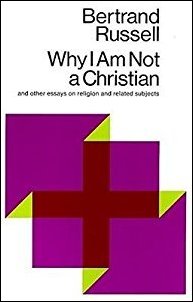
Bertrand Russell: Why I Am Not a Christian: Summary and Comments

This is a famous essay/lecture by one of the 20th century’s most influential philosophers. I first read the book containing this essay in 1979, when I was 23; I was thrilled to find someone so eminent unapologetically spell out the problems with faith and religion that had already becoming obvious to me. I happened to pick it up again today, and thought the essay worth recording and responding to, with some understanding of intellectual advances since this lecture was delivered in 1927.

These arguments about the existence of God, and the mixed record of religion as a positive or negative force in the world, are not new. The so-called “new atheists” of the first decade of the 21st century – Sam Harris, Daniel Dennett, Christopher Hitchens, Richard Dawkins – became well-known because society had changed in the century since Russell, becoming more multicultural, more accepting of alternate ideas, and more influenced by the effects of science and technology, which (unlike religion) truly have changed the world, mostly for the better — and so much more receptive to the revealing of their insights about the archaic effects of religion.

So here’s my summary/paraphrase of Russell’s famous 1927 lecture. My comments are in [[ dark red brackets ]]. Page references are to the Touchstone paperback edition of the book, https://www.amazon.com/Christian-Essays-Religion-Related-Subjects/dp/0671203231/, still the current edition in print, as shown here.

Russell:

To say one is a Christian – which used to have a much narrower, tighter meaning – these days [remember he’s speaking in 1927], means believing in God and immortality, and having some notion that Jesus was the best and wisest man in all of history.

First, about belief in God. Traditional arguments claim proof of God through mere reason. But these arguments are easily refuted.

  • First-cause argument. Russell’s response: First, why must the universe have a beginning? And if it did and God got things going, where did God come from?
  • Natural-law argument. First, many ‘laws’ are just statistical patterns. Second, if there are physical ‘laws’ that are somehow necessary and therefore instilled by God, then such necessity must be independent of God, page 9.4. [[ And if they are arbitrary, why God? Russell did not know of the anthropic argument, that if the physical constants of the universe were so different they could not allow us to exist, we wouldn’t be here to think about it; or of the multiverse idea, that there are infinitely many universes with randomly varying physical constants, and again that we are here to think about it means we are in a universe that allows life such as us to exist. ]]
  • Argument from design. It used to be thought that, e.g., rabbits have white tails to make them easy to shoot [[ an extremely anthropocentric view of the universe! ]]. Now via Darwin we know why living creatures are adapted to their environment. Further, is this world really the best an omnipotent god could do? With its fascists and Ku Klux Klan? [[ It’s easy to elaborate, and notice, for example, that most of the surface of the planet Earth is *not* suitable for human existence, and that the extremely vast observable universe seems almost entirely devoid of locations where humans might survive. If God designed the universe for us, why isn’t the universe a patch of land a few hundred miles round under a domed sky, as the Bible describes? ]]
  • Moral arguments: Kant dismissed the earlier arguments, but decided God had to exist for right and wrong (or good and evil) to exist. Quote p11b: “He was like many people: in intellectual matters he was skeptical, but in moral matters he believed implicitly in the maxims that he had imbibed at his mother’s knee.”
    • So, does good and evil exist only because of God? If so, then to God, there is no difference, and his distinction is arbitrary; if there were an actual distinction, one wouldn’t need God to distinguish them.
    • [[ There are subtle, elaborate, and fascinating reasons, detected and understood in the past few decades, for how human evolution, the selection of cooperative groups, the balance of cooperation and competition within groups, and so on, gave rise to the instinctive moral senses that all humans possess – regardless of whether particular societies have recently written holy books that supposedly are the only definitions of what is right and wrong. ]]
  • Argument for the remedying of injustice. Since there is injustice in the world, a latter world is necessary to balance it out. Why must this be so? [[ This is an instance of the “everything happens for a reason” logical fallacy. ]]

But “What really moves people to believe in God is not any intellectual argument at all. Most people believe in God because they have been taught from early infancy to do it, and that is the main reason.” P14.1

Second, about Christ. Author actually agrees with Christ on some points more than most Christians do:

  • “Turn the other cheek…” Not a new idea; Lao-tse and Buddha said it before him. And most Christians would hardly do so anyway.
  • Similarly with ‘judge not lest…’ and ‘If thou wilt be perfect, go and sell that thou hast, and give to the poor’, which Christians noticeably do not practice.

Defects in Christ’s teachings:

  • Christ [it’s notable that this essay uses the name Jesus exactly once; otherwise it’s about Christ] insists on his ‘second coming,’ over and over, within the lives of those he preached to.
  • The moral problem: Christ believed in Hell, everlasting torment, which author cannot respect.
  • And Christ responded with “vindictive fury” against those who would not listen to his preaching – an attitude similar to that of fire-and-brimstone preachers today, but not to the attitudes of other wise men in history, say, Socrates.
  • Christ’s comments about sin and the Holy Ghost and everlasting fire and gnashing of teeth have caused much misery throughout history, by making people terrified of everlasting torment for slight errors of thought. Christ’s was a doctrine of cruelty.
  • [[ Russell doesn’t mention passages about how Jesus insisted that following him was more important than staying with one’s family. ]]

Russell finds Buddha and Socrates more worthy of respect than Christ.

Still, author understands that people accept religion on emotional grounds. It’s often argued that religion makes men virtuous. In Samuel Butler’s Erewhon Revisited, a man returns to a primitive remote country many years after his first visit, to discover the locals now venerate him as a god. When he insists he is not, they urge him to remain quiet, lest the country turn wicked without its worship of him.

Author notes the “curious fact, that the more intense has been the religion of any period and the more profound has been the dogmatic belief, the greater has been the cruelty and the worse has been the state of affairs.” P20.6. Thus the Inquisitions, the burning of witches, and so on.

In contrast, “You find as you look around the world that every single bit of progress in human feelings, every improvement in the criminal law, every step toward the diminution of war, every step toward better treatment of the colored races, or every mitigations of slavery, every moral progress that there has been in the world, has been consistently opposed by the organized churches of the world.” P20-21.

With a very specific example of the church’s prohibition of birth control to prevent, e.g., the passing of syphilis from a father to his children. Religious morality, it seems, has nothing to do with human health or happiness. [[ My own theory: church teachings about sex, about prohibitions against homosexuality and birth control, has everything everything everything to do with enforcing behavior that would expand the tribe. Increase the population. Overcome the rival tribes. And nothing to do with individual human happiness or health, or self-determination. ]]

Russell goes on about fear: “Religion is based, I think, primarily and mainly upon fear. It is partly the terror of the unknown and partly, as I have said, the wish to feel that you have a kind of elder brother who will stand by you in all your troubles and disputes.” P22.

The solution: “Science can help us to get over this craven fear in which mankind has lived for so many generations. Science can teach us, and I think our own hearts can teach us, no longer to look round for imaginary supports, no longer to invent allies in the sky, but rather to look to our own efforts here below to make this world a fit place to live in, instead of the sort of place that the churches in all these centuries have made it.”

And: “When you hear people in church debasing themselves and saying that they are miserable sinners, and all the rest of it, it seems contemptible and not worthy of self-respecting human beings. We ought to stand up and look the world frankly in the face. We ought to make the best we can of the world, and if it is not so good as we wish, after all it will still be better than what these others have made of it in all these ages. A good world needs knowledge, kindliness, and courage; it does not need a regretful hankering after the past, or a fettering of the free intelligence by the words uttered long ago by ignorant men. It needs a fearless outlook and a free intelligence. It needs hope for the future, not looking back all the time towards a past that is dead, which we trust will be far surpassed by the future that our intelligence can create.”

The whole text is here:

https://users.drew.edu/jlenz/whynot.html

Posted in Book Notes, Philosophy, Religion, Science | Comments Off on Bertrand Russell: Why I Am Not a Christian: Summary and Comments

Kahneman, Thinking, Fast and Slow: Intro and Chapter 1

This is perhaps the most influential book of the past couple decades on the whole subject of human mental biases, how the ways in which we think entail errors of perception, and employ heuristics that are often but not always true. The book has been a consistent bestseller, on extended charts like Amazon’s, ever since it was published, in 2011. The author won a Nobel Prize — in economics, since there’s no prize there in psychology — and would have shared it with his very influential collaborator Amos Tversky, had Tversky not died in 1996, before the Nobel Prize was awarded in 2002.

It’s one of those books that has influenced the great ‘thought leaders’ of our time, like Bill Gates (https://www.gatesnotes.com/About-Bill-Gates/Great-Summer-Reading). Kahneman has TED talks (https://www.youtube.com/results?search_query=kahneman) — which I’ve not looked at; nor have I looked at Wikipedia summaries of this book. Reading it for myself, first.

This subject of human mental biases has fascinated me for some time now; it overturns the assumption that humans are rational beings who evaluate evidence and make decisions via logical means, and perceive the world as it actually is. No; we are all subject to biases and heuristics built into human cognition, through evolution, because they serve the purpose of human survival, and/or they work most of the time, and when they fail they do little relative harm.

My favorite books on this topic are the two by David McRaney, You Are Not So Smart (review here: http://www.markrkelly.com/Blog/2013/10/14/review-of-david-mcraneys-you-are-not-so-smart/), and You Are Now Less Dumb (http://www.markrkelly.com/Blog/2013/10/14/review-of-david-mcraneys-you-are-now-less-dumb-part-1/ and http://www.markrkelly.com/Blog/2013/11/19/david-mcraney-2-gravity-haiyan-grr-martin/). McRaney focuses on identifying these various biases, with many examples. Kahneman takes a more academic approach, identifying aspects of mental thinking that generate the biases McRaney identifies. I’m not sure, so far into Kahneman, that he further tries to understand why, evolutionarily, these biases came into existence; I think perhaps he will, but not so far in the first 100 pages — of which I summarize just the first 30 pages here.

Intro

Author wants to inform the average water-cooler conversation with understanding about judgments, the choices of others, how people make decisions. This entails understanding the distinctive patterns of errors people make—biases. We are generally unaware of how our beliefs are formed.

These ideas go back to 1969, when author met Amos Tversky, at Hebrew University of Jerusalem, and began many years of fruitful collaboration. They researched whether people are good intuitive statisticians. (Answer: no.) They developed and implemented many experiments, e.g. one about a shy meek person who might be a librarian, or a farmer. About the letter K.

In 1974 they published a highly influential article in Science magazine, that challenged current assumptions at the time: that people are generally rational; that departures from rationality are caused by emotion. (Article is in Appendix 1.)

Author notes that one reason for their success was that they included full examples of questions and answers from their experiments—an example of how “luck plays a large role in every story of success; it is always easy to identify a small change in the story that would have turned a remarkable achievement into a mediocre outcome. Our story was no exception.” (p9b [i.e. page 9 bottom]; the theme of Robert H. Frank’s recent book–https://www.amazon.com/Success-Luck-Good-Fortune-Meritocracy/dp/0691167400/)

There were some criticisms, but these ideas are now generally accepted. They shifted attention to decision making under uncertainty, and published a second paper. For these two papers the author won a Nobel Prize, in 2002, which Amos would have shared, had he not died in 1996 [of metastatic melanoma, at age 59; https://en.wikipedia.org/wiki/Amos_Tversky].

This book is a summary of all recent developments in cognitive and social psychology. Stories of intuition, especially expert intuition, and how intuition can go wrong. Intuition often devolves into two modes of thinking: if no immediate solution presents itself (fast thinking), we switch to a slower, more deliberate mode of thought. Author describes these as System 1 and System 2, fast and slow thinking. These are not literal mechanisms in the brain, but broad descriptions of different kinds of thinking.

(Then follows outline of the book’s five major sections.)

Part 1: Two Systems

1, The Characters of the Story

A photo of an angry woman; the problem of solving 17 x 24. These involve different systems of processing in the brain. You know immediately about the first; solving the second takes effort.

Description of System 1 and System 2; the first automatic and quick, and involuntary; the second requiring effortful mental attention.

Examples of activities addressed by each system – responding to sounds, faces, driving a car down an empty road; vs. searching memory for a particular sound, telling someone your phone number, checking the validity of a complex logical argument.

‘Paying attention’ is how you invoke System 2 to override the automatic responses of System 1.

When the driver of a car is overtaking a truck on a narrow road, for example, adult passengers quite sensibly stop talking. They know that distracting the driver is not a good idea, and they also suspect that he is temporarily deaf and will not hear what they say.

[Though from personal experience I know that not all adult passengers are attentive or perceptive in this way.]

Famous experiment: the Invisible Gorilla. When told to pay attention to a particular team in a basketball game, viewers *don’t see* a person in a gorilla suit walking through the court. We are blind to blindness.

The theme of this book is the interaction of these two systems. “Most of what you (your System 2) think and do originates in your System 1, but System 2 takes over when things get difficult, and it normally has the last word.” (p25.2)

Examples of conflict: reading words for size or meaning; optical illusions like the famous Müller-Lyer illusion. There are also cognitive illusions; can they be overcome?

The best we can do is a compromise: learn to recognize situations in which mistakes are likely and try harder to avoid significant mistakes when the stakes are high. The premise of this book is that it is easier to recognize other people’s mistakes than our own.

(p28.6)

(( This recalls Matthew Hutson’s book about learning to recognize such biases and trying to *take advantage* of them… https://www.amazon.com/Laws-Magical-Thinking-Irrational-Beliefs/dp/0452298903/ ))

Author stresses these two Systems are ‘useful fictions,’ useful because “The mind — especially System 1 — appears to have a special aptitude for the construction and interpretation of stories about active agents, who have personalities, habits, and abilities.” p29.8

They could as well be called the “automatic system” and the “effortful system.”

(this is to page 30, of a 499 page book, of which 418 pages are text, not counting the articles in the appendices.)

Posted in Evolution, MInd, Psychology | Comments Off on Kahneman, Thinking, Fast and Slow: Intro and Chapter 1