Coronavirus Diary May 2020: Replaying the Myst games

Here we are at the middle of May, some seven or eight weeks in to stay-at-home orders here in the Bay Area – when it started, my partner began working from home, except for the one day a week he would go in to work, his site’s senior staff alternating days to be on site. His first day working from home was March 17. For the next five weeks I suspended reading of books entirely. Things were too unsettled and uncertain to allow for the indulgence of sitting down and turning inward into a book. It was much more important to pay attention to everything going on in the outside world. I’d started Brian Greene’s intriguing UNTIL THE END OF TIME, and left it suspended around page 30. Still there.

Instead, inspired by a New York Times article I linked on Facebook, https://www.nytimes.com/2020/03/24/arts/coronavirus-myst-nostalgia.html, about the comfort of replaying computer games from years past (the article writer’s childhood; my 40s and 50s), I did in fact, over five or six weeks, replay all the Myst games, including the associated Uru and Obduction. Well, not played; I followed walkthroughs posted on various online sites, to revisit the games’ environments, their beauty, without having to re-solve all their puzzles from scratch. And, well, I played RealMyst not the original Myst. The issue is that the early games in the franchise were what were derisively called “slideshow” games in which the player could move only to certain preordained positions or nodes. In Myst and Riven and Myst III the point of view at each node was fixed. By Myst IV you could at least swivel around from each node to see your surroundings in every direction… That was true of Myst V too. RealMyst, Uru, and later Obduction, were vast improvements: the player, using arrow keys, could move freely in any direction, look around from any spot.

I should set the context that I have never been a “gamer,” and in particular have never had any interest in “first-person shooter” games or racing car games or any games that involve competition with other players. I’m a solitary guy. In fact over the 30 some years since I bought my first computer—a genuine IBM PS/2 (https://en.wikipedia.org/wiki/IBM_Personal_System/2) for some $2000, in 1987—I’ve played various solitaire games in part out of compulsion and in part as a mechanism to distract my conscious attention while my deep mind ponders other things. This is a legitimate thing. In the ‘90s there was Tetris; later things like Minesweeper; more recently Microsoft solitaire card games, and especially, currently, Microsoft’s Wordamant, where I play every month’s map and every day’s Daily Challenge. The Myst games, of course, are another league entirely than the solitaire games that take a few minutes each per round.

The first Myst game came out in 1993 and I was given it as a gift, by my long-time friend Larry Kramer, in 1994, for my birthday. I had to buy a new PC – a Gateway desktop, in a huge tower – to play it. Four years later, in 1997 (as I was launching the initial Locus Online website), I had to buy yet another new computer to play Riven. Trying it on the Gateway caused it to hang whenever I came into a scene with one of those spinning domes. The new one was a HP 8175 PC (Pentium II 233, 48 meg RAM, 56K modem, 17” monitor)—note the modem, this was pre-wifi, and the careful attention to specs about random access memory. The only people who worry about such stat’s now, I gather, are the gamers, whose new adventures require greater and greater computer power and memory and sophisticated graphics cards. Oh, and those collecting large video or music files. (For later games, I once had to purchase new graphics card, or several times install updated graphic drivers.)

Over the following 20 years, I eagerly purchased each new Myst game as it was released. Here’s a photo of all the physical editions I have, from the first releases of all the games through Uru and Myst V (IIRC the Uru expansion packs were downloads), a “10th Anniversary DVD Edition” of the first three games, the three print guidebooks I have, and finally the recent Myst 25th Anniversary Collection, which I helped fund on Kickstarter, with versions of all the games that will run on modern computers, encased in a big box that mimics the “books” used in most of the games.

And since I keep records about everything, I’ll note the following:

  • Myst, 1994, took me 10 days to complete
  • Riven, 1997, two weeks
  • RealMyst, 2001, was straightforward because it was the same puzzles as Myst
  • Myst III, 2001, two weeks
  • Uru, 2003, almost a month
  • Myst IV, 2004, almost a month
  • Uru expansion packs, 2004, 3 or 4 days each
  • Myst V, 2005, four days
  • Uru Live (online, the PC game with additional areas to explore), 2007; intervals over several months as new areas were released at intervals
  • Obduction, 2016, two and a half weeks
  • The Witness, 2016, almost a month

Keep in mind I had a day job in all these years (up to 2012), and since 2001 have had a live-in partner who disapproves of computer games, so I was only able to play them evenings, weekends, or on the sly. Yet, each time a new game was released, I was obsessed about it until finishing—I remember once I drove home from work at lunchtime because I’d had an insight into solving some puzzle, and needed to check it out immediately.

I’ve included The Witness here as the only game I’ve found over all these years that remotely approaches the beauty and complexity of the Myst games. I’ve tried others – e.g. Rhem, Schizm – but they pale in comparison, consisting mostly of convoluted puzzles without the underlying real-world sense of living places where, unfortunately, the power had been turned off (for example).

While all the Myst games involved a solitary player in some strange, bounded environment, having to solve puzzles of various types, they varied in the exact goal of the game-play, and the player’s interaction with other characters. Key points:

  • All of the games involve one or more characters with whom the player interacts, or at least listens to. In the first game, game creators Robyn and Rand Miller played the three roles of Atrus, the man created Myst by writing a “linking book,” and his two crazy sons Sirrus and Achenar. (I’ve always thought it odd that these names are one letter away from names of bright stars in Earth’s sky.) In later games professional actors, some quite good, were brought in to play other characters: John Keston (https://en.wikipedia.org/wiki/John_Keston) plays Gehn in Riven; Brad Dourif (https://en.wikipedia.org/wiki/Brad_Dourif) as Saavedro in Myst III; Juliette Gosselin as the girl Yeesha in Myst IV; David Ogden Stiers (https://en.wikipedia.org/wiki/David_Ogden_Stiers) as Esher in Myst V.
  • With the except of Uru, I think, all the Myst games offer multiple endings, one a successful or happy ending, the other or others unsuccessful or tragic ones. Which ending you reach depends on your interaction with the characters, usually about who you decide to trust. The ambitious player can save game progress at a key point, and restart it to take different paths each time to see all the endings.
  • The games all have musical scores. As with the actors, in the first and second games one of the creators, Robyn Miller, did the music; after that professional composers, Jack Wall and Tim Larkin. While the music in the later games is slick, Miller’s music in the first remains the most iconic and haunting.

As game technology advanced, the manner of game-play changed from game to game, as mentioned above. Also, while the games all had similar puzzles to solve, there was usually something distinctive about each game.

  • Uru’s game-play advances by finding and touching seven “journey-cloths” in each world, enabling return to the player’s central private island called Relto.
  • Myst V you have a “slate” on which you can draw a shape or icon and then set the slate down on the ground; then when you step away from the slate, creatures called Bahro (as in Uru) approach the slate and interpret your mark and do something useful to solving a puzzle.
  • Myst IV you can “touch” things with your cursor and hear the sound of what tapping each item would be. And certain objects trigger memories of a character’s interaction with that object.
  • Myst III includes elaborate animations at the end of each age that take’s the player’s POV on some on a ride, on a trolley, back of a bird, or rollercoaster.

I will confess that I’ve never completed any of these games without searching out at least one hint. In the ‘90s game guides were published as trade paperback books, and I have them for Myst and Riven; since 2000 or so, when everything went online, there have been any number of sites that offer hints or walkthroughs or even YouTube videos showing how to solve every puzzle. I remember the exact point I got stuck in Myst: in the Mechanical Age there’s a control panel on top of an elevator, and the key to getting there is that you hit the “down” button in the elevator and then *step out* of the elevator in the brief interval before it starts moving. Then the control panel moves down and you can access it.

In contrast to the five Myst games, Uru was open-ended, with two “expansion packs” released a year after the original game to extend play and exploration of the underground city of the D’ni. Then the entire game went online, with additional areas added over a period of months in 2007. I played through some of those, but some of the “garden ages” required interaction between multiple players logged on at the same and able to interact. I found those annoying, as defeating one of the prime attractions of all these games: they were mysterious places one could explore privately. I didn’t want to have to interact with a bunch of strangers over the internet! Yet there were some intriguing differences between the main Uru games as installed on your PC, or accessible in Uru Online, so I did play most of the game online.

*

So do I have any favorite games or parts of games? Or anything I found relatively unpalatable or annoying? I think as I played them over the years, as they were released, I thought each new game was better in some way that the previous ones, if only because each had some new aspect of game play, or ways to interact with the environment. Yet I confess I never paid completely attention to the narratives behind the games—the rivalry between the boys, whey Gehn captured Catherine, and so on; and so the interruptions by Saveedro and Esher, the fragments of remembered conversations in Myst IV, were intrusions to be sat through. (There were two or three novels based on the games in the ‘90s; I never looked at them.) Perhaps that’s one reason I’ve replayed Uru, or parts of it, more often than any of the other games; after the introductory challenge by Yeesha, you’re off on your own, all alone.

I also look back more fondly on those games that were more than a hub world with three or four satellite worlds (or ages). Thus Riven, its ages more interconnected, and Uru, with its potentially indefinite collecting of new ages represented by books on you private home island in the sky Relto. I liked the music especially in the early games, and how the music enhanced the darker, moodier ages: Amateria in Myst III, Kadish Tolesa in Uru, Todelmer in Myst V, Kaptar in Obduction.

Fortunately a year or two ago I helped Crowdstart a 25th anniversary reissue of all the Myst games and Uru in versions suitable for modern computers. There was a long period, in the mid-2000s I think, when you couldn’t replay the original Myst or Riven, because they were incompatible with then-current operating systems.

And next is something called Firmament, https://fulfillment.fangamer.com/kindling/firmament, due some in 2020.

*

So since March 25th, when that NYT article appeared, I’ve played through, following online walk-throughs, all the games, including Obduction, with two exceptions. In Myst III I’m stuck at the same point I was originally, deep in Edanna near the glowing orchids, where you’re supposed to see a path through a rotting log in order to go further down. The game is too dark, the node movements too crude, and I can’t find the path down. And in Myst IV, I’m stuck at the monkey puzzle in Haven, with nothing happening when I spin the horns however slow or fast. Also I find the game-play interface most annoying in Myst IV; it’s nodal, and it’s slow, with a second or two pause after clicking before moving to the next node. So as I write, I’m paused at those points, but have finished the others all the way through.

Now maybe it’s time to get back to reading books.

Posted in Games, Personal history | Comments Off on Coronavirus Diary May 2020: Replaying the Myst games

Academics

(This is another essay to become a section of my “memoirs,” to be promoted to a page rather than a post, eventually.)

It’s a truism that once you become an adult and have a career job, no one cares about your GPA (Grade Point Average) in high school or college, or even what college or university you graduated from. (At best the university you graduated from got you interviews with companies who otherwise would have ignored you.)

Still, sometimes a look back at report cards and college grade reports can be interesting, even revealing. (I’ve seen a couple of my Facebook friends quote comments from their earliest report cards, to illuminate or contrast their early performance with their eventual careers.)

And since I’ve saved all my report cards, all the way from kindergarten, I think I’ll show some of them there, and comment about them.

I do have two particular points to make.

  • First, the earliest report card comments were generally correct about my later academic performance. At the same time, I did not always excel in subjects that later became my central interests.
  • Second, my college records from UCLA and later CSUN showed that my academic performance was dramatically different when I was just attending by rote, versus when I had a goal to reach. A B average at UCLA, and an A average at CSUN.

Kindergarten

This was in Apple Valley, 1960-61, at Yuca Loma Elementary School, in the windy Mojave Desert. I have two artifacts from this. First, a “Conference Summary” from November 13, 1960; I had been in school a couple months. There’s a long hand-written comment by my teacher, Elaine Kutrosky.

She wrote:

Social Studies—

Mark certainly seems to work hard during our work period. He is usually found working with the blocks constructing something practical, or crayoning or even in the playhouse working hard at being someone. He talks quite well for a five yr. old.

Work Habits—

Mark does concentrate fairly well and usually finishes all projects he starts out. He does need to be reminded to go back and clean up a little better.

I can almost say Mark had some adjustment problems but not quite. He seemed a bit mystified when school started but took our class situation in his stride and is doing fine. Sometimes it is hard for him to realize that sharing is a necessity but after talking with him he understands.

Also at times he need reminding to do his responsibilities. I feel that we should help him assume his responsibilities at school. I think if we both gave him some responsibilities at school and at home would help him realize that responsibilities are important.

And it’s signed by my mother, Helen E. Kelly. (I’m not sure what “responsibilities” referred to exactly. Cleaning up better?)

And I have my report card, or “Kindergarten Growth Report.” The scores are S, for satisfactory, S+, S-, or N, for needs improvement. I got one N, for “I accept responsibility.” I can’t imagine now what that meant. I got S+ scores for being able to relax (i.e. when we took naps on towels laid out on the floor), following directions, speaking well, being polite, and working well alone. (I’m still very good at this last item.)

The one comment from Elaine Kutrosky was “Mark seems to have potential for being a good student.” Note that this time my mother signed it as Mrs. Robert Kelly.

Grade School

I don’t have a report card from the few months I attended Grant Elementary in Santa Monica, finishing first grade. The next card I have is from the end of second grade (A2 meant advanced 2nd grade, while B2 meant beginning 2nd grade). Throughout elementary school we were graded on “knowledge and skills,” on the one side, and “school adjustment” on the other. The former group included Reading, English, Mathematics, Civics, Science, and other subjects; the latter group covered Effort, Work Habits, and Citizenship.

The possible scores are Outstanding, Very Good, Satisfactory, Needs to Improve, and Unsatisfactory. If these correspond to grades A to F, then in the second period I got As only for reading and spelling. Otherwise I got Bs and Cs, the latter mostly in School Development.

This time my father signed the card.

In grades 3 through 6 we got report cards that looked like this. Again, in 3rd grade, I got high marks for reading and spelling, otherwise Bs, except a C in physical education. (As I’ve said elsewhere, I hated the enforced games, like dodgeball.) Yet in contrast to 2nd grade, I improved and got As in Effort, Work Habits, and Citizenship. In 4th grade I got similar marks, mostly As, Cs only in handwriting, music, and P.E. Slight variations in 5th grade.

At the end of the 6th grade – the ultimate judgement of elementary school – I finished with 12 As and 4 Bs. In those last two or three years, I’d always been recognized as one of the top students in each class. (As I recall, given the size of the school, each year’s class occupied two classrooms, about 30 students in each classroom.) But, as I walked out of Vanalden Elementary School for the last time, I understood that one or two other students had higher percentages of As than I did. Oh well; I would never see most of the other students there again.

It’s curious that a couple of those Bs were in science, and music, which later became core interests of mine. What did science consist of in 5th or 6th grade? I don’t recall. And in 5th grade, when I got a C in music, that was the year we got “tonettes,” (https://en.wikipedia.org/wiki/Tonette), a basic wind instrument in plastic, like a simple recorder (https://en.wikipedia.org/wiki/Recorder_(musical_instrument)), which I recall being pretty good at, or at least enjoyed. I suppose I wasn’t that good. (Later, I my 20s, I bought a plastic recorder from a music store at the Northridge Mall and played around with it for years, playing simple tunes from folk music or movie scores. I still have it, but haven’t played it in years.)

Junior High and High School

As explained on my Personal History page for these early years, the key fact about the six grades, from 7th through 12th grades, is that I attended five different schools over those six years. That was a consequence of family moves to Illinois and back, and of course the transition from Junior High to High School.

I began at Sequoia Junior High for the 7th grade. I have “Progress Reports” with no grades, just comments. “Tops in class” my math teacher wrote. My English teacher wrote “good student—very perceptive”; my Geography teacher wrote “outstanding”; my homeroom teacher Mrs. Lamberto wrote in October “Use guidance room time wisely—read—study” but by December wrote “a ‘joy’ to have in H.R.—real gentleman of a student.” I also have a separate “Complementary Report to Parents” from my Geography teacher, dated 11/17/68, saying “Mark does very fine work.”

I have two report cards, one with four As (English, Geography, Math, Winds [music, beginning clarinet], one B (in wood shop), and one C (Phys. Ed.). The second with the same subjects, my grade in English fallen to a B, my grade in shop, now drafting, an A, and my grade in P.E. a D(!) – this was when we had to throw softballs, and I was ‘uncoordinated.’

And then a mid-school-year transfer to small town Illinois, to Cambridge Community Schools. I have one report card. Mostly As, but a B in arithmetic, and in vocal music (I don’t remember that class at all), and in Phys Ed, yet an A in instrumental music, even though, as I’ve written elsewhere, the move promoted me into a class of students with more practice learning instruments than I’d had, and I felt I never caught up, was always a minor 3rd rate performer.

And then Glen Crest Junior High School, in Glen Ellyn IL, for one year. A school that used numbers rather than letters. I got 5s in Social Studies, Science, and Math; 4s in other subjects except (of course) a 3 in Physical Educ. My conduct was Satisfactory in all cases.

And then to Glenbard Township High Schools, for two years. I attended Glenbard East (https://www.glenbardeasths.org/). At the end of these two years, I got 5s in geometry, geography, freshman science, and chemistry. 4s in most other subjects including English, algebra, health (this was sex education), concert band, and driver’s ed. (We had driving simulators, in class, and then drove real cars out on the icy-slippery local streets.) And P.E.

And then back to California for the last two years of high school, and James Monroe High School in what was then known as Sepulveda, now North Hills (either way, a 91343 postal zone district of the city of Los Angeles). I was doing really well in high school in Illinois, but the high school in California didn’t quite trust those grades, and so didn’t enroll me in as many advanced placement classes that I might otherwise have been enrolled in. Thus, for example, I had no science course in the 11th grade, when ordinarily I would have taken biology; so I never had a biology course in high school. In my first semester I had Advanced algebra/trigonometry, US History (which as I’ve described wasn’t a comprehensive course, but rather a series of 10-week studies on particular topics), German, and typing. And P.E. I’ve discussed the significance of the typing class, even though I got a B; As in the first three, a C in P.E.

My final high school marks, in June 1973, were better. I got As in physics, AP math, AP English (that memorable course with Mr. Eugene Friedman, who in addition to having us read classic novels and plays gave us weekly quizzes on current events via Newsweek Magazine, who had a monthly soiree at his house, on Louise Ave., for his students), and a credit for P.E. because Mr. Friedman had worked with the P.E. teacher to have me work as Friedman’s assistant instead of attending P.E. class.

I graduated 40th in a class of 1000.

And so my high school marks were high. As described in my Personal History for this era, I took the PSAT, did well, interviewed with CalTech and MIT, and ended up at UCLA.


IQ test

In the 11th grade, after scoring well on the PSAT, one of the things that happened, in addition to being summoned and recognized by the college counselor, was that I was pulled out of class one day for a private session with some visiting official, who gave me what I gather was an IQ test, or some test about identifying special students. I don’t know; I never heard the results. I do remember a couple particular things about the test.

First, one part was a page of simple arithmetic problems. I started at the top and worked my way down. The instructor said, the ones at the bottom count more. Feeling manipulated, I determinedly kept working them in order. And the time ran out, I didn’t finish the entire page. What was being tested here?

Second, another part was that I was given a blank page and asked to draw a human. I can’t sketch for beans, but I tried to do something, and what I realized was that I was using just the upper left corner of the sheet to draw and small figure – not the entire page, with a large sketch centered in the middle. Was that what was being tested?

As I said, I never heard anything about the results of this test. Presumably I was not identified as any super-extraordinary student.

College Entrance Exams

I took the Preliminary Scholastic Aptitude Test, PSAT, sometime in 11th grade (as discussed in my Personal History essay). I scored 61 verbal, 73 math. According to the booklet that accompanied my results, those corresponded to about 95 and 98 percentile of all juniors who later entered college (and higher for all juniors). I was among the top four scores at my high school. This is what attracted the attention of the college counselor/AP English teacher, and got my photo on the front page of the Valley News and Greensheet, along with all the other 11th grade high-scorers in the San Fernando Valley (population at the time about a million).

The PSAT doubled as a test for the National Merit Scholarship Qualifying Test (NMSQT). I don’t remember the details of that program; I think it depended on the college you went to, parents’ income, and so on. Since I went to nearby UCLA, where the tuition was something like $200 per quarter (three quarters a year, not counting summer), I didn’t qualify. So I never got any kind of scholarship.

Then in 12th grade I took the SAT, Scholastic Aptitude Test, which is used by the colleges you apply to, along with your high school GPA, and in some cases personal interviews (as I had with representatives from CalTech and MIT). And, optionally, you take various Achievement Tests in particular subjects.

You can retake some of these tests, but from the paperwork I have, I only took the SAT once. Verbal 650, math 780; 98 and 99 percentiles among all students, 95 and 99 among college bound students.

I took several Achievement Tests, a couple of them twice. Math 2: 760 the first time, 800 the second time. English: 710. Chemistry: 710. American History (why did I take that? I never had a decent history course in high school. Maybe it was required.): 460.

Some six years later, as I enrolled at Cal State Northridge for a Master’s Degree (which I didn’t finish), I took the GRE, the Graduate Record Exam. There were three scores, for verbal, quantitative, and analytical. I scored 760, 790, and 770.

UCLA, 1973- 1977

I’ve said this many times in various places, that attending UCLA, living at home with my parents and younger kids, commuting to school over those four years, was the worst situation I could have been in. Parents: sent your kids away to college. Let them live on their own. That’s as much a part of the college experience as taking university courses. Whereas I was stuck at home, with three younger noisy siblings; my four years at UCLA, driving there every day from home, were to me an extension of high school.

At UCLA, I did OK. My initial ambition was to study astronomy, my early passion. But an astronomy major entailed studying physics for the first two years, and I did OK only up to a point. Many people, I’ve understood from some of my Facebook friends, have a point in their studies, especially in physics or math, where they suddenly don’t “get it.” Their intuitive understanding of the subject disappears. (This evokes a deep theme, the idea that perception of reality is limited or enabled by one’s native intelligence, one that I’ll explore in my book about science fiction.) For me, it was the third quarter of my sophomore, quantum physics, Feynman diagrams, and I just didn’t get it. I couldn’t work my way through them. I got Cs, even a D, in those courses.

I didn’t have any clear goal about a career. At the end of my sophomore year, I changed major to math, where I’d done better. As in any major, certain core courses are required, and beyond them are various options, specific courses of study one can select from; every field has specialties. I did better in some core courses than in others, and so I gravitated toward the fields I did best in. I hit a wall with what’s called “analysis,” which is the justification from first principles of calculus. It involved much study of infinitesimals, and asymptotes, and I struggled. On the other hand, I liked, and did well, in math classes on discreet topics: number theory (elementary topics there involve prime numbers and the Fibonacci sequence), linear algebra, group theory especially, and so on. I moved from getting Cs in math classes – my major! – to getting As.

I notice, riffling through my files, that on my SAT tests I identified my career goal as “doctorate.” My early ambitions to become an astronomer would obviously have indicated that direction, since there are few industry jobs for astronomers. During these years at UCLA, I had to recalibrate. For a time I considered becoming a teacher, say, a high school math teacher. Even then, I felt I was good at explaining things. (….whatever happened to that?)

As I look at my “Undergraduate Student Record Card” (shown here), i.e. my grades while in UCLA, I recall another issue about attending college. Having taken AP, Advanced Placement, courses in high school, I had license to skip introductory college courses in those subjects. In retrospect, bad idea: college courses are faster and more rigorous than those in high school. My first quarter at UCLA, I took math 11C – skipping 11A and 11B – and got a C. Similarly physics; I got a B, then a C in second quarter. I should have started from the beginning, in college.

CSUN, 1980- 1983

Here we come to the second point in my introduction. After working a non-technical job for a couple years after finishing UCLA, I rallied myself and decided to go back to school, this time in the more useful field of computer science. Part of the timing here is that I had to have supported myself for a couple years before I was eligible for student loans and work/study. Thus, I quit my day job and lived, for two full years, on student loans and a part-time job on campus. I took a full load of courses in each of four semesters, over two years. I enrolled at first for a second bachelor’s degree. Having the first such degree, I was exempt at CSUN from various “breadth” requirements, courses outside your major required to broaden your horizons. So I only had to take computer science courses, and some peripheral engineering and philosophy (i.e. formal logic) courses, to satisfy the requirements for a B.S. in computer science. I also took a few math courses, some of them perhaps required (e.g. combinatorial algorithms) but some perhaps just for fun.

Anyway, for four semesters running, plus one summer session, I got straight As. In 22 different subjects. (Some were small courses like labs or 10-week intros to old computer languages like Fortran and Cobol.) Of course, there’s a substantial difference between a UC school and a Cal State school; the Cal State campuses are middle-tier universities, somewhere between community colleges and the top-tier UC system. So it would always have been easier to get straight As at Cal compared to UC, whatever my determination.

By Spring of ’82 I’d decided to pursue a career job, and got much assistance from campus programs to bring corporate recruiters on site. But I’d also decided to continue school, and changed my intentions from a 2nd bachelor’s degree (which I therefore did not receive) to a master’s degree. I started work in June ’82, but kept taking courses in the evenings for another year and a half, three semesters. The Cal State colleges, unlike University of California campuses, served many students who worked during the day and took classes at night.

But it was a lot of work. In Fall ’82 I enrolled in two full courses and one prep course on how to develop a thesis. Too much work. I dropped the latter, got an A in one of the others, but only a B in the third—only because I didn’t complete the special project required for the A. I took one course in Spring ’83, and got an A. And then I took one class in Fall ’83, one which required writing two or three big papers, and was not keeping up—so I dropped it and got an incomplete. Ironically, that last course was in “software engineering,” i.e. the process by which industry software projects are planned and managed – exactly what my day job was all about!

So I finished with a cumulative GPA of 3.95, without a degree. But the courses at CSUN had served their purpose. I had a full-time professional job, one that I kept, with variations in assignments, for 30 years.

Certificates and Awards

If in Boy Scouts you got lots of badges and patches, so many that you need a vest-like “patch jacket” to display them all, but no paperwork, in school and college (and later at work) you lots of paperwork in the form certificates and awards that one could frame and put on your wall (but no badges). Here are some photos of a bunch of them from Junior High and High School.

The earliest, at upper left, is for participating in an “Elementary School Mathematics Field Day,” in May 1967, i.e. near the end of 6th grade. I don’t remember this.

The next, upper right, is an “Industrial Arts Award” in 7th grade for having done well in that drafting course. I suppose my father was tickled, him being an architect.

The next two items, with ribbons, were for participating in Math Club test, the MAA; again, I don’t remember the details. I was 3rd in my school one year, 2nd the next.

The three at the bottom were consequences of my having scored well on the PSAT, and having become a finalist for the National Merit Scholarship and a life member of the California Scholarship Federation. My membership in that federation never had any consequences beyond receiving these certificates.

And the ones along the left are various “service” and “honor roll” certificates for having had high GPAs in 7th and 8th grades.

I’ll have a bunch more analogous certificates and awards when I summarize my professional career at Rocketdyne.

Another IQ Test

A few years later I took another IQ test, this one self-administered. That may sound odd, but the test was deliberately designed to be extremely difficult and not open to the casual looking up of answers. It was called the Mega Test – it even has a Wikipedia page, https://en.wikipedia.org/wiki/Mega_Society — and was designed to discriminate among those who score highly on standard IQ tests. (I seem to recall that I did take a standard IQ test at some point, and scored 132? But I have no record of it.) The test was published in Omni magazine in early 1985, and readers were invited to submit their answers, taking as much time as they needed to work them out, for scoring. I spent a considerable amount of time—I have a folder full of several dozen sheets of paper with calculations and diagrams trying to work out the answers – submitted my answers, and got a scoresheet in return dated May 23, 1985. Of the 48 questions, I answered all but 7, but I got only 31 correct and so was incorrect on several I thought I’d figured out.

Anyway, I got 31 of 48 correct, corresponding, according to their booklet, to an IQ of 162.

I can’t find the test itself anywhere online, though there’s a similar one here, http://miyaguchi.4sigma.org/hoeflin/ultra/ultra.html. But I’ll photograph the photocopies I have of the test I took, along with my answers and results. (I’ve inserted this photo at especially high resolution so you can read all the original questions.)

I never bothered to apply to Mensa (or similar organizations); I wasn’t interested in joining a club, I just took the test for fun, as a solitaire puzzle to see how much of it I could figure out.

Final Point

Of course, there’s an obvious third point to make: there’s not a high correlation between high grades, or a high IQ, and success in life. I had a decent career, earning a bit over six figures a year by the end of it (in 2012), but I didn’t move into management or become any kind of expert. Outside work I built some databases, wrote some reviews, created a couple websites. I even won a major science fiction award. But I’m not the least bit famous, and it’s unlikely anything I’ve done will be remembered once I’m gone.


Posted in Personal history | Comments Off on Academics

Links and Comments: 28 Apr 2020

One of today’s news sites links to an article about how Trump, and science-deniers in general, aren’t trying to fight science per se, but are trying to “claim the prestige of capital-s ‘Science.’”. Adam Laats at the History News Network:

Fights against science itself tend to lose, but fights for the right to call bad ideas “Science” can go on for generations. [discussion of evolution-denial] … When President Trump says his decisions will be based on a “hunch,” he is repeating the tactics of generations of creationists. It might sound at first like he is rejecting the need for scientific credentials or expertise. In fact, though, Trump is positioning himself as superior to those experts, not against them.

This reminds me of the common perception that Trump supporters don’t care that he lies all the time, that he’s an idiot, that he’s a despicable person; it’s about “owning the libs.” There’s something about a resentment of intellectuals, people who understand complicated things that others do not, that drives some people to use any means possible to win, by any disreputable means possible. A weird kind of American exceptionalism.

And another example of how resistance to established science is driven by psychology, not by evidence or reason.

\\

Coincidentally, reviewing my notes about Fred Hoyle’s 1957 novel The Black Cloud, I see a wrote down a passage about an encounter between a Home Security official and a professor of astronomy at Cambridge, about how to deal with the investigation of an approaching interstellar dust cloud.

The two men were mentally too dissimilar for more than a half hour of conversation between them to be possible. When the Home Secretary talked, it was his aim to make those to whom he was talking to react according to some pre-arranged plan. It was irrelevant to him how he succeeded in this, so long as he succeeded. Anything was grist to the mill: flattery, the application of common-sense psychology, social pressure, the feeding of ambition, or even plain threats. For the most part like other administrators he found that arguments containing some deep-rooted emotional appeal, but couched in seemingly logical terms, were usually successful. For strict logic he had no use whatever. To Kingsley on the other hand strict logic was everything, or nearly everything.

The difference between politics and science.

\\

A couple weeks ago the New York Times Book Review ran a review by George F. Will of Andrew Bacevich’s anthology of essays, American Conservatism. Two weeks later several letter writers responded, noting especially conservatives’ history of racism and antipathy toward civil rights. And this:

Nothing summarizes American conservatism more succinctly than its devotion to cherry-picking those intellectual arguments that reinforce its members’ preconceived notions.

Preconceived, often religiously-inspired, notions are what they’re trying to conserve, despite the evidence of the real world. You can always find Some Random Guy with a blogspot page, or some random YouTube video, to support any position. Just as you can selectively quote Bible verses to support any position you like (as Christians did in the 19th century to defend slavery).

\\

Two op-eds from last Saturday’s NY Times.

Timothy Egan, How Republicans Became the Party of Death. Subtitle: “People are disposable. So is income. For the ‘pro-life’ party, one is more important.”

(This expands on a comment I made in a Facebook post a couple weeks ago.)

When Lt. Gov. Dan Patrick of Texas doubled down this week on prior remarks elevating commerce above life — there are “more important things than living,” he said on Fox News — he was speaking for a significant slice of his party. People are disposable. So is income. But one is more important.

All of this follows Trump’s obsession with money over human life, with markets over medicine. On Wednesday, just as the United States reported its largest daily death toll to that date, Trump tweeted: “States are safely coming back. Our Country is starting to OPEN FOR BUSINESS again.” So much for the departed.

Given that Trump is an alpha-male simpleton with no filter, it’s never difficult to find the true motive behind his tactics. As he has said, he wants all the authority and none of the responsibility. If we lose a quarter-million Americans, it’s the fault of governors running their respective shows. If the number is far less, it’s because he took charge.

When I think about how many doctors and nurses, how many cops, firefighters and other first responders, how many grocery store clerks and delivery people, how many parents and grandparents would lose their lives to get to that immunity threshold, I realize there’s only one choice.

That is: to err on the side of life. Lucky for us, most Americans already feel that way. Most Americans expect no quick fix. Most Americans are willing to be patient. And if this holds, most Americans will reject the party of death in November.

Trump’s denial of responsibility and eagerness to take credit, reminds me of … how the faithful view their God. Any bit of good fortune, like this story about a poundcake, is taken as evidence of God’s mercy. But God can never be blamed for those killed in the tornado, or those dying from coronavirus. Those are attributed to “God’s mysterious ways,” or more likely, to whatever various preachers or politicians personally dislike: abortion, the gays. (Example from Pat Robertson.)

At the same time, here’s Drew Holden’s The Lockdown Isn’t So Simple for Conservatives. (The print title was “Why Some Conservatives Resist the Lockdown.”)

One of the reasons it’s proving so difficult to organize a broad response is that the means needed to fight the coronavirus challenge basic principles of autonomy and liberty. This pandemic forces a rethinking of how our own rights may conflict with — even endanger — the well-being of others, when each of us could be an unwitting disease vector for the virus.

This last sentence is precisely the point. Going on:

This is an unpleasant thought experiment for limited-government conservatives, who center our politics on the importance of individual liberties. A lockdown runs counter to the spirit of rugged individualism that takes on near-mythic proportion in America, particularly among libertarian-minded conservatives.

But conservatives shouldn’t conflate the ephemeral necessity of collective sacrifice in pursuit of the greater good with an assault on individual freedom, particularly in moments of crisis. Not every compromise is a harbinger of tyranny.

The coronavirus pandemic, it has been said, lays bare the underlying structural problems and inequities that exist in our system. As we attempt to marshal a collective response to the virus, our own instinct to see the world through only our own eyes presents yet another impediment that we must confront together.

Posted in Conservative Resistance, Politics, Science | Comments Off on Links and Comments: 28 Apr 2020

Apple Valley: Interludes

I lived in (until kindergarten) or visited Apple Valley from the very late 1950s until the mid 1980s, with a couple visits even later than that. It’s the place I think of as “home” more than any other place in the world. I spent some the happiest times of my life there, especially during parts of seven summers in the ’70s (see third phase below), as alone as I could be.

\\

First Apple Valley: 1958 to 1962 (living there)

My family moved to Apple Valley around 1958, when I was three years old. We rented an apartment for a while, then rented a small cinder-block house in the far northeast part of the valley, and then settled into the house on Winnebago Road, shown here. (This is covered in family history, here and here and here.)

I have only a few specific memories from these years. In 1960 I started kindergarten, riding a big yellow school bus from a corner half a block from the house to Yucca Loma Elementary school (https://sites.google.com/avusd.org/yuccaloma-new/home) some 7 miles away. My memories of attending school there include 1) we brought towels from home to use during nap time, when we spread the towels out onto the floor; 2) the wind came up every afternoon, as I’ve explained, and during afternoon recess I and other boys would huddle in the corner of the low block wall surrounding the outdoor jungle gym, against the wind. (I didn’t climb up and down the jungle gym.)

Also in this period I was into plastic toy cars; see photos here. Outside were those big skies and hills that surrounded the valley protectively. In the daytime jet fighters flew low back and forth over the valley; to the west, northwest of Victorville, was George Air Force Base (https://en.wikipedia.org/wiki/George_Air_Force_Base), decommissioned in 1993 but at the time we lived there a training base. The jets screamed across the sky.

This is when I had a coloring book with outlined drawings of things like horses and mountains, lakes with sailing boats, and big puffy clouds in the sky, mostly things beyond my personal experience.

And near the end of this phase was when that desert superbloom that I remember, in Spring of 1962, occurred.

Other photos from this era on the Second Apple Valley house page.

\\

Second Apple Valley: 1962 to 1967 (family visits from Reseda)

In 1962 (half-way through my 1st grade) the family moved to Santa Monica for 6 months, and then to Reseda for several years. (Family history here.) My grandmother, “Grammie,” had already moved from Illinois to California, and we moved her into the Apple Valley house, which my father had been unable to sell. (He kept ownership of the house until sometimes in the 1970s, when he sold it to my Uncle Bob.)

During these nearly 6 years the family tradition would be to drive to Apple Valley about once a month for weekend visits with my grandmother. Typically we would leave Friday evening after dinner. At almost exactly 100 miles, the trip, at that time entirely on two-lane mountain and desert highways, took a solid two hours. (California State Route 14, https://en.wikipedia.org/wiki/California_State_Route_14, now known as the Antelope Valley Freeway, was finished through the mountains in 1964, shortening the trip a bit. [I’m always amazed at the detail of Wikipedia’s entries on any kind of interstate or highway.])

We would be there all day Saturday and Sunday until afternoon, returning home in time for Sunday dinner. Thinking back, I wonder where we all slept each night. The house had only two bedrooms. I think the answer was that my parents slept in the master bedroom, otherwise my grandmother’s; she slept on the sofa; and all four of us kids slept in the second bedroom, with one large (full-sized?) bed for the girls, two slender singles for the boys, taking up nearly all the floor space in that room.

And what did we do on those weekends? I only recall a couple things. We went to church Sunday mornings; this period would have been when, attending the local Presbyterian church, we met Roy Rogers and Dale Evans (or possibly that was in phase one). And later in the period, my father and I did a hike, in the rocky hills east of Apple Valley’s “village,” for boy scout credit, climbing over huge boulders up a gully where the rain water would gush.

There was a trip to a fish hatchery (of all things), which I remember; there was a trip to a garbage dump (according to my journals), which I vaguely recall was out near Oro Grande.

It was half way through this phase, in the Fall of 1965, when I discovered the TV series Lost in Space, and on reflection all these years later I wonder if my attraction to the show was that it was set in a place that looked just like the desert where I grew up! Or close enough. (Years later I would discover that for the pilot and early episodes, filmmakers actually did do some location shooting out in the desert, though far north of Apple Valley at the Trona Pinnacles (https://en.wikipedia.org/wiki/Trona_Pinnacles) and in Red Rock Canyon (https://en.wikipedia.org/wiki/Red_Rock_Canyon_State_Park_(California)).)

So was one of my earliest interests in anything science fictional triggered by nostalgia for a childhood landscape? Did Apple Valley inspire me to science fiction? That’s probably imposing too much story on coincidental events. But it did lead, as the years past, to the appreciation of the desert as a science fictional landscape.

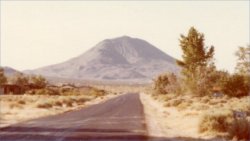
This phase came to an end as we left California to move to Illinois, in the Spring of 1968. We made the trip in the family car, that Chevelle station wagon by then, staying one night with Grammie in Apple Valley before heading northeast across the country. As we left the house, we drove back through Victorville to get on Interstate 15, then headed northeast…and along the back of Bell Mountain. It was unrecognizable. Our view of its perfect shape for all those years had been from a privileged position.

\\

Third Apple Valley: Seven Summers in the Seventies (visits from Sepulveda, 1971 to 1977)

In the Summer of 1971 we moved back to California from Illinois. As we had done when we moved there, we left Illinois without having a house to move into, and so my father parked my mother and us kids in Apple Valley for the summer, with our grandmother, while he went to LA to work and to shop for a house. We arrived in Apple Valley about 25 June, and moved into our house in the LA suburbs, in Sepulveda, in mid-August.

After three entire years away, in an area of the country far more different from Apple Valley than Los Angeles was, returning to the desert was both a homecoming and a revelation; its strangeness and appealing isolation struck anew with full force.

By this time I was in high school, entering the 11th grade that fall. The family resumed its occasional weekend trips to visit Grammie, but at a reduced rate, perhaps four or five times per year. I suppose because all four of us kids were in school by then, and had things going on.

And I was of an age when, still living at home (even through four years of college at UCLA), I began pursuing my own interests, and grew a little frustrated at being in a house with three younger children. (I did not have high school friends to hang out with…) This played out in two ways. First, just as I declined to continue attending church, I sat out some of the weekend trips to Apple Valley, and stayed home just to have some time by myself.

Second, the reverse: over the summers for several years, I managed to arrange stays in Apple Valley of a couple weeks or more, sometimes with the other kids there but often by myself. These private retreats became of central importance to me. From 1971 to 1977 (the family moved away to Tennessee in early ’78) there were seven of these summers, that I look back on fondly, and have never been able to recreate. They were my refuge, my Seven Summers in the Seventies, when I was able to revisit the landscape of my childhood, escape household circumstances to read my books, look at stars through my telescope, and be myself away from the squabble and cigarette smoke of my family.

In was during these summers, weeks at a time being in the desert every day, that I noticed patterns that I hadn’t paid attention to as a child. Mornings were crisp and clear, and still. The San Gabriel range to the southwest stood blue and sharp against the morning sky. But the winds came up invariably at mid-day, blowing from the southwest toward the northeast. As smog from the “Inland Empire” (as it came to be called) of Riverside and San Bernardino pushed its way through the pass and onto the high desert floor, the view of those mountains vanished in the haze.

  • In 1971, my mother and us kids spent about 6 weeks in Apple Valley while my father went to work and looked for a house in LA. The family had a 2nd car by then – a used Buick Skylark with peeling paint on the hood – that my grandfather had driven out for us, so after he left we had a car to get around in AV. My grandmother was working, as a receptionist for some kind of social services office in Victorville, in a building at Victor St. and 7th St (the latter the main drag in town), and across from a bowling alley long since torn down. I read some 22 paperback books during those 6 weeks, mostly books I’d acquired in Illinois and managed to pack in the interstices of the telescope box. I also had the telescope.
  • In 1972 I spent 4 weeks in AV from late June to late July, returning home earlier than planned for a family vacation, a car trip to Oregon (Crater Lake), Washington’s Olympia peninsula, and the Oregon Coast (Salishan Lodge). This was the summer I had my father’s old clunker bicycle from Cambridge, that somehow we managed to move with us. I would ride from the house to “the village” area of town, a half mile stretch of commercial district along Highway 18 at Navajo. There was a pharmacy there that had a decent magazine rack and paperback book rack. On one such trip, the right pedal broke off, out of its socket, and I had to awkwardly finish the trip home pushing on just one pedal…
  • Summer of 1973 was the period between high school and college. I spent a week in AV in early July, another 10 days in early August. A family vacation—a drive to Illinois—fell through. I applied for a couple summer jobs and did not get one (I didn’t want to bag groceries yet was overqualified for the one I applied for—I recall I had to fill out an enormous application with questions about which people we admired and why, which I realized later must have been a ploy to weed out kids who wouldn’t focus on their job).
    • Piano. During these second and third summers, my grandmother still had her job, so I would spend weekdays alone at the house. She had the piano that my family had had in Reseda, back when my mother had given me some informal lessons. (I still have a stack of the lesson books she’d used as a child.) I never had formal lessons, but I could play pieces from those lesson books. (Fun fact: back in the ‘30s and ‘40s when my mother was growing up, you could subscribe to magazines of piano sheet music, some pieces simplifications or reductions of classical pieces, some full original scores. One issue a month, with 30 or 40 pages of music. The days before TV! I have some of those too.) At best, I could finger my way through the entire original score of Beethoven’s Moonlight Sonata (1st movement), with its steady rhythm but increasingly complex accidentals.
    • Transcriptions. I also tried to write down, from tape recordings, a couple three pieces of music that entranced me. One was the main theme of the 1973 film The Day of the Dolphin, score by Georges Delerue, that I first heard on TV; another was the opening of the last movement of Mahler’s 9th symphony; another was the main theme of Stanley Kubrick’s film Barry Lyndon, a piece by George Handel. They all had had such clear, open chordal structures and harmonies, and the Mahler such clearly separate lines among the various strings, that I think my piano reductions were pretty accurate.
    • Astronomy. I had my telescope, I had my Star Observer’s Guide, by the summer of ’72 I had Brown’s What Star Is That?, and by 1974 I had Norton’s Star Atlas. I would sit out in the evenings and split doubles and find Messier objects. Moreover—I would occasionally sleep outside the entire night, in a sleeping bag on a chaise lounge, in order to wake up an hour or two before dawn and see another quarter of the sky than was visible after sunset. There were no dangerous desert critters. On the contrary, there were a couple stray cats that found me, jumped up on my sleeping bag, and befriended me. (Years later – 1980 or ’81 – my grandmother had adopted a couple stray cats, one white, one black. I was in a college computer science program at the time, learning about various historical computer languages. I named them Snobol and Cobol.) It was dark enough at night that the glare from a street light, a mile away, interfered with my night vision. I would block the light with my hand, or avoid looking that way, while looking through my telescope, to see the deep sky.
    • Jet planes. It was during these summers, either standing outside at night (I would step outside several times an evening, always, while my grandmother watched TV after dinner) or sleeping out overnight, that you could hear… high overhead… the faint roar of jet planes. They would move from the southwest to the northeast. That is, a standard flight path for planes leaving LA heading northeast would be directly over Apple Valley. (Whereas, I observed years later taking many such flights, returning flights from the east or northeast would aim first for Big Bear Lake, then angle the plane due west for LAX.) Moreover, when you looked up into the night sky to spot the plane, it would be over *there*, 10 or 20 degrees across the sky in the direction of travel from where the sound seemed to come from. Because it took that long for the sound to reach the ground.
  • 1974. After taking a summer course (Freshman Comp) at Valley College, I spent 6 full weeks in AV, from early August to mid September. Grammie had just retired from her job, so she was home all the time. Kevin and Lisa spent one of those weeks there. We must have gotten that old bike fixed, because I rode around to libraries and bookshops. (In those days even small towns like Apple Valley and Victorville had two or three new and/or used bookshops each.) This was the summer a stray dog chased me on my bike and scratched my leg sufficiently badly that Grammie took me a doctor.
  • 1975: Just two weeks in August, but the second week Lisa and Sue were there too, the latter with her ever-running radio.
  • 1976: After taking two summer courses at UCLA, I spent two weeks in AV myself, just before construction began on a remodel of the house by my Uncle Bob. Earlier in August my high school buddy Phil Klutch, taking pilot lessons, flew me to Apple Valley for a weekend. During the day he took me up again for some practice stalls. That means stalling the engine and going into free fall for a few seconds, then starting the engine back up. Of course, I got sick
  • 1977: Just after graduation from UCLA, two weeks, and instead of being dropped off and picked up, I drove the Skylark and had a car there. This is the summer I sat in the yard, looking northeast, and read new hardcover novels by Varley, Pohl, Bishop, Leiber.

This what the house looked like after the remodel in 1976. An extra room was added at the front left (behind a tree in this view), enclosing the laundry room and created a large dining room, and the entire house got this mock-adobe facade.

\\

Fourth Apple Valley: Apple Valley visits with my Uncle Bob (1978 to 1982)

My family moved back east in 1978, and I stayed in LA, working a job and going back to college, but having no car. I bicycled everywhere. (See sidebar essay about bicycling.) My Uncle Bob, now owning and having remodeled the Apple Valley house, took to visiting his mother there regularly now that my parents were gone. And so often I rode along with him. He would go once a month or so, do whatever chores needed doing, and relax. These trips were more efficient that my family’s had been; Uncle Bob wouldn’t leave until Saturday morning, and then return first thing Sunday morning. He’d pick me up at my apartment, we’d stop for breakfast along Highway 14 in Canyon Country (this is about the time I started drinking coffee), and be up there before noon. He’d run back into Victorville, or to “the village,” for supplies to do this or that home repair. These were about monthly in ’78, but ramped down to only three in 1981.

During this period I got my first camera, in May 1979, and in ’79 and 1980 I took lots of my own photos of the house, the hills, Bob’s car (a Mazda), later in ’82 my own car and my uncle’s Cadillac.

Meanwhile I got quite fit riding my bicycle everywhere, and at my most ambitious, and to connive yet more visits to Apple Valley, I embarked on 100-mile rides from my place in Northridge all the way through the mountains and across the desert to Apple Valley. And in one case, from Apple Valley back home; each time I arranged it so Uncle Bob could pick me up or drive me there for one leg of the trip. I did two of these in 1980, and one in 1981. Only the middle one was more than a couple days; that one was about 9 days, during which I cycled the fringes of valley, read books, maybe did some sky watching. (I think at some point I’d left my telescope at the Apple Valley house, since I never used it down in LA.) Unfortunately I don’t have photos from those bike trips, mainly because my SLR camera was too bulky to fit into the bike carrier along with whatever else I was taking.

\\

Fifth Apple Valley: Until my Grandmother’s Death (1982 to 1984)

In June 1982 I got a professional job and bought my first car. Now I could drive to Apple Valley any time I wanted! Except, I didn’t have the time for the week or weeks long excursions of earlier years. I had no vacation the first year on the job. I was still taking classes, at night, that Fall. So weekends at best.

And the visits themselves were getting less pleasant, because Grammie was getting batty with age. She’d always had silly peccadilloes -– one was her off-hand, obviously unserious brags, e.g. when seeing someone perform an athletic event on TV, she would say that oh she could do just as well if only she bothered to try. Ha ha. Check back at the hundredth repetition. (Another: Thanksgiving dinner was always a success because she made the gravy.)

A couple times I took friends with me to Apple Valley – once Phil Klutch, my high school and UCLA friend, for a “star party,” and once a fellow grad student named Taro. Those were awkward visits. What are your interests, Taro asked her? Oh, music, literature. In fact she sat around watching TV all day, and I never saw her read a book.

Here’s another memory just now — at some point, in the ‘70s, my parents taught my grandmother to smoke. My parents were near-chain smokers, as I’ve mentioned, and in the ‘70s people still smoked in offices, in restaurants, on planes. My parents convinced my grandmother that smoking a cigarette was a nice thing to do after dinner. So she did, for years, just the one each day. When I was there for summers or weekends, she would dutifully light up as we watched the TV news after dinner. I would move to the far end of the sofa away from her chair. She never took the hint. (There were no windows to open.)

I should give my grandmother some credit. She lived a long life, one shocked in her 40s by the death of her sheriff husband when my mother and uncle were about 13 and 12 — so she raised them herself from then on. Just 12 or 13 years later, following her children to California, she uprooted herself from a life in small town Illinois and settled, eventually, in the completely different environment of high desert California. There she settled in; she found a church community to belong to; she worked until her mid-70s; she lived there fully 20 years. She was always congenial.

\\

Sixth Apple Valley: Glancing Visits (1984)

My grandmother died in early 1984. Services were held at her church in Victorville, but no funeral – her body was flown back to Cambridge, Illinois, to lie beside her husband.

My Uncle Bob had talked for years about perhaps retiring to the Apple Valley house, had my grandmother lived even longer; but in 1985 he was only 50 years old, and not ready to retire. So over the months after her death, he cleared the house of her furniture and effects. (I got her 10-volume set of an encyclopedia called The American Educator, from 1938, which of course I still have. Fascinating to look back at what they thought about various subjects, 80 years ago.) He sold the house in November 1986, for $55,000, and according to Zillow, it hasn’t been sold since. Google views now show the property razed of all the trees and a big fence surrounding the house itself (it’s 15791 Winnebago Road, Apple Valley, CA).

My records indicate a couple trips to the house later in 1984. Once in May to pick up the encyclopedia, and a set of water glasses with cacti designs (all of which have, alas, broken over the years since then, though I’ve kept the last one, in pieces, in my display cabinet), and a bicycle – I think at some point I had two bicycles, and had left one at the Apple Valley house. And a trip in June to get my telescope, on my way to a bicycle club event at Big Bear Lake.

There was a final visit in 1985, when I spent the night in a motel, on my way to pick up my friend Larry from a bicycling event at Calico, northeast of Barstow. And a close pass in 1986 when I drove a couple guys from work, very early one morning, to see Halley’s Comet before dawn, from an area south of Highway 18 between Apple Valley and Lucerne Valley (we didn’t stop at the house).

\\

Seventh Apple Valley: Return visits since 2009

Over the next twenty years I had no occasion to go to Apple Valley, or even past it. Perhaps returning from a trip to Big Bear with someone, we took the back route home, through the desert along Highway 18? But never to just go there. It’s not a resort town, there’s nothing much to do.

But a new, final phase began in 2009 with a series of nostalgia visits. In October of that year my partner Yeong was out of town (in Europe on business), and I drove his recently purchased Subaru SUV (with its Nav function, the first of our cars to have one) to the area on a day trip. In part I was curious to explore some of the far north and eastern pockets of the valley, on the sides of Fairview Mountain, that I’d never explored because the dirt roads are too rough for an ordinary passenger car. So from Woodland Hills I drove through the mountains on Sierra Highway, through Little Rock, across the remote roads (where I’d ridden my bike on those centuries) through Adelanto, to Apple Valley, and poked around for a few hours on some of those roads. Of course I drove past the house. Though I never did find roads all the way around Fairview Mountain.

A year and a half later, in April 2011, Yeong away in China visiting family, I drove my six-month-old M3 on another day trip to the desert. One aim of this trip was to find a remote road (I used Barrel Springs Rd. south of Little Rock) to get the car up past 100 mph, if only for a few seconds. I also visited Wrightwood, a ski resort on the north slopes of the San Gabriel Mountains that I’d never had occasion to go to. Once in Apple Valley I drove out to the airport, just to check it out (Phil Klutch and flown us there back in 1976), and also visited the Victor Valley Museum in Apple Valley, which had opened in 1992. It was an interesting blend of natural history, about the landscape and indigenous people who once lived in the area, and memorabilia concerning Roy Rogers and Dale Evans, movie and TV stars who had settled in Apple Valley (and who are buried at the cemetery in the northeast corner of the valley).

It was during these trips that I saw, of course, how the area had changed. More and more houses. On Winnebago Road, where in the ’70s the half-mile stretch where we lived had perhaps three houses, widely separated, on each side of the road, now almost every lot was built. Along Highway 18 just south of the house there was now a Walmart (!) and a Target (!) in a two-block shopping center also filled with generic fast food restaurants. — This has been the course of American society, over 50 years, as national chains have replaced the local businesses that once made every village and town a unique place. The small market in “the village” where my Grandmother had shopped was now garden shop; the larger chain supermarket at Highway 18 and Navajo Rd. that succeeded it in the ’80s was closed and vacant. The main road through Victorville, 7th Street — a curving, gradually rising road from the Mojave River on the north up to the surrounding desert floor a couple miles south — was mostly shuttered, in favor of the big mall down the Interstate at Bear Valley Road. It was my personal illustration of the maxim, You can’t go home again.

Six years later, in June 2017, on the way home from an overnight trip to LA (from Oakland, where we’d moved in 2015), I took the long way home and drove through Apple Valley, barely stopping. I had a specific goal, though, to take photographs at a couple key places. One was Vasquez Rocks, just north of LA and on the way to the desert. They’re distinctive angled sandstone outcrops familiar from location shooting of dozens of films and TV shows over the decades (including Star Trek’s “Arena”). The second was to get a photo of the back side of Bell Mountain, which looks completely different than the symmetric profile view from the south, from the Apple Valley house. That done, I drove north through Barstow and west over Tehachapi Pass – a highway I’d never had occasion to drive on before – to Bakersfield and north home. (I posted about that trip here: http://www.markrkelly.com/Blog/2017/07/06/trip-report-apple-valley-2017/.)

And finally, just two years ago now in February 2018, I did a proper weekend trip to Apple. On a Friday I rented a car (a small SUV) rather than put miles on my M3, and I stayed at a motel in Victorville. I spent two full days in the area and drove home Monday. I found a small used bookshop in AV along Highway 18 that sold every book for a dollar. I poked around the now vacant Apple Valley Inn, and visited a tiny “Apple Valley Legacy Museum” in a corner of that property. I drove out to the far corner of the valley, the area where the 1st Apple Valley house was, and is now an area called Sycamore Rocks, with higher-end homes than throughout most of the area. (Mentioned here: http://www.markrkelly.com/Blog/2017/07/10/apple-valley-dreams/.) And I explored an area east of the Village called Thunderbird Ranches, with a couple hundred homes, some quite large, but all accessible only by dirt roads. Went back to the area of the house and took some photos.

On Sunday I moseyed through the “old” part of Victorville, then headed south on the Interstate to the big mall at Bear Valley Road. From there, into Hesperia, just to get an idea of the place; again, one of those areas I had never had reason to explore. East of Hesperia, where the southern edge of Apple Valley runs along the slopes of the San Bernardino Mountains, I headed east until the roads forced me back onto Highway 18. Out to Lucerne Valley then, the intersection where the highway splits off southeast into the mountains where Big Bear Lake lies. Back along Bear Valley Road. I discovered something called Lone Wolf Colony (https://www.lonewolfcolony.org/), something like half a city block fenced off and with trees and shrubs inside. My Boy Scout Troop held a camp-out there, years ago! It has the appearance of an enclosed trailer park, though its site describes it as a “a recuperative health facility” with cottages and an RV park. There was an entry gate; I didn’t go in.

And I made one other serendipitous discovery that day. Driving back west on Bear Valley Road — now heavily lined with shopping center and commercial properties — I turned into Victor Valley College, and discovered, just off campus, the fish hatchery! Perhaps noticing Mojave Fish Hatchery Road was the first clue. This was amazing because I remembered being there once, with my father, when I was very little, in the years we lived in Apple Valley. Why should there be a fish hatchery in this remote desert town? Well, it’s along side the Mojave River, which flows north out of the San Bernardino Mountains and splits a ridge of hills at the junction of Victorville and Apple Valley. Apparently it’s a county function to keep parts of the river stocked with fish. Why would my father and I have been there? No idea. But it was a thrill discovering, quite by accident, a place that triggered such an old memory.

That night, after dinner at one of the row of restaurants by the shopping mall, I drove out to the far corner of Apple Valley to look at stars. It was windy, and chilly, and a surprising number of large trucks came down Dale Evans Parkways near me — there are a couple warehouses, one a Walmart Distribution Center, in the middle of the empty north valley, that of course weren’t there years ago. But I did confirm my teenage memory of seeing, passenger jets flying overhead, from LA in the southwest to points far to the northeast, but it was too windy to hear their sounds.

I reflected yet again on the allure of this area.

First, the attraction is partly about the raw topography. It’s all out there in the visible openness of the landscape, the hills and valleys, the knolls and bluffs, not shrouded by woods or grasslands or trees. The simplicity of the street maps is given multiple new dimensions, not just height, but visibility of surrounding areas, the changing horizon from one place to the next, the extensive horizons in so many places that puts everything in a larger context — as if refracted through another dimension.

Second, looking at the stars… The paradox is that, the clearer and darker the skies, the more stars are visible, and the less obvious are the traditional constellations, because their prominent stars are drowned out by the surrounding sea of only slightly less brighter stars that are visible in a very clear, very dark sky. This is especially true in binoculars (not in telescopes, where you tend to focus on specific stars or objects); the field of view in binoculars shows even more stars than you see with the naked eye, more stars than you knew were there, and implying even more if your light-gathering power were even greater. The deep sky view is seemingly infinite, more and more, greater and greater, and implying one’s own local pocket of experience is infinitesimally tiny.

The next morning I drove home. I’ll probably never be there again.

Posted in Personal history | Comments Off on Apple Valley: Interludes

My History with Pseudo-Science (Briefly) and Science

I went through a brief phase of interest in pseudo-science.

  • Beginning at that 7th grade book fair when I bought (in addition to Blish’s Star Trek), an early edition of Ripley’s Believe It or Not, and a book by Frank Edwards called Flying Saucers—Serious Business. A year later after the move to Illinois I bought (in Cambridge) two more Frank Edwards books, Flying Saucers–Here and Now, and Stranger Than Science. The last title was a collection of nearly 100 two- or three-page anecdotes about anomalous phenomena, like those documented by the better known Charles Fort. The other two were full of fuzzy photographs and anecdotes about unidentified things in the sky. I was quite compelled by these, at age 13, that summer in Cambridge; I would go outside and look up in the sky and wonder if I would see my own flying saucer. About this time I also read a couple books by Erich von Däniken (Chariots of the Gods?) that claimed ancient human civilization were influenced by visiting alien astronauts.
  • I got over this, becoming less credulous, as I read the work of scientists like Isaac Asimov, who dismissed flying saucers with a shrug (“Every reported sighting is either a hoax, a mistake, or something that can be explained in a fashion that does not involve spaceships from the distant stars”), Martin Gardner, and others. It was easy to find other books which demolished, for example, von Däniken (Ronald Story’s The Space-Gods Revealed); a similar book was The Bermuda Triangle Mystery—Solved, by Lawrence David Kusche, that patiently examined every case of a plane or a ship that had  vanished in a supposedly mysterious way in that part of the Atlantic, and showed that every one of them involved shoddy evidence or natural circumstances that explained it.
  • The lesson I took from all these was that there are lots of credulous people with a need to believe mysterious things, and a lot of writers who, honestly or not, are willing to supply them dubiously sourced anecdotes. (Why is there is never good evidence that aliens in spaceships are visiting us? Never any physical evidence?) In contrast, I came to learn, there are phenomena for which there are endless mountains of evidence that many people reject on fatuous grounds because they threaten their religious myths. The explanations on both sides are psychological.
  • It’s worth stating that there is, if anything, an inverse relation between interest in science fiction, and credulousness about pseudo-science. Asimov and others report being asked that since they write science fiction, they must believe in flying saucers, right? No, no, no. SF writers and readers know more about science than the average person and so understand which claims are valid and which are bunk.

Meanwhile I discovered real science, outside of school, and over time, particular writers I’ve followed my entire life.

  • Earliest were those early books on astronomy, including one by Isaac Asimov. I discovered other Asimov nonfiction books in 1968 and 1969, some collections of essays published earlier in magazines, like Is Anyone There?, others books on scientific topics for general readers, like The Double Planet and The Universe: From Flat Earth to Quasar. (These were paperbacks previously published in hardcover.)
  • When I began reading the science fiction magazines at the end of 1969, I discovered that one of them, The Magazine of Fantasy & Science Fiction, published a new essay by Asimov in every issue! Asimov had a Ph.D. in biochemistry but he was an autodidact and loved explaining things in essays and books; he wrote books on astronomy, chemistry, mythology, Shakespeare, the Bible, and much else. The F&SF essays were collected every year and half or so into hardcover books from Doubleday (Adding a Dimension, From Earth to Heaven, etc etc.) and then in paperback from Lancer, Discus, and others, and I collected some of them in paperback (shown in the pic) and read others from the library. Asimov was a polymath and wrote prolifically; his essays and books were the best entry-level treatments of various basic scientific topics one could imagine (and since they dealt with basic topics they would all still be accurate today, except perhaps discussions of the size and age of the universe; quasars were cutting edge topics in the ‘60s).
  • But Asimov was a generalist crisply summarizing basic material. More interesting nonfiction writers came along one or two a decade, discovered by different ways. (There were earlier such writers, like George Gamow and Fred Hoyle, who books I found, usually in paperback, decades after they first been published. The writers below are the ones I discovered as their new books came out.)
  • One of the earliest was Carl Sagan, an astronomer at Cornell. As described on my science fiction page, I’d started following the annual SF awards, the Hugos and the Nebulas, in about 1973, after I’d discovered Locus. A new SF award was founded that year, different than the others by being juried, and named after the late editor of Astounding/Analog magazine, John W. Campbell, who’d died in 1971. In 1974 the Campbell jury gave out a special award for nonfiction – which it’s never done since—and the winner was a book called The Cosmic Connection, by Carl Sagan, a book and author I’d not heard of. I suggested to my grandmother it would be a nice birthday present (my birthday is in August), so she ordered the book through a local bookshop and gave it to me when it arrived in May. Sagan’s particular interests included the Search for Extraterrestrial Life (SETI) and he was instrumental in designing the plaques attached to the Pioneer spacecrafts (https://en.wikipedia.org/wiki/Pioneer_plaque), plaques with astronomical diagrams and also line drawings of nude figures of a human male and female. The diagram was reproduced on the back cover of the book, and no doubt caused my grandmother a moment of embarrassment when she saw it.
  • Sagan went on to write and host the TV series Cosmos in 1980, certainly a key event in my life, and several later nonfiction books, as well as a science fiction novel, Contact, in 1985, a rare foray into fiction for a major scientist. (Musical triggers? From Cosmos I discovered Vangelis, and Shostakovich.)
  • In the same year I had that summer course at Valley College (discussed on my personal history, from Santa Monica to UCLA, page), a freshman comp course, where the most interesting topic was in the textbook Logic and Contemporary Rhetoric, which described, with dozens of examples, logical flaws and rhetorical gambits used mostly by politicians and advertisers, but which I realized also applied to… purveyors of pseudo-science. Sagan, coincidentally, had hosted a symposium to study the evidence that UFOs were alien spaceships, published as UFOs: A Scientific Debate in 1972. Between these two, any lingering fascination with pseudo-scientific subjects evaporated, and I became attuned to understanding the psychological motivations for belief in pseudo-science, which was explored fully in books in the ‘90s and later beginning with Michael Shermer’s Why People Believe Weird Things in 1997, and blossomed into the evolution of psychology into a rigorous science based on clinical studies, a subject that has matured in the 21st century, marked by substantial books by Gilovich, Kahneman, Haidt, and others.
  • Next came E.O. Wilson, a biologist and naturalist at Harvard who published, in 1978, a book called On Human Nature. How did I hear about that? Probably because I’d been attuned to science fiction awards for several years, and was also aware of general book awards like the Pulitzer and the National Book Award. In 1979 Wilson’s book won a Pulitzer, unusually as a science book to win in the Pulitzer category for general nonfiction. In early ’79 I joined the Book of the Month club and chose it as one of my four free introductory volumes. It was fascinating, and a bit controversial, for outlining why Wilson felt there was such a thing as human nature, that was not arbitrarily malleable, and that there were differences between males and females. In the 1970s, and perhaps the ‘60s with the civil rights revolutions, when there was a priority was on equality, the popular notion – which I probably held too – was that boys and girls had different inclinations merely because of the way they were raised. Wilson, and many others in decades following, explored why that is not true; thus I changed my mind. (Wilson went on to write substantial later works like Consilience, The Social Conquest of Earth, and The Meaning of Human Existence, which I’ve summarized here on my site. He wrote a novel too! Called Anthill.)
  • The later exploration by psychologists of human psychological biases, things like confirmation bias and the backfire effect, explain why you can’t change someone’s mind by laying out evidence and expecting them to come to a logical conclusion. Another thing I’ve had to change my mind about. It turns out people are intuitive lawyers, trying to win, not to be right, and will rationalize away any kind of evidence that challenges their prior beliefs, or the shared beliefs of their community. And such psychological insights, as they apply to politics, even explains why so many people, incredibly, support Donald Trump.
  • Also about this time I discovered Douglas Hofstadter’s Godel, Escher, Bach: An Eternal Golden Braid, also a Pulitzer winner. I read it and was fascinated, but I admit his later works have been too abstruse, not to mention lengthy, for me to do more than glance through.
  • Over the following decades I had several methods of learning about significant nonfiction books. I had discovered the magazine Publishers Weekly in college libraries, and would browse its several dozen short reviews in each issue, of books scheduled for publication in future months, for titles that sounded interesting. I still read PW every week, or at least its reviews. College bookstores, especially at the time UCLA’s, had large selections of general books in addition to textbooks. So too did the several independent bookstores in Westwood Village near campus, stores long since driven out of business by chains like Barnes & Noble and then by Amazon.com.
  • And another key method was, in the early ‘90s, that I began to read The New York Times, with its book review section, the most substantial in the country.
  • And so later key nonfiction writers, discovered one way or another, were Jared Diamond, Richard Dawkins, Sam Harris, Daniel Dennett, Robert Wright, Steven Pinker, and many others.
Posted in Personal history, Science | Comments Off on My History with Pseudo-Science (Briefly) and Science

My History with Science Fiction

Here’s another autobiographical post, probably repetitious with some of the others, about specific events or circumstances that triggered interests or beliefs, some brief, some that have lasted a life. 3500 words just today—a draft.

Science Fiction

There are several phases to this interest, some of which have waxed and waned. An essential point is that my interest has been to particular forms of science fiction, mostly literary, and not to peripheral forms that most people think of they think about science fiction, including most sf movies, comic strips, and superhero movies. And we don’t use the abbreviation sci-fi; that’s a term of ignorance or disrespect.

How did it start?

  • A couple specific triggers. One was a comic strip in Boy’s Life magazine, the boy scouting magazine that I got for the few years I was in Cub and Boy Scouts, called Space Conquerors! It was the epitome of space opera, with four astronauts in a flying saucer whizzing around the galaxy and encountering bizarre aliens. This article from Black Gate, https://www.blackgate.com/2018/11/07/space-conquerers/, has several samples I remember vividly, especially the panel part way down that shows people dissolving into goo—very impressionable to an 8-year-old.
    • When I tossed my collection of the magazine years later… I snipped out all the Space Conquerors strips and still have them in a folder in my file cabinet.
  • At about the same time or maybe a bit later, when I was 10, the neighbor boy Jeffrey Strausser mentioned the TV show Lost in Space to me and was surprised we weren’t watching it at my house. This must have been Fall 1965 and the show had been on a few weeks. At his house one afternoon we watched an old 1950s movie called Invaders from Mars, a moodily lit sf/horror movie about a boy who realizes aliens have landed and are replacing all the adults in his town, including his parents.
  • I managed to watch Lost in Space at my house (it was a prime time show, in the evenings) once in a while, though we had only one TV and I did not always get my way. Friends at school during recess liked to play robot (“Danger, Will Robinson!). (It wasn’t until years later, actually the early ‘70s after we’d returned to California, that I saw the essential opening episodes that show the Jupiter II departing Earth and crash-landing onto their planet.)

From the Ridiculous to the Sublime

  • Being enthused by Lost in Space – a show aimed at kids, and a show that got increasingly absurd through its run — made me attentive to ads for a new science fiction show—for adults, they stressed—to debut in the Fall of 1966. That was Star Trek, which I managed to see most episodes of over its three years, and is its own subject for a different page here.
  • Then there’s a curious sequence of links from these relatively primitive TV shows, and my parallel interest in astronomy, to discovering literary science fiction.
    • Another astronomy book I ordered through the Scholastic catalog at school was Environments Out There, by Isaac Asimov, published in February 1967. Because I liked that, I ordered another Asimov title through the catalog, this one called Fantastic Voyage, which turned out to be a novelized version of the script for the 1966 science fiction movie (that I didn’t see until years later).
    • In the Fall of 1967, while I was at junior high school, book fairs were held in the cafeteria where stacks of books were laid out on tables for immediate purchase. Among the books I bought was Star Trek, by James Blish, a collection of short stories based on scripts from individual episodes of the show.
    • About a year later the film 2001: A Space Odyssey went into wide release, and though my family generally never went to the movies, I asked to be taken to see this one, and managed to see it twice. I had already bought the book—it came out in July 1968—and so had no trouble following the film.
  • These were the initial triggers. Lost in Space was kids’ stuff (though I saw it at such an impressionable age, I retain a nostalgic fondness for parts of it), Star Trek was adult but old-fashioned, and 2001 was a work of art. Within three years, serendipitously, I’d progressed from the ridiculous to the sublime.

From the Visual to the Literary

  • Then come the links.
    • Because of Isaac Asimov’s film novelization, I moved on to actual Asimov novels and stories.
    • Because of James Blish’s Trek adaptations, I discovered actual Blish novels and stories.
    • Because of Arthur C. Clarke’s novel and film script (both, in a sense, cowritten with Kubrick), I discovered other Clarke novels and stories.
    • In April 1969 Ballantine re-issued five Clarke books, including Childhood’s End, with cover illustrations of various spaceships obviously influenced by those in 2001. Because they were published by Ballantine, I trusted Ballantine for other writers, writers I hadn’t heard of. One of the first of those was… Robert Silverberg, whose collection Dimension Thirteen was published in May 1969. (And which I bought at the supermarket in Cambridge, Illinois.)
    • I joined the Science Fiction Book Club, in part to get a hardcover of 2001, and also chose early selections by Asimov and Silverberg.
    • Even though the first Silverberg books I bought were early works before his full flowering in the late ‘60s/early ‘70s, it was clear to me that he was a level or two above Asimov, Clarke, and Blish, who’d begun their careers two decades before; Silverberg had a literary background and wrote more sophisticated fiction, in terms of prose style and adult themes.

From the Casual to the Current

  • I found plenty of books to buy and read for the next few years, though high school, using chains of associations by author or by publisher in many but not all cases. For the most part I was reading paperback editions of novels and story collections that had first been published years, sometimes decades, earlier, by writers who first published in the 1940s and 1950s. Silverberg’s books, along with some anthologies of annual best stories of the year, were the closest I got to what was being published contemporaneously. (The late ‘60s was the era of the “New Wave” in science fiction, but I was only dimly aware of that, as a still casual, not-quite random reader of the genre.)
  • Then in the Fall of 1973 I began college at UCLA, and as described elsewhere, discovered A Change of Hobbit bookstore. It was significant because the store got, systematically and reliably, all the new books published each month. And because they sold the magazines, including the newsletter Locus, then a twice-monthly newsletter stapled and mimeographed.
  • Through Locus I suddenly became aware of what was going on in science fiction right now. Not just reviews of new books, but news about books authors had just sold to publishers that wouldn’t be out for a year or two. And more significantly, news about what books and stories were being nominated for, and winning, the then two major science fiction awards, the Hugos (presented by fans) and Nebulas (presented by professional writers).
  • This provided a focus for paying attention to current books and stories (mostly in the magazines, like Analog and The Magazine of Fantasy and Science Fiction, which I’d started buying in late 1969), and even playing along. That is, I could read the magazines, and many of the current novels, and decide for myself which ones were best and compare mine to results of the awards, and also to selections in those “best of the year” anthologies, of which at the time there were two, one edited by Terry Carr, the other by Donald A. Wollheim.
  • The first year I did this seriously was 1973. That is, by the time the awards ballots were announced in 1974, and Carr’s and Wollheim’s volumes were published in 1974, I had already read virtually all of those selections. I eventually read most of the nominated novels and stories from 1972 and before, back into the 1950s, but they were history; I hadn’t become keyed to current events until 1973.
  • And then, reading Locus every month (or couple weeks, its schedule was irregular then), I saw Locus had its own annual poll, and annual recommended reading list, compiled explicitly to influence the Hugos, according to the editor, Charles N. Brown. He even invited his own readers to submit their lists of favorite novels and stories! And so, by 1975 or 76, I started doing so. I became a reliable correspondent, often sending lists of stories I’d liked along with paragraphs of commentary. In 1980, I noted in my journal, the short fiction categories of the recommended reading list were credited to Terry Carr, Gardner Dozois, and me.
  • And this went on for over a decade before one day Charles Brown called me up on the phone one day and invited me to write a monthly review column for Locus magazine.
  • This era that began in the early 1970s was when my tastes matured and I discovered so many writers whose techniques and subject matters were superior and deeper compared to the traditional classic SF writers like Asimov, Clarke, and Heinlein. Silverberg was the first; then there were Le Guin, and Bishop, and Dozois, and Effinger, and Malzberg, and Wilhelm, and Wolfe. Earlier writers I’d missed, like Ballard. This continued for a quarter century, as I followed the field closely, discovering important new writers just as everyone else did (Bear, Benford, Willis, Gibson, Sterling, Robinson, Egan). My tastes were “progressive” in the sense that I welcomed novel styles, ideas, and approaches – the new is what science fiction is about! — as opposed to “conservative” writers and readers who required simplistic beginnings, middles, and ends, clearly defined good and bad guys, simple-minded battles of good vs. evil translated into space opera.

Leaving Visual SF Behind, Mostly

  • Which is a nice lead-in to my disdain for virtually all TV and movie science fiction. I retain nostalgic fondness for the original Star Trek, and even for Lost in Space, but that’s because I was in my pre-teens when I first saw them, and everything you’re exposed to in early life leaves a life-long impression. I watched the later Trek series Next Generation religiously when first broadcast, and it was fine, but I’ve never bothered to watch it again. I’ve not watched any of the other Trek series at all, and I’ve not cared much for the Trek movies. My general issue with all of them is that their themes devolve into soap opera or politics: does Spock die, or live?; Federation vs Romulans and/or Klingons. The best original Trek episodes were those that involved meeting something unknown, and dealing with it, trying to understand it, be willing to change from the experience. That central theme has vanished from all the later variations of Trek—possibly because TV changed, given to seasons with story arcs, rather than individual episodes that can be seen in any order, each with a premise and a conclusion. (I think this reflects why I’ve always preferred SF short fiction rather than novels, let alone series of novels that just keep plot churning without ever reaching any kind of conclusion.)
  • History has validated 2001: A Space Odyssey as a great film, a work of art, and the most profound science fiction film of all time. That is in part because how newbies react to it: it’s slow, it’s confusing. No, it’s not; it takes understanding; it’s brilliant because it does things differently than anything before it, which is partly what defines a classic. I was lucky to have seen it at an early age (13) and had read the book.
  • The only other science fiction film I’ve liked well enough to have bought several DVD/Blu-Ray versions of over the years is Blade Runner, from 1982, and even then I have a slightly mixed feelings about it. I love the music, the visualization of its future, the oddly mannered, poetic dialogue, and the thematic ambiguity of the difference between humans and replicants; I cringe at the too numerous gratuitous moments of physical violence.
  • In recent decades I don’t bother to see most science fiction films. Even though for years I procured and posted Gary Westfahl’s film reviews for Locus Online, I never saw the majority of the films he reviewed myself. (Partly for the reasons he expresses in his reviews, generally the formulaic result of virtually all Hollywood films—films and TV are all so much more alike each other than are the literary works of the best writers.)
  • There are some good tries and obscure near-misses, from Solaris to Contact to Interstellar, and I’ll grant that recent films like Annihilation and Arrival are very good. (All one-word titles!) But I’m seldom inclined to see them a second time.
  • And TV? The first claimant to an ambitious TV series, following Star Trek, was Space: 1999, with two major TV stars: Martin Landau and Barbara Bain (from Mission: Impossible). The opening card on the debut episode (I vividly remember watching this, with my family, at our home in Sepulveda) identified the location as “The Dark Side of the Moon.” Nonsense; there is no such place (there is however a far side of the moon, which isn’t the same thing at all). And a nuclear explosion that blew the Moon out of its orbit. Again, nonsense; elementary physics.
  • What followed? Cheesy shows like Logan’s Run? The Six Million Dollar Man? I didn’t pay them attention. In all these decades, I’ve been impressed only by the recent Battlestar Galactica, well-produced and acted in every way, though still relying on stock SF clichés like space warps and humanoid robots, and with a lame ending. (Lost had science fictional potential for a while, but also suffered from its producers making the story up as they went along, and having no decent conclusion.)
  • And movies? The science fiction field was set back 25 years into comic-book terms by Star Wars, in 1977, that fantasized spaceships moving like jet fighters, involved a simplistic good vs. evil battle, and relied on a fantasy pseudo-science “force.” I was astonished when this film took the world by storm, and dismayed that its success led to a dumbing down of science fiction publishing to appeal to readers who liked that film. (Especially at Del Rey, successor to Ballantine.) Its effect wiped out most of the advances of science fiction’s “New Wave” that brought into prominence those early ‘70s writers I was so impressed with. Science fiction became a field of sequels and endless series, alongside the new popularity of Tolkien-inspired fantasy.

And Yet Nostalgia

  • Just as I have some nostalgic interest in revisiting the original Trek, and even Lost in Space, I’m fascinated by watching older science fiction movies, from the 1960s and before. (Thus my page on this site of “Skiffy Flix” reviews: http://www.markrkelly.com/Blog/bibliographies-and-reviews/skiffy-flix/.) I find them interesting mostly because they reflect naïve ideas about how the universe works, either because the writers and producers were scientifically illiterate, or because they depicted things dishonestly for the sake of not upsetting audience expectations (as Trek did with its swooshing sound of the Enterprise flying by).
  • Later films, from the ‘70s forward, I’ve found less interesting partly because of the cheesy costuming and hair styling of the ‘70s and ‘80s, but also because my sense is that by that time the writers and producers should have known better. Audiences really were getting more sophisticated. I’m sure there have been some fine SF films over the past several decades, but very few that measure up to the best SF novels and short fiction. None that I’ve found interesting enough to rewatch, as I still rewatch those creaky 1950s films. (But I need to think about this, and revisit films of the past five decades. If I have time.)

 Keeping Current for a While

  • I wrote the monthly column for Locus reviewing short fiction, which entailed reading all the magazines every month (at that time there were three major ones and a couple minor) and the occasional original anthology, beginning early 1988, for three years, then stopped.
  • Writing for Locus, the major news magazine of the science fiction field (analogous to the book industry’s Publishers Weekly), gave me some legitimacy as a person; it validated my worth. I could go to science fiction conventions – I’d only done so two or three times before, over 15 years – and walk up to a major writer like Connie Willis, introduce myself, and be greeted with interest. (Of course I tended to approach writers whose work I liked. Obviously I avoided those whose work I hadn’t. So it goes with all associations among writers and editors, in a field with many different flavors of science fiction, political attitudes, and opinions about how stories should be written.) The first convention I attended after starting the column was a Westercon in a blistering hot Phoenix (the convention is held over July 4th weekend), where I actually met Charles Brown for the first time in person, and met Robert Silverberg for the first time. Later that year at the Worldcon, that year in New Orleans, I chanced upon some famous writer—it may indeed have been Connie—and she not only welcomed me, but invited me along to lunch with her, Greg Bear, Kim Stanley Robinson, and someone else, maybe James Patrick Kelly. That was a heady start to the weekend. On the other hand, not all writers are nice or approachable. At the same convention I introduced myself to George Alec Effinger, who’d published an excellent story earlier in the year, and all he did was complain that I hadn’t reviewed his other story, the one published in Playboy. Oh well.
  • It was also congenial in those years to be a part of the Locus crew. Charles Brown and two or three of his staff would attend, and there would be a Locus Dinner one night during the con, when we’d all go out to a restaurant and Charles would pay. These conventions usually had dealers’ rooms, and there would always be a Locus table (to sell subscriptions), and so I could drop by there to chat. Furthermore, the big publishers like Tor and HarperCollins would host room parties in the evenings, sometimes open-door but usually by invitation, and anyone associated with Locus got an invitation. Snacks, wine, scotch, more people to meet. I’m not particular extraverted, but again, having Locus creds gave me reason to mix a little and be recognized.
  • I stopped after three years due to a combination of fatigue from monthly deadlines and personal matters. The latter passed, Charles hadn’t found a replacement short fiction reviewer by the end of the next year, and so I decided to start up again, in 1992. That ran until the end of 2001.
  • (Several 1997 era columns are linked to this mirror of my first webpage, on Compuserve: http://www.markrkelly.com/CompuServeHomepage.html.)
  • For the first decade, from ’87 to ’96, I attended the annual World Science Fiction Convention, and twice the annual World Fantasy Convention, the latter a more professional affair with a quite different manner. Beginning 1997 I got more involved with Locus – I launched its website – and started going to more convention, three or four a year. Now I was a web-publisher.
  • For purposes of this discussion, though, I ended my monthly column permanently at the end of 2001, partly due again to that fatigue of monthly deadlines, and also because my partner Yeong had moved in and had little patience for my reading and writing. (Reading was for adolescents and single people, he told me.)
  • And so the upshot is, once I didn’t have to read for my monthly column, I stopped keeping up. I had read the magazines and original anthologies and kept current with the best stories published, all the new writers, and so on, for nearly 30 years. And then, for the most part, I just stopped, I stepped away. I still bought all the magazines and many anthologies (and I still do), but I didn’t read them except occasionally after some stories had already been nominated for one award or another. Yet some years go by when I don’t get around to reading any of the year’s short fiction.
  • I’ve kept up on some current novels over the past 20 years, though again there are some award winners I haven’t read.
  • I do plan to visit some of these works of the past 20 years, discovering them belatedly rather as I discovered Asimov and Clarke and the others only years after their works were first published.

Haphazard Decades, with Ambitions

  • In the past two decades, I’ve lived with a partner who has no interest in books or reading. And yet, intermittently, I’ve read about as much overall as I did in the ‘90s, discounting all the magazine reading I was doing then.
  • In the past five years, since moving to Oakland, I’ve been “retired,” staying at home every day, while my partner goes to work 5 days a week. (Until recently, April 2020, when he’s worked from home given the pandemic.) And so I’ve gotten lots of varied reading done. But not a lot of current SF. My interests have run more to nonfiction in recent years, and to revisiting classic SF. (I’ll explored nonfiction triggers on the Books page.)
  • For a couple years now I’ve been revisiting “classic” (1950s and before) SF novels with an eye to re-evaluating them from the light of contemporary understanding of science, contemporary perspectives of social and moral issues. As usual I’ve read a lot more than I’ve posted about on my blog. But my review/summaries of classic SF novels are now appearing every two weeks at Black Gate (https://www.blackgate.com/), which gives me incentive to keep going.
  • At the same time, it’s impossible to read/reread all the significant novels of the past 7 or 8 decades of science fiction publishing, and I’m now contemplating how to shift my focus from only classic SF novels, to the most significant works by selected authors over all of SF history. In support of my imagined book about “the intersection of science fiction with ancient and contemporary knowledge,” as I’ve noted elsewhere. Which authors should I focus on? The classics by Asimov, Clarke, Heinlein, sure; but then who. Silverberg. Le Guin. Robinson. Egan. Wolfe. And a few more.
Posted in Personal history, science fiction | Comments Off on My History with Science Fiction

My History with Astronomy

How did it start?

  • There was a specific event: in the 6th grade, I noticed a row of textbooks in a closet, a basic astronomy text called A Dipper Full of Stars. (I already wrote about that here: http://www.markrkelly.com/Blog/2014/05/01/cosmos-and-my-amateur-astronomy/.) I asked to borrow one and read it. Later I bought a couple mini-paperbacks through the school’s book ordering system, one called Stars and the other The Sky Observer’s Guide.
  • That let to requesting a telescope of my own, which I was given for my 6th grade Culmination. Summers looking at the stars in Apple Valley in the dark desert night. Norton’s Star Atlas. An initial ambition to major in astronomy in college. Which I abandoned when the physics got too hard.
  • In parallel I became fascinated by star names, which are matters of history and mythology of course, not astronomy. There are several dozen well-known ones (Sirius, Betelgeuse, Vega, etc.) but several hundred more obscure ones, to be found in larger sky observing guides that detail interesting object to see constellation by constellation. One of these was published in 1971, a hardcover for the then hefty price of $12.95, which nevertheless I bought, in May 1972: What Star Is That? by Peter Lancaster Brown. Others were Outer Space: Myths, Name Meanings, Calendars (1964), by Gertrude and James Jobes, which I first saw at the Victorville Public Library, and much later found a used copy of via the internet; it’s exhaustive on how different cultures have described and named stars, planets, constellations. Finally there was Star Names: Their Lore and Meaning, by Richard Hinckley Allen, first published in 1899 and reissued in a heavy-duty Dover trade paperback in 1963; this one was exhaustive in its accounting for variations in every star’s name through different cultures and spellings.
    • This was perhaps the first topic where I became more obsessed by the peripheral matter of compiling star names than by studying the stars themselves. For several years in my teens I looked for any other astronomy guides that included star names that I could find in libraries, checked out each such volume and compiled which names it included. All these data got sorted into tallies, of sorts, of which names, and spelling variations, were most common for each star. Why did this matter? I’m not sure; but compiling such data (trivia?) seemed important, and came from the same motivation, I suppose, that decades later led me to compile and maintain a website of science fiction awards, which has set a standard for such sites and is widely used.
    • More recently I discovered that the International Astronomy Union (IAU) for a working group in 2016 to formalize the official names of several hundred stars, with the results published here: https://www.iau.org/public/themes/naming_stars/

How did it go?

  • Apple Valley was the ideal place to skywatch through a telescope; the skies are dark away from city lights, and there was no smog in the desert. (Smog was a considerable problem in LA in the ’70s; my journals from those years frequently mentions not being able to see the hills 3 miles to the north, or breathing problems from long bicycle rides on smoggy days.) I suspect I just left my telescope at the Apple Valley house. For several summers in the ’70s I spent multiple weeks in Apple Valley, in between summer classes, and would often spend evenings out in the yard with my telescope.
  • You don’t use a scope to look at the moon much; it’s too bright. But looking at planets is easy and rewarding. What you can see depends on which planets are in the sky at any given time, of course. Saturn’s rings are easy to see, as are Jupiter’s four large moons. Venus is fun to see as a crescent, like a mini-moon. Mercury is hard to spot because it never gets very far from the sun, and so has to be seen just after sunset, or just before sunrise.
  • After the planets the fun things to try to see are double stars, binary stars that appear as a single point of light to the naked eye, but in a telescope can be seen to two or more individual stars. Sometimes one is obviously brighter than the other; sometimes their colors are strikingly different (one yellow, one blue for example). In the constellation Lyra, the star designated Epsilon is a double-double–in the eyepiece you see one pair at the left edge of your view, a similar pair at the right edge, separated by 10 times the angular width of each individual pair. (In one of my early journals, I have a long list of a couple dozen double stars I’d managed to “split” in my telescope in just one evening. You just need your Norton’s Star Atlas and plan in advance where to look.)
  • Beyond that are the various nebulae and galaxies, the 100 or so brightest of which were compiled and numbered by French astronomer Messier, the list known as Messier objects (https://en.wikipedia.org/wiki/Messier_object). Some of the most famous are the big globular cluster in Hercules, M13, and the Andromeda galaxy, M31. They and a few others are easy to spot in the telescope — i.e. they’re bright enough — but can be disappointing nevertheless, mere fuzzy blobs in the telescope, especially compared to the familiar high-resolution photographs of the objects we’ve seen for decades.

How did it end?

  • The looking at stars through a telescope wound down by age 30 or so, when my grandmother died and I lost access to Apple Valley. It was never practical to see stars from the middle of a big city. At some point that I don’t remember, I must have given away the telescope.

Addendum

  • But much later, perhaps 2010, my partner Yeong bought me a telescope, a similar small refractor, for Christmas. It sat outside on an inaccessible balcony of our Woodland Hills house until we moved to Oakland in 2015, where it sat outside on a balcony that turned out not to be inaccessible and someone stole it. He replaced it last year with a Cassegrain reflector (https://en.wikipedia.org/wiki/Cassegrain_reflector), a scope of similar light-gathering power in a more compact size. It sits inside. It’s useful for seeing the planets, and details of ships in the bay.
  • The interest in cosmology has never ended, but rather merged into a general interest in science (in particular all matters about the age and extent of the universe) and how our knowledge keeps expanding, e.g. the current mysteries of dark matter and dark energy.
Posted in Astronomy, Personal history | Comments Off on My History with Astronomy

My History with Books

(As I said in previous post, this is an essay that will be cross-post as a page, accessible through the drop-down menus above. For now it’s just a post.)

Anyone entering my home over the past 30 years, maybe even over the past 40 years ago in the tiny apartment I lived in during my mid-20s, would first notice that my life has been dominated by books. Not just science fiction books, but also books on science and philosophy and religion, general literature, reference books, textbooks.

Dysart asked “Why, ultimately, me?” I can’t answer why, ultimately, books. Why are some people attracted to reading, or any other interest, and others not? Clearly there is a range of personality types that influence such tastes, but why any particular personality and not some other? I think part of it is random genetic shuffle, and part is early childhood experience. So, while I can’t answer why I developed a passion for books, I can trace back the events in my earlier life that triggered it.

And I can make some general comments about how a bookish person thinks about and treats books, that non-bookish people don’t appreciate.

History

  • In retrospect it’s curious that my family, that is my parents, did not read books or provide them to their children. There were no picture books in the house when I was growing up, no Cat in the Hat or other Dr. Seuss books, nothing like that. My parents didn’t read books. They watched TV. (But never went to movies.)
  • And yet my parents must have felt some certain responsibility to provide classical education to their children. I see from my notes that our household acquired a set of Harvard Classics (https://en.wikipedia.org/wiki/Harvard_Classics) , a 50-volume set of classic literature, philosophy, and science, as early as 1962, when I was in 2nd grade! And later, a set of Encyclopedia Britannica, a set of the Book of Popular Science, a set of a children’s books called A Bookshelf for Boys and Girls (my favorite volume of which was called “Things to Make and Things to Do”). These sets of books lay in the background as I grew up; I consulted them routinely. By middle school age, I was seen as a boy who read the encyclopedia. More about this here: http://www.markrkelly.com/Blog/2016/06/07/growing-up-with-books/
  • The only household books remotely fictional (well, some of the Harvard Classics were classic plays) were 8 volumes in a set called Book Trails, collecting fairy tales and adventure stories in volumes beginning “For Baby Feet” and ranging to “Of Trail Blazers.” Somehow I’ve inherited only six of the eight volumes; I seem to recall some reason the set was split up between me and my cousin Paula, but then why would I have gotten 6 of the 8? Oh I know—I just realized. It was because when the split was made there were three kids in my family (so it must have been around 1963) and one in Paula’s. Thus the split. Such a split sends shudders down the spine of any book collector, of course.
  • I discovered books on my own at the school library, in 5th or 6th (I had gone to that library in Santa Monica in 2nd grade, but don’t remember anything I read there.) I liked certain mystery novels, I adored the series about the Melendy Family (by Elizabeth Enright) especially Spiderweb for Two, a puzzle/mystery novel involving a family of children following a series of clues that one year at Christmas I emulated (putting a paper clue inside an ice cube in the freezer, e.g., for my mother to find). And my favorites were a series of novels by an English writer, Enid Blyton, the Adventure books, about a family of four children who went off on “holiday” several times a year and discovered various amazing criminal plots, in mountains, valleys, rivers, castles. (More about those here: http://www.markrkelly.com/Views/?p=269 )
  • And I discovered my own books, books that I purchased and owned, also in about the 6th grade, where Scholastic Books catalogs were distributed in class, money was brought from home and orders placed, and books would arrive, one per classroom, weeks later. Much more about this and later processes here: http://www.markrkelly.com/Blog/2016/06/30/15-ways-of-buying-a-book-part-1/.
  • From late elementary school, then, through my mid-20s, I acquired books of my own, given my limited resources, but also drew on libraries, both public and school. I read a lot of early Heinlein from libraries, before I later bought copies of my own. For a period in college (still living at home), I went to the public libraries (in Northridge and Granada Hills) and checked out stacks of 10 nonfiction books every two weeks. I didn’t read them thoroughly, of course, but I paged through them and gleaned a lot about the range of their topics. (Histories of classical music; chemistry and physics textbooks.) I was doing light inspectional reading, as described below.
  • Once I had a full-time job and could afford to buy whatever books I wanted, I had enough to read and stopped going to libraries. And I’ve rarely been in a library since. As I write in April 2020, about two years ago I checked out a couple branches of the Oakland Public Library. They were pleasant, half-filled with computer stations and shelves of DVDs rather than shelves of books. The science fiction shelves were scattershot; seemingly random volumes by many major SF writers, but not the best volumes but all the best writers. In the nonfiction shelves, e.g. cosmology or evolution, it was a decent mix, but my thought was that my own library at home was better.

Themes:

Here are some topics about what people who don’t read books think about people who do, and who have large libraries.

  • Have you read all those books? Accumulating a library is not about reading a lot of books and keeping them. It’s not like having a record/CD collection, where presumably you listen to every new item at least once, and keep everything for future repeat listening. It’s not a pantry, which you keep restocking steadily because you use every item eventually. A library is a collection of resources. It’s a collection of things that interest you, that you might want to visit. There is never enough time to read all the books that interest you. But you keep them, because you don’t know what your future self might deem interesting, even urgent.
  • (As a side point – there are readers of books who treat books like, oh, movies or TV shows, to be seen or read once and then disposed of. This is why on Amazon, or at bookshops like Half Price Books (https://hpb.com/), there are dozens of copies of just-published books that have been quickly read and then put up for re-sale. These readers do not keep books, they don’t have libraries; these readers are transactional, not intellectual.)
  • Downsizing and regrets. Over the years I’ve been in situations where it’s seemed reasonable to sell off books I’ve collected, because of space issues, or because I think my tastes have changed and I can identify books I will never have any reason to read or look at ever again. Again and again, at least in a few specific cases, I have been wrong. I keep discovering reasons why I want to see this or that book that I no longer have anymore. This meshes with the point that a library is a resource that is larger than what interests you at the moment. Still, practical issues intervene, and so in late 2014 I sold off, to the Iliad Bookshop in Burbank (https://www.iliadbooks.com/), some 30 or 50 boxes of books (a couple thousand books, I think) that I thought unlikely I would ever actually need to read, prior to moving to the Bay Area in early 2015. And of course, some of them I miss, especially some of the anthologies I could have used for my current anthology project.
  • How to Treat Books. Transactional readers treat books like tissues to be used once and disposed of; thus, in used book shops, you see paperbacks with bent spines and hardcovers with cocked spines. Those of us who respect books treat them kindly. You don’t crack the spine. You don’t bend the cover. You don’t open the cover of a paperback and put a crease in the middle with your finger, the way you might a magazine. A new hardcover – this was true decades ago, not so much now, when books seem to be better built – needed to be broken in: you set the book spine side down, you opened a few pages on the left, and few pages on the right, back and forth, a few pages more, on each side so the spine would open it evenly, without creating any kind of spine cock (e.g. as seen here: http://www.mywingsbooks.com/coll-terms/spn_.shtml )
  • The result is I have a library of 8000 books where – except for those few books I bought used, in bad condition – you can’t tell whether or not I’ve read them. They are all in perfect condition. I’ve read about half of them, and hope to have time to read many more.
  • How do you decide which books to buy? Several strategies.
    • You go to bookstores and browse. When you’ve read a book by some author and liked it, you look for other books by the same author. If you have an interest in a particular subject, you look for new books on that subject.
    • As I mentioned elsewhere, I developed a brand loyalty early on. The Bradbury paperbacks I’d bought were published by Bantam; several Clarke reissues in the late ‘60s were published by Ballantine. And so I was more inclined to buy a Bantam or Ballantine book by an author I hadn’t heard of, than a book from some other publisher, like Berkley or Lancer. This is a dicey strategy however. There really are differences between publishers, at any given time and for any particular subject. But these differences change every few years, as the industry changes and editors come and go.
    • Better strategies are to read reviews and pay attention to awards. No strategy is guaranteed because tastes are different, but over time you learn which reviewers to trust, i.e. who seem well-informed and whose recommendations are worth following, and which awards to trust, given the people who vote for them and the kind of books that keep winning those awards.
    • One trigger in this regard was my inspiration to start reading The New York Times, around 1991, because a friend I met at the time and admired would read it every Sunday. So I started driving to a newsstand every Sunday morning to buy it, and some years later, subscribed to it daily, as I still do. NYT has the most substantial book review section of any publication in the country – and from there, especially, I first heard of substantial nonfiction books that I might not otherwise have known about.
  • How do you read a book? Not a silly question. You start at the beginning and continue until the end, right? For novels and short stories, sure.
    • For nonfiction, not so much. One of the best books I’ve ever read was called How to Read a Book; I reread it recently, in 2016 (http://www.markrkelly.com/Blog/2016/03/01/rereading-how-to-read-a-book/). The idea for nonfiction begins much as you would do for books at a bookstore. You pick it up, read the flap copy, the back jacket; look at the table of contents; glance through the index if there is one; see if its intent is scholarly enough to have bibliography and notes at the end. Read opening pages of a chapter here and there to get a taste of the prose style. This is inspectional reading. This enables you to consider many books quickly—in order to decide which ones are worth more time. (Not mentioned in that book, but another perfectly reasonable way to get a take on a book is to see who blurbs it – who provides the laudatory quotes on the front or back jackets. Some authors (E.O. Wilson, Steven Pinker) I respect enough to follow them everywhere, to take any of their recommendations strongly. Other people I might take as a reason to avoid a book, Dinesh D’Souza for example, or Deepak Chopra.)
    • Then there’s analytical reading, which I do by taking detailed notes as I read; and syntopical reading, where you pose a thesis and examine books that address the issue. I do the latter often, as I state in my summary/reviews on my blog, by posing questions at the very beginning, even if it’s a vague, what can this book (on a subject I know well) tell me that I don’t already know?).
    • I confess I’m too OCD to apply inspectional reading to books already owned, even though I have some 2000 substantial nonfiction books and am unlikely to live along enough to analytically read half of them. I keep thinking I should try; take a dozen books on similar themes, spend an hour on each, and have some idea of what they claim. Maybe soon.
    • Also, even reading fiction isn’t as simple as reading from start to end. In just the way I take notes on nonfiction, I take notes on fiction. (Usually handwritten notes as I read in an armchair, later written up into a computer file. More often lately, sitting at the computer and reading the book to one side, writing notes as I go. Much more efficient. This is why some of my blog posts summarizing nonfiction books are really long. To counteract such long summaries, my current strategy is to reread the long notes and then summarize in a few bullet points the themes and conclusions of the book at the top of the post that can be seen in one screen.)
    • This whole business of taking detailed notes is necessitated, for me, by having a poor memory for things that I’ve read. After a year or two, I barely remember the contents of a book in any but the most vague way. I’ll forget how the novel ended. Didn’t the villain die at the end? Did the hero get home? That’s one reason I’m rereading a lot of classic sf novels recently, because there’s no way I would be able to discuss them based on 30 year old memories (and secondary sources that provide summaries and commentary often aren’t very good and are, well, second-hand; the point of my discussing them is to provide some unique insight).
    • Having notes enables me to retrieve in detail the contents of books I read years or decades ago. Thus I read Silverberg’s Collision Course a full year ago, but was able to pull up my notes and fill them out into a substantial summary review for Black Gate (just posted as I write: https://www.blackgate.com/2020/04/09/a-fascinating-ordinary-1950s-sf-novel-robert-silverbergs-collision-course/). Thus the John Allen Paulos book A Mathematician Reads the Newspaper, which I read way back in 1997, but took notes on, which took only minor ironing into full sentences to post here on the blog. (I have such detailed notes on about 200 nonfiction books, only maybe three dozen of which I’ve posted.)
Posted in Personal history | Comments Off on My History with Books

My History with Bicycling

I’ve been writing a series of autobiographical essays recently, to supplement the photo sets of scanned slides and prints I’ve promised to gather on this site. Most will be installed as WordPress “pages” which then automatically appear in the menu bar at the top of each page, though I can create parent/child relations and orders to control how the links appear as drop-down menus. As the pages multiply, I keep tweaking that drop-down menu structure. So I think for the time being I will be cross-posting such essays as ordinary posts, that will appear automatically at the top of the homepage; otherwise no one will notice new “page” essays without my pointing them out. Here’s one about my history with bicycling.

At my peak, in my late 20s, I bicycled obsessively, taking long rides on weekends, riding three “century” rides of 100 miles to Apple Valley or back, and two others as long or longer in Solvang and to Devil’s Punchbowl. In contrast to my school disinterest in P.E., I became very fit by bicycling. I was a slender 135 pounds with a resting heart rate of 48.

  • How did this begin? How did it end?
  • There were a couple false starts. Very early on, in Apple Valley, my father taught me how to ride a bicycle with some red bike he had, perhaps leftover from his own childhood and moved from Illinois. Don’t know whatever happened to that; It didn’t go with us to Santa Monica or Reseda. In Reseda I had a tricycle that usually I zoomed around the back yard, not sitting on it, but riding skateboard like with one foot on the rear platform and the other pushing off the ground, half-standing up.
  • In Reseda, so sometime during elementary school, I was given a full-size grown-up bike for birthday or some similar event. I never had one of the then popular Sting-Ray bikes with high handlebars and banana seats, that were so popular with the other kids. The full-sized bike intimidated me, and I didn’t want to ride it. My father sold it. Another disappointment for him, I suppose.
  • When I started at UCLA in the Fall of 1973, I saw hundreds of students riding back and forth across campus on bikes. The campus was large enough that it could be difficult to get from one class to the next in the 10-minute interval between session times. I became obsessed by wanting a bicycle, arguing to my parents that Phil (my UCLA car-pooling partner) and I could save money at the parking garages by parking off campus on residential streets, and riding into campus on bikes. That never did happen, but I did get a bicycle for Christmas that year. Typically, I’d done some research and picked a model, and when the time came, my mother and I went to the bike shop (on Sherman Way in Reseda) and bought the one I wanted, for something like $110. It was a white Nishiki, a 10-speed with the standard curled-down handlebars of a road bike. (And then in cruel irony, for a week after we brought my new bike home, it rained.)
  • I did ride that bike off and on over the following years while in college, mostly from home to one bookstore or another. (For magazines and paperbacks my go-to place was Reseda Books, a small shop that sold magazines and paperbacks, at Reseda Blvd and Sherman Way, 5 miles from home.)
  • And then I graduated from UCLA and couldn’t find a professional job; I’ll go into that elsewhere. As family plans for the move to Tennessee solidified in the Fall of 1977 after my graduation, I searched for any kind of job and got one with the County of Los Angeles (I’ll go into that elsewhere) at a facility in Reseda, just down the street from Reseda Books. Within a few weeks, from January to March of 1978, I began this job (on 17 Jan, initially driving the family’s second-hand Buick), the family departed for Tennessee (on 17 Feb), and I found a one-room apartment in Northridge and moved in (on 6 March). I’d stayed in the house on Hayvenhurst until then because it hadn’t sold yet. Once the family left… I bicycled to work. From Vincennes Street in Northridge, a couple blocks off the Cal State Northridge (CSUN) campus, to the job at Sherman Way & Louise Ave, was 4 ½ miles.
  • So I bicycled to work for some 2 ½ years until I quit that job and went back to college, at CSUN. Weather in southern California is good most of the year, of course, but on those occasions that it rained, I took the city bus, an easy run down Reseda Blvd. There was one occasion rain hit unexpectedly during the day, and my Uncle Bob came to drive me and my bike home.
  • After locking up my bike outside at the corner of the office building where I worked, for a year, one day it was stolen, the cable locking it to the rack cut. I had to get a loan to buy a new bike, a Centurion Le Mans.
  • This is the Centurion Le Mans, or one of them; the photo would have to be 1979 or 1980. Centurion Le Mans, with a kickstand and horizontal brake handles. The latter were called ‘safety levers’ or ‘extension levers’ that experienced cyclists would never use, since their grip is indirect and riding with your hands on the crossbar isn’t the best way to keep control.
  • I also used the bike to cycle from Northridge to Westwood, to Change of Hobbit bookstore, which had all the new science fiction books that the local mall shops (Walden and Pickwick) didn’t carry. That entailed cycling up Sepulveda Blvd over the pass from the valley to Westwood. I had a big orange luggage bag that mounted in front of the handlebars that would easily hold 4 hardcover books.
  • Over the following two or three years, I went on increasingly long recreational rides, some half the day. South to Venice Beach (via Topanga Canyon or Sepulveda Blvd alongside the 405 freeway; north to Canyon Country (via the Old Road alongside Antelope Valley Freeway); northwest to Simi Valley over Santa Susanna Pass; east through Glendale, Eagle Rock, and Pasadena as far as Arcadia. Only the last route was mostly flat; the others all involved climbs over passes. So I necessarily got quite fit, at least aerobically.
  • My ultimate rides were three, in 1980 and 1981, from my apartment in Northridge, all the way to Apple Valley where my grandmother lived – or back. In each case I coordinated with Uncle Bob for a ride in the other direction. Two of these were over long weekends, but one, the last one, came at the end of a week-long stay in the desert, returning home at the end of it on that long ride. Each ride took 7 or 8 hours, if I recall, and avoided heavily trafficked highways like 138 and 18 across the desert. Instead I took remote, empty streets like Avenue T, Palmdale Blvd, and El Mirage Road, all two lane highways across the desert flats. Fortunately I never had any serious accidents. A lot of flat tires of course. At worst, on long rides, I was very dehydrated at the end.
  • (I don’t have any photos of these rides. Though I’d acquired a camera in 1979, it was too bulky to take along on such long trips when I had other stuff to carry.)
  • My single longest ride was a run-up to the first Apple Valley century: a ride from my place in Northridge to Devil’s Punchbowl, an LA County park at the edge of the Mojave Desert and San Gabriel Mountains, near Pearblossom. 60 miles each way.
  • In 1982 I got my first (and only) professional job, and first car. I didn’t need to ride as much, and cut back significantly.
  • Here’s a later bike, another Centurion, with no kickstand, no horizontal brake levers, and toe straps on the pedals. (I never did use the cycling shoes that clip into the pedals, as most serious bikers do.)
  • In the first couple years that I had my car, and a job, I tried various ways of socializing, and one was to join a gay bicycling club. It was called Spokesman at the time, and later replaced this rather sexist name with Different Spokes. Since cyclists are a passionate bunch, the group did lots of events: at least one weeknight evening ride in Griffith Park (convenient for those who lived nearby), and one longer ride on the weekend, in scattered locations (rather analogous to scouting campouts) that required driving to a particular location with bikes in your cars.
    • The first began out in Palmdale and took a path along the aqueduct for an hour or so, then came back. I had naively thought I could fill my water bottle at the parking lot. No. I was dehydrated to the point of cramped legs by the time we finished.
    • Another began in Redondo Beach and went through part of Palos Verdes.
    • Another up and down along Venice Beach. I have some pictures from this!
    • Here’s an iPhone photo of a page from my photo album, four shots from the Venice trip, with Larry Kramer in sweaty gray shirt, Alex Hernandez(?) in yellow and black.
    • And another, my friend Larry just reminded me, of a “citizen’s race” out in Calimesa, southeast of San Bernardino along Interstate 10, in which a team of five of us, Larry, me, Alex, Howard, and Kim, won.
  • And the ultimate ride for southern California cyclists was the annual Solvang Century, a 100-mile ride that began in the quaint Danish town in the wine country northwest of Santa Barbara, went west to Lompoc, north past Vandenberg Air Force Base to Santa Maria, then southeast through Sisquoc amid many wineries along Foxen Canyon Road to Los Olivos and then back to Solvang. I did the ride just once. My friend in the club Larry Kramer did it a second year, while I provided driving support. Larry did an even more ambitious ride a year or two later: A Death Valley to Mt. Whitney ride, where again I accompanied him for the weekend and drove the car as backup support for the riders, since it was a one-way trip. (I have a bunch of photos from that trip that I’ll add here.)
  • At some point in ’84 or ’85 I withdrew from the group’s busy schedule. Most of the members were passionate riders, riding every week, tinkering with their bikes, upgrading their bikes to more and more expensive models. I wasn’t that obsessed, or inclined to invest. Even before leaving my single-room apartment in Northridge, in mid-1984, I’d decided to take up jogging instead, to stay healthy, and to do something I could do in the evenings even after dark. By the time I moved to Tarzana in 1985 I had stopped biking altogether, and sold my bike.
  • Decades have since past, and the only time I’ve been on a bicycle in those decades was May 2011 when Yeong and I did a weekend trip to Santa Barbara and stayed at Hotel Oceana (which doesn’t seem to exist under that name anymore), right along the boulevard across from the beach. They had bikes for hotel guests to use, and we took them out one morning. They were fixed single-gear bicycles, horrible things, that had to be kept pedaling; you couldn’t coast, and to brake you had to pedal backwards. We rode a mile or so west, and back.
  • In recent years Yeong and I have hiked a lot, both in Southern California and here in Oakland, and for a decade I’ve thought about buying a trail bike to ride on the dirt fire roads, those part of Mulholland Drive that are dirt. Here in Oakland, our section of Crestmont Drive is very popular with packs of cyclists who pass by our house in the mornings, on weekends and weekdays. Again I’ve been tempted to invest – especially since our current living situation isn’t as amenable to gym visits, or jogging – but have been dissuaded by those same circumstances. Our street is flat for a few hundred feet to the southeast. Beyond that, any possible bike route involves going up and down hills, usually down and then having to come back up. If I had an easy place to ride on the flats for an hour, I would do so.
Posted in Personal history | Comments Off on My History with Bicycling

Boy Scout Paraphernalia

In scouts you earn lots of awards, merit badges and rank badges and patches for every significant scouting event. So many that your scout uniform shirt, and even the merit badge sash, had no room for all of them. So we had, what were they called? Patch jackets, I think. They were a thing with the Boy Scout troop in Illinois. Mine was orange felt (now a bit moth-eaten, as the photo shows), and every time I got a new patch, my mother would dutifully sew it onto my jacket. Here’s the front.

The right side in the photo (left side of the vest) shows cub scout badges. I was in Pack 215 in Reseda, California. Looking at this, I now recall that, even though I entered cub scouting later than I could have, my father had me retroactively earn the earlier badges for Wolf and Bear; Lion and Webelos I earned on schedule. I don’t remember what the silver and gold arrowheads were for.

In boy scouts I was in Troop 110 also in Reseda. I earned Second Class, First Class, and Life.

Back of jacket:

Most of the oddly shaped patches at the bottom are from scouting in Illinois — Du Page Area Council. The Blackhawk Trail, I think, was the site of that 20-mile hike. The center round patch shows San Fernando Valley Council. The semi-circular patches at the top are for Camp Whitsett, a camporee (that was the all-day event) and three scoutcraft fairs (I don’t remember what they were).

And there’s a bunch of loose patches that never made it on to the jacket.

The green sash is the standard one for merit badges. I only earned a few–astronomy and stamp collecting of course; first aid; camping? Not sure what they all are.

The white sash with the arrow is for being selected for the Order of the Arrow. The blue and yellow shoulder tassel was, I think, for being a “den chief,” a boy scout who would attend cub scout meetings and serve as a role model. I was a role model, for younger boys.

Posted in Personal history | Comments Off on Boy Scout Paraphernalia